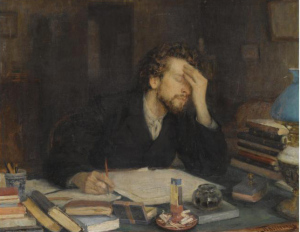
Remember the good old days when we could make fun of the longwinded nature of Russian authors who would never use ten words when a hundred could say the same thing? But then Tom Clancy came around and ruined it. A Russian author who would use 100 words instead of 10 words to say something is way better than an American author who uses 100 pages to say absolutely nothing. The longest novel I ever read that said nothing was… aw, I can’t even remember which Tom Clancy super-long epic it was (the one where Jack Ryan becomes president, I think).
At least War and Peace had a point (at least that’s what those who have claimed to have read it say).
WAR AND PEACE vs. TOM CLANCY
War and Peace: Numerous characters with long Russian names can be confusing to non-Russian readers (please, no jokes about the phrase “Russian readers” being an oxymoron).
Tom Clancy novels: numerous weapons with long-winded explanations can be confusing to readers who know nothing about modern weaponry that may or may not really exist.
War and Peace: Still relevant 150 years after publication.
Tom Clancy novels: Because of the quick movements of current events and changes in technology, irrelevant as soon as they are published.
War and Peace: Any problems with the novel can be blamed on the translation.
Tom Clancy novels: Any problems with the novel (like bad dialogue) can be blamed squarely on the author.
War and Peace: I wish I could say with pride that I’ve read the whole thing, but I can’t because I haven’t.
Tom Clancy novels: I’ve read several, but I wish I could say with pride that I haven’t. To be fair, I liked Clear and Present Danger.
War and Peace: This novel will continue to be read hundreds of years from now.
Tom Clancy novels: These novels will be forgotten in a few decades, but Tom Clancy has made a ton of money, so who cares? I would love to make millions of dollars writing novels that will soon be forgotten.
War and Peace: It breaks Dysfunctional Literacy Rule #3, but we know that we should read it anyway because it’s (supposedly) one the BEST BOOKS EVER!
Tom Clancy novels: They break both rules #2 and 3, but we read them anyway because they came out before we had rules for dysfunctional literates.
THE CASE AGAINST READING WAR AND PEACE
It’s written in Russian. Okay.
If you don’t read Russian, then you have to read a translation, and no matter how good the translation is, it’s going to miss much of the subtleties that made Tolstoy a great writer. There are also a lot of references to Russian society that might require some research. That’s a lot of work just to read a huge novel.
THE CASE FOR READING WAR AND PEACE
You can brag about it after you finish it.
THE CASE FOR READING TOM CLANCY NOVELS
The good guys always win, and the good guys are almost always the U.S.A. Since there are few subtleties in Tom Clancy’s writing, these books are probably very easy to translate into Russian, but because the Russians are often portrayed negatively, there might not be a market for translated Tom Clancy novels in Russia.
THE CASE AGAINST READING TOM CLANCY NOVELS
You can watch the movies which are usually better and take up less time in your life.
TOM CLANCY WRITES WAR AND PEACE
This is either a great idea or a horrible idea. Tom Clancy should get a synopsis of War and Peace and then retell the story in his Clancyesque style. Pierre Bezhukov could be renamed Peter Ryan. Prince Andrei Nikolayevich Bolkonsky would be renamed Prince Andy Brewer. You get the idea. The characters are still Russian, but the names are Americanized to help us keep up. Every weapon from the early 19th century could be described with intricate detail. A bunch of ironically dismissive comments about the growing United States could be made by both French and Russian characters. The book could be called Leo Tolstoy’s War and Peace by Tom Clancy, just like Tom Clancy lends his name to projects that he allegedly barely looks at. If Clancy could keep his version to under 500 pages (get rid of all the characters’ inner turmoil), we might just read it. But we wouldn’t brag about it later.
DO RUSSIANS WISH THEY COULD READ MOBY DICK?
War and Peace is kind of like the Russian version of Moby Dick for dysfunctional literates. We’d like to be able to read it, but it takes a lot of work, and we’re not sure it’s worth the time. Do Russian dysfunctional literates wish they could read Moby Dick? How does Moby Dick even translate into Russian? If you translate the title Moby Dick into Russian, do Russian teenagers laugh? If you say, “Moby Dick was a sperm whale,” in Russian, do they giggle? Does the Russian vocabulary have the subtlety for Hermann Melville’s language? Or is the idea of a long novel about an American whale hunter so abhorrent in today’s international community that no Russian would want to read Moby Dick in the first place? Do Russians even want to read War and Peace anymore? These are questions that we at Dysfunctional Literacy seriously do not know the answers to.
Any insight (other than our own) would be appreciated.

If Chuck Norris thinks this Chuck Norris joke is funny, who are you to disagree? Image via Wikipedia
Arnold Schwarzenegger and Chuck Norris were invited speakers at a science fiction/ comic book/ geek convention. Arnold was there because of his roles as Conan and the Terminator. Chuck was there because he’s Chuck Norris.
While Arnold was speaking to the crowd, he noticed that somebody had taken his Conan the Barbarian sword from the display case. Angrily, he addressed the crowd.
“I am going to leave this voom vor vun minute. Vhen I veturn, iv the svord is not veturned to the display case, by Crom, I vill kill you vith my bare hands! I vill veast upon your bones over your gravesights. I vill enslave your wives and vornicate your daughters. Or I vill enslave your daughters and vornicate your wives. Or I vill enslave and vornicate your wives and daughters! You have vun minute until… I’ll… be… back!”
The crowd cheered wildly at his performance (despite his mixing of roles in mid-sentence). Arnold thought he had regained his acting chops, his gravitas, but when he returned to the conference room, the display case was still empty. There was no sword.
Somebody from the crowd called out, “Vhen you left, did you vather any children out of vedlock?” and the crowd snickered and then fell silent.
Arnold was humiliated. The audience was embarrassed, but nobody said anything. The room was quiet, with lots of fanboys looking at the floor or at their phones.
Chuck Norris had seen enough. He stormed to the stage and grabbed the microphone. “Enough, pencil necks,” he growled at the audience. “Somebody stole my Walker, Texas Ranger hat once.”
The crowd gasped.
“That’s right. I was at a geek convention in Omaha, just like this one, and somebody swiped my very own, original, one-and-only Walker, Texas Ranger hat when I was talking to a group just like you.”
The audience stared at Chuck Norris in stunned, respectful silence.
“I’m not proud of what I had to do that day, but I did what needed to be done, and I’ll do it again if I have to. Arnold and I will leave the room one more time for one minute. If the sword hasn’t been returned when we get back, I’ll have to do what I did in Omaha.”
The audience’s collective jaw dropped in fear.
“I don’t want to do what I did in Omaha. Don’t make me do what I did in Omaha. Don’t… make… me… do… it.”
With that said, Chuck Norris left the room, and Arnold followed him. When they returned a minute later, the sword was back in the display case. And the audience was much relieved (some in their own pants).
As Arnold and Chuck left the convention hall, Arnold tapped Chuck on the shoulder and said, “I must know. Vhat did you do in Omaha?”
Chuck Norris shrugged his shoulders and said, “I bought a new hat.”
I deleted this blog post because it was kind of stupid, and it doesn’t fit this blog’s purpose. At the time, I was experimenting with search engine algorithms (that’s a whole different topic), and I learned what I needed to learn (and I can write about that another time), but I ended up with dozens of stupid blog posts that aren’t appropriate for my blog’s purpose anymore. I’ve kept other stupid blog posts that actually are appropriate content for Dysfunctional Literacy.
I deleted this blog post because it was kind of stupid, and it doesn’t fit this blog’s purpose. At the time, I was experimenting with search engine algorithms (that’s a whole different topic), and I learned what I needed to learn (and I can write about that another time), but I ended up with dozens of stupid blog posts that aren’t appropriate for my blog’s purpose anymore. I’ve kept other stupid blog posts that actually are appropriate content for Dysfunctional Literacy.

President Bush explains to Obama and Clinton that he too can write his own memoir. Yes, he really can!! Image via Wikipedia
Decision Points by George W. Bush
Dreams from My Father by Barack Obama
BEST POLITICAL DISCUSSION STARTER EVER!
Read President Obama’s Dreams from My Father with a Decision Points book jacket over it. When some wise-acre says something derisive like, “Worst president ever,” you whip off the jacket and retort, “Yes! Yes, he is!”
This set-up can also work in reverse, with a Dreams from My Father jacket covering a Decision Points book.
Whether you think Bush sucks or Obama sucks, whether you think of Bush as the worst president ever or Obama as the worst president ever, this trick is the BEST POLITICAL CONVERSATION STARTER EVER!
WHICH PRESIDENTS REALLY WROTE THEIR OWN MEMOIRS?
Whenever a famous person writes a memoir, there is speculation and debate about whether or not that celebrity truly wrote the book. That happens because ghostwriting seems to be kind of accepted in the memoir business. So now there are those who question whether both our previous and current presidents wrote their respective memoirs, Decision Points and Dreams from My Father. In President Bush’s case, some people are skeptical that he can write at all, much less finish a 500 page page-turner. With President Obama, it was the flowery prose and poetic imagery that made conspiracy theorists shake their heads.
Here at Dysfunctional Literacy, we have a simple technique to determine if a famous person truly wrote his or her book. We read the words aloud, and if we can picture the alleged author speaking, if we can hear his voice along with the words, then we figure that the celebrity actually wrote the book.
First is a short excerpt from Decision Points by George Bush, from the first page of Chapter 1.
“I have a habitual personality. I smoked cigarettes for about nine years, starting in college. I quit smoking by dipping snuff. I quit that by chewing long-leaf tobacco. Eventually I got down to cigars.”
When you read that, can you picture President Bush uttering those words? The verdict from the staff at Dysfunctional Literacy is… yes. We proudly declare that President Bush is the true author of Decision Points. That was a no-brainer.
Next is a short excerpt from Dreams from My Father, from the first page of Chapter 1.
“I was living in New York at the time, on Ninety-fourth between Second and First, part of that unnamed, shifting border between East Harlem and the rest of Manhattan. It was an uninviting block, treeless and barren, lined with soot-colored walk-ups that cast heavy shadows for most of the day. The apartment was small, with slanting floors and irregular heat and a buzzer downstairs that didn’t work, so that visitors had to call ahead from a pay phone at the corner gas station, where a black Doberman the size of a wolf paced through the night in vigilant patrol, its jaws clamped around an empty beer bottle.”
When you read that excerpt, can you hear President Obama uttering those same words? We at Dysfunctional Literacy weren’t so certain. Something just didn’t seem quite right. Maybe, just maybe, Barack Obama did have a ghostwriter for his memoir. Then we thought, how arrogant can you be, to not only write a memoir before you become famous but then to also hire a ghostwriter to pen it for you? That is the height of youthful narcissism! Perhaps the conspiracy theorists were on to something!
Then we realized what the problem was. The editors probably made a slight change to Obama’s original text that completely altered his voice. Here is what the excerpt might have looked like before the editors changed it.
“Uh, let me be clear. I was living in New York at the time, on Ninety-fourth between Second and First, part of that unnamed, uh, shifting border between East Harlem and the rest of Manhattan. Let me be frank, it was an uninviting block, treeless and barren, uh, lined with soot-colored walk-ups that cast heavy shadows for most of the day. The apartment was small, uh, with slanting floors and irregular heat and a buzzer downstairs that didn’t work, uh, so that visitors had to call ahead from a pay phone at the corner gas station, where, let me be clear, a black Doberman the size of a wolf paced through the night in vigilant patrol, its jaws clamped around, uh, an empty beer bottle.”
Okay, now that sounds like the President Obama we try to tune out every day. We at Dysfunctional Literacy proudly declare that Barack Obama is truly the author of Dreams from My Father!
And shame on all of you that would doubt the literary integrity of our Commanders in Chief.
I deleted this post because it was stupid, and it doesn’t fit with the rest of my blog Dysfunctional Literacy now. I have a bunch of other stupid posts, but at least they (kind of) fit what I do now.
All Quiet on the Western Front
By Erich Maria Remarque
Yeah, it’s told from the German point of view, but it’s still worth reading.
STUPIDEST WAR EVER!
If you want to make the case that all war is stupid, okay. I’m not sitting in my rocker in the safety of my home smoking my pipe and nodding my head saying, “World War II, now THAT was a smart war.” All I’m saying is that some wars at least have an objective or a point. The Civil War was meant to keep the Union together, and millions of people got slaughtered, but the issue was settled. World War I had no point, it got millions of people slaughtered, it didn’t really solve anything, and it led to World War II just a couple decades later where millions of more people again got slaughtered. It was almost like a war just for war’s sake, and that was stupid.
If we at Dysfunctional Literacy have offended any fans of World War I, we apologize.
WHY IT’S A CLASSIC
All Quiet on the Western Front is one of the few books that explores the psychological and emotional damage war causes for the soldiers. Even today, when graphic descriptions of violence are common in novels, there aren’t many authors willing to get as emotionally deep as AQOTWF. Plus, it’s not preachy. Also, it’s pretty short. Finally, it’s just a damn good book.

“Uh… Let me be clear… This President Obama joke… uh… is not funny.” Image via Wikipedia
A few months into his administration, President Obama decided to visit the first elementary school named after him, Barack H. Obama Elementary. He was understandably proud and knew the children (and maybe even the teachers and administrators) would be excited to see him visit.
As the presidential motorcade rolled up to the school, Obama noticed that the Obama hope flag was flying level next to the United States flag, and that made him happy.
As Obama and his entourage entered the school, he saw artistic posters of his image all over the school walls, and that made him happy.
As Obama entered the school library, he saw that a whole row of books was devoted to his two memoirs, and that made him happy.
As Obama entered the cafeteria, he saw food preparation staff steaming vegetables and inspecting fresh fruit for the children to eat and nourish themselves, and that made him happy (or at least made the First Lady happy).
As Obama entered the school auditorium, he heard students chanting “Obama! Obama!” and then heard the school choir sing a hymn of Obama’s praises, and this made him happy.
Then just as Obama was beginning his speech to the children, the students began a unified prayer. At first he thought perhaps the prayer was directed at him, but then he realized that the kids were actually praying to God, and this did not make President Obama happy.
Obama turned to the school’s principal and said, “Don’t you know that a led prayer at a public school is unconstitutional?”
“Yes, Mr. President,” the administrator stammered. “I think it’s a spontaneous prayer, and they’re only doing it today because you’re here.”
Obama was relieved. “Let me be clear, then. These students are praying for my safety.”
“No, Mr. President. They’re praying that you won’t talk too long.”
*****
UPDATE- June 20, 2018
Yeah, I know this is a lame blog post. As tempting as it is to delete it (and it’s tempting), I’m leaving it up to show my development as a blogger/writer. Yes, I know this post sucks. I’m pretty sure I knew it sucked when I wrote it, but back then I saw this blog as practice because I knew nobody was reading it and I could experiment a little. Some experiments go horribly wrong.
I deleted the content of this post because it was pretty stupid, and it doesn’t fit I’m doing with my blog anymore. Yes, I’m leaving up a bunch of other stupid posts from my early days of blogging, but at at least those posts still fit what I do.
THE ADVENTURES OF HUCKLEBERRY FINN
By Mark Twain
It’s difficult to discuss Huckleberry Finn without first mentioning the most controversial aspect of it, so let’s get this over with.
WHICH VERSION? N-WORD, OR NO N-WORD?
The meanings of some words change over time, but the n-word is still the n-word. I even feel uncomfortable saying words that rhyme with the n-word (That bald spot on my head keeps getting bigger and big… I mean, it’s getting larger and larger). Therefore, I have no problem with an abridged version that replaces the n-word.
If this leads to just one single person who would otherwise not read Huckleberry Finn to read Huckleberry Finn, then (dramatic pause)… it’s all worth it.
BEST ADVICE EVER!!!
If you’re listening to the audio version of Huckleberry Finn in public, you probably want the one without the n-word. It takes a few minutes to explain the context behind the n-words and the depth of the theme of the book, but when an n-word is dropped in public, you might not get those few minutes to explain.
If you’re determined to listen to the n-word version on audio in public, then wear headphones.
WHY HUCKLEBERRY FINN IS A CLASSIC
The only problem with this novel is that it’s required reading in some high school and college courses, and that takes all the fun out of it. Some of the problems that Huck faces (an abusive, alcoholic father that kidnaps him) are relevant today and often used heavily in Lifetime programming, but this novel is way better written. Mark Twain is also kind of funny, and even dysfunctional literates should be able to understand the humor without any laborious research.