.png)
(image via Wikimedia)
Today I found out that I’ve received a small refund credit from Amazon. It’s not cash, and it’s not worth a lot, but it’s unexpected and I can buy something nice with it. I like getting a refund when I never asked for it. If I have to ask for a refund, then there was usually something bad that happened first, and that can ruin the good feeling of getting refund credit.
It’s not that Amazon did anything wrong to give me a refund. According to the U.S. government, it was the fault of Apple and a bunch of publishing companies.
A few years ago, the U.S. Department of Justice accused Apple and a bunch of book publishers of colluding against Amazon to keep the price of ebooks artificially high. Since Amazon, Apple, and the publishers have reached a settlement, customers who bought ebooks during that time period of collusion can get refunds for the price difference.
The details are kind of boring. You can read about them here if you want. I was aware of the lawsuit a few years ago, but it was not as glamorous as other stuff going on. There was no sex or murder (that we know of), and it involved lots of numbers, so journalists probably didn’t want to deal with the story. I was aware of it only because I try to pay attention to book news. Anytime book news is something that is not related to J.K. Rowling, Stephen King, James Patterson, or a celebrity children’s book (or memoir), it catches my attention.
Amazon figured out the refunds for each customer through an algorithm, but I don’t know if I should trust the algorithm. Sometimes Amazon’s algorithm suggests books that I don’t want to read. If the algorithm can’t pick books for me to read, then how can it determine my refund credit? Maybe there’ll be some class-action lawsuit claiming Amazon messed up the algorithm. I’d hate to sit on the jury for that lawsuit.
I almost didn’t know about my refund. Amazon sent me a notification through my app, but a bunch of apps send notifications, and I usually ignore them. I almost ignored this notification too. I saw the words Amazon and free, but I thought it was just another Kindle Unlimited ad, so I ignored it. If you’ve been ignoring your Amazon notifications, double check. You might have gotten an unexpected refund.
If you don’t want to spend it right away, you can wait a year. It doesn’t expire until July 24, 2017. At first, I misread the date and thought I had only a couple days to spend the refund credit. It actually stressed me out because I already have stuff to read and I wasn’t sure how I wanted to spend my credit. Then I got mad at myself for getting stressed out over how to spend a refund credit. Then I got mad at myself for not realizing I had an entire year to spend it. I really don’t get mad at myself very often. It was just one of those days.
Anyway, if you’ve been an Amazon customer for the last few years, check to see if you’ve received a refund credit. And if you did, don’t stress yourself out while spending it.
*****
If you’re not sure how to spend your Amazon refund credit, this won’t take much out of it:
Only 99 cents on Amazon!
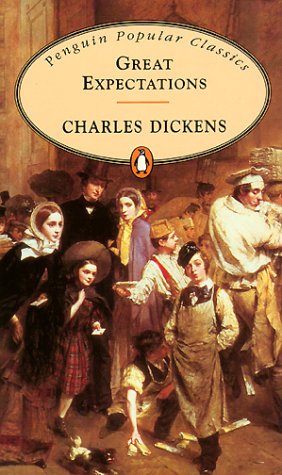
Great Expectations can be difficult if you’re average.
Classic novels are classic for a reason, but sometimes the sentences in those classics can be tough for an average guy to read. For example, struggling readers might think the novel Great Expectations by Charles Dickens has an unintentionally ironic title because they don’t expect much, except that it will be difficult. Charles Dickens has a reputation, after all; he’s not the easiest author to get through.
I know that “bad” and “good” sentences are subjective. My rule is that if a writing instructor would call it a bad sentence when a student writes it, then it’s a bad sentence. Classic literature is filled with sentences that writing instructors would tell us not to write. True, modern literature has many of the same issues too, but it’s more fun to find bad sentences in literature that instructors tell us are the classics.
I thought it would be easy to find these kinds of bad sentences in Great Expectations, but after reading the first few chapters, I changed my mind.
The sentences in Great Expectations aren’t as complicated as I was expecting. At least for me, they’re easier to follow than sentences in other classics, and I think I could even diagram most of the sentence in Great Expectations (if I really wanted to). But I saw a few sentences that I wasn’t sure about. These sentences might be great to sophisticated readers. To an average reader, however, they might suck. And if students turn in sentences like these to their writing instructors… Look out!!
SENTENCE #1 (Chapter Three)
I had seen the damp lying outside of my little window, as if some goblin had been crying there all night, and using the window for a pocket-handkerchief.
My instructors might have thought that was a good sentence, but I don’t know. They might have said this kind of figurative language detracts from the story. Why did we need to have a metaphor describing the damp outside window? Where did the goblin come from? And the window being used a handkerchief, well, that’s just disgusting.
One of my writing instructors was paranoid, had a constantly runny nose, and carried a handkerchief. He would have taken this sentence as an insult.
SENTENCE #2 (Chapter Three)
The gates and dykes and banks came bursting at me through the mist, as if they cried as plainly as could be, ‘A boy with Somebody-else’s pork pie! Stop him!”
My writing instructors were not fans of the speaking simile, where an inanimate object talks, but it’s a technique that Dickens uses. If I had written a sentence like that in high school or college, my instructors would have told me to chop off the second half. We didn’t need to know the exact words that the mist is figuratively crying out. Seeing those words is distracting. Maybe it wasn’t distracting in the 1800s, but it’s distracting now. At least, that’s what my writing instructors would have told me if I had written it.
SENTENCE #3 (Chapter Three)
On every rail and gate, wet lay clammy; and the marsh mist was so thick, that the wooden finger on the post directing people to our village- a direction which they never accepted, for they never came there- was invisible to me until I was close under it.
This was just a fancy way of saying that Pip couldn’t see much in front of him, but it took a long time to get to a simple idea. That’s when descriptions can get in the way, my writing instructors would say. We’ve got a thick mist, a sign with a finger that nobody pays attention to even when the mist isn’t thick, and the finger isn’t necessary to explain that the mist was thick. That was the whole point, wasn’t it? The mist was thick.
But since it takes too long to get to its point, I think my instructors would have called this a bad sentence if I had written it.
SENTENCE #4 (Chapter Seven)
mI deEr JO i opE U r krWite wEll i opE i shAl soN B haBelL 4 2 teeDge U J O aN theN wE shOrl b sO glOdd aN wEn I M peNgtD 2 u JO woT larX an blEvE ME inF xnPiP.
Even by today’s texting standards, that’s a bad sentence. I think I’ve written sentences like this in the middle of the night, but there’s no way I’d ever have shown them to my writing instructors.
The word bad has such a negative connotation, and I know that most of the sentences listed above aren’t really that bad. A lot of them together, however, can make a book difficult to read. And if you turn sentences in like these to your writing instructors, some of them will find the sentences questionable.
Questionable. Maybe that’s a better word than bad. Maybe the next series from Dysfunctional Literacy will be… “Questionable Sentences in Classic Literature.”
*****
What do you think? What is your opinion of each sentence? Would you use a speaking simile in your own writing? Do you think context matters for SENTENCE #4?
*****
Here are some more Bad Sentences in Classic Literature!
Bad Sentences in Classic Literature: Jane Eyre
Bad Sentences in Classic Literature: Moby Dick
Bad Sentences in Classic Literature: The Great Gatsby
Bad Sentences in Classic Literature: The Scarlet Letter
Bad Sentences in Classic Literature: Harry Potter and the Sorcerer’s Stone
Bad Sentences in Classic Literature: Great Expectations
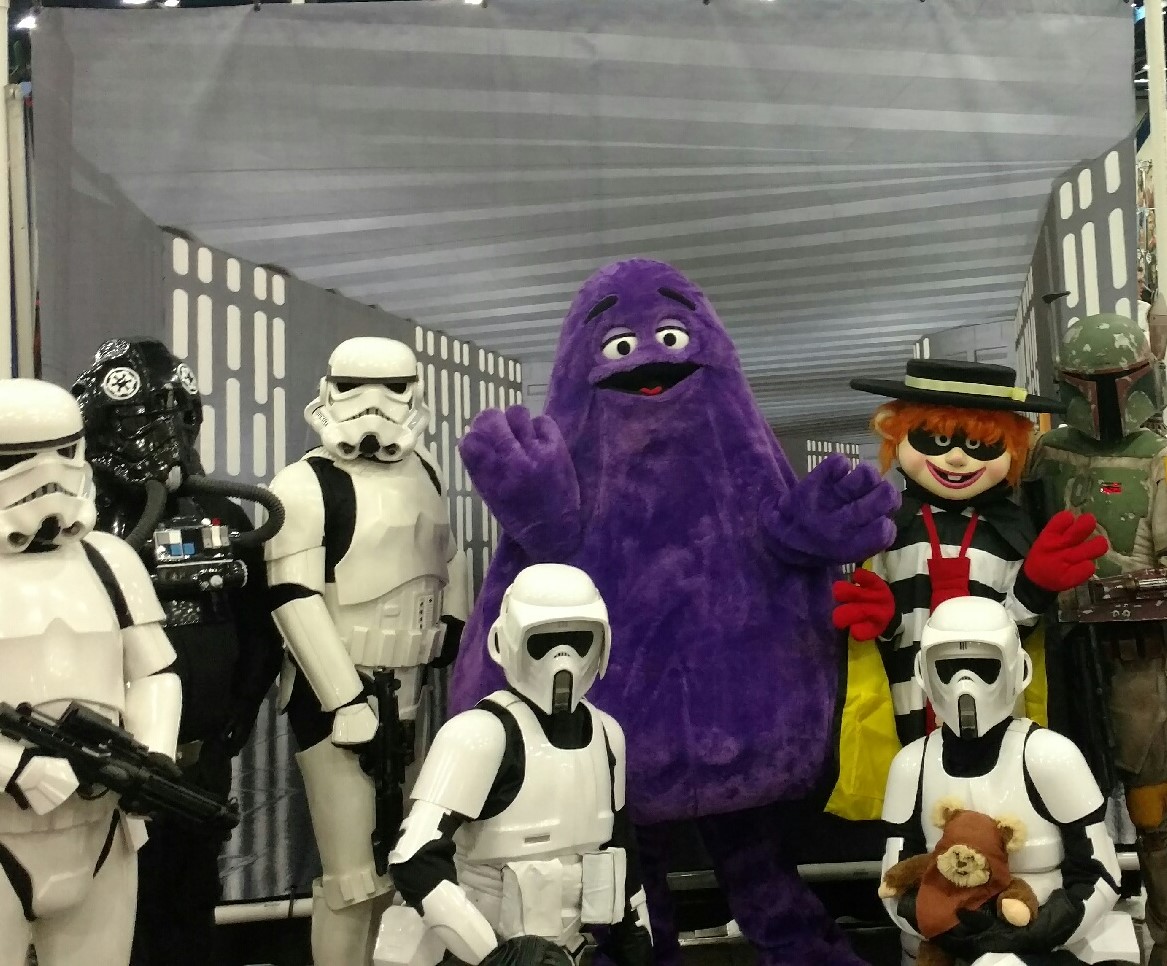
Everybody would have Grimaced if they’d seen the kid vomiting behind them.
I didn’t mean to take a picture of a kid throwing up.
It was near lunchtime at the comic book convention, and food vendors had just opened up their booths. Groups of costumed characters (I guess they’re called cosplayers now) were taking pictures with the rest of us normal people.
Everybody was getting along. Marvel and DC cosplayers were taking selfies together. The weirdest mix was a group of imperial stormtroopers posing with the McDonalds Hamburglar and Grimace (the goofy purple monster). The comic book convention is the only place where different genres of cosplay can get along. If they’d met in Times Square, there would have been a brawl.
Anyway, a bunch of bystanders were taking pictures of the Star Wars/McDonalds team-up in front of a starship corridor backdrop. Since I’m slightly taller than average, I stood behind everybody else and took a wide shot that caught part of the food court behind the backdrop.
As the characters were posing, I heard a faint “UUUrrrgh” grunt and a prolonged splaaaaaaatt!
When you’re a parent, you recognize the “UUUrrrgh” and splaaaaaatt sounds, especially on a concrete floor. Even with all the convention clatter, I heard the vomit sound, but the cosplayers didn’t notice, probably because their backs were turned.
My daughters hadn’t noticed yet either, so I steered them away from the food court because I didn’t want them to react to the vomit. My youngest daughter has a weak stomach, and I didn’t want her setting off a domino effect in such a crowded space.
“Let’s come back later,” I said, shooing them to a caricature artist on the other side of the convention floor.
“I’m hungry,” my youngest said, beelining toward the food vendors.
“You won’t be if you keep walking that way,” I muttered and turned her around.
My oldest looked back at the food court and laughed. “Some boy just puked.”
I hesitated and said, “Yeah, I think I got a picture of it too.”
For some morbid reason, all three of us wanted to know if I had caught it on my cell phone, so we stopped in a secluded corner where I could check my phone. I even put my back up against the wall so nobody could sneak up from behind and conk me on the head. I tapped the camera button on my phone and and inspected the Star Wars/McDonalds photo.
“There he is,” I said, pointing to the right edge of the picture.
“Oooooh,” my oldest daughter said in disgust, but she snatched my phone and expanded the section with puking kid.
“Uggggh,” my youngest daughter said. She made faces, but she kept staring and watching as my oldest daughter manipulated the picture size.
“When I was a kid, you couldn’t expand the picture,” I proclaimed. “If a kid threw up in the background of a picture, it stayed in the background of the picture.”
The puking kid was lucky it was my phone. If my daughters had taken the picture on their phones, they would have gone public with it. In fact, they begged me to text the picture to them. They were going to post it on Instagram. They were going to make a meme with it. They wanted to make this kid go viral.
I couldn’t let that happen to the poor boy. He’d probably been dreaming of a fun day at the comic convention, and he ended up throwing up in public. Having his vomit go viral might have made that the worst day ever for him. Plus, I don’t like meme humor. I think it’s down there with puns and famous movie quotes. And even if I did like memes, I wouldn’t want to create one with some poor kid throwing up in public.
As a parent, it’s my responsibility to tell my kids when they have a bad idea. There’s a part of me that would like to share a photo of a kid puking, but the adult part of me needed to take control and not do it. Bad ideas are great for fiction but not for real life.
So naturally, I put the picture on my blog. I have standards, though. I’ve cropped the picture so that you can’t see the kid losing his lunch. In the original, he’s off to the side in the food court in the distance, and you might miss it if you don’t look closely. But with an expanded picture, you can pretty much tell which of the food vendors he’d just visited.
When you’re in public, you can expect to end up in somebody else’s pictures. It’s unavoidable. I try to never scratch my nose or adjust my pants in public because you never know who’s making memes I wouldn’t want to adjust my pants and discover later that I’ve become a meme. That’s one my goals in life, meme avoidance. I’ve always tried to avoid conflict. I might as well avoid becoming a meme too.
When we got home, my wife asked us, “What’d you get?”
We’d gotten caricatures, a celebrity autograph, superhero t-shirts, posters, an action pillow, and assorted comic book related trinkets. What was the first thing my youngest daughter said to my wife?
“Dad took a picture of a boy throwing up.”
*****
When I was a kid, I got my mouth washed out with soap for saying the word crap.
Looking back, it ticks me off because now I know….
Now available on Amazon!

Not THAT kind of “adult” coloring book! (image via wikimedia)
When I first heard the term “adult coloring book,” I thought it would be something I couldn’t show my daughters. I was actually kind of disappointed to see that it was simply a coloring book too intricate for most kids. 20 years ago, we called them black-and-white comic books. We rarely colored our black-and-white comic books back then, but we could have. Since we have to be clear about how “adult” these adult coloring books are, they should probably be called coloring books for adults. When it comes to the word adult, word placement means everything.
Most people who don’t read books might not recognize the name Chuck Palahniuk, but they know Fight Club. Everybody knows Fight Club. Everybody knows the rules of Fight Club. Even people who haven’t see the movie know the rules of Fight Club. Anyway, famous author Chuck Palahniuk who wrote the book Fight Club is collaborating with Dark Horse comics to put out a collection of new short stories in a coloring book format . Fans of Chuck Palahniuk might buy his coloring book simply because they’re fans of Chuck Palahniuk. Fans of coloring books for adults might buy it because it’s intriguing, and then they might read some of Chuck’s other books later on.
Dark Horse is a comic book company that has put out a lot of underrated stuff. It’s not ever going to overtake Marvel or DC, but it’s a respectable company that takes some risks, and some of their stuff (at least 10-20 years ago) was worth reading. Maybe they’re hoping to attract comic book readers too. Comic book fanboys like Fight Club. Comic book fanboys like anything that has fights in it.
Some adults malign this new trend of coloring books for adults. Some say it’s childish, that adults today are clinging to their childhoods rather than embracing their responsibilities. I read comic books until my mid-40s, so I don’t have any business mocking somebody else’s hobbies. As far as I’m concerned, as long as adults are fulfilling their responsibilities as adults, their hobbies should be whatever they want it to be.
I never enjoyed coloring, though, when I was younger. I had a few coloring books, but to me they were a waste of time. The stories were always very basic, and they didn’t take long to read. They usually had only one sentence at the bottom of each page. They weren’t very challenging. Even the pictures weren’t complicated, and if you colored outside the lines, some other kid always criticized you.
Color by numbers were even worse because it eliminated all choice. “What kind of fascist puts out a color-by-number coloring book?” I yelled out in school one day. I didn’t know what fascist meant, but it sounded good. I think I’d heard that word around my house a lot.
As a former comic collector, I’d be torn about the Chuck Palhniuk coloring book because the first rule of comic collecting is that you don’t mess up the comic book. You wrap it. You store it in a safe, dry, dark location so the color doesn’t fade. And for god’s sake, you never color a comic book, even if it’s black-and-white. Comic collectors who buy the coloring book won’t color it because they see coloring it as ruining the value. 30 years from now, somebody might want a mint condition Chuck Palahniuk coloring book for adults.
I’ve read some Chuck Palahniuk short stories. To me, this coloring book for adults looks like a gimmick. I don’t see how making a new short story into a coloring book for adults makes the story better or improves the experience. I’m not against a coloring book for adults. If they made a Fight Club coloring book, I might buy it. It’s Fight Club.
*****
What do you think? Is a short story coloring book for adults anything more than a gimmick. Would you be more likely to buy an adult coloring book or a coloring book for adults?

(image via wikimedia)
The internet is a massive race for new content. Monolithic websites combine news with cat videos, scantily clad women, and lists, lots and lots of lists. YouTubers rush out new videos every day. When you read/watch too much of it, you realize most of the content is regurgitated. So many people are creating new content that most of the ideas are overlapping.
And with so much new content being forced on the public, it’s tough for independent artists and writers to make money off of it.
I’m not complaining. 20 years ago, it was almost impossible for independent writers to make money. Now it’s just difficult. I’d rather live in a time where it’s difficult to make money than a time when it’s impossible. But I’m not sure I’m prepared to do what it takes to be successful in a difficult environment.
Last week I ran across an article about plagiarism where an indie author says she has to write 15 books a year to make a living. 15 books? That’s James Patterson range, and he has a bunch of co-authors doing his work for him. I don’t want to use this author’s name because she’s feeling a lot of stress from writing (and other issues) anyway, and even though she probably doesn’t read my blog and wouldn’t care what I had to say, I don’t want to feel like I’m criticizing her personally. She’s making a living by writing, which is what I’d like to do, so more power to her.
But 15 books a year? I’m sorry. I can’t let that go. 15 books a year.
This prolific author writes erotic romance books, and that’s a completely different genre from what I write. I’ve written one sex scene in my life, and she’s written 75 sex books in the last five years. I don’t know how many sex scenes go into an erotic romance, but I’m guessing it’s more than one.
Who’s got the dirty mind? I’m a guy, and I don’t think about sex enough to write 15 erotic books a year. If I had to write 15 erotic books a year, I’d feel a lot of pressure, and I’ve heard what can happen to some guys when they feel too much stress about their performance…
I don’t want to think about it.
If I were in my 20s or 30s, I’d probably be working for a website churning out that new content. Instead, I’m in my 50s with a job that has nothing to do with writing, so I can take my time. True, I might run out of time (I try not to think about that), but anybody can run out of time and not realize it.
I’m not sure I’d want to be a writer if I had to write 15 books a year to make a living. I’d rather have a day job and struggle selling one ebook at a time. At least I’m having fun writing. I don’t always have fun at my job, but it doesn’t feel like the independent writer who has to write 15 books a year is having fun either. And if you can’t have fun writing 15 sex books a year, then what can you have fun writing about?
Writers have to be a little delusional, but I’ve never been insane enough to think I could write 15 books in a year. I couldn’t think of enough new ideas to fill out 15 books. Readers wouldn’t want to read 15 of my books a year. I haven’t even finished reading 15 books this last year (I’ve started dozens/hundreds, but I’ve finished only a few.) Writers shouldn’t write more books in a year than they read in a year. I don’t know if that’s true, but it sounds good.
Sometimes I complain about my lack of financial success as a writer, but maybe I shouldn’t. I’m having fun, and the writing isn’t stressing me out. If I felt like I had to write 15 books a year to make a living on writing, maybe, just maybe it wouldn’t be worth it.
*****
What do you think? What is your book-per-year limit? How much writing would make the whole thing not worth it for you? Is it better to write for fun or to stress out making money from it?
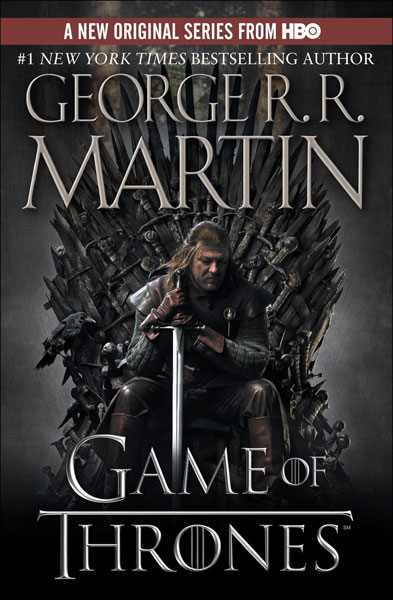
At least Ned Stark doesn’t have to read all seven books to find out what happens to him.
No matter what time of year it is, people who watch Game of Thrones like to talk about Game of Thrones. It can be annoying to the innocent bystanders who don’t watch it. Even worse are the book snobs who have read the books and watch the show. The book snobs have had an advantage for years because they’ve known what was going to happen on the show and would like to sprinkle spoiler hints just to piss off the rest of us who haven’t read the books.
Just so you know, I have nothing against book snobs. I was a book snob when the Lord of the Rings movies came out. And I’m still a comic book snob when it comes to superhero movies. I’ve bored many non-comic book readers about how the movies are different from the original comic books. I’ve lost friendships over it, and I don’t even have many friends. So being a book snob isn’t necessarily meant as a negative.
As much as I respect them, it’s fun to annoy the book snobs by calling the book series A Game of Thrones. A Game of Thrones is the name of the first book, the book snobs keep telling me. The name of the entire series is A Song of Ice and Fire. The book snobs are right, but they don’t need to remind me every time I mention the Game of Thrones books. Everybody knows what I mean. If I say A Song of Ice and Fire, a bunch of people who know about the Game of Thrones TV show but don’t give a crap about the books won’t know what I’m talking about.
So from here on out, I’m going to call A Song of Ice and Fire… A Game of Thrones.
With the series overtaking the books, book snobs don’t have as much bragging rights anymore. Now, they’re just as uncertain about what’s going to happen as the rest of us, especially since the show has changed a bunch of stuff.
A Song of Ice and Fire was originally supposed to be a trilogy. Now it’s set for seven books, with only five of them completed. But how do we know that author George R.R. Martin won’t decide that seven isn’t enough? If three wasn’t enough, seven might not be either. Three is usually the magic number for trilogies. Once a trilogy goes beyond three books, plots get convoluted, and the reading experience deteriorates. I’m not convinced that seven books will be enough, especially since Martin keeps adding subplots.
Plus, Martin writes other stuff. A new Dunk and Egg book came out a few months ago. If I were an avid fan of ASOIAF, I’d be pissed off that Martin is writing other stuff, even if it’s related to A Game of Thrones. I’m sure Dunk and Egg is very entertaining, but it’s not Game of Thrones.
When I was younger, I hated cliffhangers because the time between episodes seemed to take forever. Now I hate cliffhangers because I’m not sure I’ll be around to see the next episode. I’m not being morbid; I’m just thinking about the odds. Plus, George R. R. Martin might not be around either. If he died before he finished writing Game of Thrones, I’d feel cheated. Dude, I’d think to myself, you had over 20 years. When the author dies before the series is completed, that’s the ultimate cliffhanger.
I don’t want some literary agent or estate lawyer “finding” Martin’s almost-completed manuscript in an attic and hiring another writer to do the editing. If I can’t read the whole thing as it was meant to be read, I don’t want to read it at all.
THE CASE FOR READING GAME OF THRONES
It’s much more detailed than the series, book snobs tell me. Sometimes in the show, things happened that might seem not to make sense, but the books explain it better. Characters have different personalities. Some events are completely different. The first three books supposedly are great, and even the fourth and fifth books have moments of greatness, even if the plots get complicated and stories are told from points of view of characters you might not care about.
Maybe it would be fun to see what changes the TV show made, except the book snobs have already told me. In a way, watching the show is more fun now because the book snobs don’t know much more than I do. And now that the TV show has passed the books, there may be even more changes and the book snobs won’t know it until the book series is completed in a few years… or more!
Ha ha book snobs!
It could be fun reading A Game of Thrones, but there are other books that I want to read. And they don’t have television shows based on them. And they’re already completely written.
*****
What do you think? What other good reasons are there to read A Game of Thrones? Do you trust George R.R. Martin to finish the series?
*****
While you’re waiting for George R.R. Martin to finish A Song of Ice and Fire (if he ever does), you can read The Sunset Rises: A 1990s Romantic Comedy (sample chapter) .
And you can purchase The Sunset Rises: A 1990s Romantic Comedy here on Amazon!
Or you can get your own signed copy (I might even write a note where I pretend I know you!)
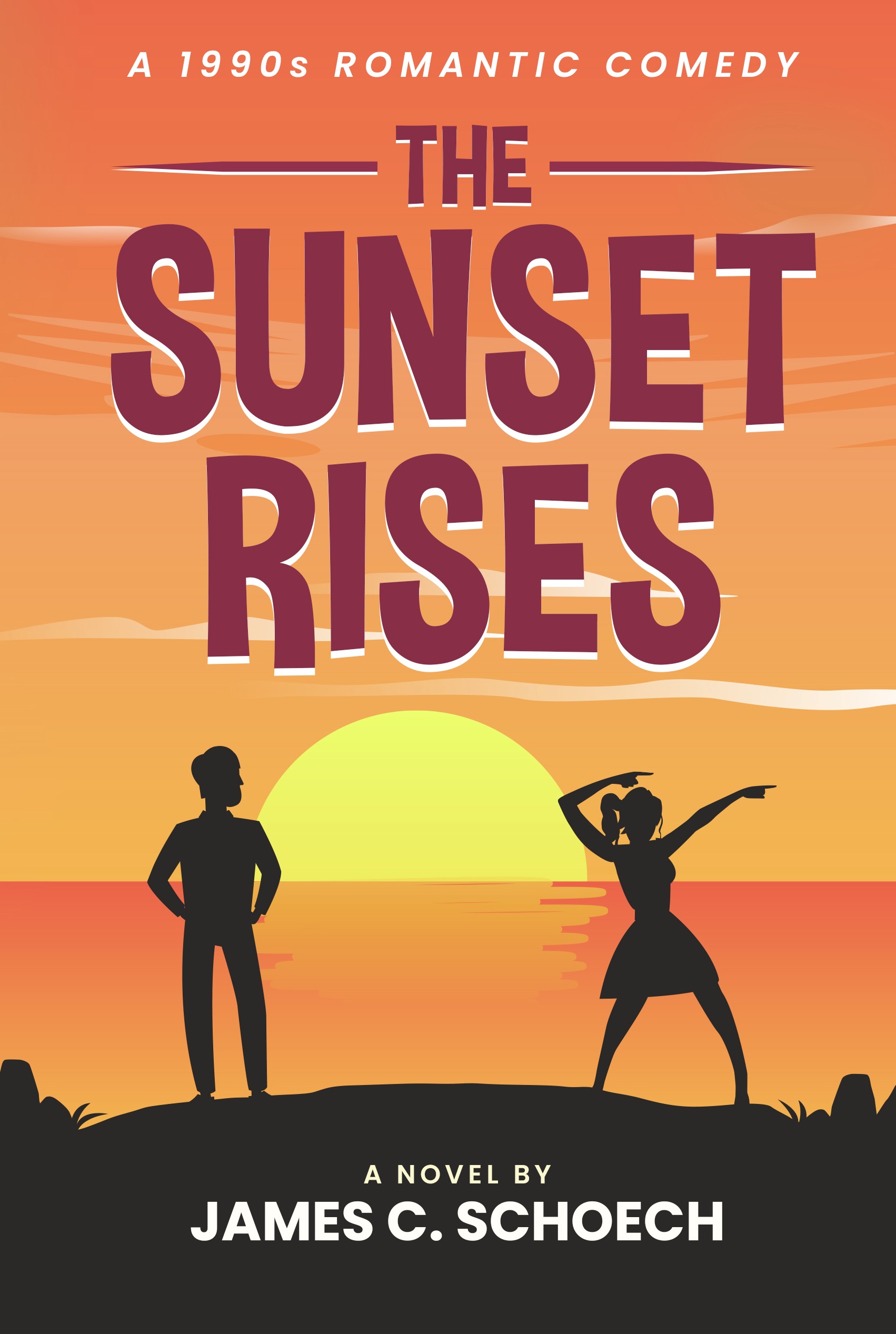
The Sunset Rises: A 1990s Romantic Comedy
Get a signed copy of my one and only novel, The Sunset Rises: A 1990s Romantic Comedy. The price includes USPS media rate shipping in a sturdy box. My signature is legible, but I’m left-handed, so I might smudge it sometimes. I usually mail out the book within two business days of payment.
$20.00
It has to be a “summer read” if the word “summer” is in the title.
Summer is either a great time to read books or a lousy time to read books. If you get any vacation time, you can take the time to catch up on reading. On the other hand, if you have vacation time, there might be so much going on that you’re too busy to read books. Either way, there will be a bunch of new best sellers coming out over the summer, and here is the list so far in mid-June 2016 (according to the New York Times):
1. The Emporer’s Revenge-Clive Cussler and Boyd Morrison
Clive Cussler is still writing books? I remember reading Raise the Titanic almost 40 years ago. Times have changed. Back in the 1980s, Cussler’s protagonist was Dirk Pitt. Dirk Pitt was a manly name. Now his protagonist is Juan Cabrillo. I guess Juan Cabrillo is a masculine guy, but no name is more masculine than Dirk Pitt… except maybe Clive Cussler.
Clive Cussler is a manly name. The hard c’s make it alliterative and masculine, Clive just sounds manly, and Cussler has the word cuss in it. It’s tough to get more manly than that combination.
It’s too bad Dirk Pitt isn’t in the new Clive Cussler novel. Otherwise, I’d have to decide whose name is more manly.
2. Before the Fall-Noah Hawley
Noah Hawley is/was a writer for the television series Fargo (not the movie), so if you like the television series, you might enjoy this book. I watched one episode of Fargo and stopped. Plus, this book is about a plane crash. I grew up in the 1970s when there were lots of movies about planes crashing (or almost crashing). Plus, I got suckered by the first season of Lost, which started off with a plane crash.
But if you like the TV show Fargo and you like Lost….
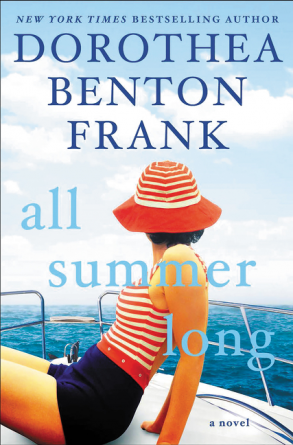
3. All Summer Long– Dorothea Benton Frank
This has all the appearances of a summer read. It has the word summer in the title. The cover has a woman in a summer outfit on a yacht in open water. The blurb is vague, but it talks about zany eccentric rich people and life-altering decisions. I was expecting a hot young guy for the married female protagonist, but no hot young guy was mentioned in the blurb. I also thought maybe a zany eccentric rich character would get murdered, but that wasn’t mentioned either.
If there’s no murder and there’s no hot young guy, how can this be a summer read?
4. The Girl on the Train– Paula Hawkins
Every time I review a best seller’s list, I have to think of something new for The Girl on the Train. It’s difficult to come up with something original to say about this book. I just can’t believe there are still enough people who haven’t read this book to keep it on a best seller’s list.
5. After You– Jojo Moyes
This is the sequel to another Moyes best seller Me Before You. Since I haven’t read Me Before You, I’d probably better not read After You. If you’ve read Me Before You and wondered what happened to the main female character afterward, then you should read After You, but you might get mad at what you discover.
6. 15th Affair– James Patterson and Maxine Paetro
James Patterson. Pffffft.
Is it disrespectful to review a James Patterson book with a “Pfffft” before even reading what it’s about?
7. A Hero of France– Alan Furst
I wish my last name was Furst. It’s not a braggadocious name because its spelled F-U-R-S-T instead of F-I-R-S-T. If it’s spelled F-I-R-S-T, then a guy can look kind of arrogant. But if it’s F-U-R-S-T, then you can still be pronounced First without proclaiming that you’re first. I wonder how many times somebody has said: “This is the first Furst novel I’ve ever read.”
At any rate, here’s another best selling book set in during World War II. No best seller’s list is complete without at least one book set during World War II.
8. The Weekenders– Mary Kay Andrews
It’s a mystery on a resort island. The main character is an outsider and must learn about a bunch of local secrets. The blurb was kind of vague about what the mystery was about. Usually the blurbs tell me more about the story than I want to know. I think it’s one of those light-hearted murder mysteries where the main character is never in any real danger. At least, that’s the impression I get.
9. The Last Mile– David Baladacci
I almost forgot that I’d included The Last Mile in May’s best seller list, which is ironic because the main character Amos Decker never forgets anything. When your main character remembers everything, your editors better scour every page of every Amos Decker book to make sure there are no inconsistencies. I know that authors have to come up with something unique for their protagonists, but a hero with a perfect memory is risky. It’s probably easier to have your protagonist just be a good fighter, or be a good shot, or be immune from catching sexually transmitted diseases.
10. The Nest– Cynthia D’Aprix Sweeney
The Nest has a controversially long first sentence, and I’m not sure how to pronounce the author’s middle name. The middle name does make the author seem more serious. Cynthia Sweeney seems like a simple name (because of the alliteration), but you throw in the “D’Aprix” (which I don’t know how to pronounce), and now her name looks more literary. A Cynthia Sweeney doesn’t sound like a literary author.
*****
What do you think? Which of these best sellers would you most likely read? What unique characteristic would you like your fictional main character to have? What name is more manly than Clive Cussler? And how do you pronounce D’Aprix?

They would have tolerated his cheating at cards if he hadn’t farted so much. (image via Wikimedia)
There are a lot of valid reasons to get into a fight. If somebody looks at you funny. If somebody talks about your mom. If somebody is disrespectful to your spouse. If somebody gives you a crappy nickname. But what if you get accused of farting in public?
It’s happened. A few nights ago in a Florida restaurant, a brawl broke out over public flatulence. It was reported on the news, so it has to be true. Plus, if this lone incident made news, think about how many times this has happened and has gone unreported.
I’m not the kind of guy who likes to watch fights on the internet. Even so, I’d like to see a video of what escalated an argument about farts into a fistfight. It validates one of my most strongly held life-long beliefs. I’ve proclaimed all (or most of my adult) life that few accusations are worse than being accused of farting in public. It’s almost as bad as being called a racist. In fact, the last time I was called a racist (it doesn’t happen much), I accused my accuser of farting in public. He was stunned by the comeback, and I left before he could take a swing at me.
Since I got the last word, I won the argument.
Everybody knows, it’s rude to fart in public, but nobody likes being accused of farting either. Usually people try to pretend the fart didn’t happen. If the fart was loud, bystanders look down or make brief eye contact and try not to laugh. If the flatulence is smelly, bystanders might hold their breath while trying not to look like they’re holding their breath. Sometimes people have to make a decision between breathing through their noses or their mouths. But rarely do farters get called out for their gas passing. Accusing somebody of farting is almost as rude as farting.
I know fights over farts happen. I got beat up once after school because I farted in class and passed the blame onto some other guy. This other guy was quiet, so I figured he wouldn’t do anything about it. I guess being accused of farting was his breaking point because after school he charged me, knocked me off my bike, and beat a confession out of me. In my defense, I couldn’t build any righteous anger to fight this guy hard because I knew I was wrong, so I went ahead and admitted it. Luckily, my family moved a few states away the next year, and my reputation as a farter didn’t follow. At the time, my pacifist friends told me that it was a dumb reason to fight. But it taught me a lesson; don’t accuse others of farting unless you’re ready to go all-out.
Some say that elevators are the worst bad place to pass gas because it’s such a confined space. It would also be a bad place to get into a fight over who farted. I have nightmares about elevators dropping, so I’d go insane if a fight over a fart ever broke out in an elevator. Between the flatulence, the confined space, fists flying all over the place, and the elevator dropping, I’d probably panic.
The worst place to fart, even worse than an elevator, is anywhere where food is being served. Farting in a restaurant is the worst, and farters in that situation should be dealt with. I don’t condone violence, but sometimes farters don’t listen to reason. I’m proof of that. Getting farted on in a restaurant is like being seated right next to the bathroom. If I’m seated next to the bathroom, I politely tell the waiter that I won’t spend money on an establishment that puts me next to a bathroom. I’ll put up with a lot of errors from restaurant staff because I know it’s not an easy job, and I usually tip too much, but I refuse to be seated next to a bathroom. I’m not sure I’d get into a fight over it though. But if I won’t sit next to a rest room when I’m eating, then I can understand why people don’t like farting in a restaurant.
*****
Writing about farting and other body functions on my blog is a little risky because I try to avoid stuff that’s too low brow. Usually I like to talk about literature and the writing process and stuff like that, but then I saw this story about a fight over a fart in a restaurant. How could anybody resist that? If I hadn’t acknowledged that brawl in some way, I might have regretted it for the rest of my life.
*****
What do you think? Would you fight somebody who accused you of farting in public? What’s the dumbest reason you’ve ever gotten into a fight? What body function is too low brow to write about on a blog?
*****
When I was a kid, I was punished for saying the word crap. Looking back, it kind of ticks me off because now I know…
And here is the true story of my one moment of high school glory!

Now only 99 cents each on the Amazon Kindle!

She’s smiling now, but if you spoil the ending to Harry Potter and the Cursed Child, she’ll be pissed. (image via Wikimedia)
It’s a problem only a truly successful author can have. Famous author J.K. Rowling doesn’t want fans to spoil the ending of her new play Harry Potter and the Cursed Child.
Spoilers are probably inevitable though. A play isn’t like a movie; people can’t attend simultaneous performances. Only a fortunate few will see each performance, but those few will be excited and want to talk about it, and once they start yammering about it, secrets about what happens will be revealed and feelings will be hurt. Maybe even J.K. Rowling’s feelings.
Nobody wants to hurt J.K. Rowling’s feelings.
Even if J.K. Rowling fans take J.K. Rowling’s request to go spoiler-free seriously, there are a few jerks in every crowd, and somebody will spoil the end. After all, J.K. Rowling couldn’t even keep Robert Galbraith a secret for long, so you know somebody will spoil The Cursed Child.
There is a way to prevent spoilers in this situation, but only an author like J.K. Rowling could do it. Next time she writes a novel (or a play), she should have several different endings and not tell the public there are several different endings. Each book (with the different endings) would have the exact same cover. The whole point is that none none of her fans would have any idea that there were several different endings.
Then, when somebody spoils the ending, somebody else who has read the book (but probably a different version) will overhear the conversation and contradict the spoiler. A big argument will ensue over how the book really ended. If the gods are devious that day, several different readers who’ve read several different versions will end up arguing with each other at the same time.
How long would it take before the public realizes it has been pranked? Then J.K. Rowling could eventually declare that one ending is the definitively true ending, and fans could argue over which ending it is.
Rowling could use the spoilers’ eagerness to ruin other peoples’ enjoyment against them. It would be awesome if done correctly.
I’d do it myself, but I’m a struggling aspiring author. I’d be lucky if several people read my books and discussed them with each other. Only an author like J.K. Rowling (or Stephen King) could pull this off. Maybe George R.R. Martin could do it, but it would take him a couple decades to write all five endings.
Maybe this has already been done, and I don’t know about it. I can’t be the first person to have ever thought about this. I’d hate to have this grand idea and then have a bunch of people point out that it has already been done dozens of times. It would be humiliating. But even if it has been done, it probably hasn’t been done by somebody with a following like J.K. Rowling.
*****
What do you think? Would you be upset if you found out you had been pranked by an author who wrote several different endings? Has somebody already done this and I just don’t know about it? What authors other than J.K. Rowling could pull off a spoiler-prevention prank like this?
*****
When I was a kid, I got my mouth washed out with soap for saying the word crap.
Looking back, it ticks me off because now I know….
Now available on Amazon!

If I say no, she’ll badger me until I take her phone away from her. (image via wikimedia)
A YouTube star is coming to a local book store for a signing, and my daughters want to go. I have a tough time calling a YouTuber a star, but this guy has millions of subscribers, and his first book was a best seller, so I guess not calling him a star would be quibbling.
I’m not looking forward to the book signing. We’ll probably have to get to the book store early and stand in line just to get our slip with the number that tells us where to stand in the real line. Those lines will be filled with a bunch of people whom I don’t want to be around. I don’t even like standing in book-signing lines when I’m surrounded by fellow book readers. There’s no way I can handle a line filled with teenage YouTube fans.
I’m going to be a bad parent that day. My plan is to drop my kids off in the line and go far away. Thankfully, the line will be in a book store, so I won’t go too far. I’m not driving away and going home for a few hours. I’m not that kind of a bad parent.
The YouTuber is in his late 20’s and is obnoxious (by my standards). He eats food and makes stage faces. He does DIY videos and also conducts an occasional interview with other obnoxious people. He curses way too much.
The first time I watched one of this YouTuber’s videos, he used the word “f#cking” twice as an adjective in his first two sentences. I would have felt better if he had used the term “f#cking” only once in his first two sentences. I’m not sure what the “f#cking”-per-sentence ratio should be, but it shouldn’t be once-per-sentence. That’s just lazy. Maybe once every two sentences is approaching respectability, but I expect higher standards for somebody with millions of subscribers.
Then again, I’m not the YouTuber’s target audience. I’m probably not any YouTuber’s target audience. I’m the guy who pays for the YouTuber’s target audience. That should mean that the YouTuber needs my approval, but things don’t work like that anymore (if they ever did).
When I was kid, if I had talked the way this YouTuber talks in his video, I would have gotten my mouth washed out with soap or have gotten the belt. I’d kind of like to see a video of this guy getting his mouth washed out with soap. That would make a great YouTube video. Even though I’m not in his target audience, I’d watch that. And I’d pay to see it.
This YouTuber churns out a new video almost every day, and within hours has hundreds of thousands of hits. It’s a little deflating to me. I write one blog post a week, and a few people read it. Maybe I’ll get a few comments but nothing like this guy gets. Most of his commenters don’t seem to write very well, though. At least, if they do know how to write, they don’t show it. On the other hand, people who comment on my blog write very well and are probably smarter than me because half the time they’re correcting my own errors.
In case you can’t tell, I really don’t want to spend money on this YouTuber’s book. I feel like I’m just rewarding his bad behavior. Even worse, I’ll probably have to buy two copies, one for each daughter, so both of them can take individual pictures with him. This means I’ll be rewarding his bad behavior twice. I don’t even know if this new book is any good or not because it won’t come out until a couple days before the signing!
Despite my better judgement, I’m probably going to let my daughters go to the book signing. But they’re going to do a bunch of my own chores around the house to get there. And they’re going to have to wait until I get home from work to do these chores. And while they do my usual chores, I’m going to get extra time for reading and writing, and they’re going to leave me alone while they do my chores.
I’m going to get so much reading and writing done while they’re doing chores that I’ll get bored of reading and writing. Maybe, just maybe, my daughters will do so many chores that they will start to despise this YouTuber. And if they do enough chores, I might even start to like him.
*****
I think YouTube is great. I watch YouTube, but my viewing habits are different from my daughters’. They watch new content (which I don’t find appealing), and I watch old content, such as old comedy routines, scenes from old movies, football games from years ago, and the occasional Game of Thrones commentary. Most of the YouTube stars I’d want to meet are dead already.
*****
What do you think? Would you allow your kids to go to a YouTuber book signing? Would you even want to read a book written by a YouTuber? What is respectable “f#cking”-per-sentence ratio for a performer?
*****
When I was a kid, I got my mouth washed out with soap for saying the word “crap.” Looking back, that ticks me off because now I know that…
Now available on Amazon!


 Dysfunctional Literacy