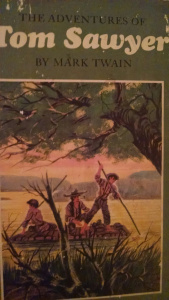
This might be beat up, but it’s been in my family for over 50 years.
I don’t own as many books as I used to. 25 years ago, my home/apartment was filled with shelves stocked with books of all kinds. Then I started a family. Then we started moving a lot. Then I realized that holding on to too many books was impractical. I knew that I was going to reread only a few of them. Decades later, I’m down to a fraction (I don’t know the precise fraction) of books, and most of them are really old and beat up and kind of ugly.
I like these old ugly books. When we move again, I’ll be willing to pack these books and move them yet again. Yeah, I’ll probably curse and throw a couple fits on moving day/week, but it will be worth it.
Anyway, we just finished repainting the interior of our house, and in order to get the hanging shelves painted, we had to move a bunch of old dusty books. Now we like the shelves without the books. When we put the old books on the newly painted shelves, the books don’t look right. In fact, these old books look downright ugly.
I’m not getting rid of the books, but we might not display them either. In the video below, I talk about several of the old books and why each one is important to me. And I also get mad over the word relevant.
Relevant? It just doesn’t look right.

(image via wikimedia)
It’s really too bad nobody got a video of this.
James Patterson was speaking on a panel with other famous authors such as Stephen King, Elizabeth Gilbert, and Malcolm Gladwell when a struggling writer in the audience asked a question about writer’s block.
“What is the best way to get rid of writer’s block?” the struggling writer asked the panel.
Stephen King spoke first.
“Amateurs sit and wait for inspiration, the rest of us just get up and go to work,” he said, and everybody in the audience nodded at the profound statement.
But the struggling author was dissatisfied with the vague answer.
Next was famous author Malcolm Gladwell, who said: “I deal with writer’s block by lowering my expectations. I think the trouble starts when you sit down to write and imagine that you will achieve something magical and magnificent — and when you don’t, panic sets in. The solution is never to sit down and imagine that you will achieve something magical and magnificent.”
Again, the audience nodded at the profound answer, but the struggling writer was frustrated at the vagueness.
Famous author Elizabeth Gilbert said: “I don’t sit around waiting for passion to strike me. I keep working steadily, because I believe it is our privilege as humans to keep making things. Most of all, I keep working because I trust that creativity is always trying to find me, even when I have lost sight of it.”
And before everybody could nod in agreement, she added: “Writing is f*cking great!” and everybody laughed because Elizabeth Gilbert said “f*cking.”
The struggling author still felt dissatisfied. Surely a famous author on the panel could offer concrete advice or specific techniques for beating writer’s block.
“What about James Patterson?” the struggling writer asked. “What do you do when you get writer’s block?”
The audience listened intently for James Patterson’s response. If anybody had a cure for writer’s block, it would be the author who published more than 10 novels a year. What was his method for dealing with writer’s block? Every member of the audience sat in silence as they waited for his answer.
“So, what is your cure for writer’s block?” the moderator of the panel finally asked again.
James Patterson cleared his throat. “When I get writer’s block,” he said with gravitas, “I have my coauthor write it for me.”
HAHAHA!
*****
I hate admitting this, but that might actually be the best way to beat writer’s block. Thank you, James Patterson!!
Like I said, though, it’s too bad nobody got a video of this. As far as I’m concerned, if there’s no video, then it didn’t really happen.
*****
What do you think? Do you have a better cure for writer’s block than James Patterson’s? If so, what is it?

(image via wikimedia)
If you’re an English teacher, you probably don’t want to say “dumb kids can’t write.” An English teacher would probably get fired for that (and maybe the teacher would deserve it). An English teacher would be expected to come up with a more diplomatic way to express sensitive thoughts like that.
The reason I say “Dumb kids can’t write” is because educators in New York are freaking out over the state’s standardized writing test’s results. As you can probably guess, the results aren’t good. A lot of students are failing the tests, despite a lot of money and time spent preparing for them. Some critics even say students’ writing is getting worse.
It’s not just New York that has this problem. Every state with a writing test probably struggles with how to teach and grade writing. I live far far away from New York, but my daughters have had to take writing tests and they usually get mad at the results. They’re good writers (I should know; I’m an excellent judge of writing), but they get frustrated with the lame topics (very generic so that every student in the state can write about them), the length (there’s usually a line limit), and unclear directions.
Writing has to be tough to standardize. Every other test can be run through a computer, but you can’t grade an essay without hiring a teacher (or somebody even more bitter) to read/grade it. My daughter has shown me the grading system that our state uses, and it’s pretty complicated. Explaining it would give me (and readers) headaches.
Besides, I’m not sure you can teach writing like you can math or science. In most classes, there are formulas and steps that can be standardized. There is no writing formula. Test makers have tried to design formulas, but then teachers teach to the formula and the writing becomes formulaic, which then makes it bad writing.
Plus, the scales of grading writing are confusing. Adults think grammar, spelling, and punctuation should matter, but students are told that their ideas matter more, but without grammar, spelling and punctuation, ideas can’t be understood, so then everybody is confused.
The grammar, spelling, and punctuation is the formula that could make writing standardized. Yet it seems like schools are getting away from that. I don’t blame the teachers. The administrators or school boards tell the teachers what to teach, and it’s usually a good idea to do what the people paying you tell you do, unless it’s unethical or illegal. Maybe it’s unethical not to teach students more grammar, spelling, and punctuation, but I haven’t thought about it enough to have an opinion.
It’s probably easier to grade writing when you don’t have to focus on the grammar, spelling, and punctuation. English teachers probably get headaches from red-marking all the grammar, spelling, and punctuation mistakes. Some teacher 50 years ago probably got tired of getting headaches, so he/she became a specialist/consultant/expert and just made up stuff about how unimportant grammar, spelling, and punctuation are. Now fewer kids can write. And insensitive bloggers like me are calling them dumb.
As I’ve gotten older, I’ve become more skeptical of consultants/specialists/experts. A lot of them just make stuff up, and then a bunch of people who should know better nod and agree because they’re getting paid to nod and agree. If you don’t nod and agree, you get fired. That’s the position teachers are in. They know the standardized test stuff is a bunch of nonsense, but they have to nod and agree. Even if they don’t physically nod and agree, they have to comply. Then they have to make students comply.
I’m not badmouthing teachers. Almost every job requires you to comply. That’s why employees get paid. Nobody likes to comply for free. That’s the great thing about our governing/economic system. Most people throughout history have had to comply and have gotten nothing but tyranny, poverty, and abuse. At least now in the United States, we can get paid a decent salary to comply.
Anyway, back to writing.
I shouldn’t use the word dumb to describe students who struggle with written expression. I should say students with below average verbal skills, but nobody would read a blog post with that title. Instead of being taught grammar, students are taught to think critically, but students with below average verbal skills probably have a tough time expressing original thoughts. And I’m not sure you can teach kids how to have original thoughts. Where would a teacher start?
I don’t think I had an original thought until I was 17 (and even then I’m not sure the thought was truly original). I was always told that I was a late bloomer. To be fair to myself, I wrote a couple original pieces that impressed English teachers enough to put me into a writing contest, but I blanked when the pressure was on. That’s why I like blogs. No pressure.
Even though my verbal skills are way above average (at least they were 35 years ago), I probably wouldn’t score well on a writing standardized test today because I don’t use clear topic sentences, and I don’t use concrete examples (I’m often intentionally vague), and I ramble. I can write sentences that are grammatically correct and I spell reasonably well (and I know the difference between the words good and well), but that doesn’t seem to matter much in today’s standardized tests.
I’m glad I’m not a student today.
*****
What do you think? Are there any English teachers out there who can explain some of this standardized writing?

(image via wikimedia)
Everybody on the internet is asking for money. Websites want you to pay for subscriptions. Artists/creators want you to give to their Paypal or Patreon accounts. A bunch of people have GoFundMe accounts or something like that.
I have nothing against the practice of trying to get money. I have a couple books on Amazon, but that’s it. I don’t ask anybody to give me money just for putting up content. I figure if enough people buy my books, I’ll write more books. I don’t want to go too far.
But here’s an example of somebody going too far. I was reading an article about an odd sub-genre on a publishing website, but after one paragraph, the article was cut-off and I was asked to pay $19.95 a month for an online subscription.
I laughed out loud. I rarely laugh out loud when I’m online. $19.95 a month for a publisher’s site? That takes a lot of nerve, I thought. Publishing sites are some of the most boring sites on the internet. This particular publishing site doesn’t even try to make things interesting.
I don’t have an issue with a website trying to get paid subscribers. I wouldn’t be surprised if the print version were on the verge of cancellation. Any income is a victory. But $20 a month? $240 a year? Most people don’t even pay that much for porn. I mean, they’d probably pay more for porn if they had to, but they don’t because there’s so much free stuff out there. And if people won’t pay $20 a month for porn, they definitely won’t pay that for publishing.
I don’t want to name the website because I read it occasionally and it has never said anything bad about me. It can be a useful site at times. It’s boring, but so am I, so I understand where it’s coming from. The $19.95 a month subscription is probably the first time I’ve had an emotional reaction to the site (besides yawning).
I’m almost outraged. I almost want to go to their offices and scream as people walk to the elevator. “$20 A MONTH? ARE YOU INSANE?”
I won’t go to restaurants and shout at them while they eat, but I might yell at an elevator. And then I’d apologize for being rude.
I’ve had subscriptions to comic books (when I was a kid) and magazines (when I was an adult), and I always had to cancel them because the quality seemed to decline once they got my money. I mean, it’s been a while since I’ve had a magazine subscription, but I know I never paid that time period’s equivalent of $20 a month for a magazine subscription.
The whole point of a subscription years ago was to save money. Now it’s to get access. But you can always find the information cheaper, most of the time for free. If I were an online publishing website that absolutely had to try to get paid subscribers, I’d probably go for around $5.00 a month.
To be fair, I’m not sure how much I’d be willing to pay for an online subscription to a website. I buy books. I buy an occasional magazine. I buy indie ebooks. But I have a tough time subscribing to online content.
Netflix costs around $10 a month. I might complain about the negative effects of streaming and binge watching, but Netflix has way more interesting stuff that that publishing website. YouTube Premium, with some original content and no ads, is $10 a month and has way more interesting stuff than the publishing website. Maybe the creators of the publishing site think their content is valuable. To somebody else, it might be. I don’t know.
Now I’m constantly visiting the website just to make sure the subscription rate hasn’t changed. By doing that, I’ve probably doubled the site’s traffic and increased its ad revenue. Maybe the subscription rate plan wasn’t so stupid after all.

Sometimes I think my kids will laugh at anything. (image via wikimedia)
I fell for it again! I was announcing my fast-food order in the drive-through line, and I didn’t stop myself from saying, “I’d like a number two meal!”
My daughter laughed. It’s true. My 16-year old daughter who prides herself on her maturity actually laughed when I said “Number two.”
She has been laughing at this number for many years. You’d think her sense of humor would change a bit as she gets older, and in many ways it has, but there are still some juvenile words and phrases that she reacts to.
In the video below, I talk about some of the words that have made my kids laugh over time. I wrote a lot of it in a blog post several years ago, but I guess some things will never change much.

(image via wikimedia)
Despite everything that had gone wrong so far, the date wasn’t a disaster. Yeah, Jenny liked Garth Brooks when I hated country music. Yeah, we went to a restaurant that Jenny’s ex-boyfriend managed. Yeah, my nose was runny at inopportune times because of the food. And yeah, the ex-boyfriend was sitting in my spot across from her in our booth when I returned from the bathroom.
Still, I had a couple things going for me. Jenny understood my humor. She made coke addiction jokes as I was taking care of my nasal issues. And she had astounding cleavage. I know I’ve probably mentioned it too much in this story (You can read about it here), but there’s a reason.
“Hey, Bob,” I said as I approached the booth. I tried to put some friendly inflection in my voice. “Thanks for keeping Jenny entertained.” I didn’t want to seem threatened by an ex-boyfriend, and I thought I had done a good job, but then a slight itchiness returned to the back of my nasal passages, and my nose twitched and I sniffed.
“Did the food get to you?” Bob asked proudly.
“He has a coke habit,” Jenny said.
I looked around the restaurant and spotted a couple other customers sniffing or grabbing water or laughing at somebody else suffering at the table.
“It looks like I’m not the only one here with a coke habit,” I said to Bob. His expression shifted. His smile disappeared, and he shot a glance at Jenny. Jenny looked startled. I’m not sure how to describe facial features of a startled person, but she actually seemed to flinch a bit.
Bob got up. “I’d better get back to… managing.” He glanced at Jenny again and then shook my hand quickly and left. I was glad he left, but I wondered if I’d said something wrong.
I was puzzled by the sudden shift in mood. What was the big deal?
“I meant other customers were sniffling,” I said to Jenny as I sat back down. “I didn’t mean that Bob had the coke habit.”
“It’s okay,” Jenny said, but I knew better.
“I’m serious, look around.” But she seemed dejected. I wondered if she still had a thing for her ex, or if she was genuinely the type to worry about hurting an ex-boyfriend’s feelings. I mean, she shouldn’t bring dates to a place her ex managed. And if the ex is going to be proud of giving runny noses to his customers, then he should be prepared for coke habit jokes. Hell, Jenny had even started it! I hate it when someone starts the joke but can’t handle the follow up. Of course, I couldn’t say any of that. As a guy, you just stew in it.
“It got cold in here,” Jenny said and pulled a sweater from her purse. At first, I sat in bewilderment, wondering how she could magically pull out a sweater out from her purse.
“Do you keep a rabbit in there too?” I asked.
She laughed as she placed her arms inside the sleeves and I was glad that she seemed to have her humor back, but then she started buttoning her sweater. I wasn’t all that concerned as she began at the bottom and worked her way up, but her fingers moved quickly and I almost shouted “Nooooo!” as she fit the final two top buttons into place.
What? I was almost outraged! The cleavage was covered. And then I noticed that the sweater was ugly. How could she cover such cleavage with an ugly sweater? It was a crime. I don’t remember the sweater’s pattern, but it hurt my eyes. Then I noticed she had a blemish on her nose. And my nasal passages had suddenly cleared up.
I wondered if I was allergic to her cleavage. I almost asked her to unbutton her sweater just to see if my nose would start running again, but there was no tactful way to do that.
I left a generous tip on the table and let Jenny lead the way out. Since she had gone silent and covered up, I wasn’t optimistic about the rest of the date. We still had a movie to go to, and movies could be catastrophic on a bad date. It’s true, you don’t have to talk during a movie, but you’re stuck, and a good movie is usually tough to enjoy. Still, I was prepared to go through with it.
“It looks like we’ll get to the show a little early,” I said as I opened the passenger side for her. “As long as traffic cooperates.”
But when I got in on the driver’s side, Jenny announced:
“I don’t feel like going to a movie. Just go ahead and take me home.”
Maybe I should have been glad that this date was almsot over, especially since she was covered with an ugly sweater. Unfortunately, I knew the awkward date wasn’t over yet. Next up would be the awkward drive home.
*****
To be continued in Awkward Moments in Dating: The Long Drive Home!
And in the meantime, you can read Awkward Moments in Dating from the start.

(image via wikipedia)
This is one of those topics that I have to be careful with. Stephen King is a great author who’s written a bunch of books that I like a lot. When I suggest (or outright state) that he has written some bad sentences, some readers/writers get mad.
To me, it comes down to a famous quote about writing attributed to Stephen King: “I believe the road to hell is paved with adverbs,…”
You might think that an author who says this would be precise with his use of that cursed part of speech, but he (and he admits this) can be just as guilty as any other author.
Even so, it can be fun to take a look at Stephen King’s most popular (and maybe greatest) novel to see how he uses adverbs in writing.
I’ve always said, if your sentence has a part of speech that puts you on the road to hell, then that must be a bad sentence. And as I demonstrate in the video below, Stephen King used a lot of adverbs in The Shining.

My dad always called this television character a prick. (image via wikimedia)
Prick is an underused word today. It rhymes with dick, and people laugh at dick when you say it, so sometimes people will laugh at prick as well. I called a public figure on TV a prick a couple days ago, and my daughter laughed, just because she had never heard me use the word prick in that context. The public figure probably deserved being called a prick. He makes a lot of money, says stupid stuff, and he can’t hear me anyway. If I’m going to call somebody a prick, it’ll be someone who can’t hear me.
I don’t know how the dictionary defines it (I write about what I think, not what the dictionary thinks), I think of a prick is an annoying person. A prick is not an overt threat or a danger, but you still would rather not deal with one. A real prick (a non-person prick) is a little pinch that might hurt a little bit but not enough to cry or scream in agony about. It’s barely annoying enough to notice.
A prick can also be a tiny male appendage. A human who is a prick is usually annoying, and calling him a prick implies he’s annoying because he has a tiny appendage. Guys with small appendages tend to overcompensate (so I’ve heard), and guys who overcompensate can come across as obnoxious and hence are pricks.
Prick rhymes with dick, and dick is considered by some as a bad word. Not every word that rhymes with dick is bad. Pick isn’t bad, but can have some negative connotations (especially when it involves your nose). Sick isn’t bad, but nobody wants to actually be sick. Quick is okay in most circumstances. Brick is good. Nick is a cool name and in a worst-case scenario a nick is still less annoying than a prick.
You have plausible deniability with the word prick. If anybody accuses you of having used a bad word, you can just say that you meant “annoying.” If the accuser thinks you meant little dick or guy with a little dick, that’s the accuser’s fault for having a dirty mind.
My dad would try not to swear in front of kids (he’d swear in front of me if I was alone, but he wouldn’t swear when my friends were over), but he’d say the word prick a lot. He never tried to stop saying prick in mid-word. He would stop for actual profanity. He might say “That motherfu…” or “Son of a bi…aarrgh!” or “piece of sh… son of a… darn it!” But he’d say prick out loud.
There was a character in the original Lost in Space television series that annoyed my dad, and whenever he saw that character on TV, he’d say, “What a prick!” and then leave the room. It took a lot to get my dad to leave a room.
The problem was that I wasn’t allowed to say the word prick, even when Lost in Space was on. My dad smacked me upside the head once when I said prick. I wasn’t even talking about him. I was talking about somebody my dad didn’t like. Even though my dad agreed that this guy was a prick, he didn’t want me saying the word. It was confusing. My dad said it with impunity, even when we had guests in the house, but I wasn’t supposed to say it.
I knew he was allowed to say words I wasn’t. He believed kids shouldn’t swear until they were 18 because they needed something to look forward to. I respected that (when he was around). But I couldn’t understand why prick was up there with the BIG WORDS.
If I had said one of the BIG WORDS, I would have understood the head swat. I mean, he didn’t knock me out over it. It didn’t leave a mark. He just didn’t feel like telling me not to say prick again. I understand not feeling like talking. I don’t swat my kids when I don’t feel like talking. I just grunt really loud. They get the idea.
Moms and dads had different punishments for those words that were in between appropriate and profanity (stuff like crap and dick). Moms would wash our mouths out with soap. Dads would swat you upside the head. I’d rather have the swap upside the head, just because it was instant. It didn’t really hurt. You weren’t going to get a concussion from it. Maybe if you got twenty of them at one time, there might be some temporary memory loss, but one wasn’t going to hurt. The soap in the mouth was worse. It tasted bad, and you had to admit (unless you lied) that your mom had just physically dominated you. That was more humiliating than the soap.
If you said the serious words, you might risk an actual beating (Child Protective Services wasn’t an option then), so you just didn’t hardcore curse in front of your parents. You had to rely on words like fudge or crud. And you couldn’t say prick.
I might try to bring back the word prick. That’s one thing this new generation misses. They have the internet, magic mobile phones and unlimited streaming, but they don’t seem to use prick in their vocabulary.

I write about The Corrections by Jonathan Franzen a lot on this blog. I’ve always resented it (it being The Corrections, not my blog). I never understood why it was so popular or why it almost won a Pulitzer Prize. It might be my fault that I don’t get it. If a book is brilliant and I truly don’t get it, I don’t want to blame the book for that.
I know I need to get over it. It’s been almost twenty years since The Corrections came out. Hopefully, this video will settle me down once and for all, so I can move on to other books and authors.
There’s some guy named James Patterson who writes about 15 books a year. Maybe I should complain about him every once in a while.

If you want to write a bestseller, he’s your topic.
In the last couple years, Donald Trump has sold a lot of books. I mean, he hasn’t written the books, but he’s the star of them. After all, you can’t have a bestselling Donald Trump book without Donald Trump.
It seems that every anti-Donald Trump book becomes a bestseller. Fear by Bob Woodward has sold more copies in its first week than any other book in Simon & Schuster history, and it’s already on its tenth printing. Before that, a reality star wrote a book about Trump, and it became a bestseller even though everybody hates the reality star. A former FBI director wrote a book about Trump, and it became a bestseller, even though people who hate Trump blame the former FBI director for helping Trump win. A porn star is writing a book about her experiences with Trump, and that will become a bestseller because she’s a porn star and the stories just have to be awesome.
I mean, you know the world will be disappointed if the porn star says that Trump just wanted to cuddle.
Donald Trump might get blamed for stuff that’s not his fault, but he also can take credit for stuff he didn’t necessarily cause. That’s the trade-off when you become a politician. In this case, Trump can boast that he’s saved the book industry. Book publishers have been complaining about stagnant sales over the last few years. Barnes & Noble is struggling. Streaming services are putting out so much content that people don’t have time to read. But now if a book company needs to spike sales, they can just publish a bunch of hit pieces on Donald Trump.
Unfortunately, this is one of those times when I wonder if my brain works differently from everybody else’s. I don’t understand why people who hate Donald Trump want to buy books about Donald Trump.
Don’t get me wrong, I have issues with Donald Trump, just like everybody else, but I don’t need to buy a book to find out bad stuff about him. I can just turn on any news channel or the radio or get on the internet and find out bad stuff about Donald Trump. I’m a cheapskate. I don’t want to spend $25 on a hardback book just to get something I can hear for free.
Besides, I can’t live my life being outraged by politicians, especially today. I see too many people consumed by outrage over today’s current events (which won’t stay current for very long). Each outrage against Trump is devoured the next day by the next day’s outrage, so every outrage is outdated the next day.
The same holds true for anti-Trump books. Each anti-Trump book gets outdated by the next one. It must be exhausting being somebody who is outraged at Trump all the time. Plus, it gets pretty expensive if you’re buying all the books.
These book sales have to tick off any political writer who is trying to write serious analysis about the Trump administration. Trump spends most of the day with business leaders or world leaders or rallies or golf courses, and all anybody talks about are rumors and tweets. There’s serious stuff going on with the tariffs and the Chinese and the North Koreans and NAFTA and it’s all connected, but the journalists who want us to rely on them for information are focused on stuff that is not necessarily serious.
Maybe Trump should open his own book store but not tell anybody he owns it (that’s probably illegal, but since when has that stopped politicians?). He could hire a bunch of authors to write nasty books about him, put them in his bookstore, and then pocket the profits. It’s a win-win. He gets his political opponents to spend all their money… on him. Most politicians have to use the IRS or the tax code to get that done.
Plus, this could help Trump compete against Jeff Bezos in their quests for world domination. Jeff Bezos has the Washington Post. Donald Trump could start the Trump Post. It sounds like the word compost, so late night comedians could make fun of it. But it would still make a lot of money. It would be so pro-Trump that even FOX News might get mad at it.
I don’t like writing about politics, but I have to sometimes because it affects books and publishing. Jeff Bezos owns the Washington Post (which is very political) and Amazon (which sells a lot of books, including mine), so it’s impossible for a book blogger to ignore it. Again, let me be clear about this. Even though I don’t like politics, I pay attention. I have my opinions. I vote. I’m aware of most of what’s going on, but I don’t get much/any of my Trump information from political books.
But don’t let me stop anyone from buying anti-Trump books (I don’t have that kind of influence anyway). If these books end up saving the publishing industry, then I’m all for them!