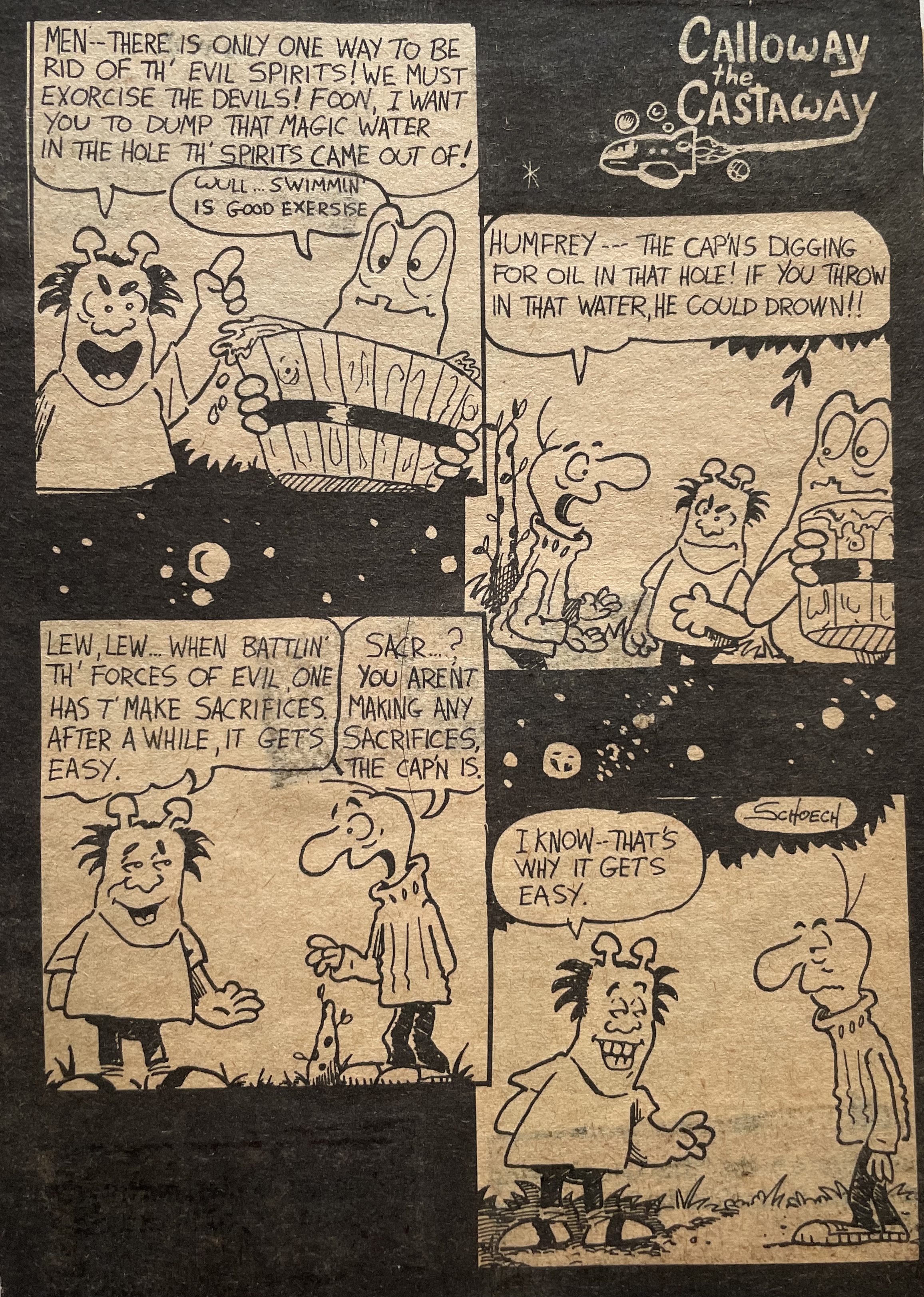
Unfortunately, “Calloway the Castaway” had several factors working against it back in 1979. The comic strip appeared in a small suburban weekly newspaper with few readers. The small weekly newspaper didn’t pay my older brother anything for his weekly cartoon. And my older brother was 21 and broke. When he suddenly had the opportunity to move to the East Coast to pursue other endeavors (including a woman), he took it.
What was a 21 year-old guy supposed to do? Stay in a small suburb and continue cartooning for free? Or move to the East Coast chasing a woman?
Looking back, he probably should have sta… aw, never mind.
For more “Calloway the Castaway,” start at The Lost Adventures of “Calloway the Castaway” Episode 1!
Not sure what’s going on? Read the current storyline from the beginning below!
The Lost Adventures of “Calloway the Castaway” Episode 20
The Lost Adventures of “Calloway the Castaway” Episode 21
The Lost Adventures of “Calloway the Castaway” Episode 22
The Lost Adventures of “Calloway The Castaway” Episode 23
The Lost Adventures of “Calloway The Castaway” Episode 24
The Lost Adventures of “Calloway the Castaway” Episode 25
And come back next week for The Lost Adventures of “Calloway the Castaway” Episode 27 .

Years ago, when I wrote blog serials for Dysfunctional Literacy, Awkward Moments in Dating was the only blog serial series where I wrote multiple sets of stories. It’s not because there was such a demand for more Awkward Moments in Dating stories. It’s more like I just had a lot of them to write about.
Back in the early 1990s, I was an average (on a good day) looking guy with occasional moments of charisma. I had some success in the dating world, but I had to put effort into it. Unfortunately, when things went wrong on a date, they really went wrong.
It’s a good thing that I’ve been married and have aged out of the dating market because I don’t want to go through any of these awkward situations again. It’s bad enough remembering them. Of course, there might come a time when I WON’T remember any of these moments, but I try not to think about that too much.
Each story below is the first episode of its own Awkward Moments in Dating series (with links to the next episode). Dating disasters aren’t fun to experience, but they’re great when they happen to somebody else.
Awkward Moments in Dating: The Coworker
Awkward Moments in Dating: The Ex-Boyfriend
Awkward Moments in Dating: Just Friends
Awkward Moments in Dating: Prom
Awkward Moments in Dating: The Poetry Professor and My Ex-Girlfriend
And to read the ultimate Awkward Moment in Dating story, get a copy of my ONE novel here on Amazon!!
Or you can get a signed copy from ‘the trunk of my car.’
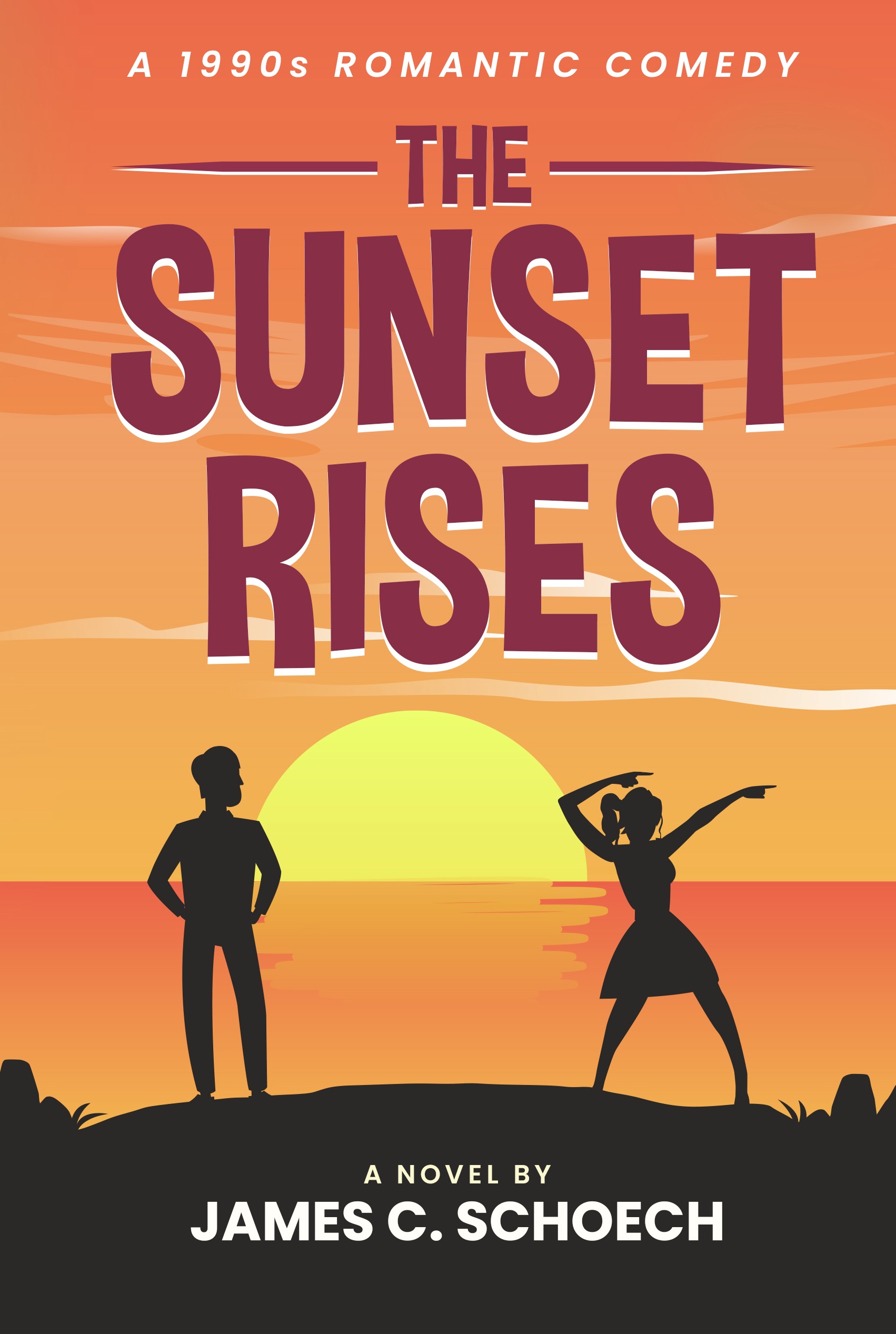
The Sunset Rises: A 1990s Romantic Comedy
Get a signed copy of my one and only novel, The Sunset Rises: A 1990s Romantic Comedy. Free delivery in the United States!
$10.00
Is the correct word ‘blither’ or ‘blather’? I always thought it was ‘blather, but I just found out I was semi-wrong. Several online dictionaries have both ‘blither’ and ‘blather’ with the meaning as ‘long-winded.’ I then thought maybe one could be a verb and one would be a noun, but no, evidently both ‘blither’ and ‘blather’ can be used as either nouns or verbs.
Even my 1973 Random House College Dictionary lists both ‘blither’ and ‘blather’ as words. The internet might be wrong, but Random House wouldn’t be, at least not back in 1973.
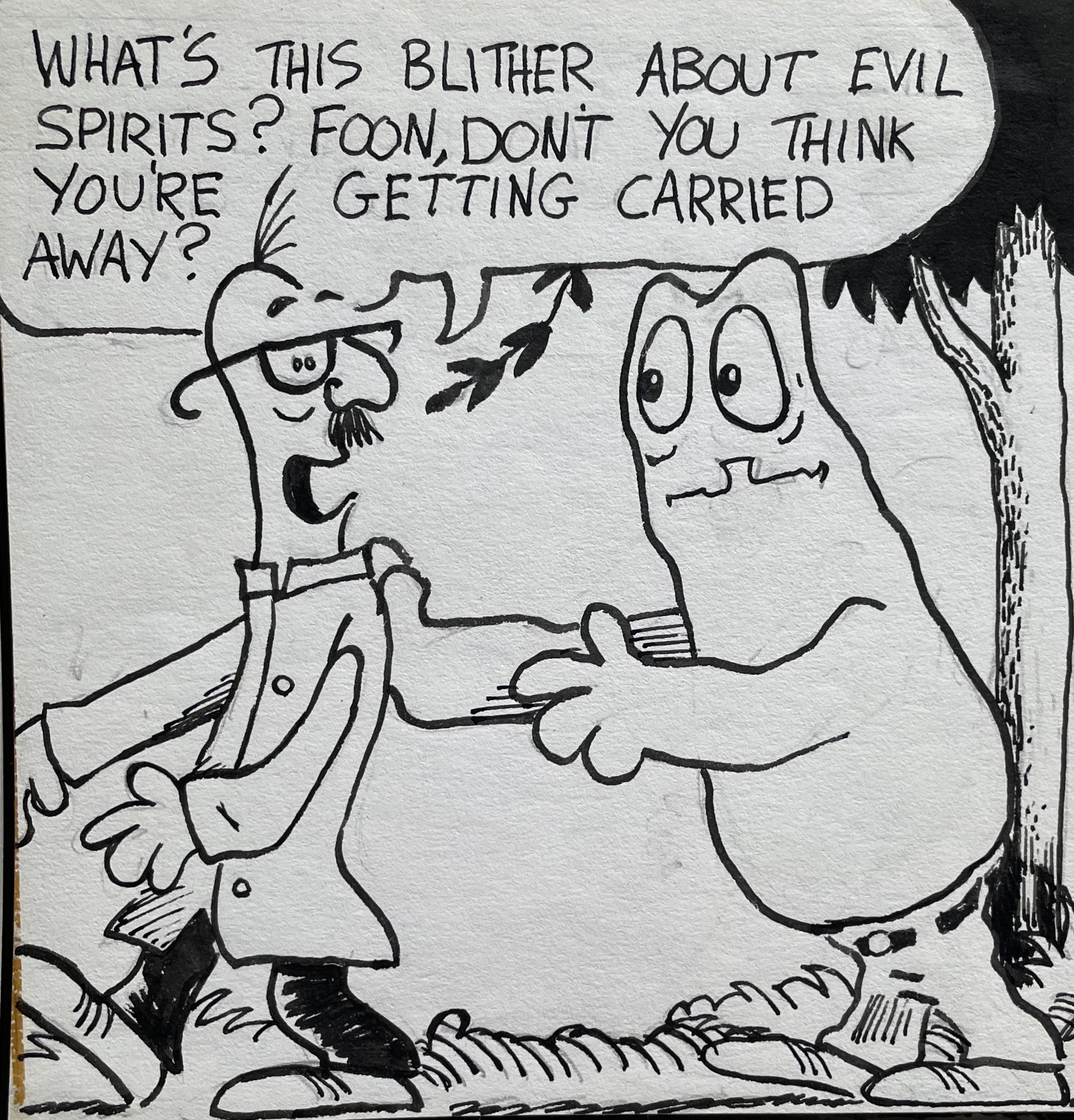
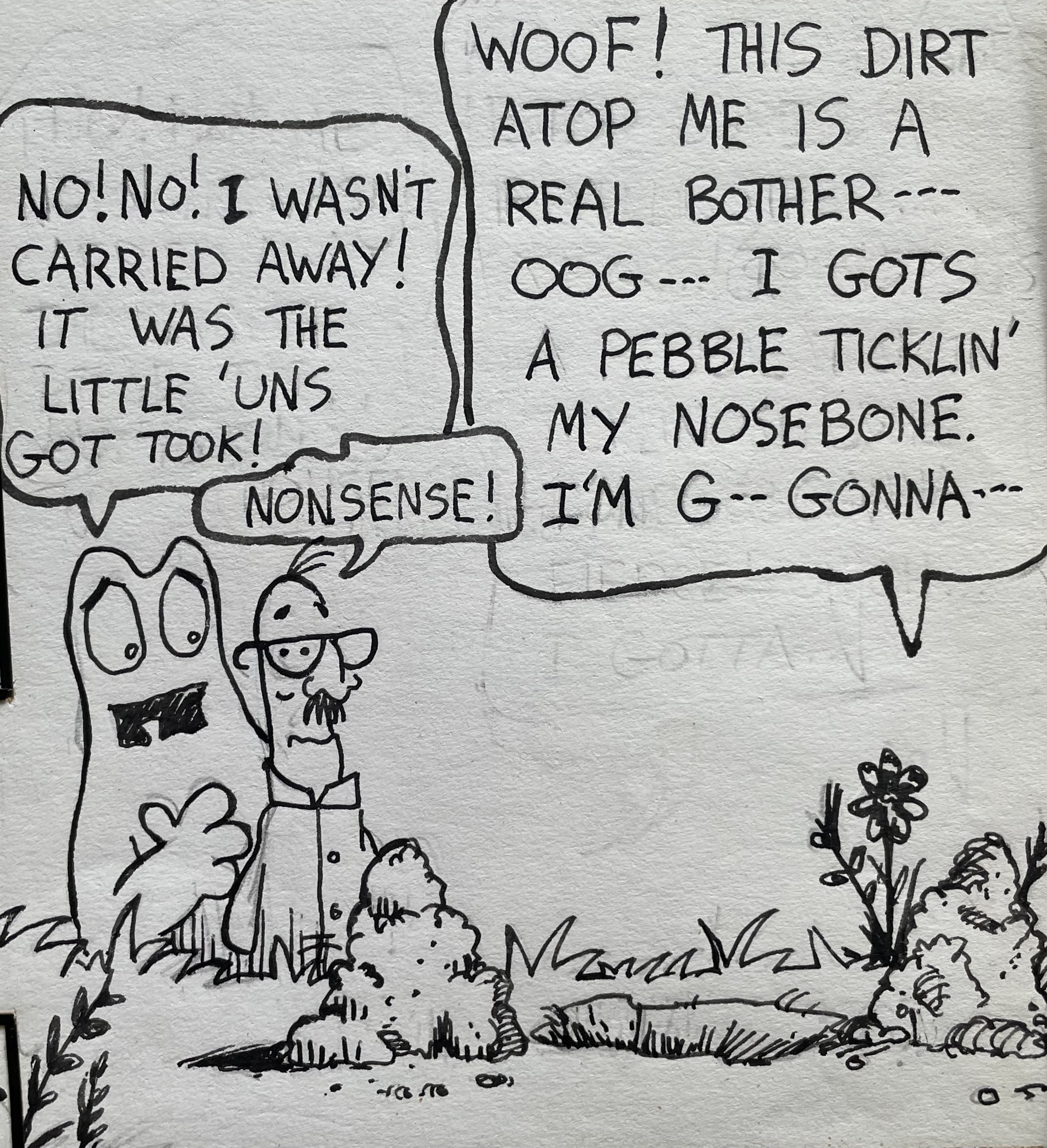
Enough blither (or blather) about these words! Here’s the 25th episode of my older brother’s comic strip “Calloway the Castaway,” published in our local weekly newspaper back in 1979.
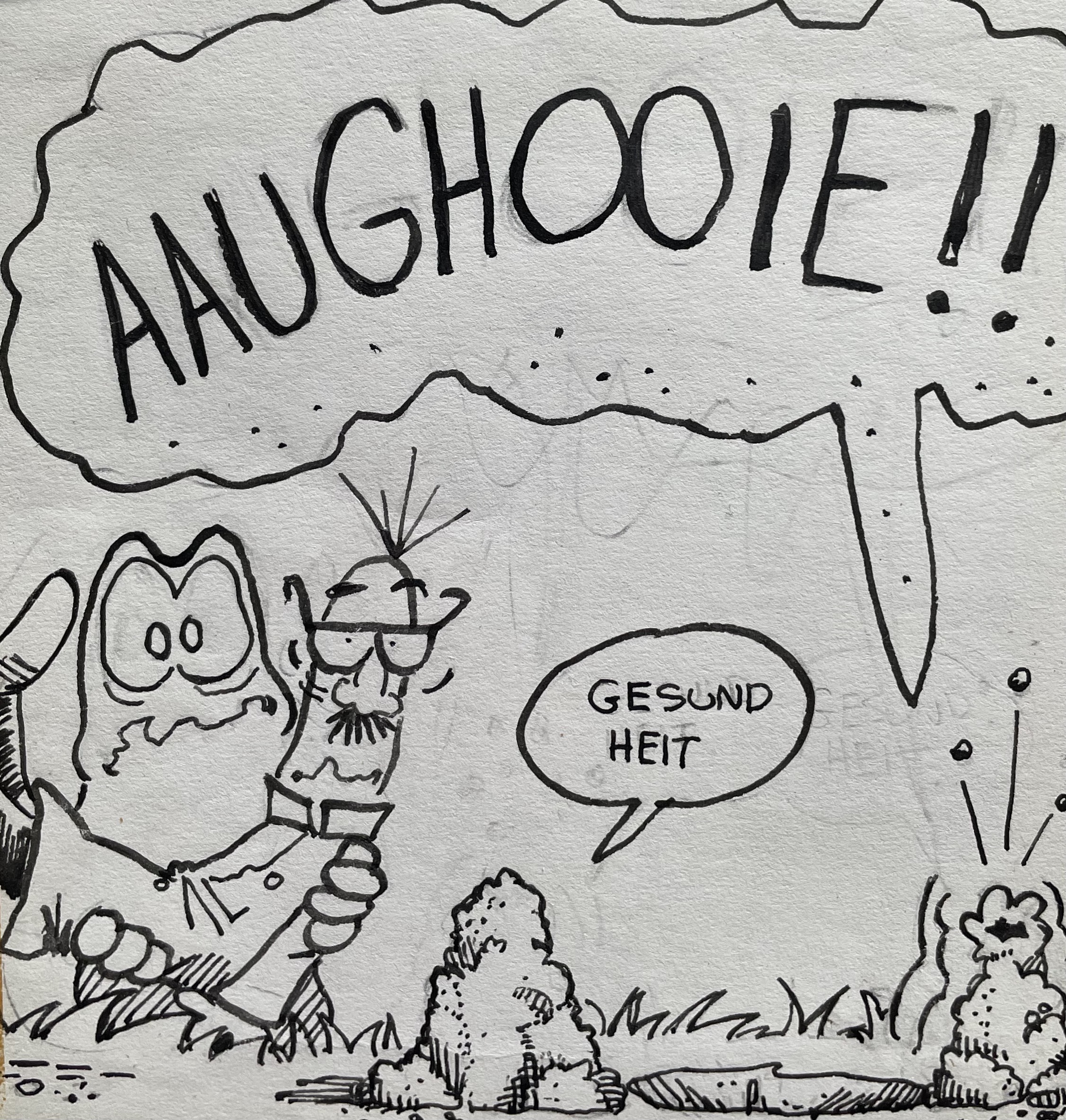
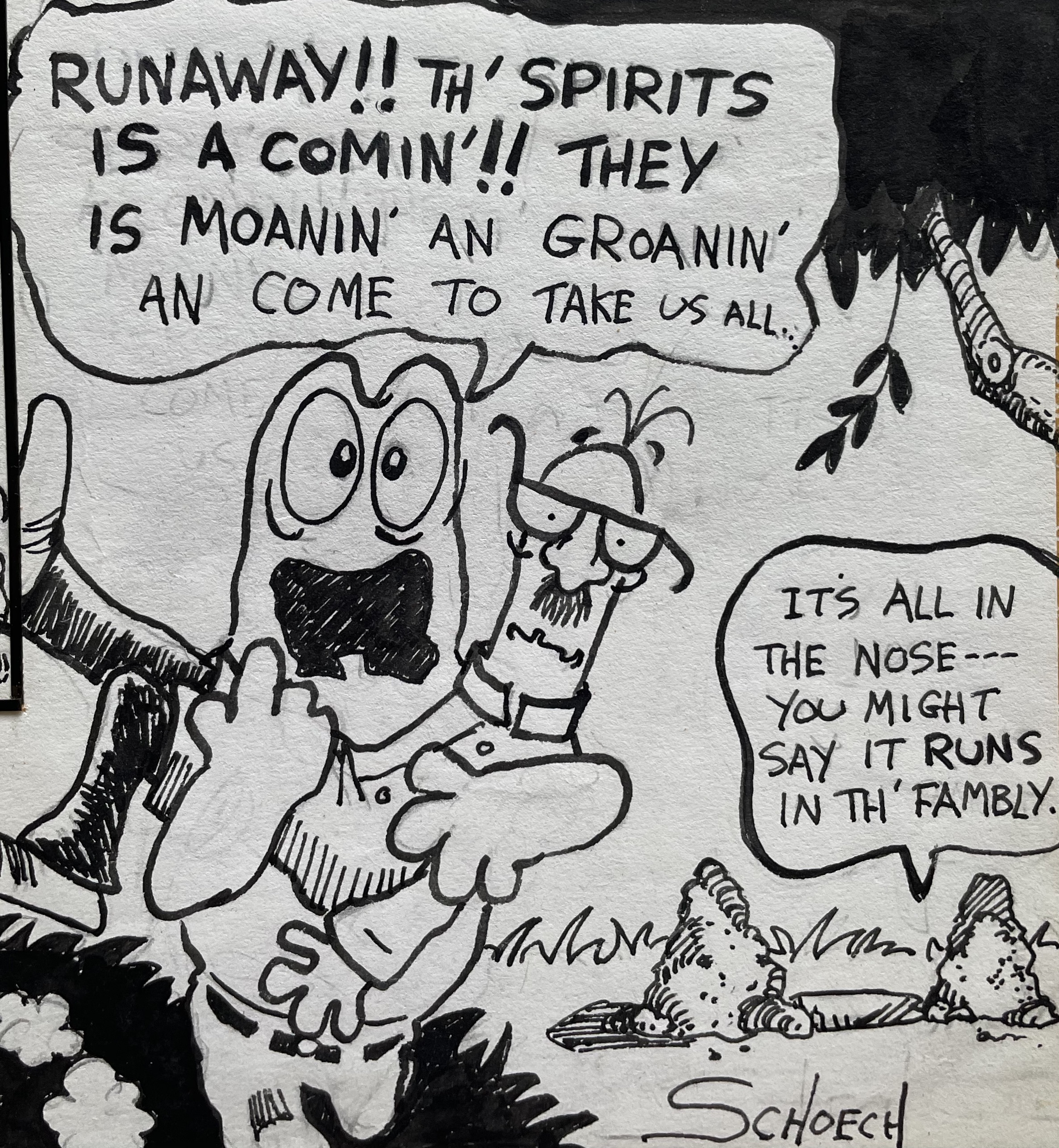
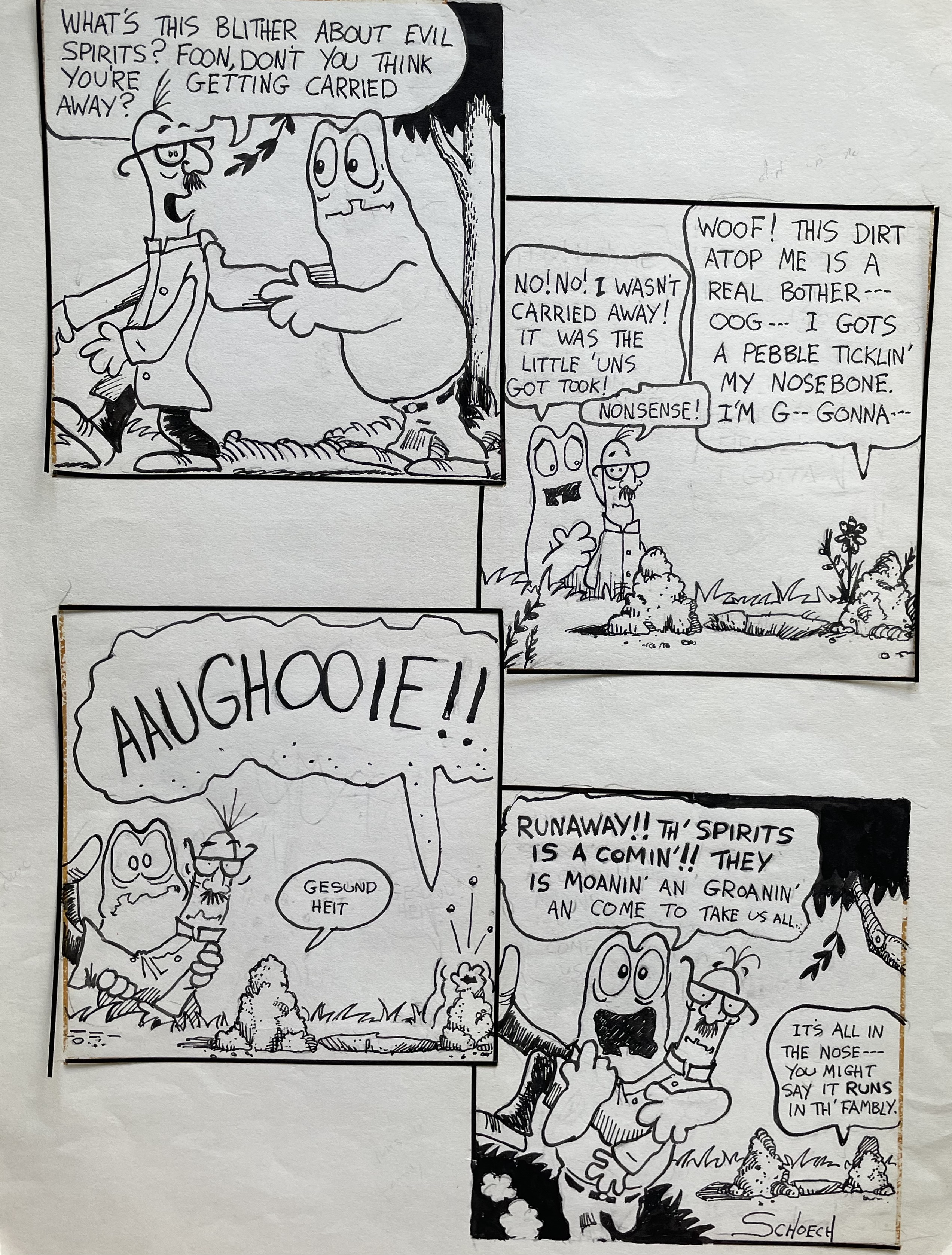
For more “Calloway the Castaway,” start at The Lost Adventures of “Calloway the Castaway” Episode 1!
Not sure what’s going on? Read the current storyline from the beginning below!
The Lost Adventures of “Calloway the Castaway” Episode 20
The Lost Adventures of “Calloway the Castaway” Episode 21
The Lost Adventures of “Calloway the Castaway” Episode 22
The Lost Adventures of “Calloway The Castaway” Episode 23
The Lost Adventures of “Calloway The Castaway” Episode 24
And come back next week for The Lost Adventures of “Calloway the Castaway” Episode 26 .
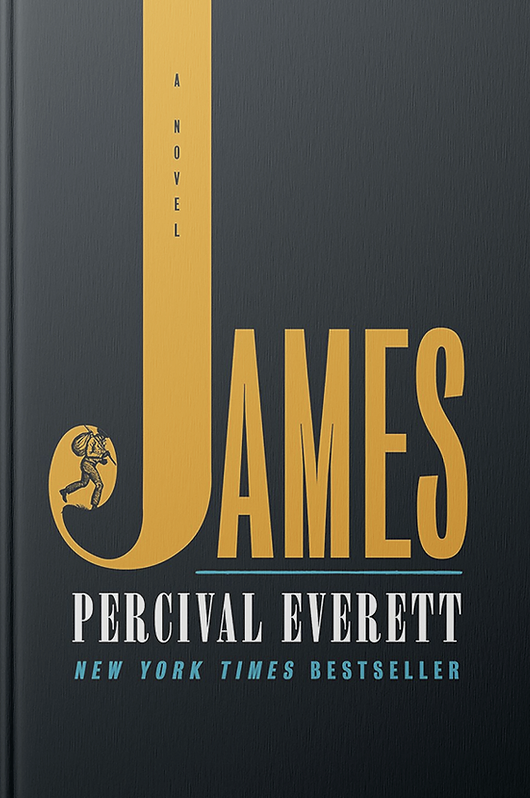
When I first saw the cover of James: A Novel by Percival Everett, I thought, ‘What a lazy title. Who the hell is James, and why would I want to read a novel about him?’
Then when I read about the premise of the book, I thought, ‘I’ve already read The Adventures of Tom Sawyer and The Adventures of Huckleberry Finn. If I’m going to read The Adventure of James, I want to read Mark Twain’s version.’
Except Mark Twain didn’t write a novel about Jim.
A part of me thinks it’s cool that somebody is writing pastiche fiction about Mark Twain characters. I’m not usually a fan of pastiche fiction, but at least the author chose a character that doesn’t have his/her own book yet.
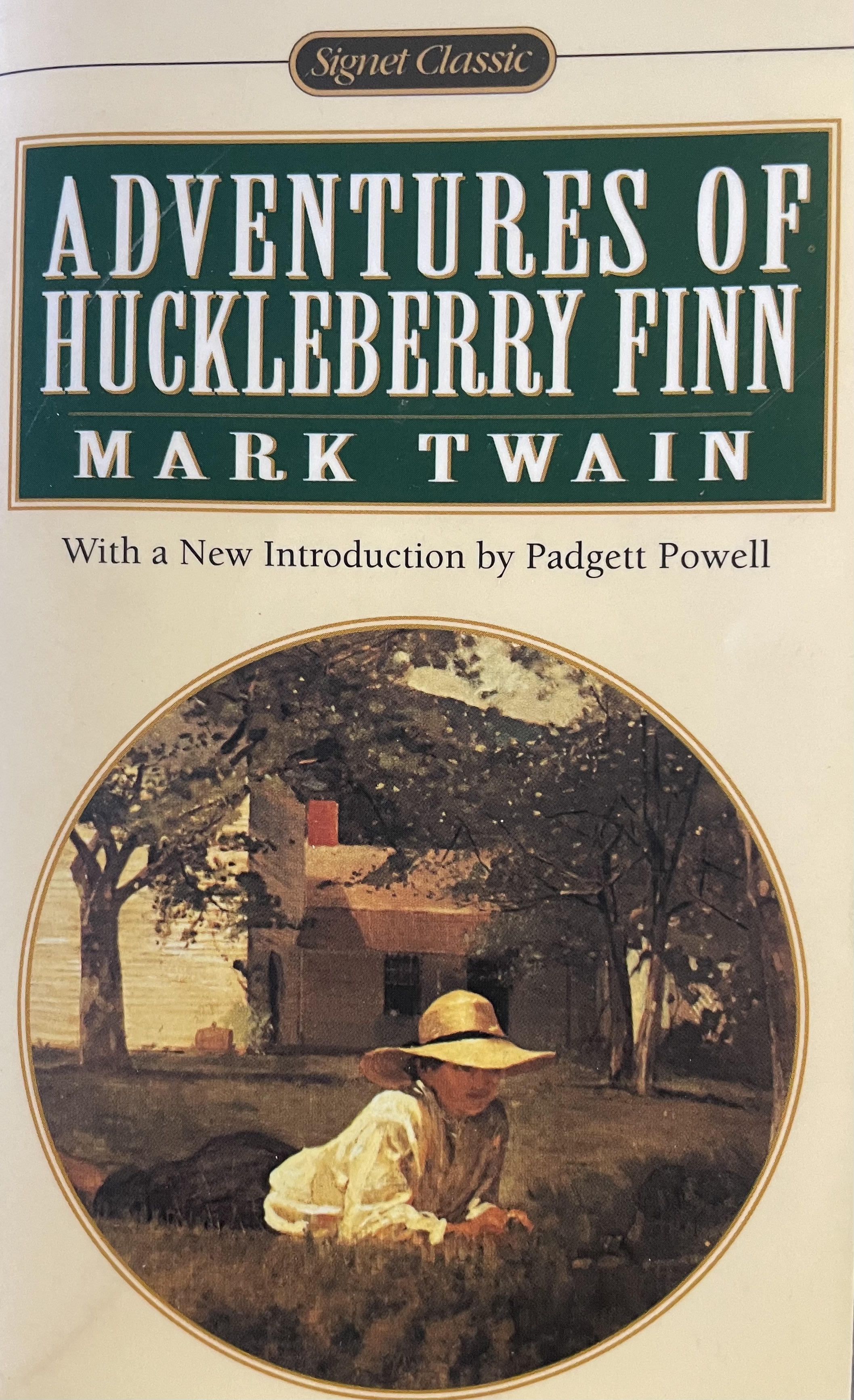
I don’t, however, normally read pastiche fiction. Any Conan the Barbarian story written by somebody other than Robert E. Howard is just a story about another barbarian who happens to be named Conan. Any James Bond story written by an author other than Ian Fleming is just a story about a random spy who happens to be named James Bond. Any Sherlock Holmes story written by somebody other than…. You get the idea.
Out of curiosity, I started reading James: A Novel. It was okay. It’s easier to read than The Adventures of Huckleberry Finn. I kind of rolled my eyes when James and the slaves started speaking in perfect English when nobody else was around. That kind of thing works for a high school skit (depending on the high school, I guess), but it’s an eye roll for a serious novel.
Maybe Percival Everrett just didn’t want to write dialect (I have no proof to back that up). Dialect is a pain to write, and people don’t like reading it. Readers probably appreciate how straight forward the writing in James: A Novel is. And maybe they like the idea of slaves speaking perfect grammar when nobody else is around.
Or maybe I’m wrong. Maybe slaves did speak perfect English when their owners weren’t around. I admit that I have astonishing gaps in my knowledge. Maybe I’m the only person who doesn’t know about this historical tidbit.

What’s more likely? Percival Everett didn’t want to write dialect? Or that slaves spoke perfect English when nobody else was around? I’m not qualified to answer that question.
I’ll also admit that I’m not the best judge of what works and what doesn’t work for serious novels (literary fiction). I hardly ever read serious novels. I like to read stuff that’s actually good (by ‘good,’ I mean ‘entertaining’).
Is James: A Novel worth reading? That depends. Do you think James: A Novel is a lazy title? Are you glad that the author didn’t use a lot of dialect in the narration and dialogue? Do you mind reading about a Mark Twain character in a book that’s not written by Mark Twain? If you answered “yes” and “no” to some of the previous questions, you might enjoy James: A Novel.
*****
My ONE novel might not be considered serious fiction, but at least it doesn’t have a lazy title. I worked hard on that title.
*****
A grammar-obsessed English teacher falls in ‘luuuvvv’ but discovers how chaotic and dangerous ‘luuuvvv’ can be.
The Sunset Rises: A 1990s Romantic Comedy
Get a signed copy of my one and only novel, The Sunset Rises: A 1990s Romantic Comedy. My handwriting is actually legible, but I’m left-handed, so I might smudge my signature sometimes. Free delivery in the United States!
$10.00
Or you can buy a copy here on Amazon!
Here’s more Literary Glance!
Literary Glance: The Murder House by James Patterson
Literary Glance: The Handmaid’s Tale by Margaret Atwood
Literary Glance: It by Stephen King
A part of me wants to write a synopsis of the story so far because new readers to this blog or this comic strip might wonder what’s going on. Then I remember that back when my older brother’s comic strip was published in our local weekly newspaper back in 1979, four-panel comic strips rarely had a synopsis. Readers were on their own to figure things out.

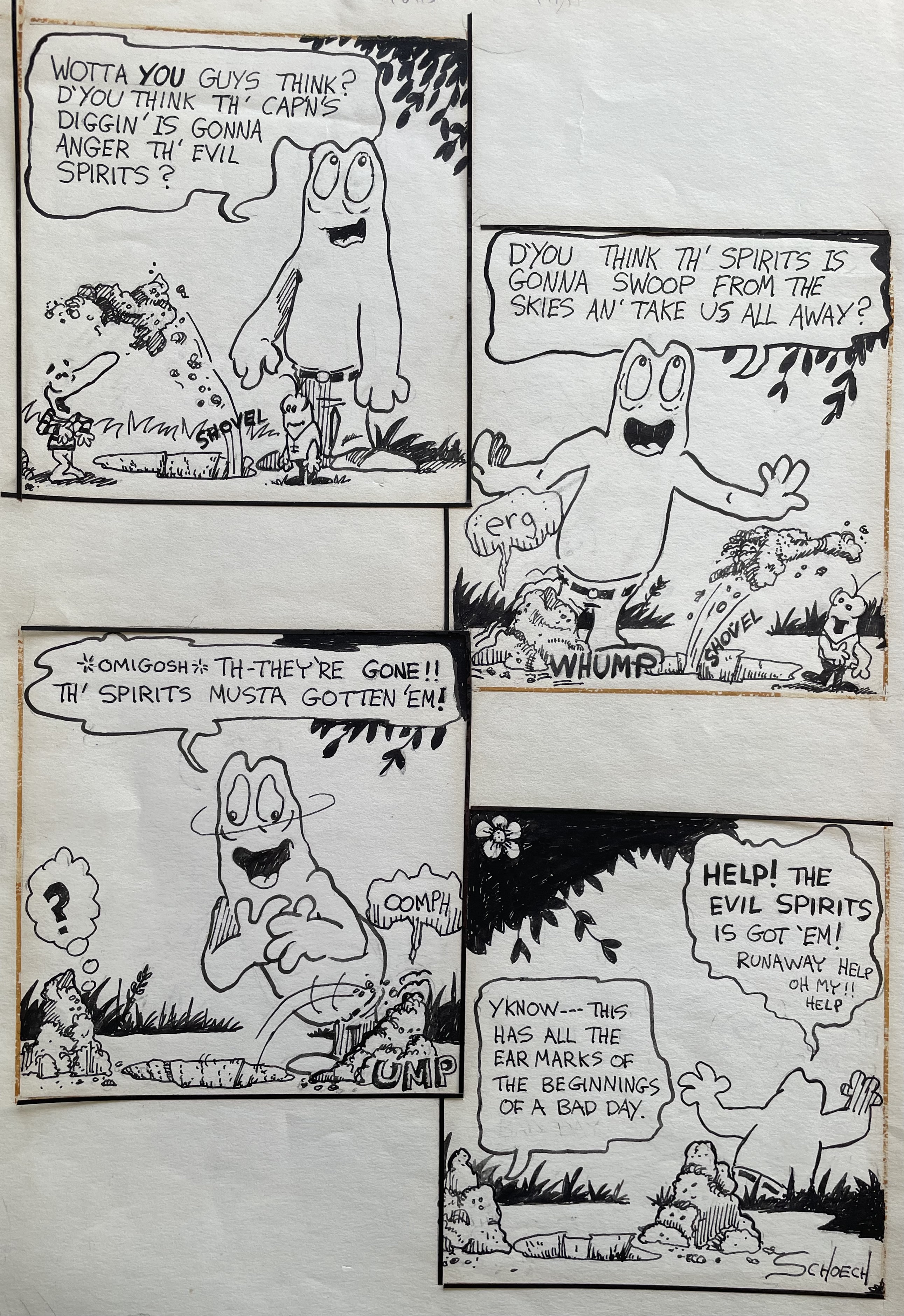
Today, we have the internet, and with this internet comes the power to provide links. But with the power to provide links comes the responsibility to use them judiciously.
For more “Calloway the Castaway,” start at The Lost Adventures of “Calloway the Castaway” Episode 1!
Not sure what’s going on? Read the current storyline from the beginning below!
The Lost Adventures of “Calloway the Castaway” Episode 20
The Lost Adventures of “Calloway the Castaway” Episode 21
The Lost Adventures of “Calloway the Castaway” Episode 22
The Lost Adventures of “Calloway The Castaway” Episode 23
And come back next week for The Lost Adventures of “Calloway the Castaway” Episode 25 .

Gen Z gets a bad reputation for being lazy and having bad manners. They stare at their phones. They don’t make eye contact. They’re allegedly too sensitive to criticism. They can come across as rude to those of us from older generations.
I work part-time at a grocery store with a bunch of Gen Z co-workers, and I kind of like being around them. I can sit next to them in the break room and not feel like I have to talk to them. We just nod and stare at our phones. Sometimes we don’t even nod. This behavior is a lot different from the way I was taught to act.
When I was a kid, I was taught to be polite, even with strangers (unless they were driving a white van). When I was a teacher from 1990-2020, I would greet co-workers and students with a “Good morning” or something similar, and most students would respond, even if they really didn’t want to. My Gen Z co-workers in the grocery store? If I say “Good morning,” they continue looking away, continue staring at their phones, or give me looks that read, “Why the f*** are you talking to me, Boomer?”
By the way, I’m not a Boomer. I’m Gen X. That’s completely different, but that’s for another blog post (maybe).
I was put off by this Gen Z behavior for a while. I still fake-smiled after I’d been snubbed, but in my head I was thinking “you stuck up little pricks.” They didn’t always behave stuck up, though. If these Gen-Z co-workers needed my help with something in the store or if I was the last available option for conversation, they’d talk to me politely, but otherwise, yeah, they came across to me as kind of rude. Then one day it hit me (and this really shouldn’t have taken so long).
I’ve never liked being polite.
I’ve actually… kind of… hated… being polite.

I decided then to be more like Gen Z. I don’t say “Good morning” much anymore. I don’t make eye contact. I don’t try to make polite conversation. No more talk about the weather. I stare at my phone (or a book) but only when my back is leaned up against a wall. I still don’t stare at my phone when I’m walking, though (Gen Zers aren’t as spacially aware as they think they are). Even with my old teacher-in-the-hallway instincts, I like to check out my surroundings. I don’t like getting conked on the head. I can’t believe more Gen Zers don’t get conked on the head.
Don’t get me wrong; I’m not being rude to anyone. If somebody wants to talk to me, I’m still polite and occasionally friendly. I don’t ignore customers or co-workers who have questions (though that’s tempting). But I don’t feel compelled to greet everybody. I don’t have to make eye contact. I can just zone out. I like zoning out.
Since I’ve cut down on meaningless polite interpersonal contact, I have more energy during and after work. Physical work at the grocery store isn’t always work to me. Communication with other people is more draining to me than physical work. Maybe Gen Z has it right.
The only potential problem is that the Gen Z short attention span might rub off on
*****
Here’s my one and only novel. You can even read it on your phone if you want to!
It’s the oldest story in the world, 1990s style!
Man meets woman; man falls in “luuuvvv” with woman; man gets blindsided by reality!
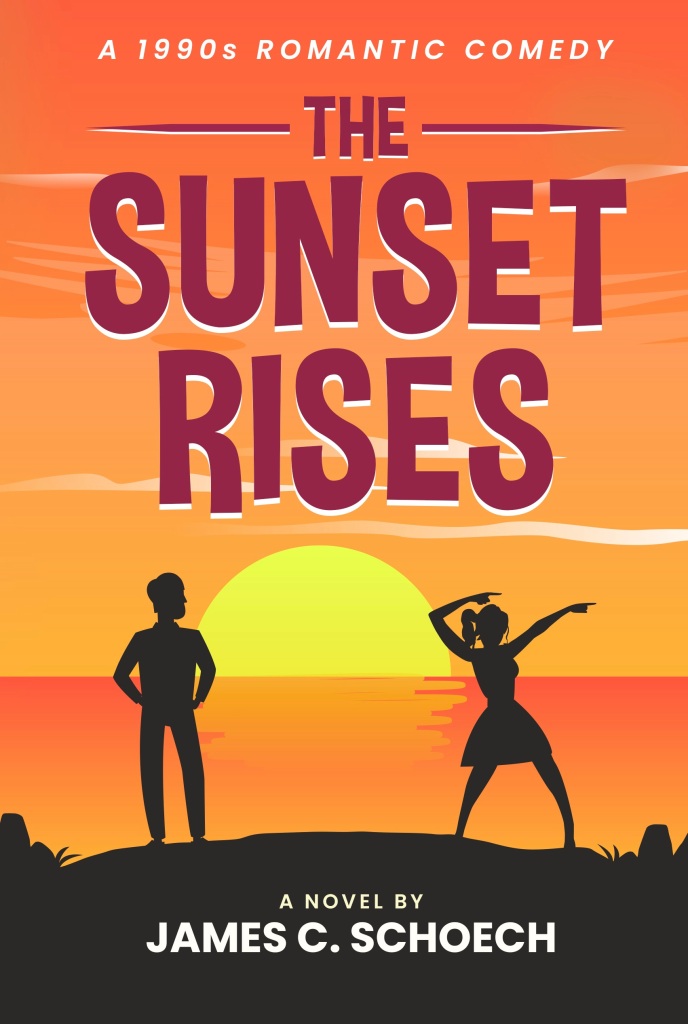
The Sunset Rises: A 1990s Romantic Comedy is now available on Amazon !
I’m usually not a fan of puns in comic strips, but since this is my older brother’s work, I’ll defend it with my last ounce of energy. This one is okay.
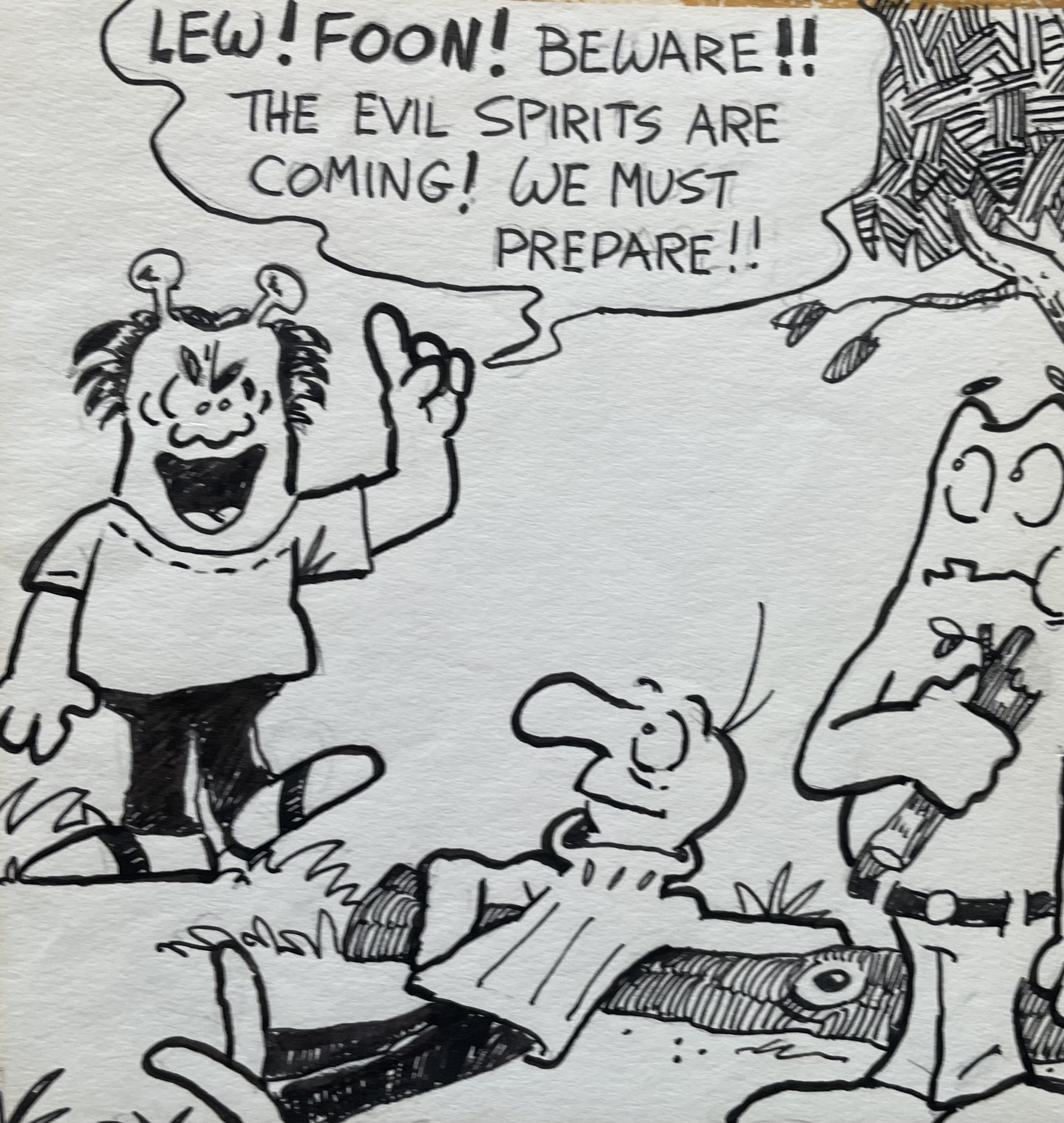
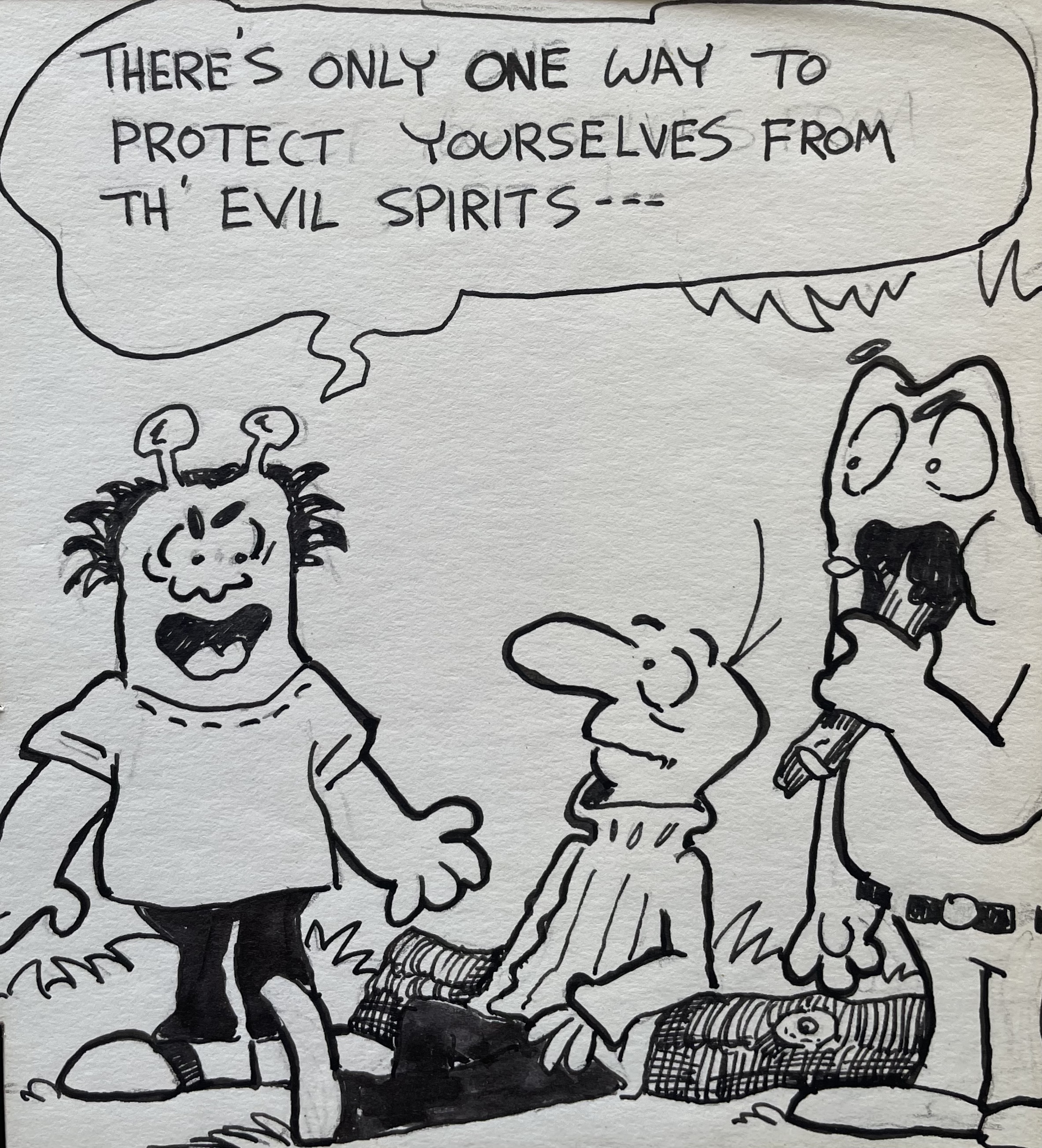
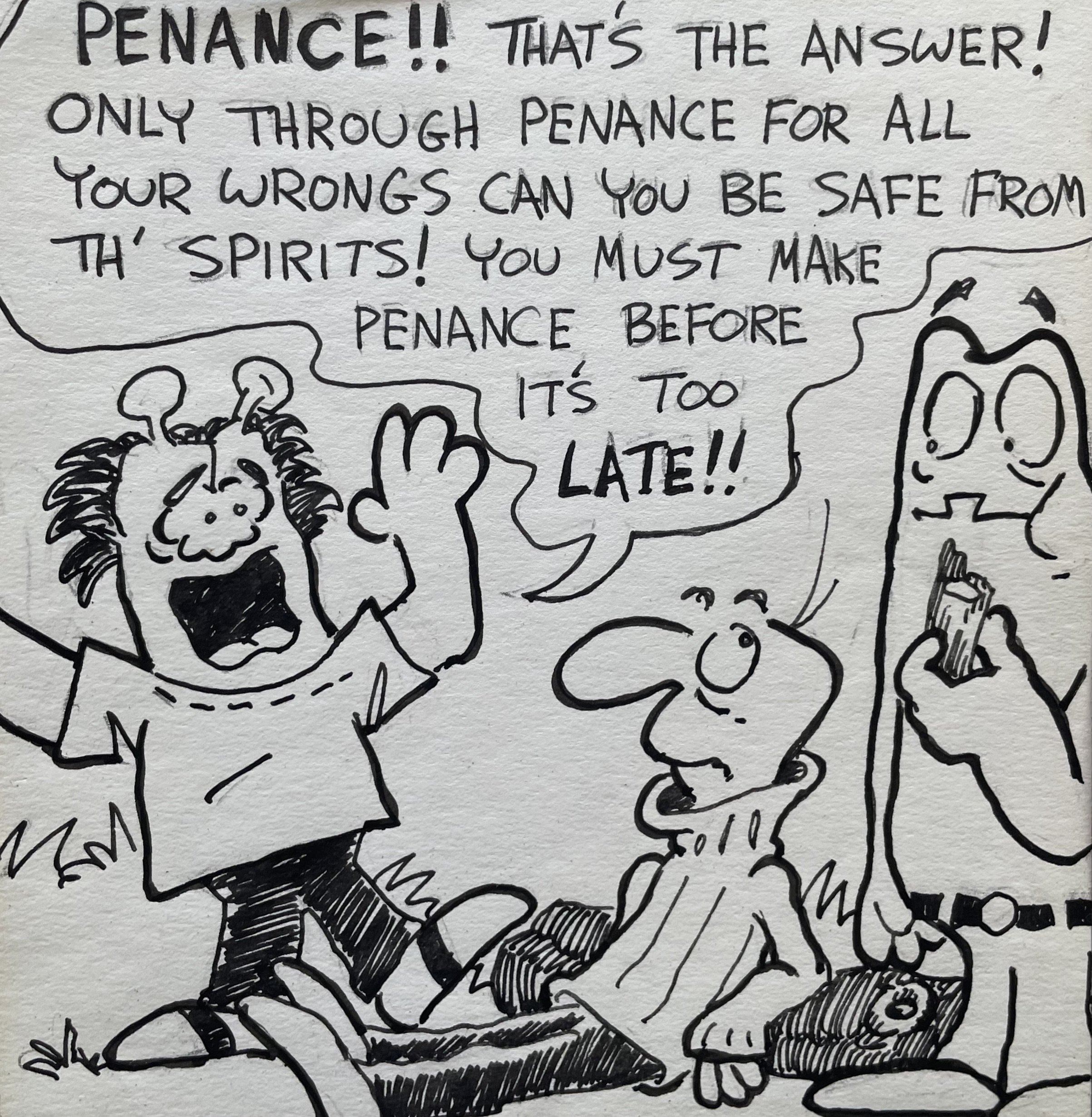
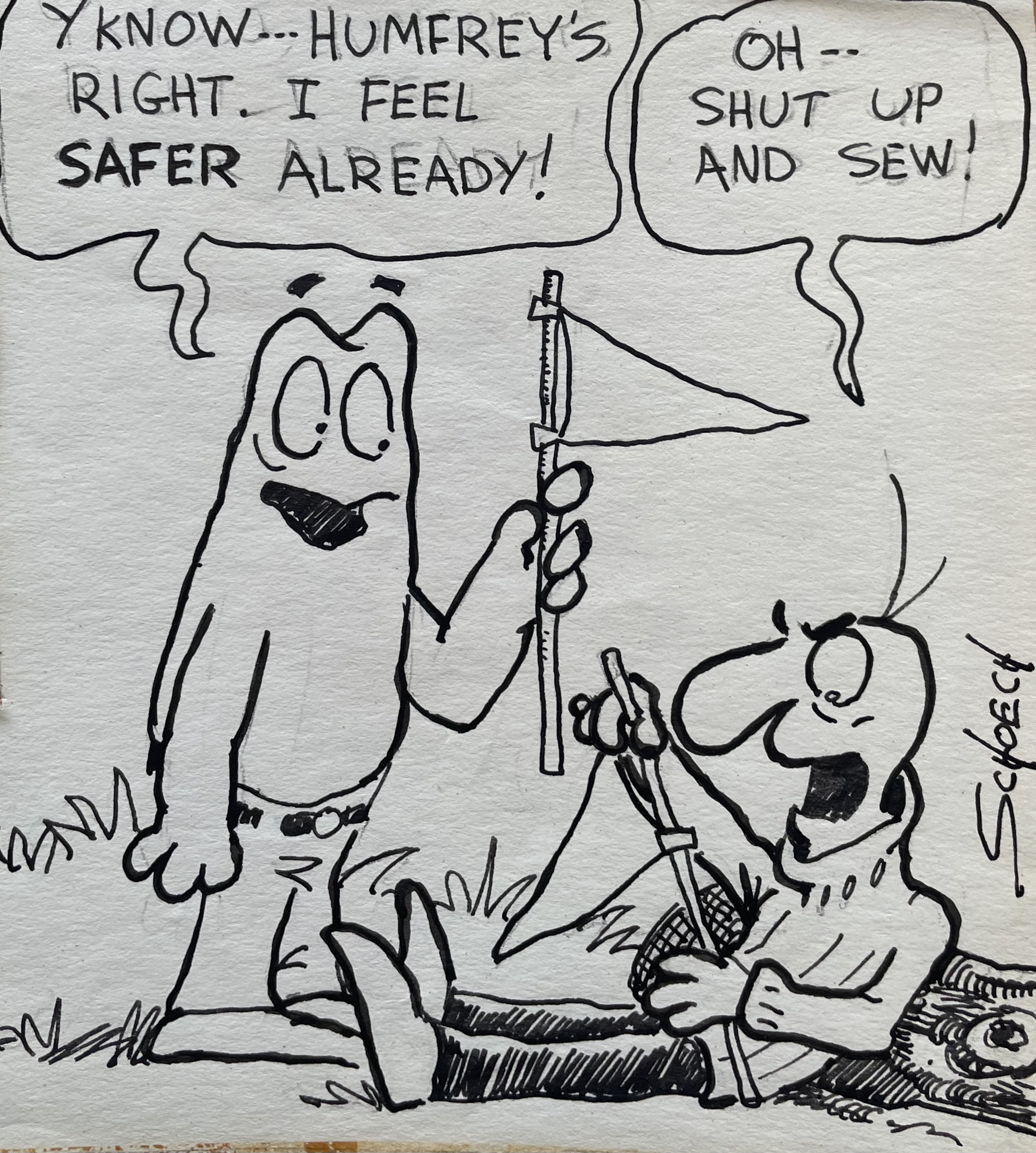
Pennants? Penance? Pun? Homophone? Ugh. Whatever it is, even if it’s the creative work of my older brother, I can’t defend this after all.
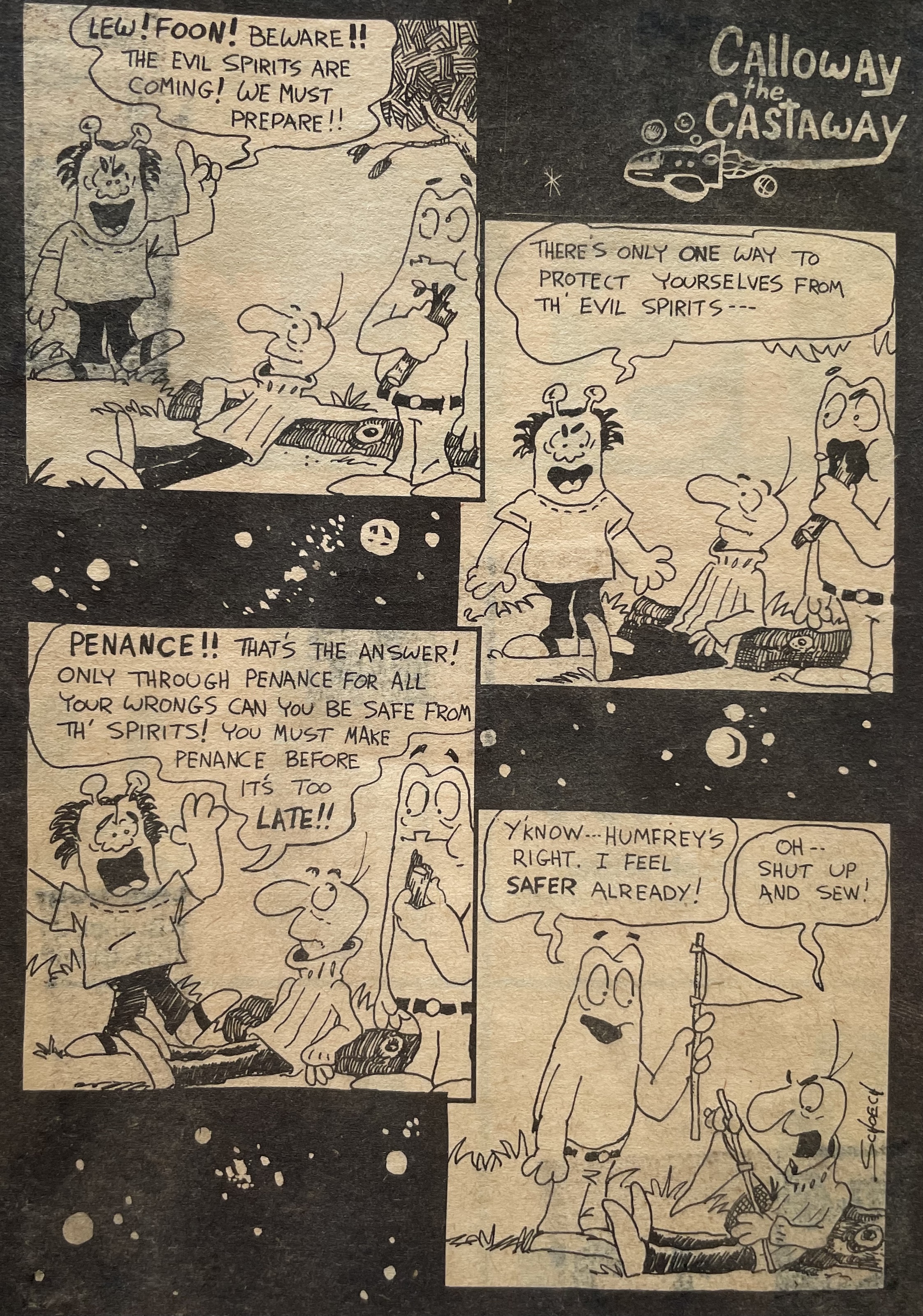
For more, start at The Lost Adventures of “Calloway the Castaway” Episode 1!
And come back next week for The Lost Adventures of “Calloway The Castaway” Episode 24 .
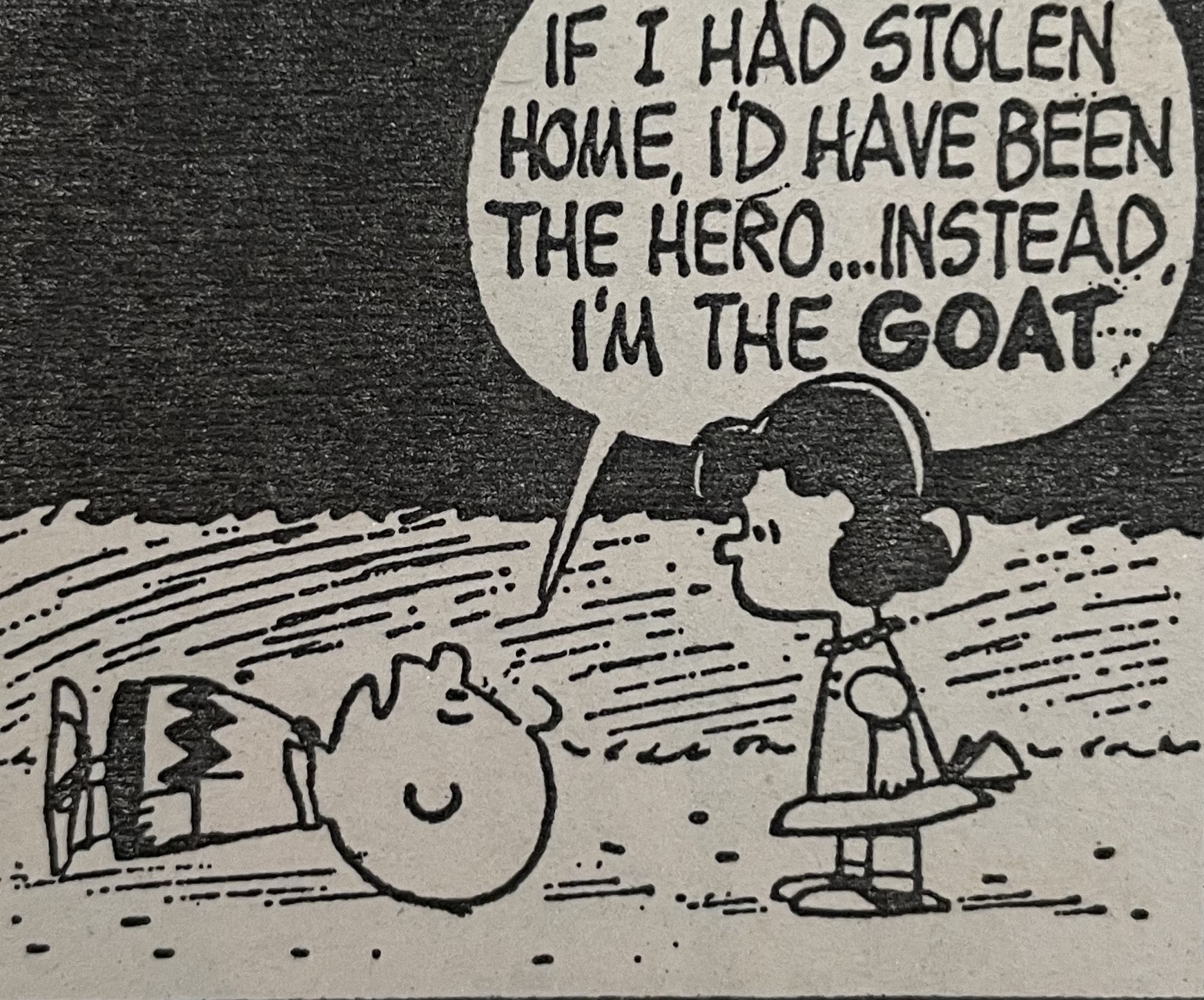
Back in the 1970s, calling somebody a goat was bad. The word ‘goat’ was short for ‘scapegoat’ and generally meant ‘loser.’ It might have been a little bit before my time because it wasn’t part of my elementary school vernacular. If another kid was a loser, we’d just call him a loser or something worse. Even though we might never have used the word ‘goat’ to put losers in their place, we knew what it meant. We had Charlie Brown to thank for that.
Maybe ‘goat’ was something our parents had said when they were younger, but I can’t ask them about that anymore. It must have at least been something that somebody had said to Charles Schultz, the creator of the comic strip Peanuts starring Charlie Brown, because that’s where we saw ‘goat’ being used all the time. So for several generations, at least as far as I know, the word ‘goat’ meant ‘loser.’
Nowadays, when I hear youngsters (anybody who is 30 years younger than me) say the word ‘goat,’ they usually mean G.O.A.T.: an acronym for Greatest Of All Time. It’s usually in reference to sports, often football or basketball. The common arguments today are that Tom Brady is the G.O.A.T. of professional football and Michael Jordan is the G.O.A.T. in professional basketball, though youngsters today might make the claim that LeBron James is the G.O.A.T.
LeBron James?

Unfortunately, LeBron James claims himself to be the G.O.A.T., so that automatically excludes him from the argument. If you have to call yourself the G.O.A.T., then you’re not the G.O.A.T. Plus, LeBron James was the old version goat of the 2011 NBA championship series, where the underdog Dallas Mavericks defeated the heavily-favored Miami Heat, partially because LeBron James was at times outplayed by an athlete that very few people had heard of. You can’t be the goat of a championship series and then also be the G.O.A.T.
Anyway, that’s not the point.
Back when I was reading the comic strip Peanuts every day in the 1970s and 1980s, we sports fans didn’t argue about who was the Greatest Of All Time. We might have argued about who in our particular time period was the best, but even as teenagers, we knew that the athletic standards of the 1980s weren’t the same as those of the 1950s. For one thing, all the footage of the 1950s was in black-and-white. There was no way that athletes competing in black-and-white footage could compare with athletes in full color.
Nowadays, all the footage of 1980s sporting events is grainy, so today’s youngsters must believe that there was no way the athletes of the previous century can be compared to today’s athletes whose highlights have been recorded in glorious HD (or whatever is even better than High Definition… I lose track of these things).

Whenever the topic of G.O.A.T. comes up with the youngsters (it doesn’t happen that often), I have to mentally clarify which type of goat (or G.O.A.T.) we’re talking about. Thankfully, with writing, there’s little chance of misinterpretation. Charlie Brown might have seen himself as a goat, but the comic strip Peanuts is probably the Greatest Of All Time.
On the other hand, LeBron James might see himself as the Greatest Of All Time in basketball, but in reality he’s just a goa… record-breaking basketball player who will probably have a polarizing legacy.
But that’s for other bloggers and content creators to argue about.
*****
For more Dysfunctional Literacy , read…
Scrabble Makes New Dictionary Filled with Fake Words
Words Not To Say In Front Of My Kids
We Don’t Need A New Word For That
*****
I’m going to take a page from LeBron James and call my novel The Sunset Rises: A 1990s Romantic Comedy the G.R.O.A.T. (Greatest Romance Of All Time)!
*****
It’s the oldest story in the world, 1990s style!
Man meets woman; man falls in “luuuvvv” with woman; man gets blindsided by reality!
The Sunset Rises: A 1990s Romantic Comedy is now available on Amazon and from the trunk of my car!
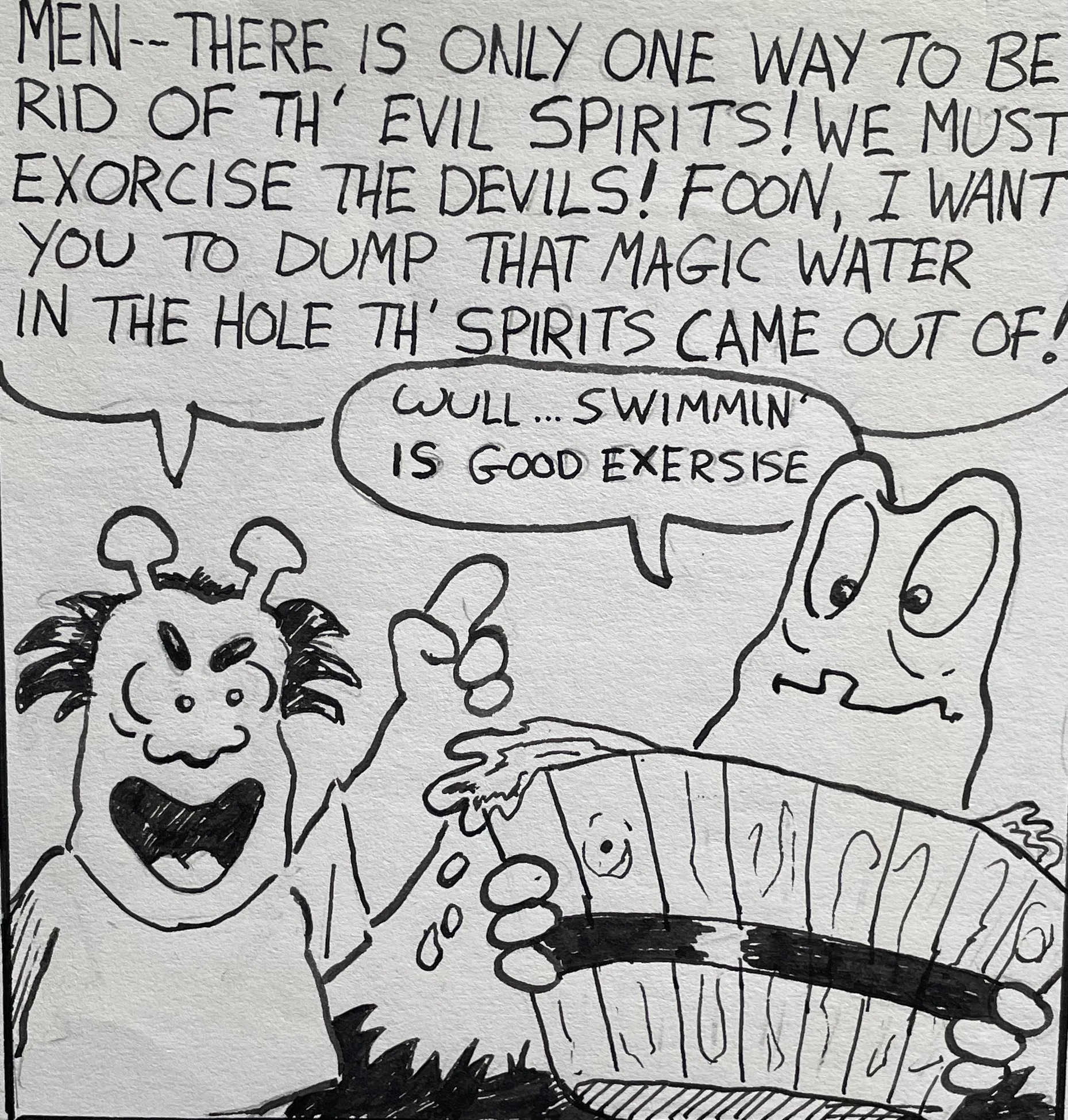
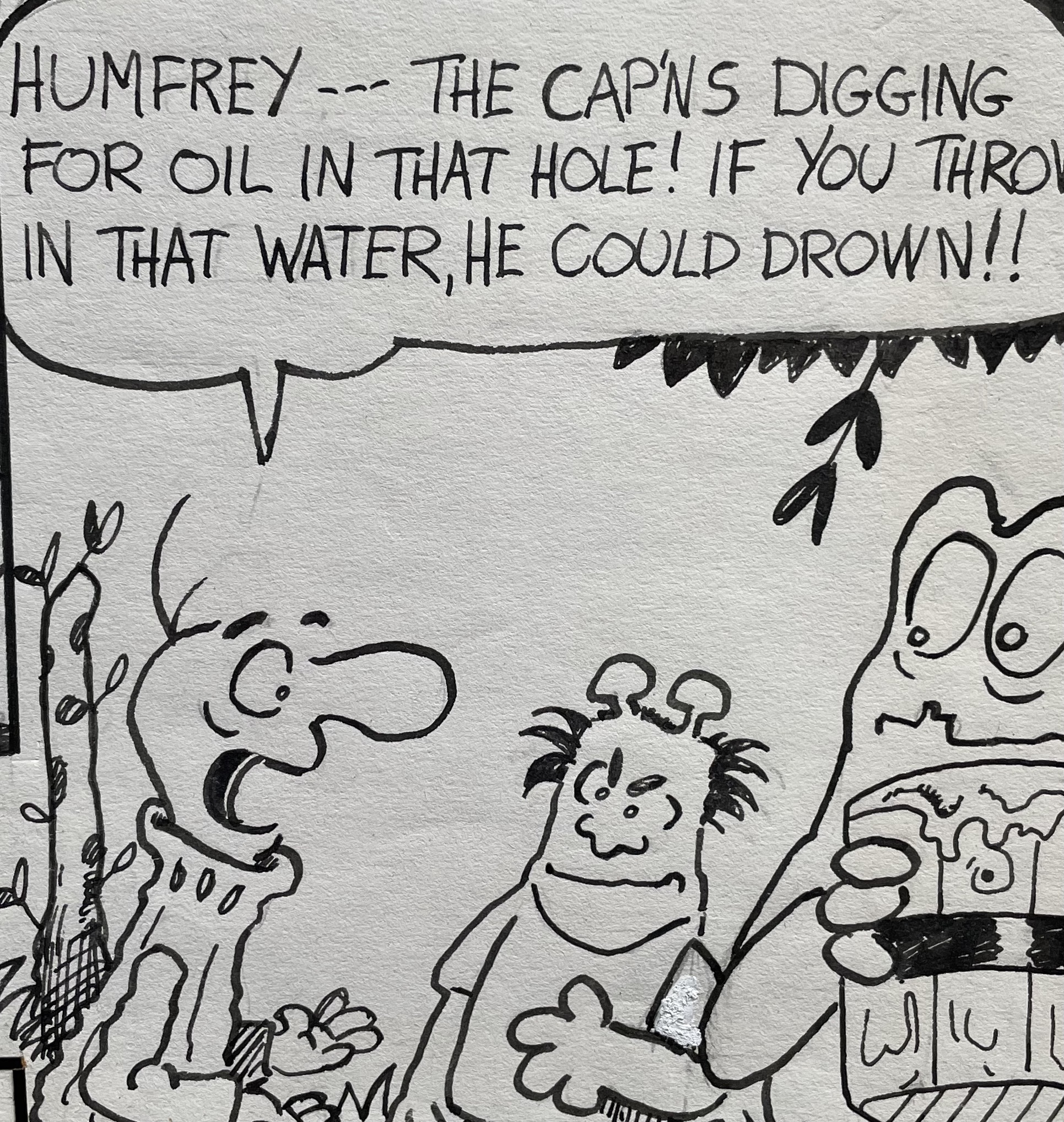
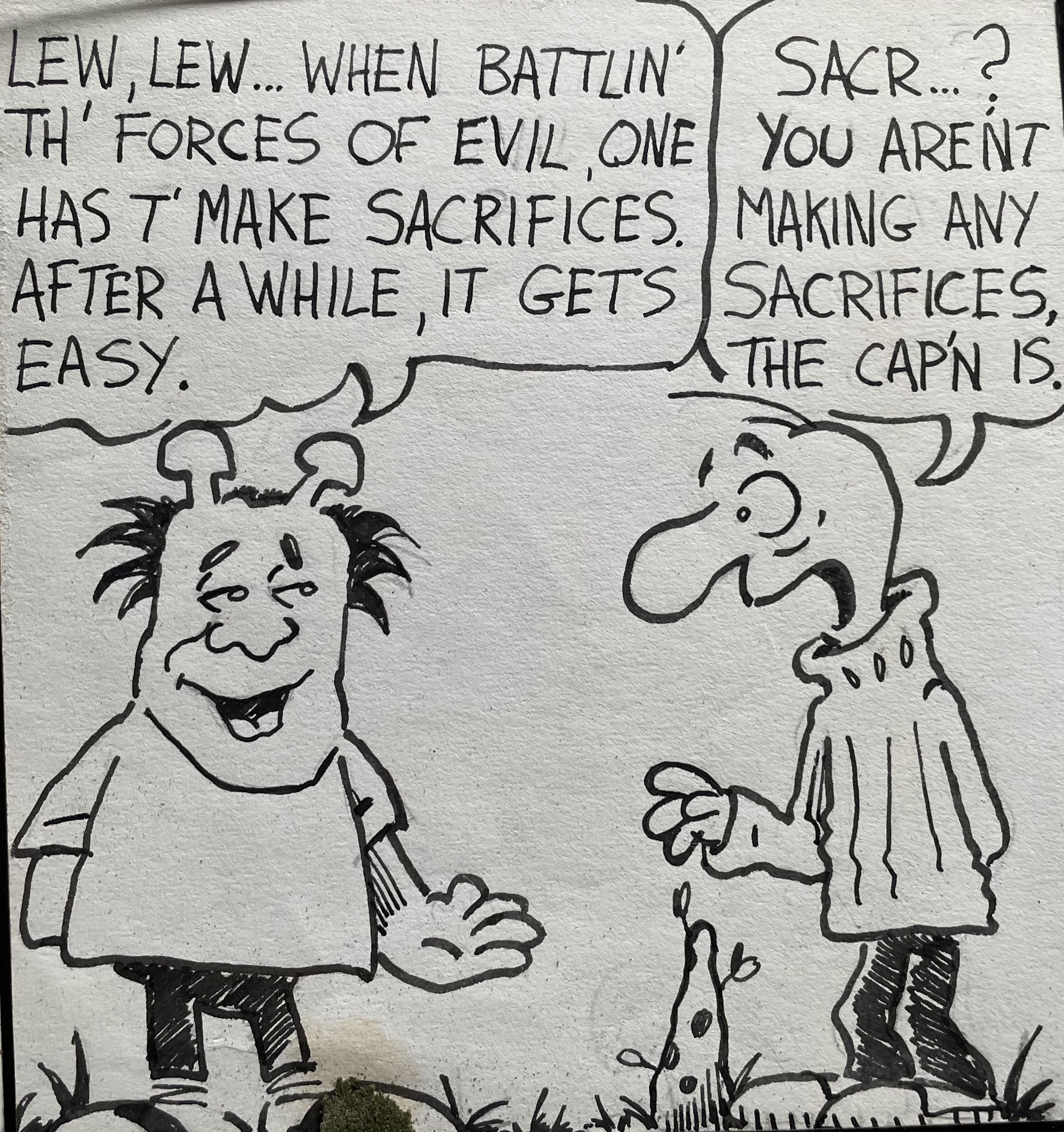
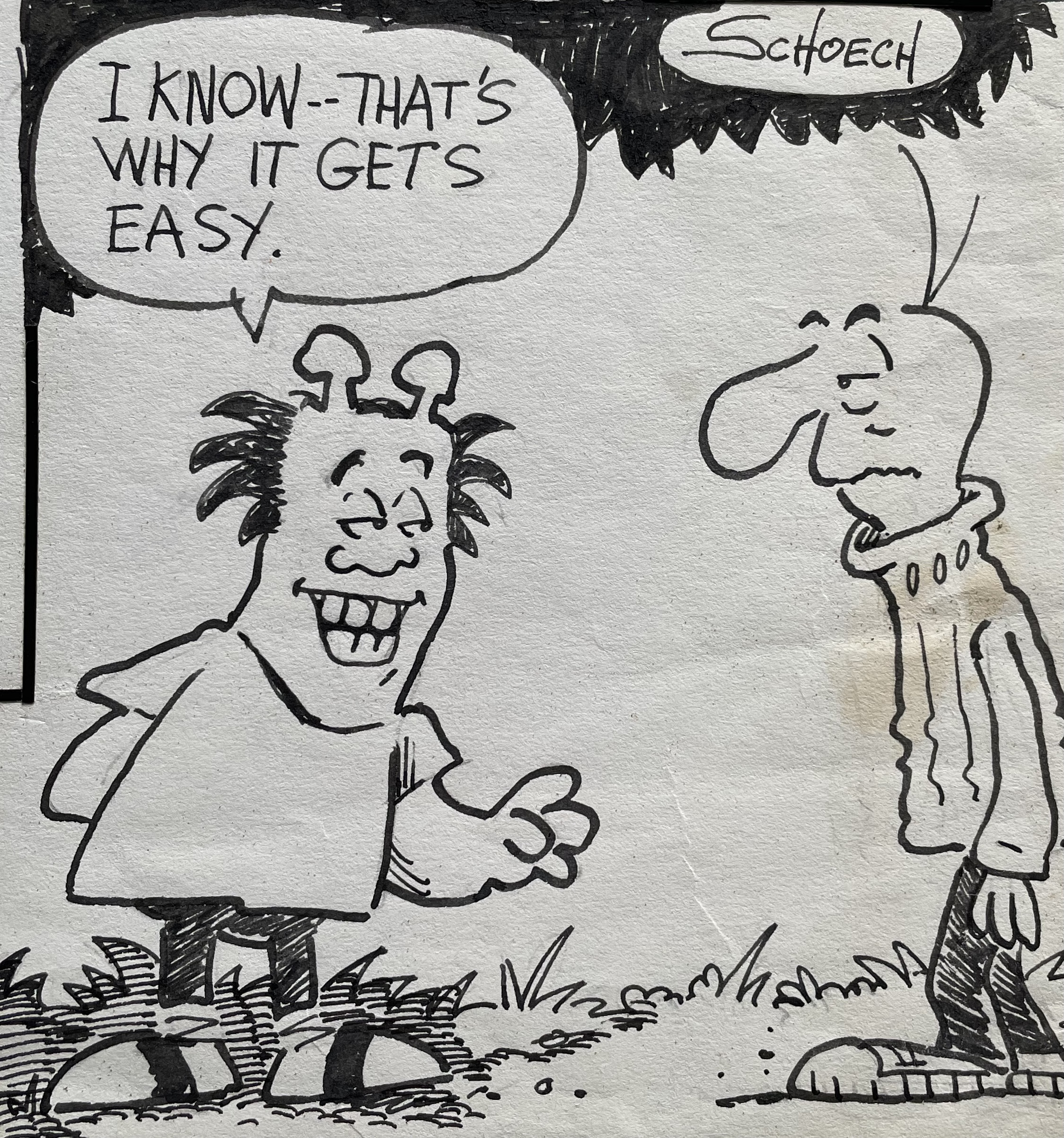
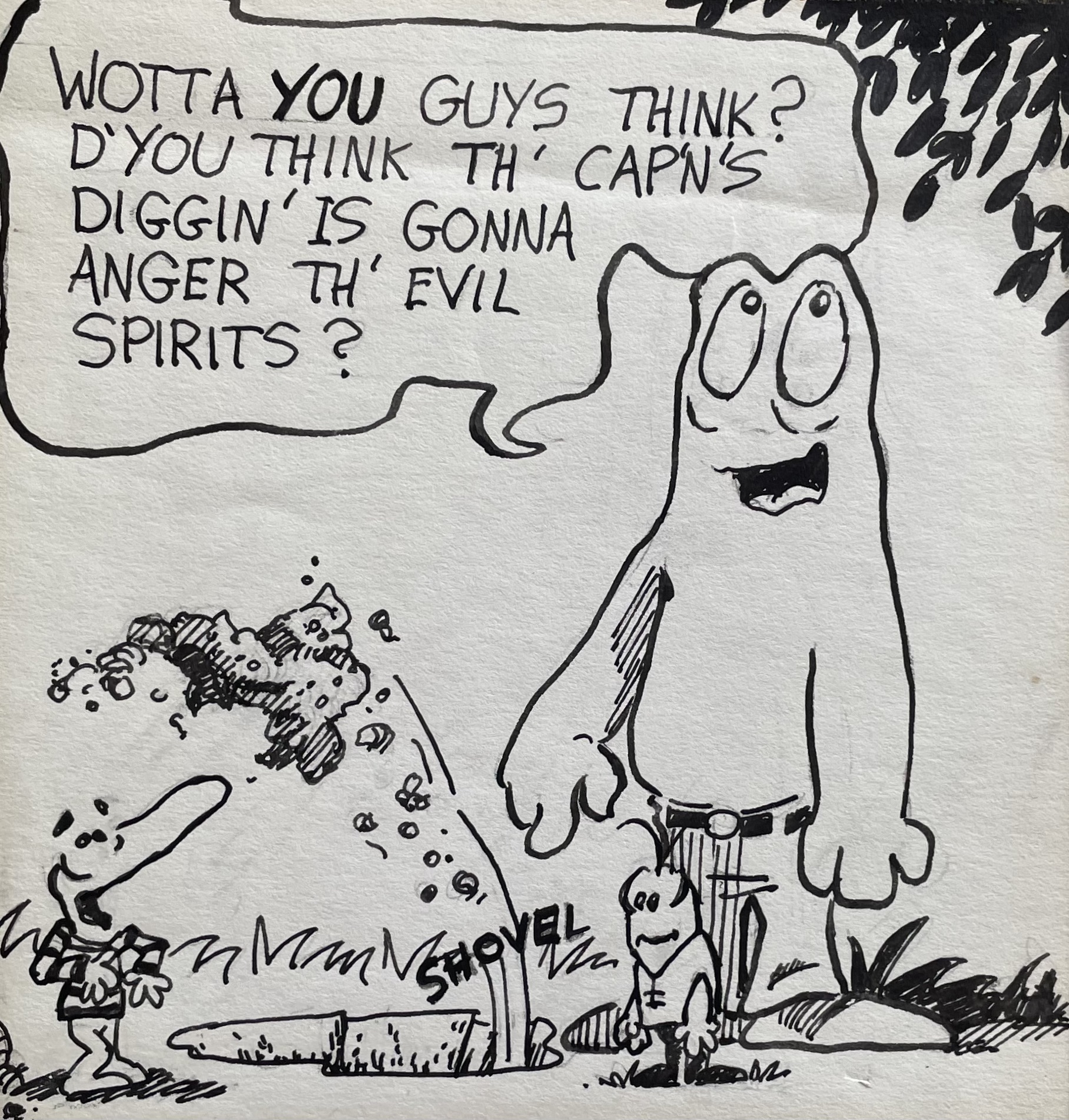
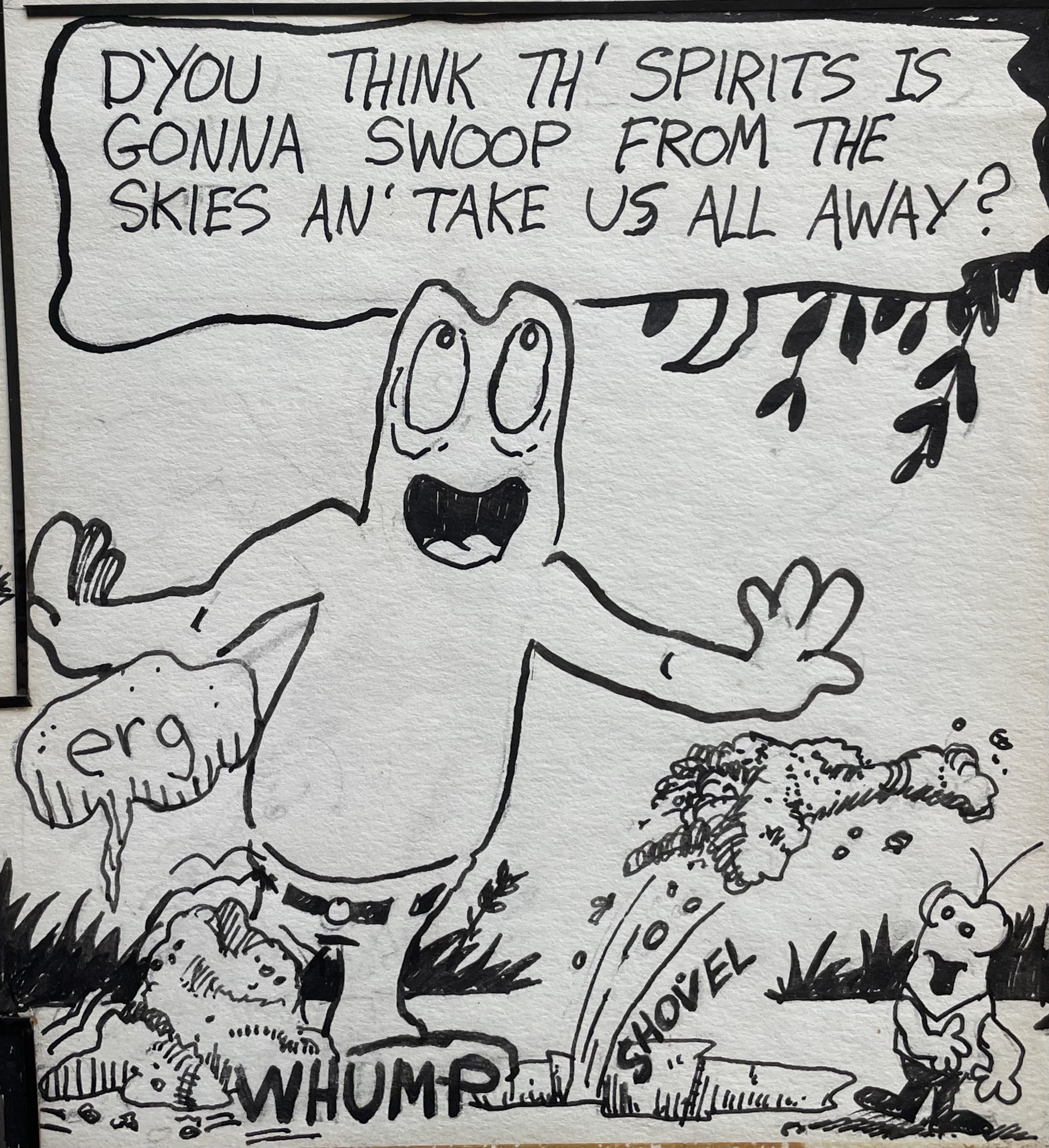
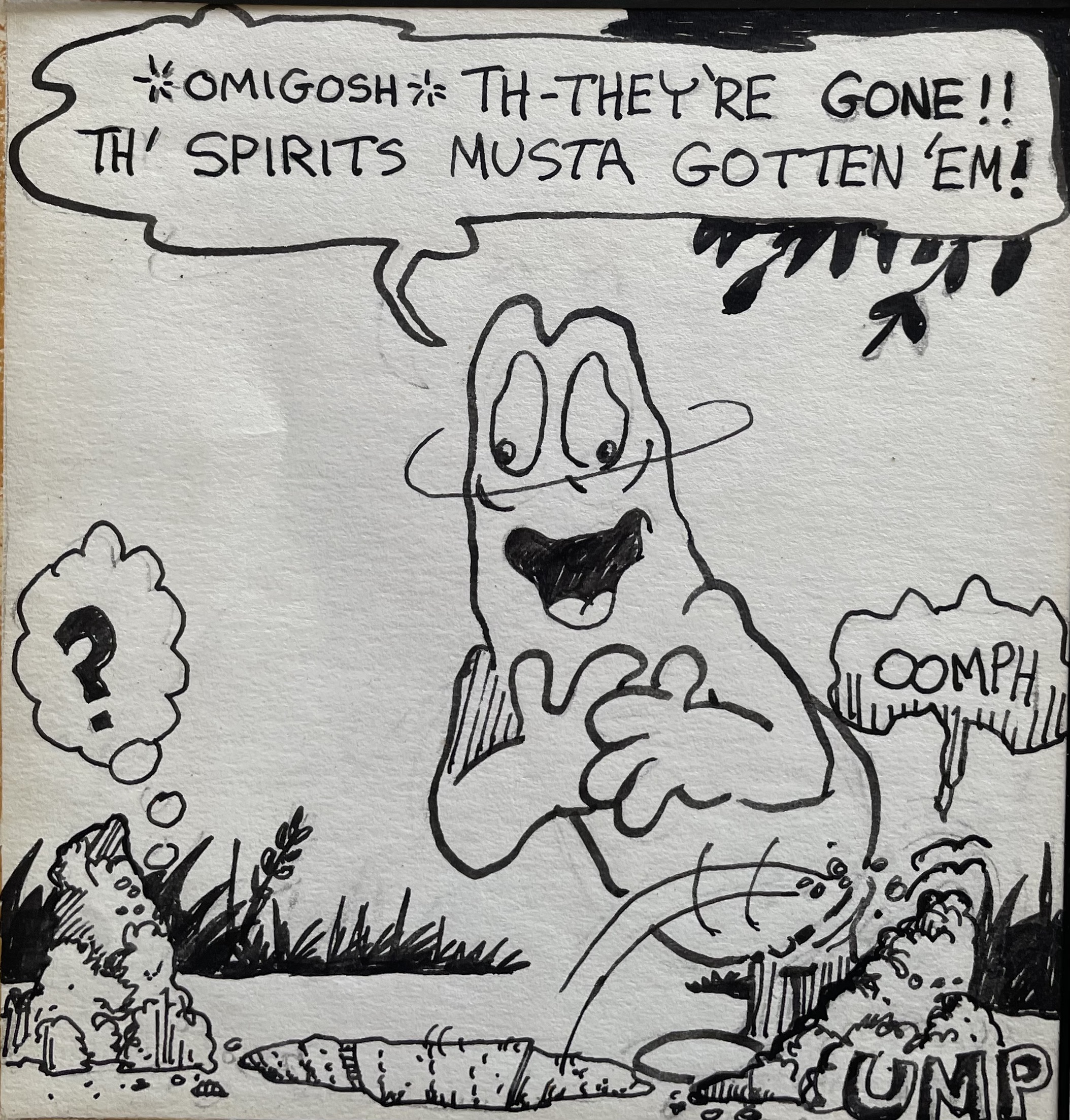
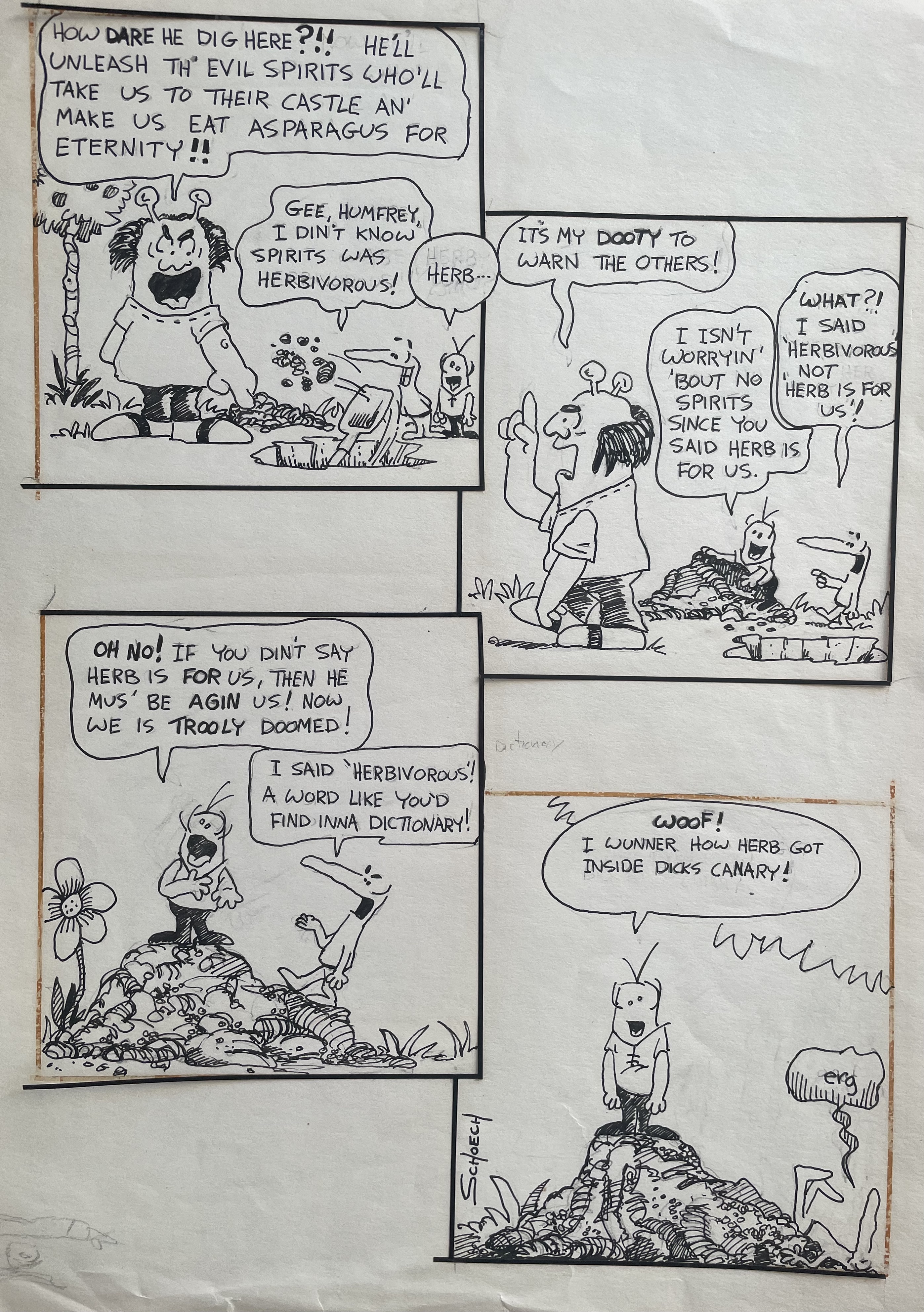
I don’t recall how this episode of “Calloway the Castaway” went over with the average reader of our hometown weekly newspaper back in 1979. Writing out heavy dialect in dialogue was more frequent in books and comics back then, but now it’s kind of frowned upon. My older brother was a big fan of Pogo by Walt Kelly, and Walt Kelly’s characters spoke in different dialects, so reading it was kind of a chore for some people.
Anyway, I see episodes like the one below as my brother paying homage to cartoonists like Walt Kelly and Al Capp. Or maybe my older brother was just high when he drew this.
Just in case you don’t know or don’t remember, Calloway is the one digging the hole.
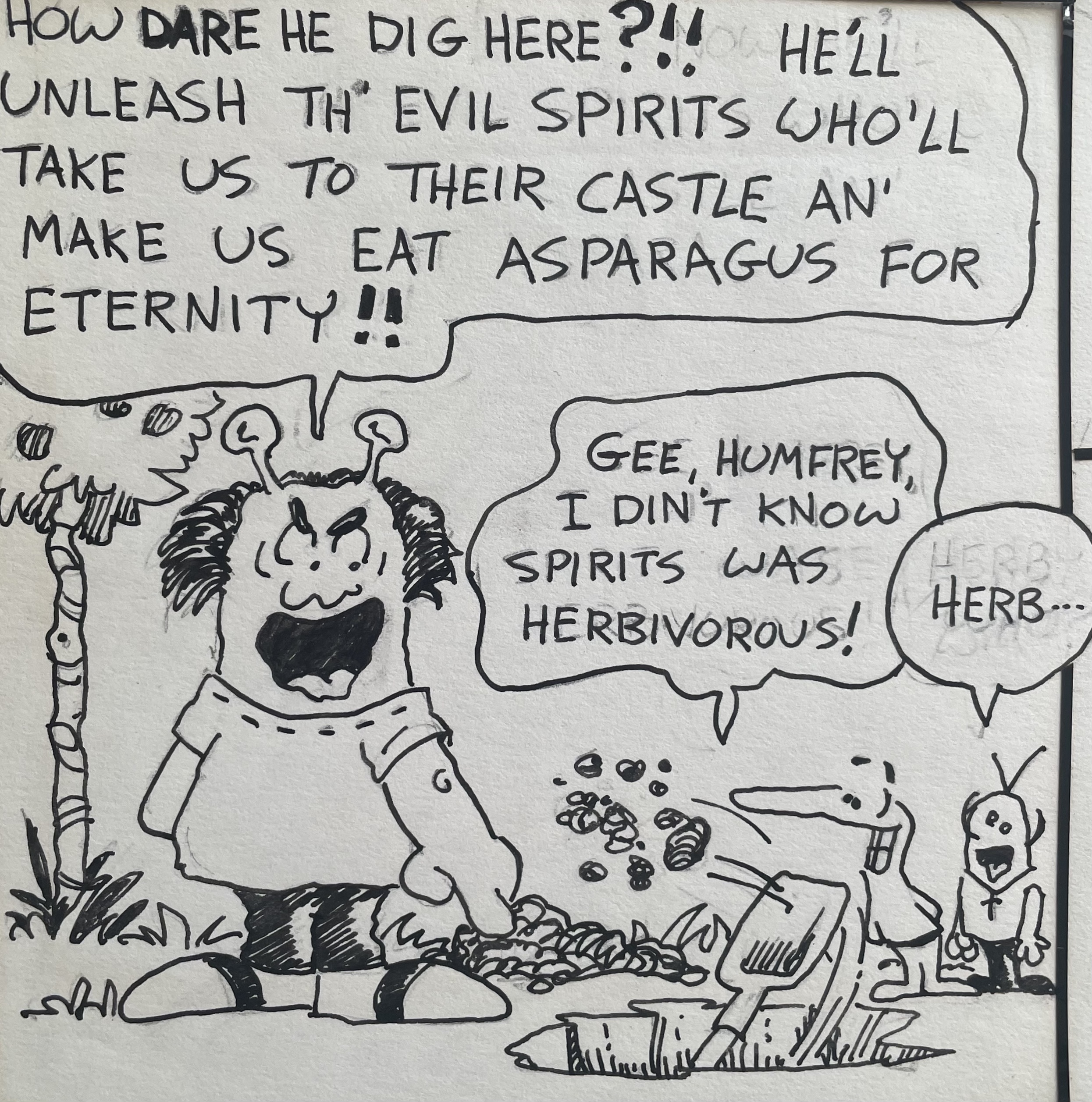
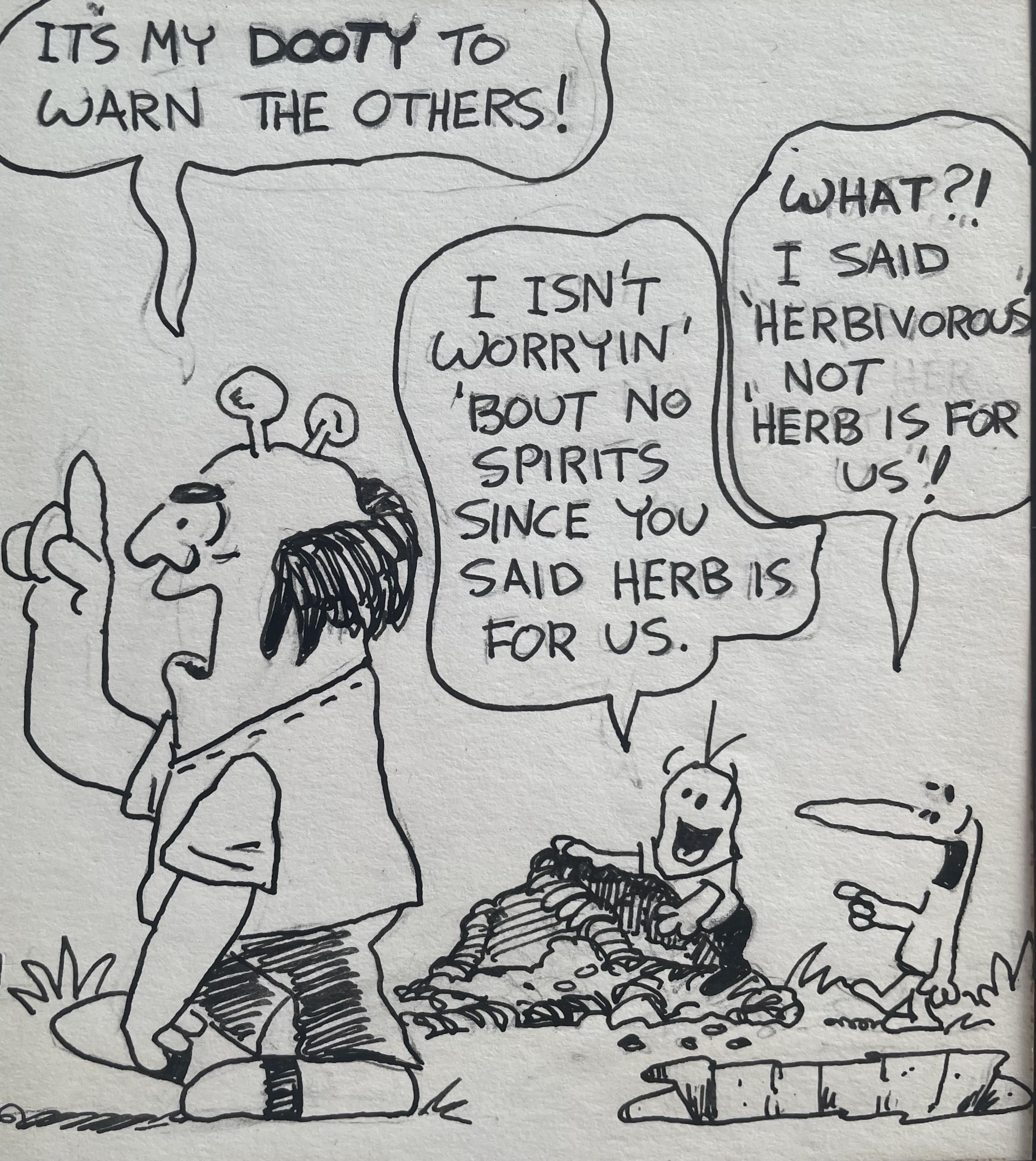
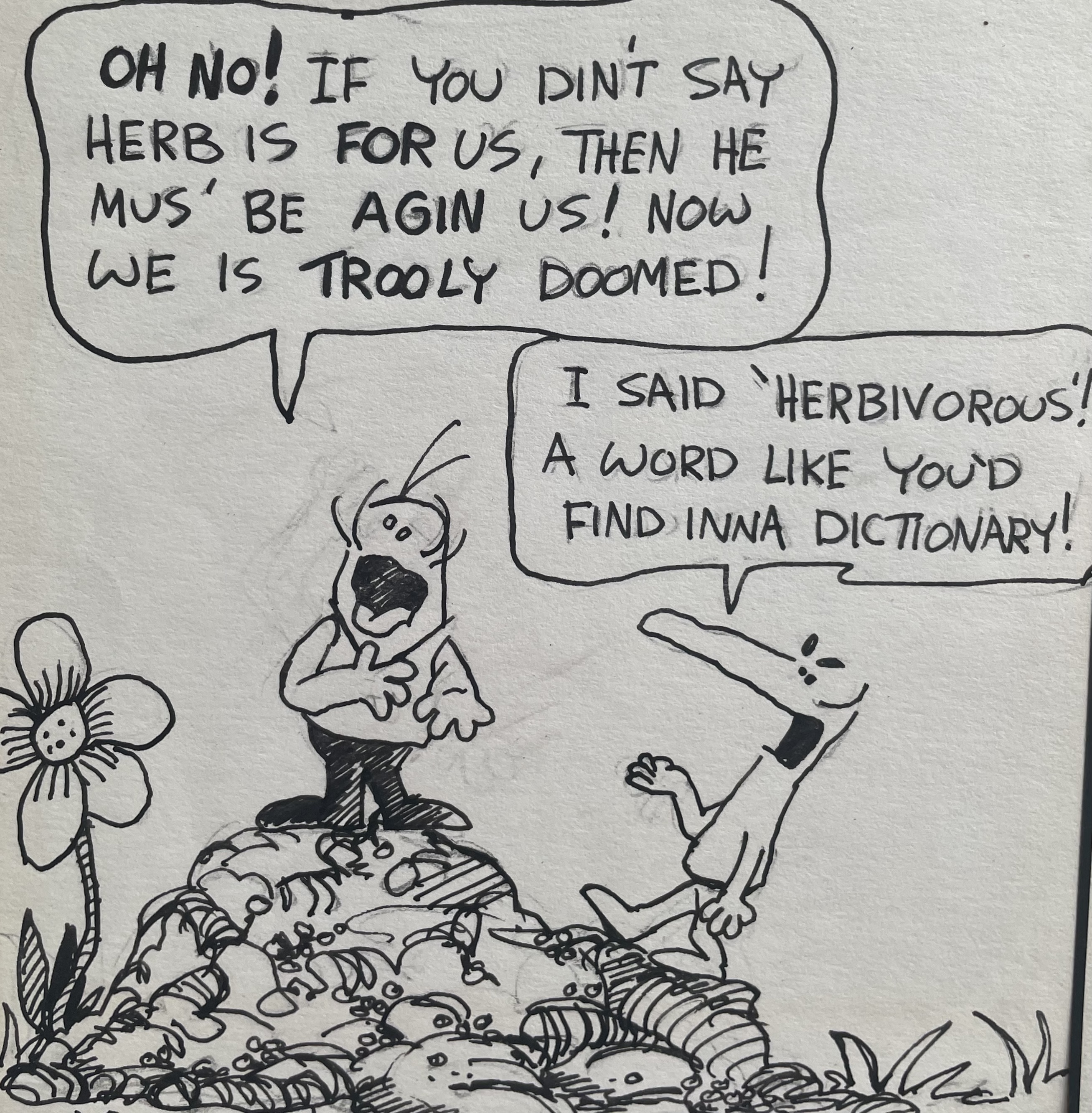
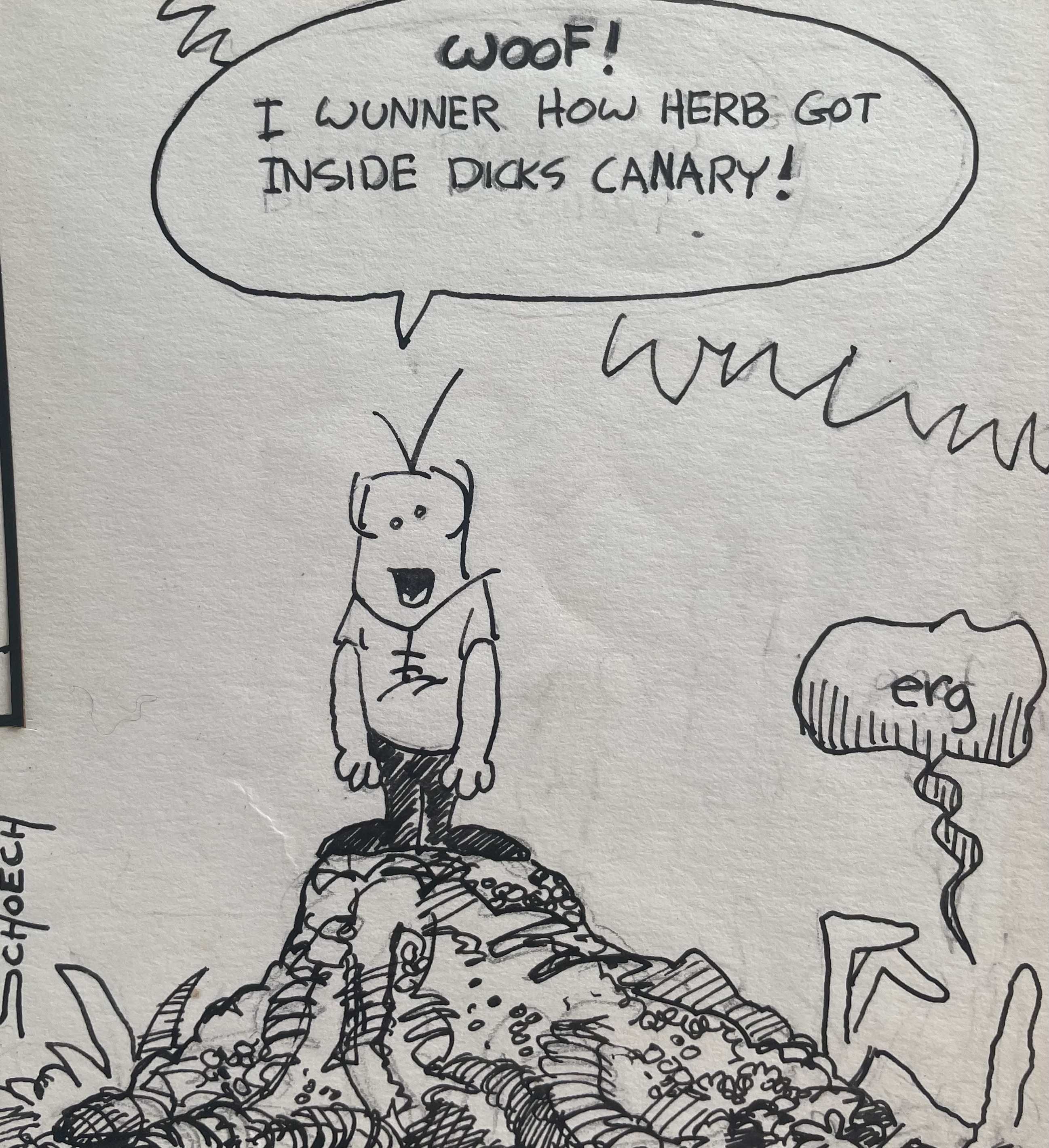
For more, start at The Lost Adventures of “Calloway the Castaway” Episode 1!
And come back next week for The Lost Adventures of “Calloway The Castaway” Episode 23 .

I’ve forgotten a lot of what I’ve read over the last few decades, but my forgetfulness seems to happen more for me with books written by famous old mystery writer John D. MacDonald than with other authors whose books I’ve read. Maybe there’s a formula in John D. MacDonald’s writing that makes his stories seem similar.
I’ve read a bunch of John D. MacDonald’s Travis McGee novels (pictured above), and I read them over a span of several years. It’s not like I binge read them so that all the stories ran together, but, even so, I don’t recall much about individual plots.
I remember that the sometimes investigator (when he needed the money) Travis McGee lived on his boat, and that in each novel a different woman was either staying with him on the boat or hanging around a lot. Sometimes the woman was directly involved with the plot. Sometimes she incidentally or accidentally got herself involved with the plot.
Sometimes it felt like the major female character was there just because the author John D. MacDonald needed a woman in the story. It’s possible to write a short mystery story without a major female character, but it’s a bad idea to try to write a mystery novel without one.

That’s all I remember. I seriously don’t remember any of the plots of these books. I know that I liked all the Travis McGee novels, especially their cynical commentary about American culture in the 1960s. Man, if only John D. MacDonald could only see what’s going on now!
I also enjoyed McDonald’s short story collection The Good Old Stuff because of its understated title. McDonald calls his writing ’stuff.’ He says it’s ‘good’ and doesn’t try to overhype it. He admits that it’s ‘old.’ Keep in mind that this book came out in 1982. 43 years ago, this stuff was ‘old.’ Now it’s really ‘old,’ but I don’t think the new edition is going to be named The Really Old Good Old Stuff.

I’ve read all of the stories in The Good Old Stuff, but I don’t remember any of them, except for one where a guy decides to murder his wife. He starts putting his plan into action, and everything he plans works out perfectly, so perfectly that he gets himself killed too.
“Death Writes the Answer”… THAT’s the name of that story (I just found it). It originally was published in May, 1950 in some pulp mystery magazine that is no longer in publication. If you’re mad that I spoiled the ending, there are 12 other stories in The Good Old Stuff that you can read. Then, since I don’t remember any of the other stories in the book, you can spoil the ending for me in the comments.

Just so you know, I’ve never planned on killing my wife. I always told my wife, though, that if she ever decides to kill me to please make it quick and don’t get caught. I’d be pissed if my wife murdered me and didn’t get to cash out on the life insurance. I’d rather my murderess wife keep the insurance money than for the insurance company to hold on to it. Insurance companies… what a scam.
But my wife isn’t planning to murder me. So if anything happens to me, it was an accident, I promise.
But enough about me! What do you think? Have you read any of John D. McDonald’s books? What books or book series have you completely forgotten about? Has your spouse ever tried to mur…. ? Never mind.
*****
I’m not “one of the world’s supreme storytellers,” but I’ve written one decent novel that people seem eager to talk about with me when they’re done reading.
A grammar-obsessed English teacher falls in ‘luuuvvv’ but discovers how chaotic and dangerous ‘luuuvvv’ can be.
The Sunset Rises: A 1990s Romantic Comedy
Get a signed copy of my one and only novel, The Sunset Rises: A 1990s Romantic Comedy. Free delivery in the United States!
$10.00
Or you can buy a copy here on Amazon!
Not sure? Read a sample chapter of The Sunset Rises: A 1990s Romantic Comedy.


 Dysfunctional Literacy