
Until recently, I thought that J.D. Robb was a male author. I mean, I didn’t spend a lot of time thinking about it. It was just an offhand assumption. When I found out that J.D. Robb was a female author’s pseudonym, I wasn’t shocked or outraged. I just thought it was a smart pen name.
First of all, Robb is a guy’s name. And when I think of J.D., I think of Jack Daniels. Almost every guy associates the initials J.D. with Jack Daniels. If you’re a woman who absolutely has to come up with a pseudonym that sounds like a dude, use a whiskey and a guy’s first name. That’s an important thing to know.
Secrets in Death is J.D. Robb’s latest mystery, and it’s okay so far. After a few pages, I haven’t learned any secrets and there hasn’t been any death, but none of that is necessarily bad. The only thing that has stood out so far is the word ass, and I don’t mean that in a pervertish kind of way.
In this opening scene, Lt. Eve Dallas (also a cool name) is entering a bar to meet a friend(?):
She stepped out of the noise and rush of downtown New York, into the fern –and-flower-decked noise of the trendy, overpriced drinking hole.
The bar itself, a dull and elegant silver, swept itself into an S curve along the facing wall. Mirrored shelves filled with shiny bottles backed it. On the top shelf exotic red flowers spilled out of the black-and-white checked pots.
Stools with black-and-white checked seats lined the front. An ass filled every seat while other patrons crowded in, keeping the trio of bartenders busy.
I don’t know. The word ass kind of seems out of place in this scene. Don’t get me wrong. I’m not offended by the word ass. I’ve written about the word ass a couple times on my blog. I even spell out ass completely. I don’t replace the a in ass to make it look like @ss. @sshole should be tinkered with a little bit, but ass is fine.
The thing is, the sentence with the word ass could easily have been reworded to make it less awkward.
All the seats were taken while other patrons crowded in, keeping the trio of bartenders busy.
“All the seats were taken” implies that a human being is sitting in each seat, which in turn means that an ass was placed on every seat.
I don’t think I’ve used the phrase “an ass filled every seat.” I’ve never walked into a crowded restaurant and thought/said “Those seat are filled with lots of asses.”
When offered a place to sit, I’ve never said, “I shall fill that seat with my ass.”
Maybe people talk like this and I just haven’t noticed. I’m trying to be a writer, an observer of the human condition, and I can’t believe I’ve missed a linguistic trend like this. As an aspiring author, I try to borrow the writing strategies of successful authors and try new things, so I’ll try using this expression in my own life.
When I continue to read Secrets in Death by J.D. Robb, my ass shall fill my recliner.
So far, Secrets in Death seems like an okay book. Some of the phrasing seems awkward though. I would mention it, but I don’t want to seem nit picky.
It’s been tough keeping up with the blog recently. Several rooms in my house (including the den) are getting worked on because of recent storm damage, so all my writing has to be done in a high-traffic room amidst television noise, teens arguing, and pets vying for attention.
Writing has been a struggle recently (more so than normal), but I’ve been following my system for blogging. Over the last few years, I’ve realized that when I follow my system, blogging doesn’t stress me out.
If anything, blogging keeps me from getting stressed out.

 (image via wikimedia)
If you’re writing a blog, it’s easy to find basic tips all over the internet. Leave comments on other blogs. Promote yourself with other kinds of social media. Use key words that show up on search engines. Become a credible source in a specific niche. Those tips can be useful, but some of them are time-consuming and can take the fun out of blogging.
I’ve been blogging for a little over 5 years, and I’ve noticed that a lot of writers who had blogs 5 years ago have either slowed down or no longer blog at all. I think some of them burned out because they were trying too hard to follow the usual guidelines, and doing all of that isn’t very fun. Self-promotion is time-consuming when you just want to write.
In my five years of blogging, I’ve accumulated lots of writing. I’m embarrassed by some of…
View original post 675 more words
Five years ago I made a list of bestselling authors who I thought were hacks. Almost all of these authors are still writing bestsellers, even those who are now deceased.
My favorite hack from five years ago is still alive and writing, but I won’t read his books anymore. I tried his new book a few months ago and I could have sworn I’d read it before, even though it had just come out. He’s still my favorite hack, though. I’ll always give him that.
 If you call a writer a hack, this is the response you might get. (Photo credit: Wikipedia)
“Is it just me, or has Stephen King become a hack?” I asked a bunch of my peers in a writer’s group a few years ago.
I’m often surprised at what makes people snap. I had figured that if I stayed away from politics and religion in my group’s post-writing-critique discussion, that we would be safe from any potential group-splitting controversy.
I was expecting an even-handed response (you know, because we writers have such stable personalities).
Instead, another writer snapped at me, saying, “Stephen King has forgotten more about writing than you’ll ever know.”
That was true, and it was kind of my point. Yes, Stephen King had indeed forgotten a lot about writing, and he was demonstrating that in his recent novels.
When I had started that discussion moments earlier, I was just asking…
View original post 831 more words
My youngest daughter’s first month of school has been relatively uneventful, but she’s noticed that a few teachers have bad speaking habits. One teacher casually uses the word ain’t while giving directions to the class. Another teacher keeps saying that assignments are due “on tomorrow.” She also has a librarian who pronounces the word library as “lie-berry.”
I have complete confidence that my youngest daughter goes to a very good school. And I’m not overly concerned about any of the common errors that these teachers are making with the English language.
Except ain’t. I’m pretty sure that a teacher shouldn’t say ain’t. I mean, I was taught that ain’t isn’t even a word.
But is it?
 If it’s in the title of a song, it has to be a word. (image via wikimedia)
40 years ago, nobody thought ain’t was a real word. After all, it wasn’t in the dictionary. At least, ain’t wasn’t in any of the dictionaries that we students looked in. The conventional wisdom back then was that if a word wasn’t in the dictionary, then it wasn’t really a word. It never occurred to me then that a dictionary could change its mind. Nowadays, if enough people start using words, then the dictionary will bend its judgement and include them, infuriating purists and grammarians everywhere.
If any non-word should become a word, it’s ain’t. I don’t have proof to back this up, but it’s probably been one of the most commonly used non-words over several generations.
In elementary school, I had a friend who used to say, “Ain’t ain’t a…
View original post 634 more words
Maybe calling this a quiz wasn’t a good idea. Some people get nervous when taking a quiz because it brings back unpleasant memories of school.
Don’t worry! There’s no grade involved and no judgement on my part. And the results are completely confidential, unless you choose otherwise.
Perhaps questionnaire would have been a better word.
 (image via Wikimedia)
Writing habits can explain a lot about your personality. Take the quiz below, keep track of the points as you go, and see what kind of writer (and human being) you really are!
A. When a commenter on your blog tells you that you suck, what do you do?
- Feel bad that the commenter didn’t like your writing.
- Feel proud that somebody cared enough to tell you that you sucked.
- You enjoy comments, but they don’t have any effect on you.
- Get mad and leave a “You suck!” comment on the commenter’s blog.
*****
B. When you get writer’s block, what do you do?
- Stare at the screen until you fall asleep.
- Write “I don’t know what to write” until you think of what to write
- Shrug your shoulders and go do something unrelated to writing.
- Throw a loud, profane fit.
*****
C. When your spouse/significant other tells…
View original post 635 more words
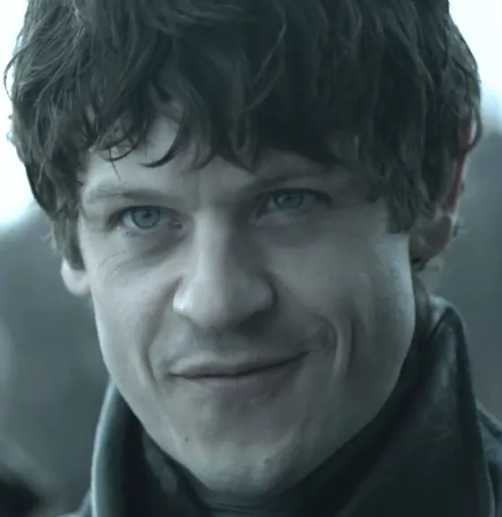
Even if you don’t watch Game of Thrones, this guy just looks like a bastard.
Saying the word bastard is fun. When I was a kid, I liked saying bastard, even though I didn’t know what it meant. I knew what most other forbidden words meant. I knew what the words shit, damn, and bitch meant, but I didn’t know what a bastard was. It had to be pretty bad, I thought, because I wasn’t supposed to say it. I believed at the time that bastard was the male version of bitch. Maybe a bastard was even a male dog. Then I found out what a bastard really was.
What a disappointment.
I was surprised that such a cool sounding insult wasn’t very insulting.
Technically, a bastard was a guy who was born out of wedlock. The word was considered an insult because in the old days, bastards couldn’t inherit anything, and in a society built on a strict class structure, that was a big deal. Non-bastards would look down upon bastards because non-bastards were socially superior. Today we would call that non-bastard privilege.
Man, those non-bastards used to get all the breaks.
When I call somebody a bastard, I don’t mean it literally. I usually have no idea what the guy’s background is. I’m just using the word bastard because the guy did something I didn’t like and I’m tired of using other derogatory terms like dick or @sshole. If I had to rank them, I’d probably put bastard between dick and @sshole, with @sshole being the worst, and dick being the least offensive. A dick is somebody who’s a little worse than a jerk. A bastard was a dick who deserved two syllables. An @sshole was somebody who is completely out of control.
I can’t find my definitions anywhere else, so it’s not official. It’s just the way that I see things.
When I was growing up, bastard was seen as the male version of bitch. If you called a girl a bitch (which I don’t condone), you weren’t really calling her a dog. It was just the go-to insult. You could call a guy a son of a bitch, but sometimes the guy was just a dick but you knew his mom was okay so you didn’t really want to insult the mom by calling her son a son of a bitch. So you called him a bastard. Even if it wasn’t literally true.
Maybe bastard shouldn’t really be a bad word, or even an insult. A guy can’t help it if he’s a bastard. It’s not a character flaw. Maybe those old-timer European elitist snobs thought being a bastard was a character flaw, but most people don’t care. I just like saying the word.
I’d hate to say the word bastard in front of somebody who might be sensitive about it, though. I’m sure it’s happened, and I just don’t know about it. I guess I should stop saying the word bastard, just in case that situation come up. I don’t want to hurt anybody’s feelings.
But bastard is such a fun word to say. Bastard! Bastard! Bastard!
Ugh, this is going to be a tough habit to break.
*****
Hey, look what I’ve finally done after ten years of blogging: I’ve written a novel!
The Kickstarter campaign for my one-and-only novel The Sunset Rises: A 1990s Romantic Comedy has begun, and it’s going pretty well for a book written by a literary nobody like me.

Please check it out at The Sunset Rises: A 1990s Romantic Comedy and consider supporting!
I’ve started reading a bunch of books over the last few months, but I haven’t finished many of them. It’s not that all of the books were bad. Only a couple of them were stinkers, but between my job and my family and my other hobbies, it’s tough to find the time to finish every book I begin.
But I wasn’t always like this.
 This was as close as I got to finishing Moby Dick. (image via Wikimedia)
When I first started reading, I took pride in finishing every book I started. In elementary school, I finished Harold and the Purple Crayon, even though Harold was getting out of control. In middle school, I finished The Winds of War and War and Remembrance, even though I was being mocked for carrying big books around the school (they were WAR books, I explained… luckily, I had a copy of Massage Parlor II that kept me from getting beat up). In high school, I finished Noble House, despite having to read a bunch of Willa Cather books in my English class. In college, I finished reading The Mists of Avalon, even after my girlfriend broke up with me for calling it a “woman’s book.”
But somewhere along the way, I lost my passion…
View original post 848 more words
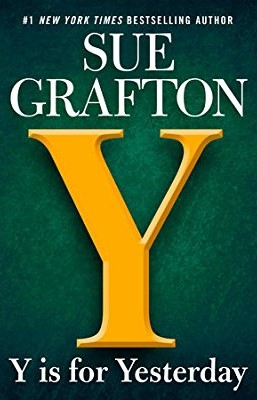
25 years ago, I never believed Y is for Yesterday by Sue Grafton would ever get published.
I’d better clarify that.
When I first heard of Sue Grafton’s alphabet series back in the early 1990s, I thought it was a dumb idea. After all, the alphabet has 26 letters, and that meant there would be 26 books with the same detective, Kinsey Millhone. I was reading B is for Burglar, and I thought it was pretty arrogant for an author to assume she could get 26 books out of the same character when she was only on her second novel in the series.
That just shows you what I know. It’s over 25 years later, and Sue Grafton is on her 25th book in the series. I don’t know if all the books are good because I’ve only read a couple of them. I remember that I enjoyed parts of the books, but I thought there were too many details about her characters’ personal lives and habits, and sometimes unnecessary details slowed down the story.
Again, that shows you how much I know. Her die-hard fans love the details about her characters’ habits and personal lives. Those details separate her novels from the countless other detective novels out there, I guess. Sue Grafton’s fans will defend her when a blogger like me criticizes her for writing about too many mundane details about her characters’ habits and personal lives.
I wish I had fans like that. I’m jealous. Even James Patterson fans don’t defend him like Sue Grafton’s fans will defend her. I respect an author who has fans like that.
Anyway, about Y is for Yesterday. The beginning is different from the other Kinsey Millhone books I’ve read. Usually the action focuses on the detective as she solves the case (and does a bunch of other stuff that has nothing to do with the case). In contrast, Y is for Yesterday starts off 10 years earlier than the rest of the story at a private school and focuses on a girl who is not Kinsey.
After the prologue, though, Grafton goes back to her usual prose, giving us a lot of descriptions about Kinsey Millhone’s everyday life and background. Here she even describes the habits of her 89-year-old landlord, Henry:
In the interest of conservation, Henry had stripped his backyard of grass, which left us with dirt, sand, and steppingstones. Henry’s two Andirondack chairs were arranged in conversational range of each other on the off chance we might want to enjoy a late afternoon cocktail as the sun went down. This was never the case. I didn’t want to sit contemplating barren packed earth, which doesn’t promote relaxation in my humble opinion. His potting bench and gardening gloves were superfluous and the row of larger tools he’d hung on the side of his garage- shovels, wood-handled garden forks, and pruning shears- had been unused for so long the spiders had spun webs and now lurked in ominous arachnid tunnels in hopes of snagging prey. Henry’s cat, Ed, seemed to look on the backyard as one big litter box and he made use of it every chance he could- one more reason to avoid the area.
That’s not bad writing at all. But Grafton’s books have the reputation for using lots of seemingly unnecessary descriptions. To be fair, there isn’t much like that in the prologue or first chapter. So far, the novel moves at a decent clip, faster than some of her other books.
Even though Y is for Yesterday was published in 2017, it takes place in 1979 and 1989. I wonder how difficult it is writing about those time periods without using anachronisms. I grew up in the 1970s, and I have false memories of me checking my cell phone all the time as a kid, even though I know I’ve only had a cell phone for about ten years. It might be easier to write about the 1800s than it is about the 1980s because there’s no way you’ll accidentally put a cell phone in an 1800s story, unless you’re writing steam punk.
I know Sue Grafton isn’t going to have Kinsey Millhone carry around a cell phone in 1989, but it would be cool if she did. It would probably help her solve the case more quickly. And it would make the everyday descriptions of Kinsey Millhone’s personal life and habits more interesting.
Even though there’s a bunch of crazy stuff going on around the world and in all our personal lives, I’m excited because today is the first full day of the NFL season. I won’t be able to sit down and watch the games (because of all that crazy stuff), but I’m still glad that the games are on.
Despite all the problems with football (concussions, off the field behavior, etc.), I still think it’s a great sport, and I’ll defend the game of football to the bitter end.
 Cheerleaders might be a great reason to watch football, but they don’t make the top six list! (Photo credit: Wikipedia)
The same thing happens every autumn. Football season begins, and my intellectual friends wonder why I spend so much time watching it instead of reading books and writing schlock. I don’t wear face paint or get into drunken brawls, but I’ll flip channels and go split-screen to watch several games at once, and I’ll yell and curse even though I’m usually a quiet guy. This puzzles my intellectual friends. I’m supposed to be a smart guy (I think I still have most of them fooled), yet during football season, I don’t always show it.
So every fall, instead of hiding my love for football, I defend it by trying to explain what makes (American) football so awesome. At first, it was difficult to explain. I couldn’t find the words except for…
View original post 946 more words
The movie It is getting some good reviews, and that almost surprises me. I remember the 1980s when almost every movie based on a Stephen King book would suck. Even though the Stanley Kubrick/Jack Nicholson version of The Shining is seen as a cult favorite now, back when it came out, most people thought it was too campy.
I wouldn’t say The Shining movie sucked, but it had its issues. I cringed at the “Heeeeeeeere’s Johnny” moment when I first saw it, while the rest of the audience was laughing. Too many kids today know “Heeeeeere’s Johnny!” from The Shining, but they don’t know who Johnny Carson is. At least they know “Heeeeeeere’s Johnny.”
Anyway, Cujo the movie wasn’t very good. Christine the movie was bleh. Children of the Corn? Haha!
I remember It was a decent TV mini-series from the early 1990s. I remember John Ritter was in it, but that’s about it which is fine because I don’t remember if I’ve even read It or not. It’s about time somebody made a good version of It. It deserves it, even if I don’t remember reading it.

Sometimes I read books from decades ago just to see if they’re as good as I remember them. I’d like to do that with It by Stephen King, but I don’t remember reading it. I had it in my house for a long time. I remember looking at it. I remember some friends talking about how great It was. But I don’t remember reading It.
I remember enough about The Stand to know that I’ve read it. I remember enough about The Shining to know that I’ve read it. But It? I don’t know.
I think It was the book that ruined clowns. That’s too bad. Before It, clowns were still kind of socially acceptable. They were annoying, but there wasn’t quite the universal hatred for them.
Back then before It, everybody hated mimes instead of clowns. Mimes were way worse than clowns. Mimes wore the…
View original post 521 more words


 Dysfunctional Literacy