A prominent politician has made news in the last couple days by by by publishing a letter to her teenage self . I don’t want to mention that politician’s name because people either love her or despise her and I don’t want to start a political spat with anybody.
I know, however, that writing a letter to your teen self is a bad idea. I tried it a few years ago, and wow, did it backfire!!

 (image via Wikimedia)
I’ve noticed recently that a lot of people are writing letters to themselves in the past. Usually, the letters are to their teenage selves because the teen years are almost always pretty rough. The letters are meant to be encouraging, I guess, or to offer advice, and I remembered my teenage self. He had some social issues and self-esteem issues and there was some family stuff going on, so he could have used some encouragement from his future self.
As intrigued as I was about writing a letter to my teenage self in the past, I knew I had to be careful with it. I didn’t want the letter to be very specific. There was a slight chance that my teenage self would read it, and any information that could change my past behavior might lead to incalculable alterations in history or cause a butterfly effect. If there’s one…
View original post 1,017 more words
I’m not above reading the occasional self-help book, but they usually don’t do me much good. The problem is that I never remember any of the advice after I’ve read the book. What good is a self-help book if I forget everything after I’ve read it?
It’s okay if I forget everything in a novel because that means I can read it again a few years later and be entertained. But a self-help book is worthless if I can’t remember the advice.
That’s why I stick with How To Win Friends & Influence People by Dale Carnegie. If I’m going to forget self-help advice, I want to forget the best!
 If the cover says it’s “the only book you need to lead you to success,” that’s good enough for me!
Just so you know, I didn’t decide to read How to Win Friends and Influence People by Dale Carnegie because I needed some self-help. Well, I might need help, but if I ever read a self-help book because I actually need help, I’m not going to admit that to anybody.
When I was a kid in the 1970s, the big self-help book was called I’m Okay-You’re Okay. That title rubbed me the wrong way because it implied that everybody was okay and even then I knew a lot of people who weren’t okay. I wasn’t even sure I was okay. Maybe the author and I disagree about what “okay” means. I’ve never read the book to find out. Sometimes I think I’m better off if my opinion is uninformed.
View original post 831 more words
“Should I read this?” my daughter asked, pointing to an obscure book with a drab cover of a snow man with a vulgar carrot sticking out.
She was looking for a book at B&M Booksellers and was wandering around aimlessly in the Fiction/Literature section. She used to complain about me doing the same thing, but I didn’t remind her of that.
“I know that book!” I exclaimed. I almost mentioned that I had written about it on my blog once, but she hardly ever reads my blog, and I wanted to keep it that way. We writers have more creative freedom knowing that family members, friends, and coworkers won’t read anything we put on our blogs.
“This?” she said. “You know this book?”
“He cheated to get it into book stores,” I said. “It’s a long story.”
The idea of me telling her a long story scared her off, and she moved along to find another book. But I still have the blog post I wrote.
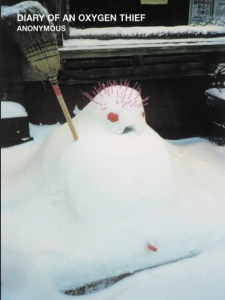 Sigh! Some snowmen will do anything for attention.
There are a lot of ways to cheat when you’re trying to sell a book. You can put cleavage (or a hot shirtless guy) on the cover. You can put profanity in the book title. You can put a humorous vulgar image on the cover. You can give yourself a gimmick pen name, or you can even pretend to be the opposite gender.
I’m not saying that cheating is wrong when it comes to selling a book. New authors have to do what it takes to grab readers’ attention, so I don’t have a problem with an independent author cheating to sell books. I call it cheating because these gimmicks often have nothing to do with the quality of the book, but the cheating isn’t necessarily bad.
The book Diary of an Oxygen Thief by some guy named Anonymous took a…
View original post 745 more words

For as long as I can remember, atheists have been trying to convince me there is no God. That’s okay, because all my life I’ve been going to church and have been immersed in religion, so it’s good to have some balance. I don’t talk about religion much, mainly because it’s personal and I don’t care about other people’s spirituality. I mean, I care, but I don’t start debates about it.
In Origin by Dan Brown, a character claims to have found proof that the teachings of all religions are “dead wrong.” When I read the character’s dramatic statement, instead of being intrigued, I thought, there’s Dan Brown being Dan Brown. And it brought back some pleasant literary memories.
After books like The DaVinci Code and Angels and Demons came out 10-15 years ago, there were a bunch of message board arguments about the accuracy of Brown’s books. For those of you who aren’t old enough to remember, before Facebook and YouTube, internet trolls argued about stuff on message boards that various media sites had. The arguments (usually about trivial matters) were nasty and vicious, and eventually most of the message boards were removed.
I didn’t participate in the online arguments about Dan Brown, but I read a few of them. I never knew which self-proclaimed experts were really experts. Most likely, none of them were because experts usually don’t resort to name-calling on message boards. But the arguments made for fun reading.
I didn’t take any of the arguments seriously. After all, I don’t get my history from historical novels. I don’t form my political views from documentaries. And I take everything I read in a Dan Brown novel with a grain of salt. I treat everything like a fantasy; in his world, everything he writes is true. That way, I can stay out of all the arguing about DaVinci and God and science and religion.
But I do like researching the locations that Brown writes about in his books. In this age of the internet, I don’t have to rely on the words that Dan Brown uses. And that’s good because sometimes his words are inadequate. That’s not a knock on Brown. He chooses some stuff that is difficult to describe. For example, in Chapter 1 of Origin, he describes The Guggenheim Museum in Spain:
Professor Robert Langdon gazed up at the forty-foot tall dog sitting in the plaza. The animal’s fur was a living carpet of grass and fragrant flowers.
I’m trying to love you, he thought. I truly am.
I’m trying to love the descriptions in this book. I truly am. But that’s a fairly lame description of something that could have been interesting. I’m not good at descriptions, so I can’t offer any suggestions. Maybe I shouldn’t criticize if I can’t do any better, but that’s what critics do.
Like I said, I don’t blame Dan Brown. This giant dog is art. It’s difficult to describe art. That’s why it’s art. Art depicts something that is difficult/impossible to put into words. But a giant jigsaw puzzle of flowers that form the shape of a dog should be verbally more interesting than what Brown came up with. Here’s another:
A towering black widow spider rose before him, its slender iron legs supporting a bulbous body at least thirty feet in the air. On the spider’s underbelly hung a wire-mesh egg sac filled with glass orbs.
Again, giant spiders are cool. How can a professional author NOT come up with a cool description of a giant spider? I mean, I know the book is about to get into that proof that the teachings of all the religions are dead wrong. But still, it’s a giant spider. The giant spider deserved so much more.
One last thing. It’s tough to read a Dan Brown novel starring Professor Robert Langdon without picturing Tom Hanks. I’ve never even seen the movies. I read the books before the movies came out. Even so, I still picture Tom Hanks. That might just be me. I picture Tom Hanks when I read a lot of books. The last time I tried to read Moby Dick, I pictured Tom Hanks. I think I was supposed to picture Gregory Peck.
I accidentally ordered an ebook on my Amazon Kindle. I had meant to download a sample but instead hit the purchase button. At first, I was ticked off, but then I remembered that I could get a refund, so everything worked out just fine. Even though I might end up buying the book, I’d like to know if I’d enjoy it first.
That’s one way to ruin a good book, to unknowingly spend money on it and then getting mad later.
 (image via wikimedia)
Finding a good book to read can be difficult, but ruining a good book for somebody else is easy. It’s so easy that excited readers usually don’t realize they’re destroying somebody else’s pleasant experience. There are probably dozens of ways to ruin a good book for somebody else, but here are (the top?) five:
Spoiling the Ending
When I was reading The Iliad in junior high (by choice… 30+ years ago), some wiseacre tried spoiling it by telling me the Greeks won the war. I smugly replied that I already knew that. Then the spoiling wisacre revealed to me that The Iliad doesn’t go all the way to the end of the war. I couldn’t believe it! I cheated and read the final chapter where Achilles returns Hector’s body to Peleus, and I was shattered. I was really looking forward to reading about the Trojan Horse.
Maybe
View original post 862 more words
“Ugh, I’d rather read Ulysses than this,” I said, turning away from my computer.
My coworkers stared at me. They know I hate the long-winded jargon that I was skimming through, but nobody commented on my reaction to it.
It might have been my monotone voice. Or maybe they don’t know what Ulysses by James Joyce is. It’s kind of an obscure book and somewhat difficult to read. If I had said “I’d rather read Moby Dick than this,” I’d probably have gotten a laugh.
Instead, I got nothing. It was that kind of day.
 I should have known from the cover that this book wasn’t about Roman mythology.
When it comes to reading classic literature, there are a lot of challenges. The writing style from novels published generations ago can confuse today’s readers. Some of the books have lots of references that today’s readers don’t understand. And a lot of those classic novels are just too long for our short attention spans. Any one of those challenges can deter people like me from trying a book. But when a novel is challenging on every level, I know I’m screwed.
The worst of all of these classic novels might be Ulysses by James Joyce. I don’t know if Ulysses really is the worst of all the tough classic novels because I haven’t read most of the tough classic novels. I’ve been told it’s not fair to judge a book that you haven’t read, but I…
View original post 967 more words
A reader just caught a mistake on a blog post that I wrote a few days ago. It kind of ticks me off because I stared at that post for a long time before I actually put it on the blog, and I still didn’t catch the mistake until it was pointed out to me. It was a weird grammar rule that few people know about and is hardly ever used, but I understand the basics of it and should have noticed the error.
Anyway, even though I have a job that has nothing to do with reading and writing, I’m pretty good at both. Even so, I have a tough time with grammar sometimes.
At least I know I’m not alone.
 Don’t let them fool you. They struggle with grammar just like the rest of us. (image via wikimedia)
English grammar can be tough. Even people who enjoy reading and writing have a difficult time getting all the rules right. When I was in college, I got careless with a composition and messed up a bunch of “its” and “it’s.” My writing instructor admonished me, saying I couldn’t be successful in a writing profession by making basic mistakes.
At the time, I knew the rules, but I also knew I had a tendency to get careless, so I ended up going into a profession that has nothing to do with writing. It’s my fault I didn’t choose a writing profession. But almost everybody struggles with grammar, so if I blame grammar for my problems, almost everybody will agree with me.
Below are five perfectly good, rational reasons that explain why English grammar is…
View original post 863 more words
There’s a Decade Day at my oldest daughter’s school next week, and she’s deciding how to dress up. She’s leaning toward the 1980s or 1950s, but I think she’s missing out on the best decade.
If I ever get to dress up for Decade Day (I think I’ve aged out of these things), I know which one I’d choose. It’s a no-brainer.
I’d dress up as the ugly 1970s.
 Maybe “ugly” isn’t the right word, but everybody knows what I mean. (image via wikimedia)
It’s tough to explain the fashion sense of the 1970s to my daughters. Whenever they watch a movie from that decade, they cringe and say something like, “How could they wear that?” or “What made them think that looked good?”
Every decade has a reputation. The 1950s were cool because of Elvis, Marilyn Monroe, and a bunch of tuff cars. The 1960s had the counter cultural stuff with The Beatles, The Rolling Stones, and lots of drugs. They were cool too. But the 1970s? That decade still had the drugs, but those came with ugly hair, bell bottoms, weird color combinations, and big collars. None of that is cool. And it was kind of ugly.
There was some good music from the 1970s, but you don’t look at music, at least you didn’t in the 1970s. …
View original post 673 more words

When I was in college, a girlfriend broke up with me because of Interview with the Vampire by Anne Rice. This girlfriend had a lot of great qualities, but she was a bit tyrannical over the books I read. She always strongly suggested books like The Mists of Avalon and The Handmaid’s Tale, and she flipped out when I was reading a Stephen King book.
She finally broke up with me when I told her that Interview with the Vampire sucked. Looking back, I don’t think I meant it. I mean, I was tired and cranky at the time, and I wanted to read my own books, so I told her that Interview with the Vampire sucked, and I gave her a Mack Bolan book and a football magazine (with a hot chick in a bikini on the cover) as my suggested reading. I admit, my humor needed refining, and she broke up with me.
The thing is, I don’t remember if Interview with the Vampire really sucked or not. I’ve been wanting to read it again without the bias I once had, and now is a good time. My wife doesn’t care what I think of Interview with the Vampire, so it’s probably safe for me to review now.
After a chapter or so, I can say that the book itself is a lot easier to read than I thought it would be. Anne Rice can get kind of wordy sometimes. I’ve stopped reading a couple of her more recent books (”recent” as in the last 20 years), and there seem to be lots of long paragraphs with sentences that took a lot of words to not say much. Or maybe that was my original bias.
Here’s a section that I MIGHT have thought sucked back in the 1980s, a section where the vampire was discussing his transition:
“My last sunrise,” said the vampire. “That morning, I was not yet a vampire. And I saw my last sunrise.
I remember it completely; yet I do not think I remember any other sunrise before it. I remember the light came first to the tops of the French windows, a paling behind the lace curtains, and then a gleam growing brighter in patches among the leaves of the trees. Finally the sun came through the windows themselves and the lace lay in shadows on the stone floor, and all over the form of my sister, who was still sleeping, shadows of lace on the shawl over her shoulders and head. As soon as she was warm, she pushed the shawl away without awakening, and then the sun shone full on her eyes and she tightened her eyelids. Then it was on the table where she rested her head on her arms, and gleaming, blazing, in the water in the pitcher. And I could feel it in my hands on the counterpane and then on my face. I lay in the bed thinking about all the things the vampire had told me, and then it was that I said good-bye to the sunrise and went out to become a vampire. It was… the last sunrise.”
I don’t remember what approach I used to criticize the novel back in the 1980s. If I were to criticize it today, I’d point out that the author used the word gleam twice in one paragraph and that an editor should have asked for a synonym. I was taught to avoid repeating the same desriptive word, even if it was vampire dialogue. I don’t know. I think using the same kind of word like gleam/gleaming twice in one paragraph is fair criticism, but it’s not enough to say that the book sucks.
Interview with the Vampire is okay, I guess. I don’t like admitting it. The writing isn’t tedious. The story is interesting enough. As far as I know, it was original for its time. I probably shouldn’t have told my ex-girlfriend that it sucks.
I just told my daughter that Ragged Dick was the little-known sequel to Moby Dick. Ragged Dick is on her school’s recommended classic literature reading list, and I guess she was too lazy to look it up herself, so I decided to see how far I could take my explanation.
In Ragged Dick, I said, the injured whale escapes to a nearby island where it befriends a lonely boy. The lonely boy helps nurture the whale back to health (renaming it Ragged somewhere in the 8th chapter, I think). Of course, some local whalers find out about Ragged and try to hunt it down, but the boy and whale work together and the whale escapes.
Nothing. My daughter seemed to think nothing that I said was implausible. I guess she hasn’t read enough classic literature.
Then I said that in order to raise money to keep the whale healthy, the boy staged a musical to save the whale and a bunch of celebrities like Mark Twain AND Edgar Allen Poe pitched in. That was my daughter’s breaking point.
Next time, I think my daughter will look up the book herself. I hope my daughter doesn’t develop any trust issues with me over this.
 Everybody knows what Moby Dick looks like, so… here’s Ragged! (image via wikimedia)
It’s probably not fair to classic literature that word meanings change over time. Nobody laughed when Moby Dick by Herman Melville or Ragged Dick by Horatio Alger, Jr. came out. I mean, I wasn’t around back then, but I’m pretty sure people didn’t laugh.
It’s not that people were more sophisticated in the 1800s. It’s just that Dick was only a name back then. I’m also pretty sure if “dick” had meant back then what it means right now, people would have laughed. Nowadays, if you want your book to be taken seriously, you don’t put “Dick” in the title.
I’m not the kind of guy who compares Dicks very often, but I’ll do it for the sake of literature. Moby Dick was published in 1851 and was supposedly a commercial failure when it came out. Ragged…
View original post 616 more words