The Underground Railroad by Colson Whitehead is kind of an impressive book. It was a New York Times bestseller. It won the Pulitzer Prize for Fiction in 2017. It even has an impressive array of positive reviews on the back cover.
I’m reluctant to buy books because I rarely finish reading them anymore, but when I found a cheap copy at a used bookstore, I bought it. After all, it won a Pulitzer. Even if I didn’t like the book (I don’t always enjoy Pulitzers), I could find somebody else who’d appreciate it.
I actually finished reading The Underground Railroad, so that’s something. On the other hand, it took me more than six weeks to read it. I’m not that slow of a reader. I just didn’t feel like reading The Underground Railroad sometimes. And my reaction to the book was much different from those whose positive reviews ended up on the back cover of the book. For example:
*****
Oprah Winfrey wrote: “Kept me up at night, had my heart in my throat, almost afraid to turn the next page.”
I wouldn’t go that far. The Underground Railroad didn’t keep me up at night. I thought the author Whitehead didn’t write tension very well. Scenes that should have been riveting weren’t. Even though the book moved at a pretty good pace, I rarely felt suspense while I was reading. Maybe there was some suspense at the end of the chapter in North Carolina and toward the end when the reader finds out what happened to Mabel. Even worse, the Tulsa-like slaughter felt like it was written by a tired author going through the motions.
*****
People (magazine) wrote: “A great adventure tale teeming with memorable characters…“
I disagree. It was a decent adventure with a couple memorable characters, but most of them had very little personality. They were very courageous, or very smart, or very evil. Even the protagonist Cora didn’t have much personality, except maybe she was stubborn and very determined, but those aren’t memorable character traits for a major character in a major novel. Homer was probably the most memorable character; at least he was the only character who wasn’t predictable.
*****
Michiko Kakutani of The New York Times wrote: “He (Colson Whitehead) has told a story essential to our understanding of the American past and the American present.”
That’s a bit overstated, especially if the reader believes that the Underground Railroad was literally an underground railroad. A reader should have a lot of background knowledge before reading The Underground Railroad; if not, the reader could get really confused about what happened when in United States history, especially during the South Carolina section of the novel.
The literal underground railroad itself wasn’t used as much as I thought/hoped it would be. The concept of a literal underground railroad was cool. The idea of it carried me through what I thought was a lackluster opening. Once it was introduced, the underground railroad was underused, especially at the abrupt end.
The Underground Railroad won the Pulitzer Prize for Fiction, so maybe there’s something that I’m missing in this book. I’m not saying it should NOT have won a Pulitzer Prize because I haven’t read the other nominees, and I’m not the type of blogger who’ll read other nominees just to see if the winner deserved it. However, I think it was at the very least overrated.
*****
What do you think? If you’ve read The Underground Railroad, what am I missing? Was Cora meant to be uninteresting? Was she interesting and I was just expecting too much? What other highly regarded books do you think are overrated?
*****
Here’s my own book! It can’t be overrated because it’s barely even been rated.
It’s the oldest story in the world, 1990s style!
Man meets woman; man falls in “luuuvvv” with woman; man gets blindsided by reality!
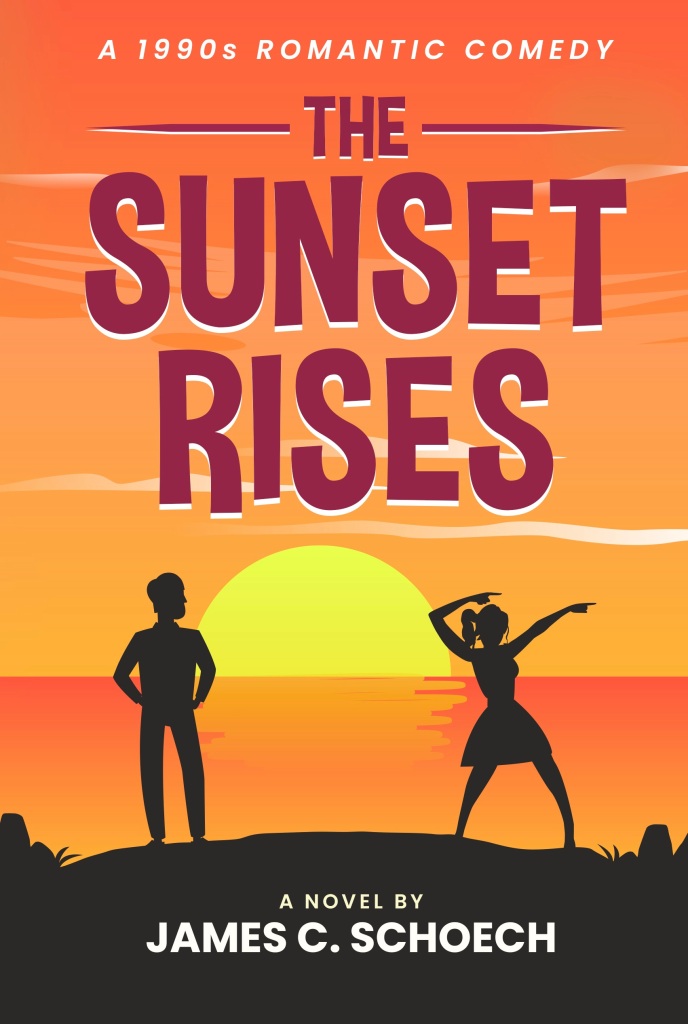
The Sunset Rises: A 1990s Romantic Comedy is now available on Amazon !

The Merriam-Webster Dictionary claims that the word pandemic is the 2020 Word of the Year. It probably doesn’t matter much. The word pandemic doesn’t receive anything for being Word of the Year, except for a little bit of extra attention, which is unnecessary because pandemic has already received a lot of attention this year.
When it comes to Word of the Year, nobody actually receives an award or anything. And unlike a lot of awards, the standards for Word of the Year seem to be objective. Dictionaries (or the people who run them) judge Word of the Year, not by how much they like a word, but by how often a word is researched online.
At least it isn’t a bunch of dictionary word geeks sitting around and debating which words qualify and which don’t.
*****
Sometimes a single word defines an era, and it’s fitting that in this exceptional—and exceptionally difficult—year, a single word came immediately to the fore as we examined the data that determines what our Word of the Year will be.
Based upon a statistical analysis of words that are looked up in extremely high numbers in our online dictionary while also showing a significant year-over-year increase in traffic, Merriam-Webster’s Word of the Year for 2020 is pandemic.
The first big spike in dictionary lookups for pandemic took place on February 3rd, the same day that the first COVID-19 patient in the U.S. was released from a Seattle hospital. That day, pandemic was looked up 1,621% more than it had been a year previous, but close inspection of the dictionary data shows that searches for the word had begun to tick up consistently starting on January 20th, the date of the first positive case in the U.S.
Read more at Word of the Year 2020 | Pandemic.
*****
I prefer to choose my words of the year by how often I hear words used in casual conversation (so I guess I’m a word geek after all). From my own anecdotal, nonscientific evidence, I think the Word of the Year for 2020 is…
SUCKS.
I probably heard the word sucks and said the word sucks more frequently than any other word in 2020.
Here are some common examples:
“2020 sucks.”
“COVID-19 sucks.”
You get the idea. I know the word sucks has been used more frequently than any word on Merriam-Webster’s list. The problem with sucks is that it’s always been used a lot, even before 2020, but it seems that sucks usage has been way up this year.
To be fair, I liked a lot of 2020, but some people aren’t ready to hear about positive stuff right now. So in keeping with what I think should be the 2020 Word of the Year…
The word pandemic sucks!
*****
What do you think? What do you think the criteria should be in judging the Word of the Year? What do you think the 2020 Word of the Year should be?
A famous political figure author made news last week by donating 105,000 digital copies of his book to high school students and teachers in his home city.
This might be a cool idea, giving digital copies of his book away. It saves paper. It means students wouldn’t have to spend money on his book.
Then again, maybe high school students don’t give a flip about his book. Maybe the school district could have used copies of other books that are in high demand or in the curriculum.
May be the author thinks too highly of himself if he thinks high school students really want to read his book. They might like an autographed copy, but digital?
Since the author involved is a major political figure, most people will form their opinions based on their personal politics rather than the author’s actions.
I’m wondering, when a famous (or even struggling) author gives away copies of his/her books, is it a form of genuine giving or is it an act of narcissism? I actually don’t know, so in the excerpt below, I’ve removed the names. If you had no political bias, what would you think?
And if you have no political bias, what do you think?
*****
High school students and teachers at City Public Schools received an email Monday morning that didn’t tell them exactly who would be at their virtual assembly that afternoon but gave some strong hints: The speaker had “strong ties to city,” “millions of Twitter followers” and “made history multiple times throughout their career.”
Hours later, those who tuned in to the live-streamed assembly were greeted by famous author, who surprised districts’ 105,000 high schoolers and thousands of teachers with free digital copies of his new book, “Title.”
Read the unedited version and more at Obama, in surprise appearance, gives 105,000 CPS students free digital copies of ‘A Promised Land’ .
*****
What do you think? Is giving away digital copies of your book really an act of giving? Or is it narcissism? Would you give away 105,000 copies of your book (if you could afford it)? How many free copies of your books could you afford to give away?
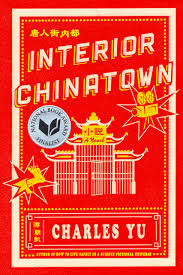
Interior Chinatown by Charles Yu has just won the 2020 Nation Book Award for Fiction. I appreciate literary awards because without them I would miss out on a bunch of award-winning books that I’ve never heard of.
Even though I read (or skim through) a lot of books, the beginning of Interior Chinatown threw me off because it’s written in 2nd person.
*****
Int Golden Palace
Ever since you were a boy, you’ve dreamt of being kung Fu Guy./ You are not kung Fu Guy/You are currently Oriental Guy Making a Weird Face, but you’ve been practicing./Maybe tomorrow will be the day.
*****
The risk of opening in 2nd person is that the reader can deny the opening statement and stop reading:
Author: Ever since you were a boy, you’ve dreamt of being Kung Fu Guy.
Reader: No, I haven’t. (Gets annoyed, slams book shut, returns book to shelf)
Sigh! As a reader, I probably should go further to see what this narrator guy is talking about. A few pages later, the author/narrator explains how difficult it is for him to get a decent role in movies/television.
*****
Roles
First you have to work your way up. Starting from the bottom it goes:
- Background Oriental Male
- Dead Asian Man
- Generic Asian Man Number Three/Delivery Guy
- Generic Asian Man Number Two/Waiter
- Generic Asian Man Number One
and then if you make it that far (hardly anyone does) you get stuck at Generic Asian Man Number One for a while and hope and pray for the light to find you and when it does you’ll have something to say and when you say that something it will come out just right and have everyone in Black and White turning their heads saying wow who is that, that is not just some Generic Asian Man, that is a star, maybe not a real, regular star, let’s not get crazy, we’re talking about Chinatown here, but perhaps a Very Special Guest Star, which for your people is the ceiling, is the terminal, ultimate, exalted position for any Asian working in this world, the thing every Oriental Male dreams of when he’s in the Background, trying to blend in.
Kung-Fu guy.
Kung Fu guy is not like the other slots in the hierarchy-…
*****
And then the narrator talks some more about Kung Fu guy. The author/narrator’s obsession with kung fu threw me off a little bit because I thought nobody cares about kung fu anymore. Maybe 10, 20, 30, or 40 years ago, but not now. When was the last time a kung-fu movie hit it big in the United States? Is it even a stereotype anymore?
If the author is making a point about Hollywood’s stereotyping, then part of me is… so what? All demographic groups complain about how they’re portrayed in Hollywood.
They’re not wrong. It’s just that everybody already knows that media relies on stereotypes, and I don’t need a novel (a form of media) pointing it out in the first few pages. From my point-of-view (a guy who doesn’t give a flip about actor problems), knowing the character first might have gotten me more interested in the book. But who am I to judge? The book just won an award.
Good job, Kung Fu Guy wannabe. Winning a National Book Award beats being Kung Fu Guy any day.
What do you think? Would you rather be Kung Fu Guy or win a major book award? How much of a book written in 2nd person can you read before you start denying the stuff the narrator is saying about you?
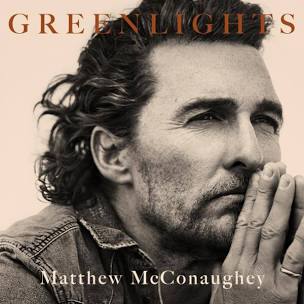
Fans of famous actor Matthew McConaughey have a few reasons to buy his memoir Greenlights . Matthew McConaughey seems like a cool guy. I’d rather read a book written by a cool guy than one by a guy who comes across as a dick. McConaughey has photos of him going shirtless, so some of his fans will like that.
Plus, he tells a bunch of stories from his childhood. Everybody likes reading about childhood stories, as long as they’re funny and not too preachy.
McConaughey mentions that he used to get his mouth washed out with soap. I don’t think parents do that to kids anymore, but it was common back in the 1970s when McConaughey and I were growing up. When I mention getting my mouth washed out with soap, my daughter doesn’t believe me. She would be shocked that this happened to a celebrity like Matthew McConaughey too.
People will believe Matthew McConaughey, even though he has the word Con in his name. He even has the word Hey in his name. It’s almost like his last name is warning everybody that he’s a con. That’s not hiding in plain sight; that’s actually plain sight. But people will believe him anyway.
Anyway, here’s the mouth washing out excerpt from Greenlights:
*****
I got my mouth washed out for saying “shit,” “damn,” and “fuck,” but I only ever got into real trouble for the using or doing of the words that could harm me. Words that hurt. The words that helped engineer who I am because they were more than just words; they were expectations and consequences. They were values.
My parents taught me that I was named my name for a reason.
They taught me not to hate.
To never say I can’t.
To never lie.
*****
If you like that kind of writing, you’ll probably like Greenlights. If you don’t like that kind of writing but still like shirtless pics of shirtless Matthew McConaughey, you don’t need to read Greenlights as long as you have the internet.
And here’s an excerpt from my own ebook Crap Is NOT a Bad Word, where I also mention getting my mouth washed out with soap (But I don’t have pictures of me shirtless).
*****
Getting your mouth washed out with soap is a lot worse than it sounds. It happened to me a few times when I was a kid, and I don’t have the words to describe it. It was just pretty bad.
It started when I said the crap in front of my mom. When she told me not to say the word crap, I said it again. Then she warned me that if I said crap one more time, she’d wash my mouth out with soap. I weighed my options. How bad could soap be? I liked saying the word crap. So I got in my mom’s face and said the word crap, and she dragged me to the bathroom and shoved a lathery bar of soap into my mouth. After I sputtered and gagged and spit, I vowed that I would never say the word crap again, at least not in front of my mom.
*****
If you like that kind of writing, you’ll probably like Crap Is NOT a Bad Word.
But enough about me! What do you think? What childhood punishments from the past seem really weird today? Would you read Matthew McConaughey’s book if it hadn’t been written by Matthew McConaughey? Would you read Matthew McConaughey’s book even if it didn’t have pictures of him going shirtless?

It’s amazing how many books dead people can get published. 25 years ago, I used to resent L. Ron Hubbard because he was dead and still seeming to get a new book published every year. I was resentful because I was trying to get a book deal and couldn’t, and I saw this dead guy getting new books published all the time.
Being resentful was stupid, I know; at least I was still alive (and still am).
J.R.R. Tolkien has been dead for a while too, but now he has a new book coming out. It’s been a while since Tolkien has had a new book out, and I appreciate Tolkien more than I do Hubbard, so I’m not resentful at all.
*****
After all these years, there’s still more to learn about Middle-earth. On Thursday, Houghton Mifflin Harcourt announced they will be publishing what they describe as a “previously unseen” collection of writings by The Lord of the Rings author J.R.R. Tolkien. This new volume will be titled The Nature of Middle-earth.
HMH VP and publisher Deb Brody describes The Nature of Middle-earth as “a veritable treasure-trove offering readers a chance to peer over Professor Tolkien’s shoulder at the very moment of discovery.”
“For him, Middle-earth was part of an entire world to be explored, and the writings in The Nature of Middle-earth reveal the journeys that he took as he sought to better understand his unique creation,” Brody said in a statement.
Read more at New collection of J.R.R. Tolkien’s writing coming next year.
*****
There’s a part of me that thinks an obsession with world building is a waste of time. I’m not talking about a story or a book series about a fantasy world. I’m talking about volume after volume of fake history.
There’s a lot about real history that I don’t know. Before I spend hours learning about a fantasy world, I’d rather learn about a real culture that I know nothing about. To be honest, I rarely go out of my way to learn about new cultures, but I never go out of my way to learn about fake histories.
The thing is, I don’t even trust our own history books. I’m pretty sure history books on Earth are filled with distortions and outright lies. If the Tolkien estate found a Middle-earth history book buried in the attic that claimed The Lord of the Rings was a lie, that the Hobbits created Bilbo and Frodo to give Hobbits undeserved credit in the war against Sauron, then I’d read that book. I might even pay full hardcover price for that book.
Who would you believe? The Lord of the Rings? Or Tolkien’s newly-found manuscript that claimed The Lord of the Rings was a lie? That would be a Middle-earth history book worth reading!!
*****
What do you think? Am I being a little harsh with world building? What fake world would you be most willing to learn about?
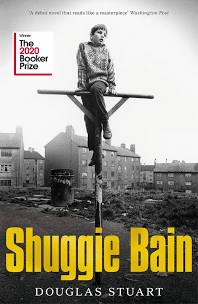
Most Americans don’t know much about the Booker Award. That’s okay because most Americans don’t know much about American literary awards either.
When I heard that Shuggie Bain by Douglas Stewart won the 2020 Booker Award, I didn’t ask “What is the Booker Award?”
I asked, “Who is Shuggie Bain? Or what is a Shuggie Bain?”
That’s the problem with novels titled after their main characters. If readers aren’t interested in the name, they might not be curious enough to read the book. I didn’t read Emma by Jane Austen because I didn’t care who Emma was. The same with Jane Eyre by some woman who was not Jane Austen. I cared about Dracula by Bram Stoker and Frankenstein by Mary Shelley because I already knew who they were.
But Shuggie Bain? Yeah, I didn’t care.
But since I’m a book blogger (kind of), I try to keep up with stuff pertaining to literature, so I began reading a sample of Shuggie Bain: Here, in the first couple pages, the narrator describes his relationship with three co-workers when he was around 16 years old early in the first chapter:
*****
In truth, the girls were three middle-aged Glasgow women. Ena, the ringleader, was a rake-thin, poker-faced woman with greasy hair. She had no eyebrows to speak of, but she did have a faint mustache, which seemed unfair to Shuggie. Ena was rough even for this end of Glasgow, but she was also kind and generous in the way hard-done-to people often are. Nora, the youngest of the three, wore her hair scraped tightly back and held in place with an elastic band. Her eyes, like Ena’s, were small and sharp, and at thirty-three she was mother of five already. The last of the group was Jackie. She was different to these other two in that she very much resembled a woman. Jackie was a riotous gossip, a big, bosomy sofa of a woman. It was her that Shuggie liked best.
He sat down near them and caught the ending to the saga of Jackie’s latest man. It was guaranteed that the women were always full of good-hearted patter. Twice now they had taken him along on their bingo nights, and as the women drank and howled with laughter, he sat amongst them like a teenager who couldn’t be trusted to stay home alone. He had liked the way they sat easily together. How their bulk surrounded him and the softness of their flash pressed to his side. He liked how they fussed with him, and although he protested, how they pushed his hair from his eyes and licked their thumbs to wipe the corners from his mouth. For the women, Shuggie offered some form of male attention, and it did not matter that he was only sixteen and three months. Under the La Scala bingo tables they had each tried at least once to brush against his…
*****
WHAT? I try to keep this blog family-friendly, so… let’s just say they weren’t still brushing his hair. It seemed a bit out of place, and I thought maybe the narrator would drop the subject, but…
*****
The strokes were too long, too searching…
*****
And I stopped there. I’m no prude; I wrote Best Porn Jokes Ever!! But I’ll stop there.
I’ll admit that Shuggie Bain seems to be well-written, but that was a little too much for me at the beginning of the book. I wasn’t invested enough in the character to read about stuff like that yet.
I guess that’s the problem with books named after the main character; it’s probably going to be exclusively about that character, and I just didn’t want to keep reading about that kid.
****
Enough about me! What do you think? Would you use your main character’s name for your book title? At what point do you stop reading a novel that won a prestigious award?
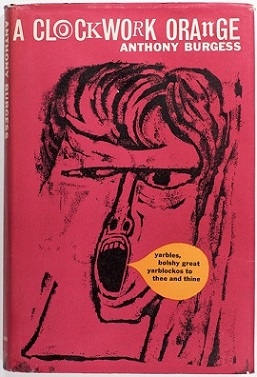
A Clockwork Orange has a reputation of being a disturbing movie, but the novel by Anthony Burgess is controversial for a different reason: the United States version of the novel is missing the final chapter.
I haven’t read A Clockwork Orange, not because it’s disturbing, not because it’s missing a 21st chapter, but because the novel relies on a fake slang language (called Nadsat) throughout. Too much fake slang language can be distracting to me.
Creating a fictional language is a cool gimmick for a novel or short story, but I’m not a fan of learning a new language just to read a book. If I’m going to put the time and effort into learning a language, I want to apply it after I’ve learned it. Yeah, I’m interested in the 21st chapter of A Clockwork Orange, but I don’t want to slog through 20 chapters of a slang language just to get to it.
Below is an excerpt from the first page of A Clockwork Orange. Maybe somebody will write a translated non-slang version:
*****
“What’s it going to be then, eh?”
There was me, that is Alex, and my three droogs, that is Pete, Georgie, and Dim, Dim being really Dim, and we sat in the Korova Milkbar making up our rassodocks what to do with the evening, a flip dark chill winter bastard though dry. The Korova Milkbar was a milk-plus mesto, and you may, O my brothers, have forgotten what these mestos were like, things changing so skorry these days and everybody quick to forget, newspapers not being read much neither. Well, what they sold there was milk plus something else. They had no license for selling liquor, but there was no law yet against prodding some of the new veshches which they used to put into the old moloko, so you could peet it with vellocet or synthemesc or drencom or one or two other veshches which would give you a nice quiet horrorshow fifteen minutes admiring Bog and All His Holy Angels And Saints in your left shoe with lights bursting all over your mozg. Or you could peet milk with knives in it, as we used to say, and this would sharpen you up and make you ready for a bit of dirty twenty-to-one, and that was what we were peeting this evening I’m starting off the story with.
*****
What do you think? Does A Clockwork Orange rely too much on its fake language? Am I a lazy reader for not wanting to check an appendix to translate a fake language while reading one (and only one) novel?

Most sequels suck for a variety of reasons. Some sequels are too much like the original book and seem pointless. On the other hand, some sequels deviate too far from the original and piss off the fans. Some sequels are rushed because the author wants to publish it while the original is still in the public’s mind, and the sequel comes out poorly written. Some sequels ruin beloved characters established in the first book.
At any rate, it’s tough to write a good sequel.
Now famous author Ernest Cline is writing a sequel to his best selling novel Ready Player One. So far, the title seems to be… Ready Player Two.
The gimmick in Ready Player One was the bombardment of references to 1980s pop culture. I enjoyed the first chapter of Ready Player One because it focused on Robotron, my favorite video game of the early 1980s.
Even though I like Robotron, I didn’t finish reading Ready Player One. And I didn’t see the movie either. I heard the movie didn’t mention Robotron at all.
Despite my distrust of sequels, the writer in me is interested in an author’s perspective in writing one. Below is an excerpt where Ernest Cline discusses writing a sequel to Ready Player One::
*****
The sequel picks up a little over a week after the first book ends. Then there’s a gap of time, but it all kind of flows out of the first story. It’s that trick of a sequel where you don’t want to tell the same exact story again, but you want to give fans similar elements that made the first story a success. I think I successfully did that in a very different story that takes place over a different time span than the first book, but it has all the same characters, and some new characters and I also built on the characters’ backstories, and it also builds on the technology and the world.
Read more at ‘Ready Player Two’ author Ernest Cline on returning to the Oasis .
*****
Now that I think about it, I’m not sure the title Ready Player Two reflects what the sequel will be like. The term ready player two usually means the guy competing with whoever is ready player one. A book titled Ready Player Two would logically be about Ready Player One’s competition. Instead, Ready Player Two seems to have the same protagonist as Ready Player One.
I don’t know. Maybe I’m overthinking it.
What do you think? What makes a good sequel? What makes a bad sequel? Does the title Ready Player Two make sense if the it has the same protagonist as Ready Player One playing a different game?

When Bright Lights, Big City by Jay McInerney came out in the 1980s, it was a big deal because the author was a young New Yorker who wrote a novel in the second person point-of-view. Plus, it was a novel about drugs and New York and debauchery, and maybe the author knew what he was talking about, so his book was a literary hit.
This book has always rubbed me the wrong way. When I wrote a short story in second person for my fiction class in the 1980s, the professor mocked me for the attempt, saying it should never be done. A few months later, this Jay McInerney guy got applauded for doing the same thing I did, except in novel form. I wanted to take a copy of Bright Lights, Big City and rub it in the professor’s face, except the semester was over.
To be fair, my short story might have sucked. Bright Lights, Big City might have sucked too. Here’s an excerpt from the first paragraph:
*****
You are not the kind of guy who would be at a place like this at this time of the morning. But here you are, and you cannot say that the terrain is entirely unfamiliar, although the details are fuzzy. You are at a nightclub talking to a girl with a shaved head. The club is either Heartbreak or the Lizard Lounge. All might come clear if you could just slip into the bathroom and do a little more Bolivian Marching Powder. Then again, it might not. A small voice inside you insists that this epidemic lack of clarity is a result of too much of that already. The night has already turned on that imperceptible pivot where two A.M. changes to six A.M. You know this moment has come and gone, but you are not yet willing to concede that you have crossed the line beyond which all gratuitous damage and the palsy of unraveled nerve endings. Somewhere back there you could have cut your losses, but you rode past that moment on a comet trail of white powder and now you are trying to hang on to the rush. Your brain at this moment is composed of brigades of tiny Bolivian soldiers. They are tired and muddy from their long march through the night. There are holes in their boots and they are hungry. They need to be fed. They need the Bolivian Marching Powder.
*****
Yeah, this could get old really quickly. Plus, the spell can get broken with one moment of reader denial.
Book: “Your brain at this moment is composed of brigades of tiny Bolivian soldiers.
Reader: “No, it isn’t. This is stupid. (Reader slams book shut and places it back on shelf.)
I don’t remember much about my second person point-of-view short story in the 1980s, but I know my paragraphs were shorter, and I got straight to the point. Maybe my short story didn’t suck after all.
*****
What do you think? Does second person point-of-view work for you in fiction? How many books about New York debauchery can you read before it gets old?