Maybe “Aaarrrgh!” is too strong of a word. “Ugh!” might be better, especially since I knew this was going to happen. I was hoping it wouldn’t, but I figured it would. Supposedly, it happens to every self-published author.
Anyway, I’ve been flipping through my ONE novel, The Sunset Rises: A 1990s Romantic Comedy , which I self-published a couple weeks ago, and I’ve found several little errors.
I’m kind of annoyed because I spent a lot of time looking closely at my writing before I published my book. I even hired an editor, and the editor missed a few things. I can’t blame the editor, though, because I’m a retired English teacher, and I’m supposed to know what I’m doing when it comes to editing.
In my defense, the errors that I’ve spotted might not be considered a big deal. I haven’t spotted any misspellings. I haven’t noticed any missing words or weird inconsistencies with the formatting.
Here’s what I’ve noticed… so far!
- Two missing commas (not on the same page), both when there are paired adjectives that can be reversed.
- Misusage of an uncommon word (but not so uncommon that a reader would think of it as uncommon).
- A couple incorrect past-perfect tense uses. Professional writers misuse past-perfect tense all the time, though. I think some authors don’t even know what past-perfect tense is.
I’m a little embarrassed by the mistakes because the narrator is a grammar-obsessed English teacher, and here he goes making mistakes that he would mentally criticize others for making. Then again, the main character is kind of a prick sometimes, so maybe this will be a humbling experience for him.
I’ll be honest: it hurts my ego too. I promise that I’m not as grammar-obsessed as my main character, and I really hope that I’m not as much of a prick as he is, but I guess I’ll never really know. I don’t get to decide whether or not I’m a prick, and people who know me probably wouldn’t tell me if I am one.
Just so you know, online comments telling me that I’m a prick don’t count.
So, here’s my ONE novel. Overall, I’m okay with it, except for a couple missing commas, a couple past-perfect verb tense errors, and a slightly incorrect use of a word. At least, that’s all I’ve found so far.
*****
A grammar-obsessed English teacher falls in ‘luuuvvv’ but discovers how chaotic and dangerous ‘luuuvvv’ can really be.

The Sunset Rises: A 1990s Romantic Comedy is now available on Amazon !
Or you can get a signed copy directly from me!
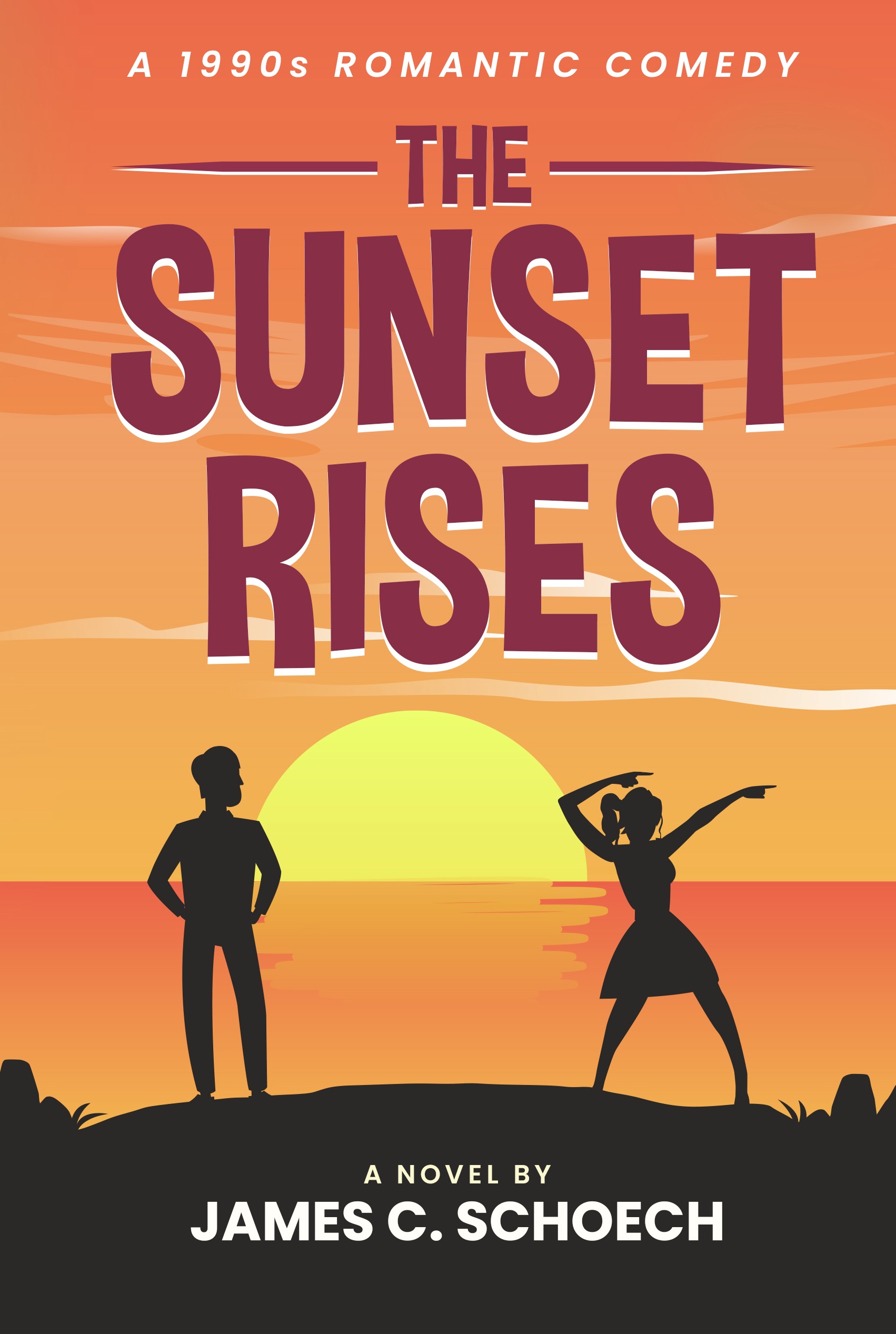
The Sunset Rises: A 1990s Romantic Comedy
Get a signed copy of my one and only novel, The Sunset Rises: A 1990s Romantic Comedy. The price includes USPS media rate shipping in a sturdy box. My signature is legible, but I’m left-handed, so I might smudge it sometimes. I usually mail out the book within two business days of payment.
$20.00

First of all, I want to apologize to famous author Edgar Allan Poe. I’m using a well-known picture of him because he’s dead and hopefully won’t care if I’m using his bad picture as an example. When I’m dead, I won’t care if somebody pulls out all my bad photos from the closet and uses them as examples either. Edgar Allan Poe looks drunk and depressed in this picture, but he supposedly was drunk and depressed a lot.
I wonder if Edgar Allan Poe got mad when he saw the above portrait. Did he want it redone? Or maybe he was drunk when he saw it and thought he looked great. Maybe he did look great by 1850 standards. From what I understand, people didn’t smile for pictures back then. Maybe that was a typical 1850 smile. I wasn’t around back then, so I don’t know.
I mention Edgar Allan Poe’s bad portrait because I took a lot of pictures a few weekends ago. At least, a lot of photos of me were taken that weekend when I went to a parents’ event at my daughter’s college campus , and it was a lot of fun, but, damn, my daughter and her friends wanted to take a lot of pictures.
Even though a few of the pictures we took with our phones came out pretty good, for every good picture we took, my daughter and I deleted at least 10. A 10-to-1 ratio in the old days of photography would have been horrible. It’s great that today we can delete bad pictures of ourselves, but it hasn’t always been like that.
For most of my life, you could only take one picture at a time with our old cameras. Taking a picture used to be a lot of pressure because you had only one chance to get it right. One muscle tic in your cheeks, a mistimed closed eye, or a tingle in your nose, and you were screwed. Back then, we would pose, not knowing if our heads were tilted at the best possible angle. We couldn’t tell if our faces were doing what we thought our faces were doing.
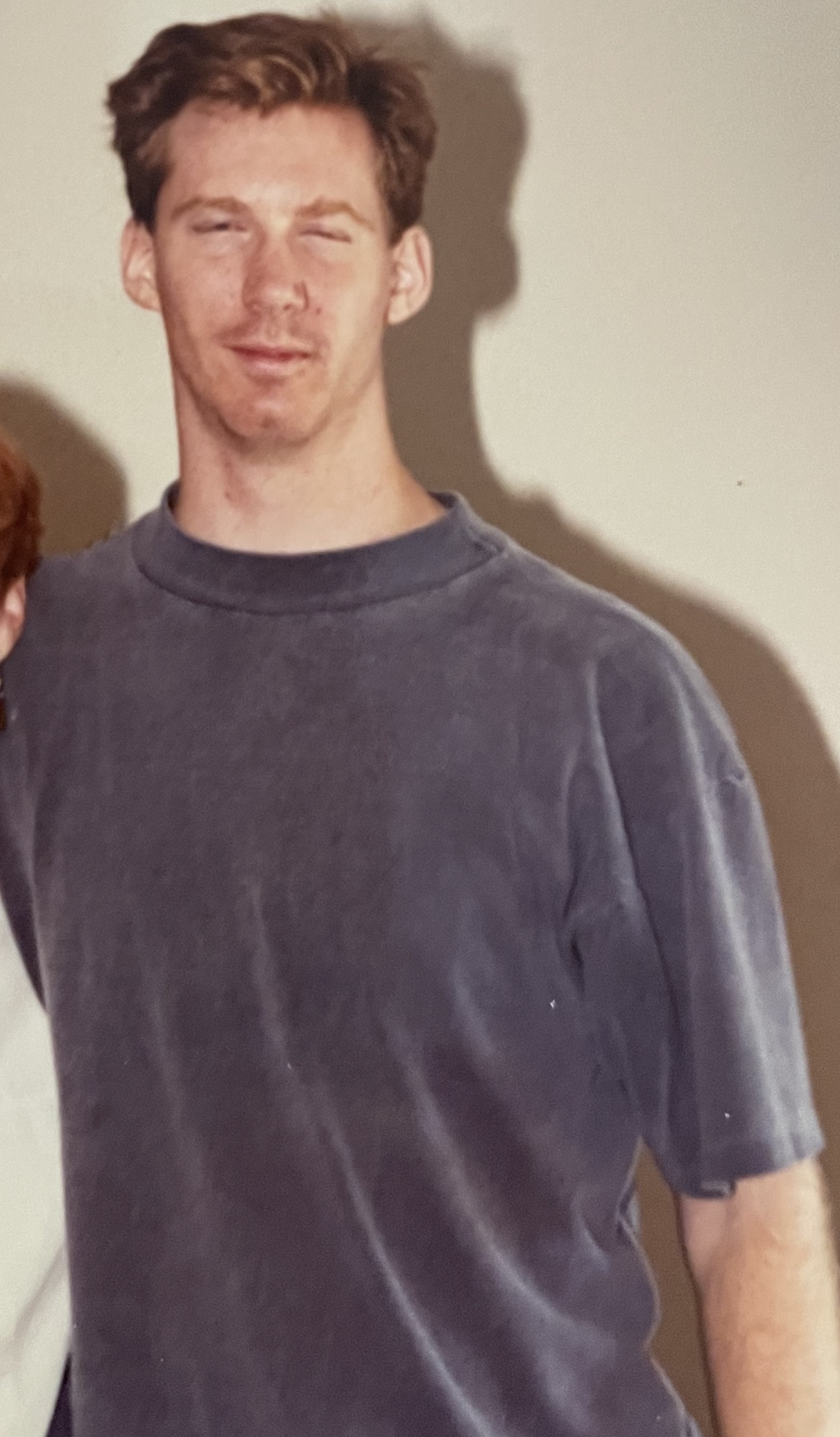
That was a problem because I usually took lousy pictures. I often had my eyes closed. Or I was looking the wrong way. Or I looked drunk. I made Edgar Allan Poe look good. I can sympathize with Edgar Allan Poe because I look drunk in a lot of my old pictures, but at least I looked like a happy drunk.
Taking a bad photo could be traumatizing. Family members and friends would mock you for imperfections in pose or facial expressions. You couldn’t just rip the pictures up because that wasn’t fair to other people in them. Yeah, sometimes people destroyed photos they didn’t like, but it was wrong to do because photos were so rare.
When we took pictures with developed film, we would wait days or weeks before we could see how we messed up our faces. We would take bets over who screwed up the photos the most. Then there were the instant photos. You could do retakes with the instant photos, but the film was limited. And most of the time you weren’t taking pictures of yourself, so you didn’t care if somebody else had a drunken expression. You only cared if it was you.
Now I can relax a little since I know I can get rid of any photo that turns out flawed. Most of my current pictures show me smiling like a normal person. I didn’t have to get surgery or go to a psychologist. I just needed the chance to take as many photos as possible before I got a decent shot.
*****
A few years ago when my parents passed away, I rediscovered a bunch of scrapbooks filled with pictures taken over the last 80 years. Some of the photos were yellowed and disintegrating. Others were remarkably preserved. I noticed that a lot of people in my family looked drunk, but they were often holding various cans, bottles, and glasses in the pictures, so they actually could have been drunk.
I think they had the right idea, holding alcoholic drinks while taking photos. Alcohol, even if you’re not drinking it, takes the stress out of posing. From now on, I think I’ll hold an empty beer can whenever I have to take a picture in public. Then everybody who sees it will remark that I look amazingly sober for a drunk guy.
*****
For more “Old Things That Are Tough To Explain,” go to Old Things That Are Tough To Explain: The Home Page.
*****
After more than ten years of blogging, I’ve finally written a novel.
A grammar-obsessed English teacher falls in ‘luuuvvv’ but discovers how chaotic and dangerous ‘luuuvvv’ really can be.
The Sunset Rises: A 1990s Romantic Comedy is now available on Amazon and from the trunk of my car at various local bookstores… until parking lot security kicks me out. Buy it now while supplies last!

You might have heard the complaints about the latest batch of kids, Generation Alpha. Gen. Alphas are lazy, according to my teacher friends and acquaintances. They can’t read. They’re addicted to technology. They whine all the time. They just inherently suck.
Complaining about other generations is nothing new. For years, it was Boomers complaining about younger generations like Millennials and Gen. Z being lazy and too sensitive, and younger generations complained about Boomers being selfish and benefiting from a post-war economy that has since been ruined by Boomer debt. Hardly anybody complains about Gen. X (Boomer-lites), but that’s only because nobody knows about us. Thank you, Boomers!
But Generation Alpha? Everybody f***ing hates Generation Alpha.
Personally, I have a problem with the Greatest Generation. They’re called the GREATEST because they survived/endured both the Great Depression and World War II. I don’t know about that. If they were so GREAT, they would have prevented The Great Depression and World War II. Plus, it was the Greatest Generation that raised their Boomer kids with too much television and a lot of sugary breakfast cereals. So no generation is perfect.
I like the Silent Generation. They don’t talk much. I respect that. But they might have been kind of sneaky. I wouldn’t be surprised if the Silent Generation had all the money and has set up the Boomers to take the blame. I have no proof of that. I bet they could read, though, unlike Generation Alpha. And they didn’t whine. If they had whined, they wouldn’t be called the Silent Generation.
I don’t know when generations started getting named. I can’t find any proof that generations in the 1800s had names. I think they were too busy toiling their lives away on the farm or getting their bodies mangled in factories to worry about generational names. But I’m sure those farmers and factory workers complained about their lazy ass younger co-workers.
Some Ancient Greek named Socrates a few generations back said something about his young students being lazy and disrespectful:
“The children now love luxury; they have bad manners, contempt for authority; they show disrespect for elders and love chatter in place of exercise.” Ha! Even the Ancient Greeks complained about youthful slackers… supposedly… if you believe history.
I think Socrates also told his students to get off his lawn. What a Boomer.
To be fair, Gen. Alpha might have gotten screwed from the start because of its name: Gen. Alpha. The word ‘alpha’ has a connotation of being first or the top or the best. Unfortunately, Gen. Alpha hasn’t earned that status. People who think they’re alphas but aren’t are really annoying. So now we have a bunch of kids who are categorized as ‘alphas’ but haven’t done anything to earn that status, except be obnoxious, ignorant, and uneducated (according to every other generation).
At least Gen. Alpha has finally united the Millennials and Gen. Z with the Boomers. I never thought I’d see anything those generations would agree about. Whenever a Boomer complains about a Gen. Zer being lazy or not being able to handle adversity, and a Millennial accuses the Boomer of putting every other generation into insurmountable debt, all generations can look at Gen. Alpha in disgust and say: “At least we’re not them.”
What do you think? Does categorizing people into generations even make sense? If so, are Gen. Alphas really worse than other generations? What is your worst Gen. Alpha story? And don’t worry about insulting Gen. Alphas; they can’t read this anyway.
*****
After more than ten years of blogging, I’ve finally written a novel.
A grammar-obsessed English teacher falls in ‘luuuvvv’ but discovers how chaotic and dangerous ‘luuuvvv’ can really be.
The Sunset Rises: A 1990s Romantic Comedy is now available on Amazon and from the trunk of my car at various local bookstores… until parking lot security kicks me out. Buy it now while supplies last!
The Godfather is a book?
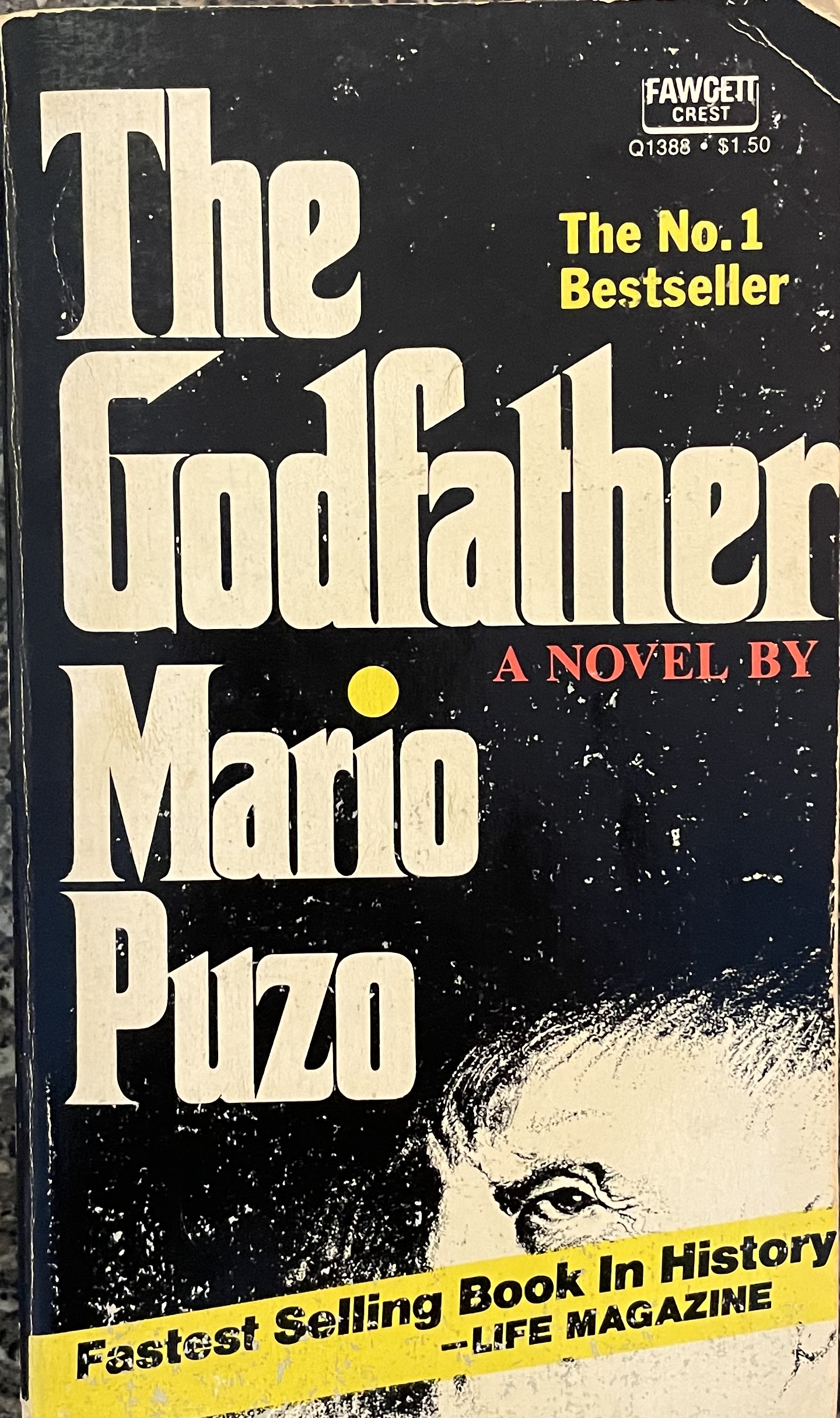
That’s the reaction I got when I mentioned to a couple younger co-workers that I found an old paperback copy of The Godfather by Mario Puzo at a used bookstore. I’ve always gotten that kind of reaction. I don’t know why people are surprised to find out that The Godfather was a book before it was a movie. Books being adapted into movies, that kind of thing happens a lot.
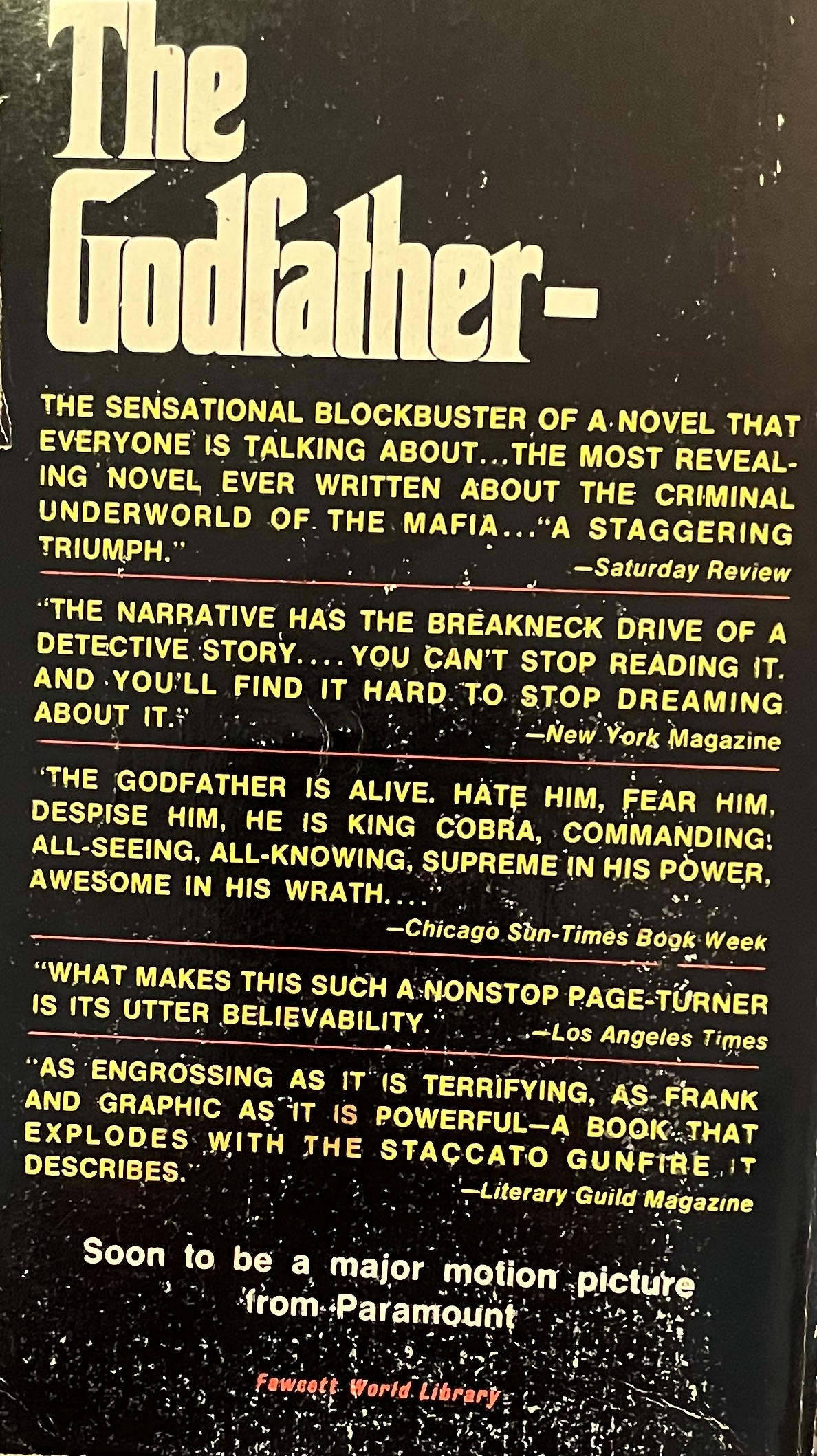
To be honest, the only reason I originally read The Godfather decades ago was because I liked the movie. Maybe some people like The Godfather movie a little too much (if you know what I mean), but I still like it. I don’t like the movie enough to quote it all the time, but I liked it enough to read the book.
In fact, The Godfather is one of my favorite books to read when I feel brain dead or if I have reader’s block or if I’m stuck some place with no wifi. It was a great book to take to the airport in the days before wifi. I’m not saying it’s a great book. I’m just saying that it was a great book to take to the airport.
I’m also not going to say that the book is better than the movie or vice-versa. Both are great in their own ways. The novel, of course, provides a lot more details, but it gets bogged down in a couple places (as most novels do). Everybody knows that the movie is great with few (if any) wasted moments, so I’ll spare readers a review.
The following scene is a great example of how the book and movie take different approaches to the same characters and situations. I’m not sure how much context to provide, so I’ll provide nothing (AND YOU’LL LIKE IT!!), except that I’m using the movie scene first because it starts earlier and provides more of a set-up. So, here’s a famous scene from the movie The Godfather.
MOVIE VERSION:
BOOK VERSION: I’m not a fan of long block paragraphs, but if I have to read long block paragraphs, I’ll choose to read them from The Godfather.
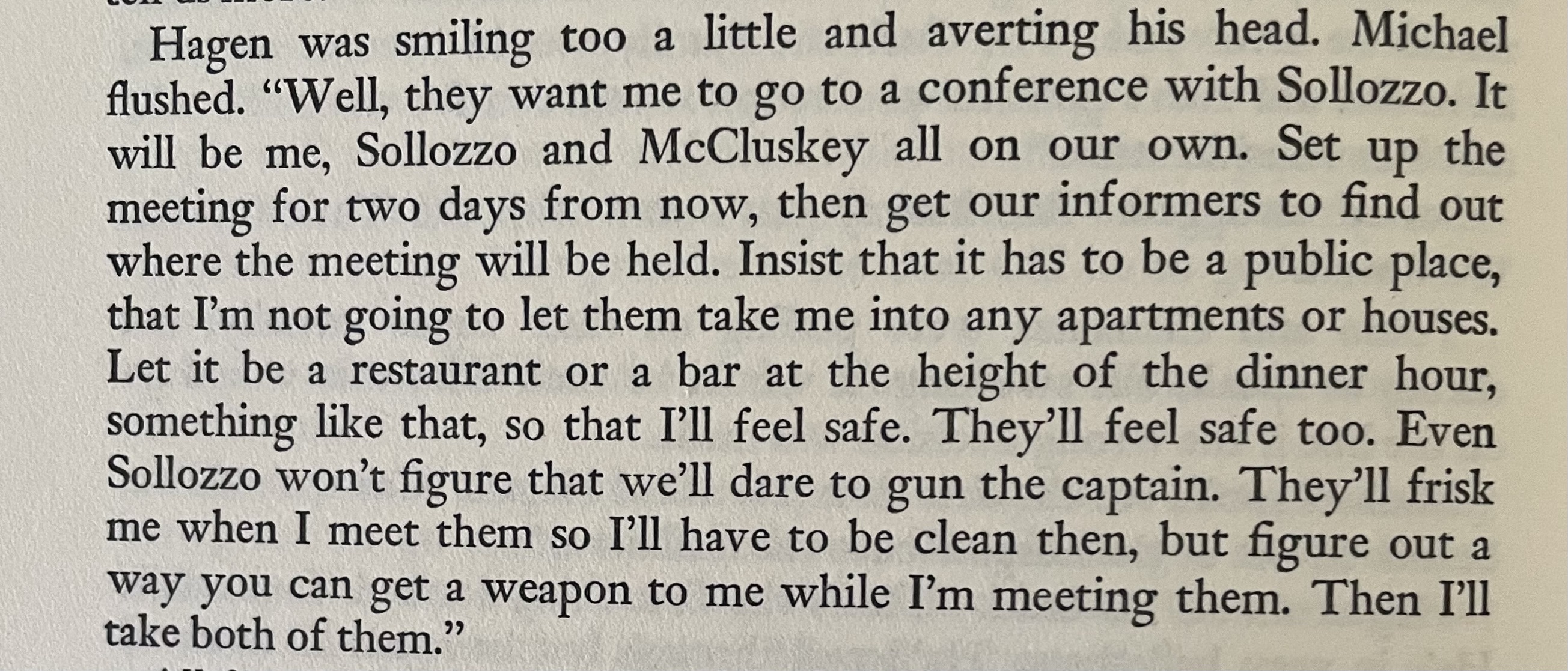
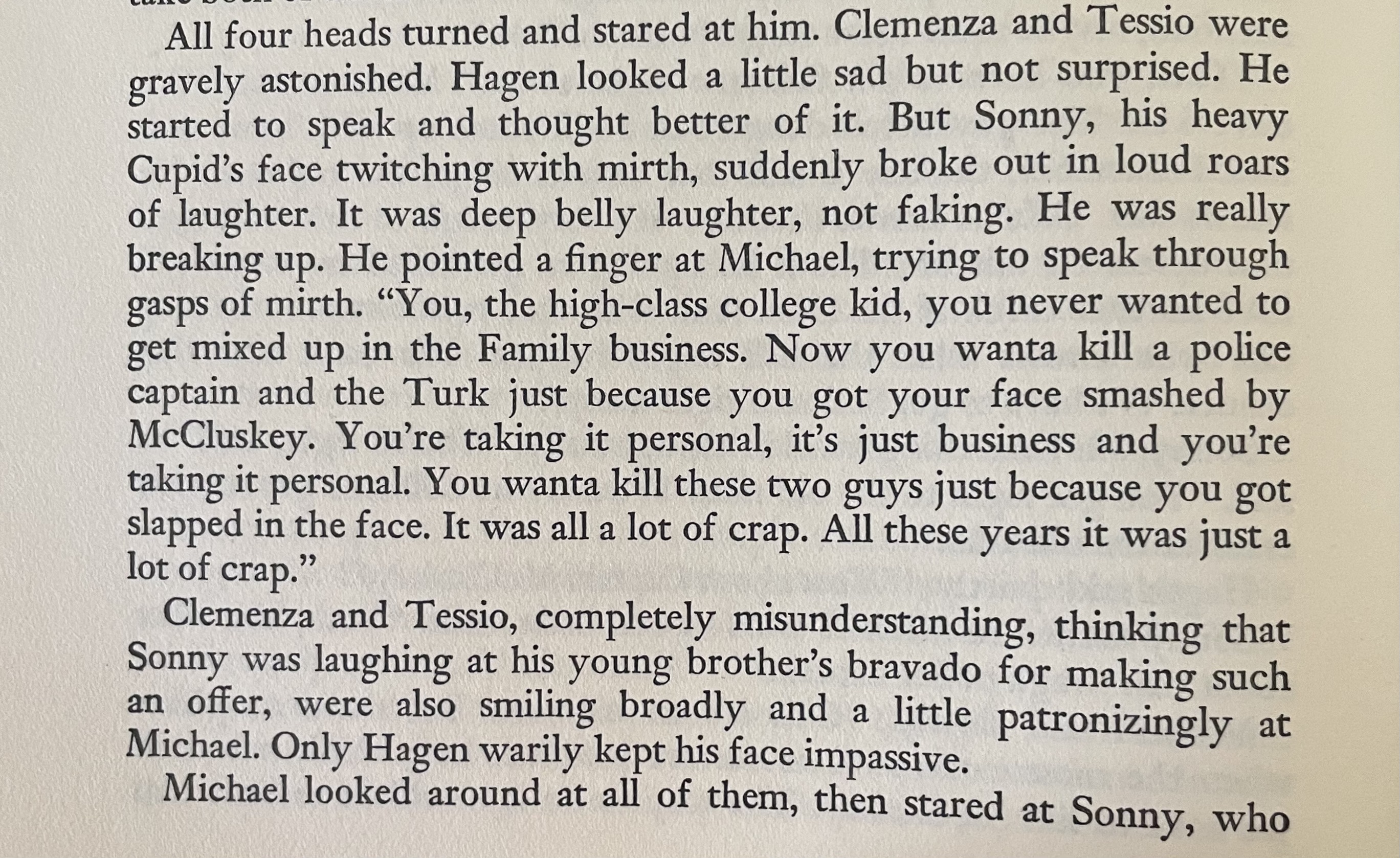
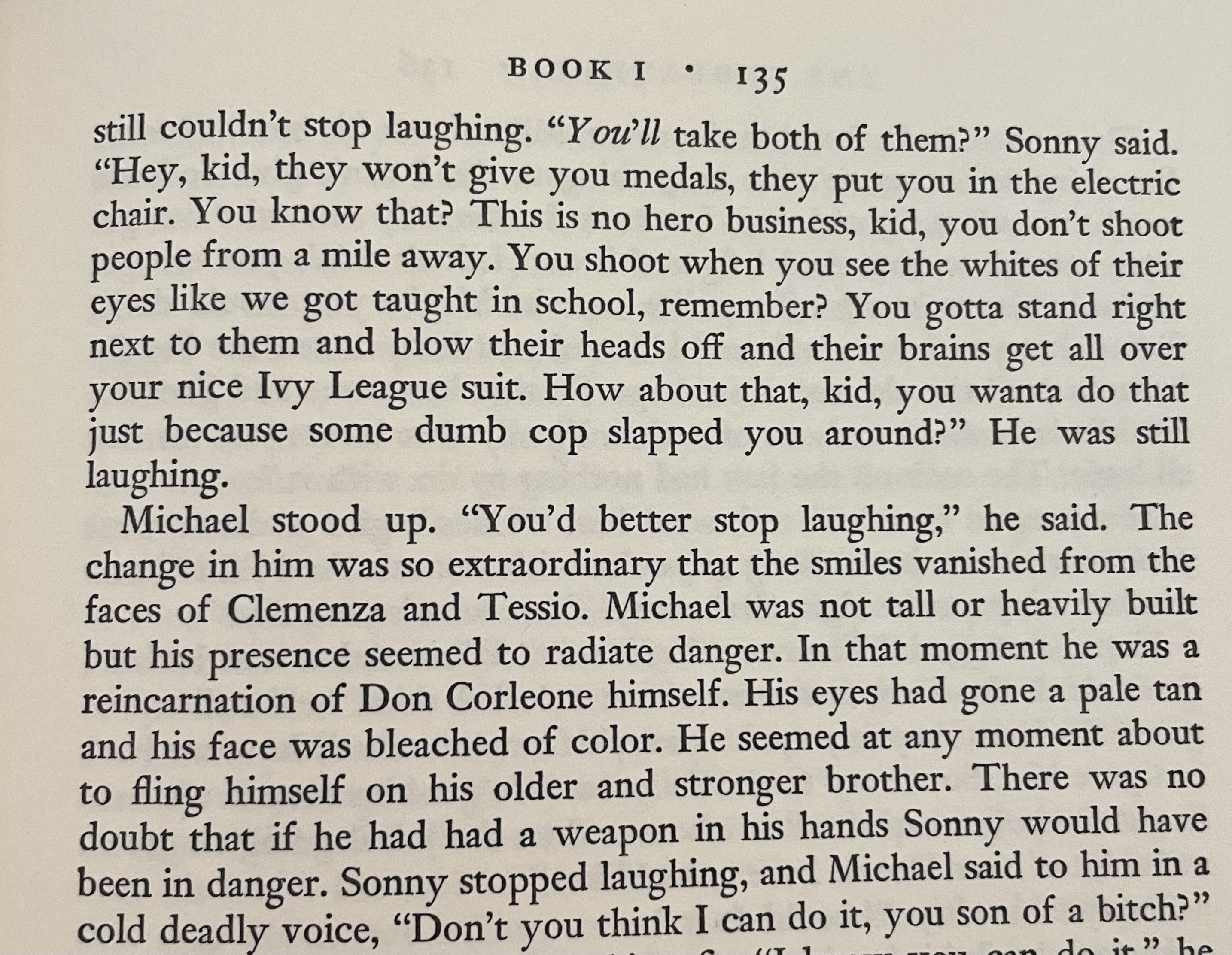
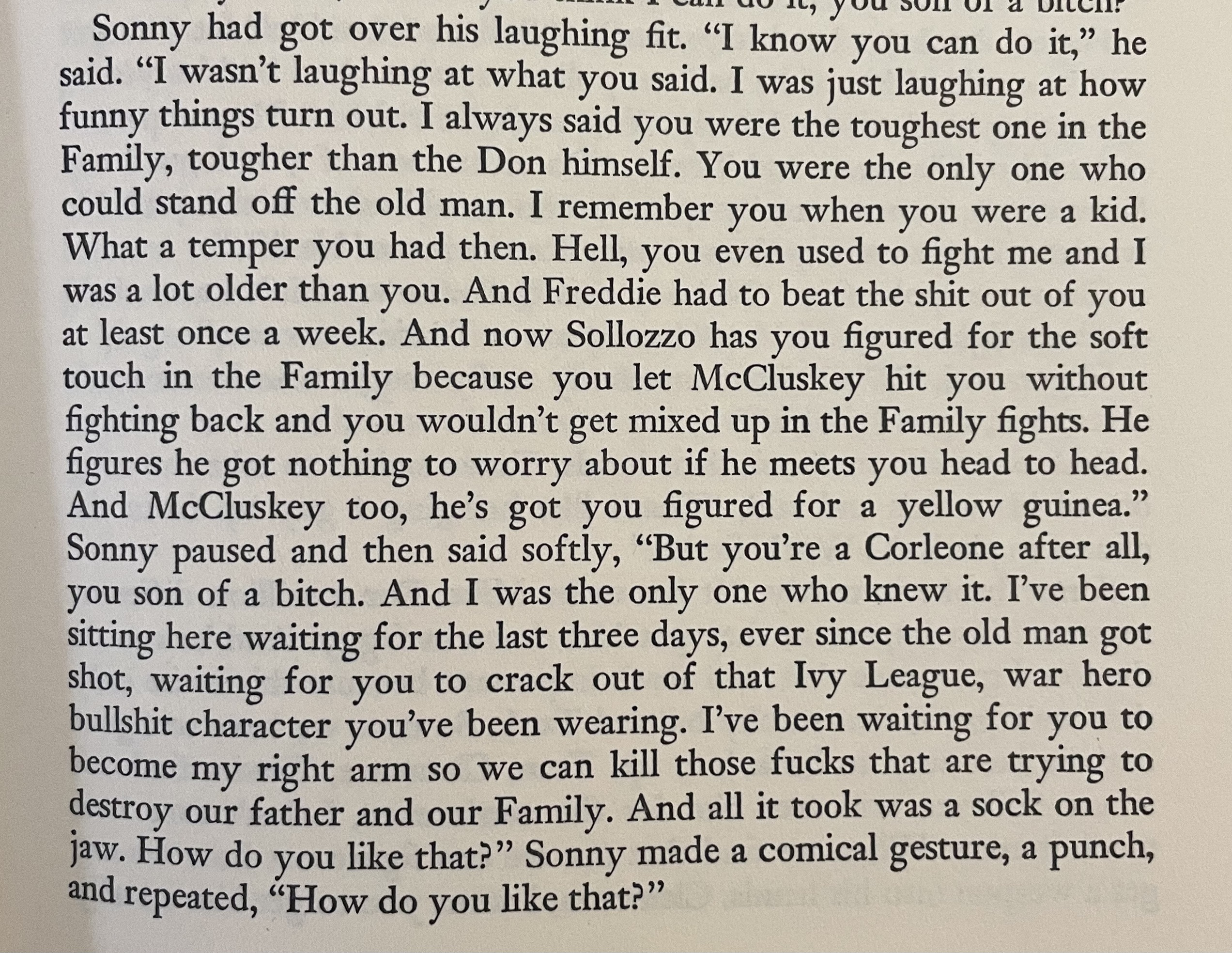
The book and movie have a bunch of other differences, but those will have to wait for another time. If you’re going to read books from The Godfather, just read The Godfather. Every sequel or Godfather adjacent book is disappointing.
If you’re going to watch The Godfather movies, just watch The Godfather and the Godfather II. The Godfather III isn’t bad, but when it comes to The Godfather, ‘isn’t bad’ isn’t good enough. And it wasn’t Sofia Coppola’s fault. Godfather III had issues that went way beyond Sofia Coppola.
What do you think about the differences between the book and movie versions of The Godfather? What other differences between the book version and movie version of The Godfather stand out to you? How refreshing is it to see Al Pacino not overacting in a scene?
*****
After more than ten years of blogging, I’ve finally written a novel.
A grammar-obsessed English teacher falls in ‘luuuvvv’ but discovers how chaotic and dangerous ‘luuuvvv’ can really be.
The Sunset Rises: A 1990s Romantic Comedy is now available on Amazon and from the trunk of my car at various local bookstores… until parking lot security kicks me out. Buy it now while supplies last!
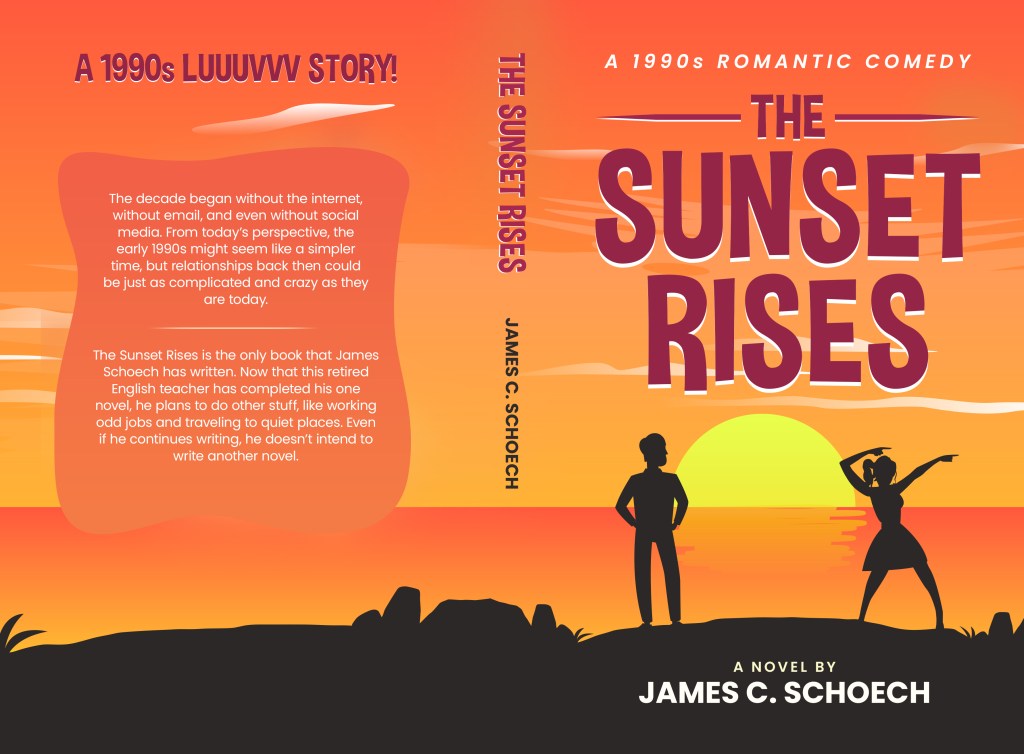
Now available here on Amazon and from the trunk of my car at various local bookstores… until parking lot security kicks me out.
*****
When I was in college in the 1980s, a classmate in a literature class proclaimed that his goal in life was to write THE great American novel. Even back then, I thought that his goal was kind of selfish; it was okay to want to write a great American novel, I thought, but wanting to write THE only great American novel seemed too much.
I wasn’t so ambitious. I just wanted to write a decent novel. At the time, I knew I was a decent writer, but my writing didn’t fit a niche and I didn’t trust my ability to make a living from writing alone, so I became a public school English teacher.
Even though I knew I had a novel in me, I never thought that I would end up writing a romantic comedy. During my thirty years of teaching, I tried writing a mystery novel, a horror novel, a sword & sorcery novel, and even a time travel novel. I almost finished the mystery novel. By ‘almost finished,’ I mean that I wrote a complete rough draft but never went back to finish it. Looking back, that mystery novel kind of sucked.
When I retired from teaching, I began looking over my accumulated unfinished works and decided to focus on a romantic comedy short story that I had written in 2013/2014. The story dealt with several aspects of relationships that people usually don’t discuss openly, and it was by far the most popular of my short stories (judging by comments and views at the time) on my blog. Even after I decided to expand my romantic comedy short story, it took me several years to put everything together in the form of a novel.
Now I finally have my ONE novel. This is it. I might write another book someday, but I’m probably not going to write another novel. If I do, it will probably take me another ten years.
So, here it is… The Sunset Rises: A 1990s Romantic Comedy! Buy it now while supplies last!

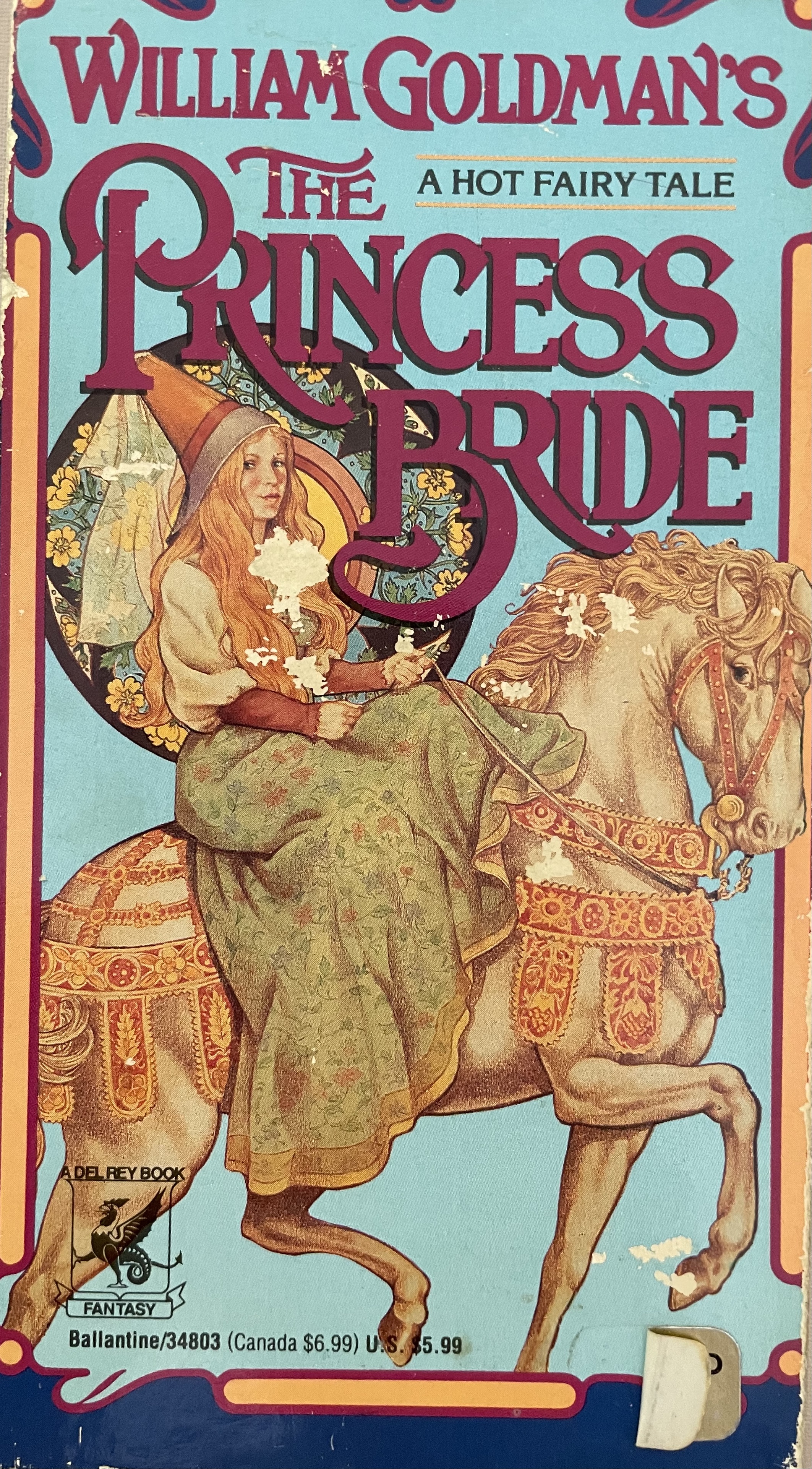
The writing lesson from William Goldman The Princess Bride is pretty simple. When it comes to fiction, just write the “good parts.”
*****
I don’t remember when I read both Marathon Man and The Princess Bride by William Goldman. It was probably in the middle of the 1980s. I remember at the time being impressed that Goldman could write two completely different books that were pretty good in their own ways.
Most authors have one genre and beat the crap out of that one genre, and I don’t blame them, especially if their primary goal is to make a lot of money. Some authors write the same book over and over until readers get tired of it.
But that’s not my point.
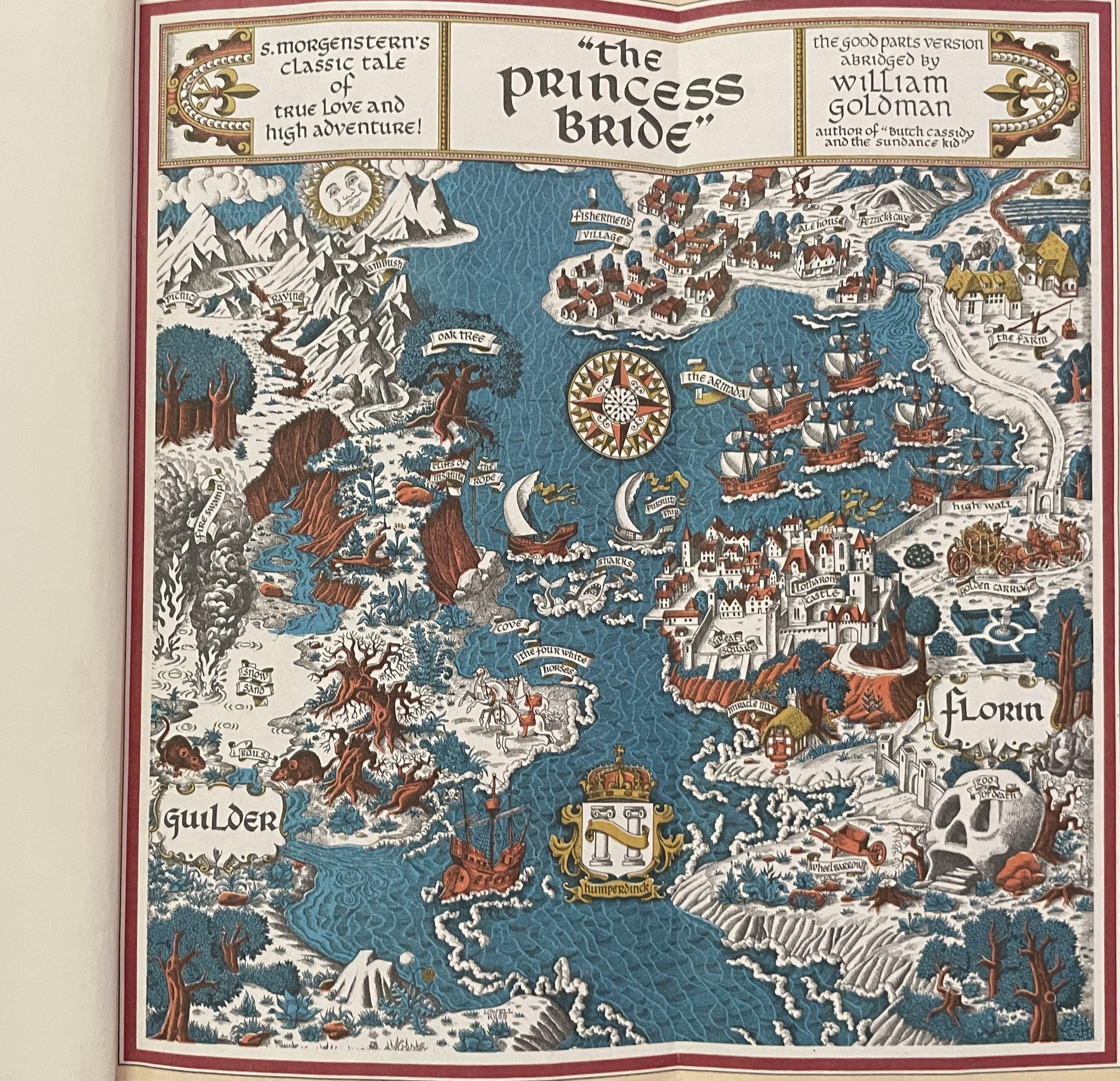
When I first saw this map in the first few pages of The Princess Bride, I focused on the geographical details so that the story would make more sense to me as I read it. Now that I’m older and don’t care as much about world-building, I pay more attention to the upper right corner.
And that’s where the “good parts” comes from.
At the beginning of The Princess Bride, author William Goldman explains how he tried to have his son read the “original” version of The Princess Bride (the S. Morgenstein version that only the purists can get through), but it was too long, too detailed, and too convoluted for his son to follow. To make this fairy tale more readable for the average person, Goldman then rewrote it, just leaving in the “good parts.”
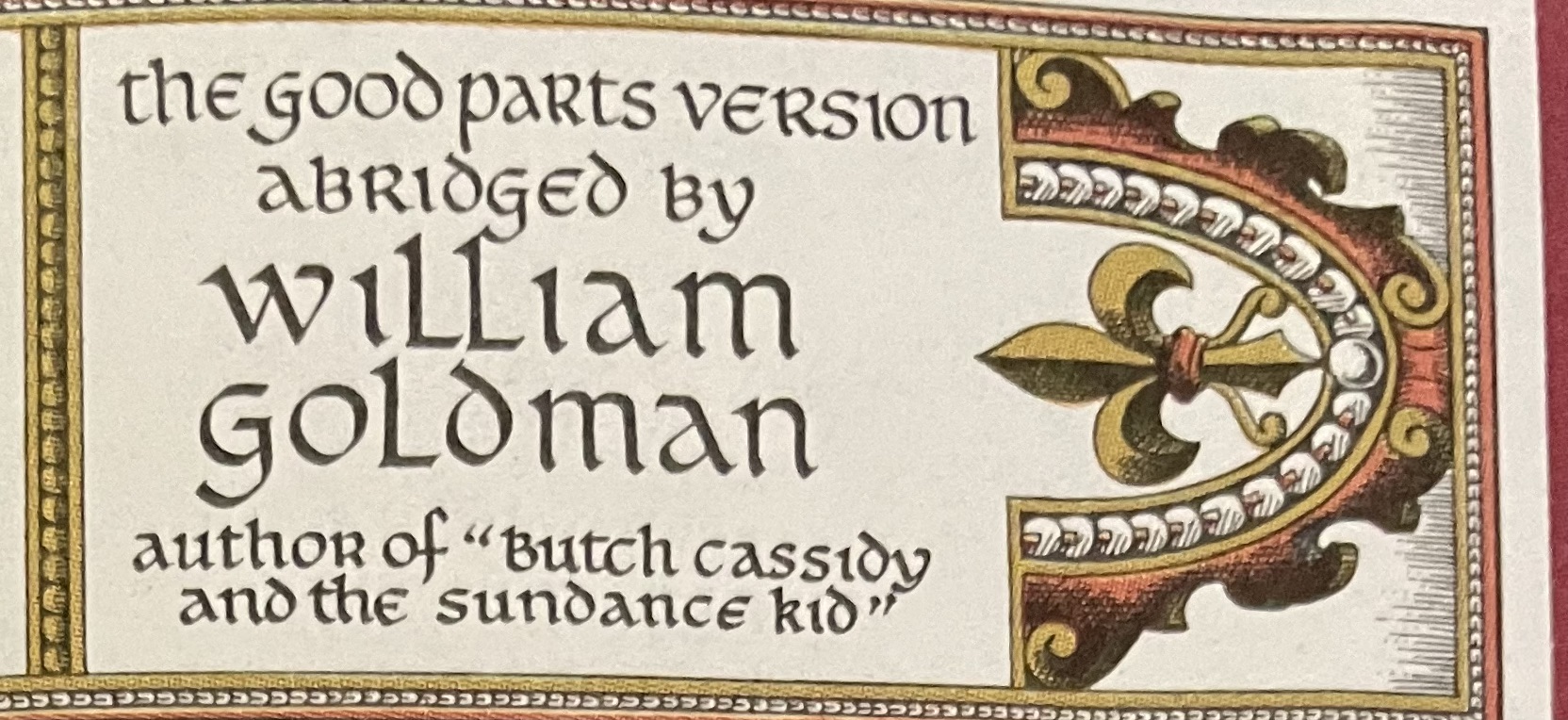
William Goldman is on to something here. If George R.R. Martin had only written the good parts, he probably would have finished his A Song of Ice and Fire series in 2010.
And have you tried reading the S. Morgenstein version of The Princess Bride? My god, when I finally found my own copy, I made the mistake of trying to read it. It was almost as tough to get through as Finnegans Wake, and it was ten times longer. It’s a good thing that Goldman rewrote it because there’s no way that Hollywood would make a movie out of the S. Morgenstein version of The Princess Bride.
An S. Morgenstein movie version of The Princess Bride? Inconceivable!
*****
And you know what else is “Inconceivable!”?
After ten years of writing and revising, I’m finally done with The Sunset Rises: A 1990s Romantic Comedy, and it’s available for pre-order (release date February 10) at The Sunset Rises-Amazon Page ! Plus, a sample is here at The Sunset Rises: A 1990s Romantic Comedy (sample chapter) .
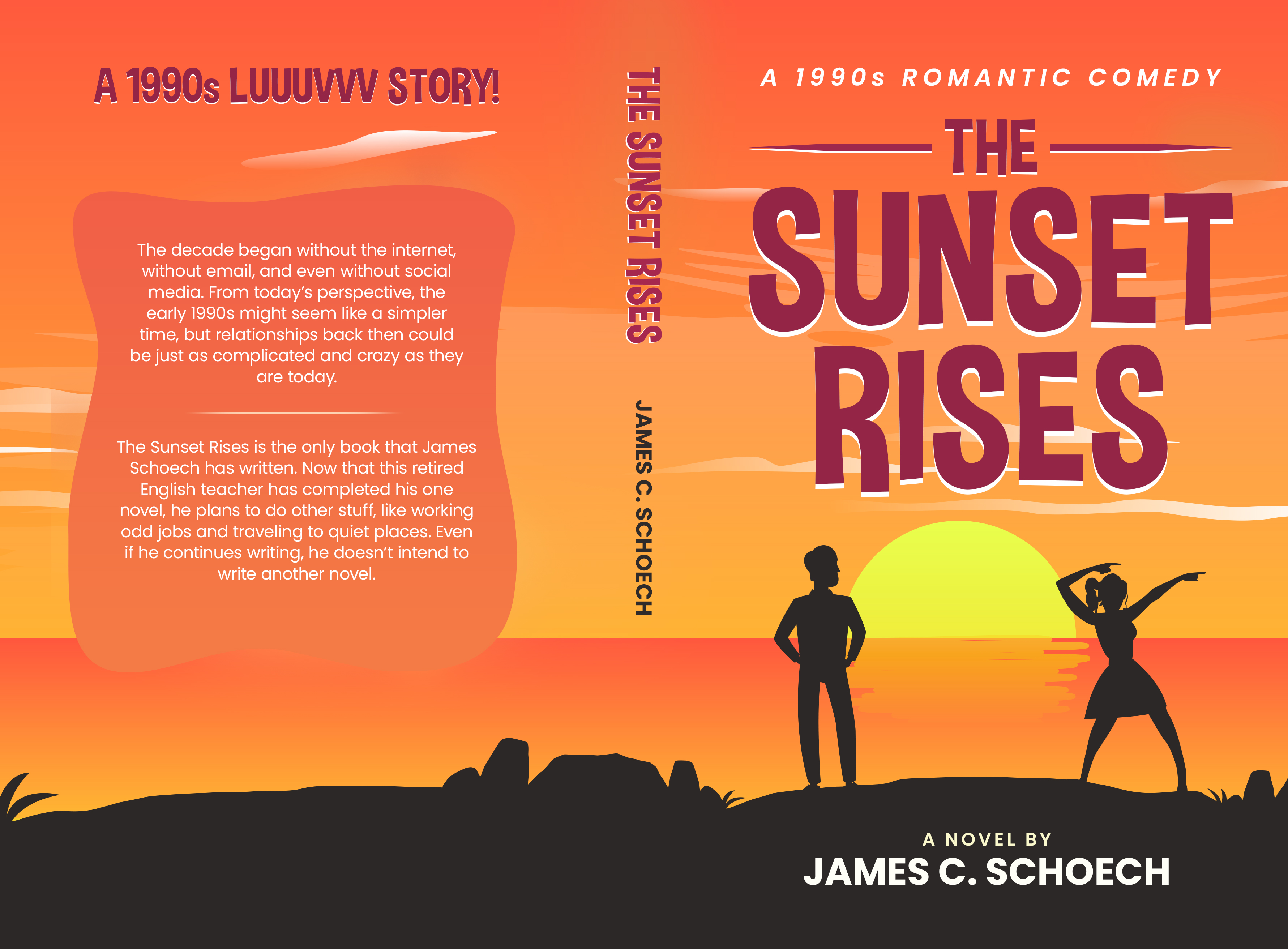
Saturday, February 10.
Unless something disastrous happens, I am going to release/publish my one novel, The Sunset Rises: A 1990s Romantic Comedy on February 10th.
The publication date has nothing to do with Valentine’s Day. It’s just that I have some plans for March and April, and I want my book stuff done by then. Besides, I’ve been working on The Sunset Rises for long enough.
Now that I know what it takes to put a book together, I might want to write another one. I put a lot of effort into the self-publishing process; it would almost be a waste to do this only once. I know I’m not a novelist, though, so I’d have to think of something else to write. I wouldn’t be in a hurry. I have several non-writing projects that I’m working on, so I’ll be busy whether I’m writing or not.
In the meantime, the Amazon page for The Sunset Rises is here at The Sunset Rises-Amazon Page.
You can also read a sample chapter here at The Sunset Rises: A 1990s Romantic Comedy (sample chapter) .

There’s not much new to say about the novel Dune by Frank Herbert, but having nothing new to say never stops anybody, so here we go.
Since Dune was published in 1965, the year that I was born, I didn’t read it right away when it came out. I tried reading Dune right away, but it was a little above my age level. When the first movie was released in 1984, every science fiction nerd was excited about it because all of them had read the book (or had claimed to), and sci-fi nerds were usually still optimistic about science fiction movies because of the success of the Star Wars trilogy (at the time).
Most fans, however, were disappointed in Dune the movie. In fact, the popular opinion was that it outright sucked. It wasn’t like Star Wars: The Phantom Menace over a decade later where fans initially liked it (or maybe they felt like they had to like it) but then slowly realized it wasn’t that good. Almost everybody I knew didn’t like Dune at its release. I almost felt sorry for it.
It made me, however, feel vindicated for not finishing the book when it was published in 1965. The 1984 movie also kept me from trying to read the book again.
Dune? Why would I want to read Dune? The movie sucked.
Looking back, the movie had little/nothing to do with me not reading the book. I was in my first year of college, and I was temporarily through with my science fiction phase of reading.
A few months ago, I watched the first 30 minutes of the most recent Dune movie (part 1) and didn’t fully understand what was going on, so I found a cheap used paperback copy (image at the top of the blog post), and after reading it, I’m confident that if I ever get around to watching the Dune movies again, I’ll fully understand what’s going on.
DUNE BOOK REVIEW
It’s pretty good. I finished it. I lost interest in the chapters that focused on the main character Paul in the second half of the book, but all of the other characters were interesting. I won’t read the other books, though. It’s kind of weird when the main character of a book is the least interesting (but that’s probably just me). That’s a possible blog topic in itself, books where the protagonist is the least interesting character.
Even though some parts of Dune bored me, other parts were great! To me, if a book has a bunch of great scenes connected by scenes that are a little dull (just my opinion), then that’s at least a pretty good book.
Dune ends abruptly, however. When I finished reading Dune, I thought for sure that somebody had ripped the last few pages out of my used copy, but no… that’s how Dune ended. The ending wasn’t bad. It was just

I’m finally done writing The Sunset Rises: A 1990s Romantic Comedy. That’s my update.
*****
ADDITIONAL UPDATE
I’m still not sure when I’m going to publish/release The Sunset Rises. I’m waiting on one more person to beta-read it before I send it to a proofreader/copyeditor.
Hey, last beta-reader: “Hurry up and finish reading The Sunset Rises so that I can move on to the next phase! But take your time. But hurry up! But take your time. But hurry up!”
PERSONAL NOTES
I’m surprised by the lack of urgency that I’m feeling. Months ago, I thought that when I reached this point, I’d be eager to get everything done as soon as possible. I thought I’d be excited. Instead, I’m just ambling along step-by-step. There are a couple reasons for this, but I’m not going to get into them.
This might be the last update about The Sunset Rises that I post before I publish the book. I’m not one of those bloggers that’s going to do a day-by-day step-by-step update for my book. Details about self-publishing are kind of boring. I’m glad I went into teaching instead of publishing. At least I was never bored as a teacher. I was anxious all the time but never bored (except during standardized testing).
Just to be clear, I’m not bored with The Sunset Rises. I really like The Sunset Rises. It’s the self-publishing details that are boring.
I’ve learned from writing The Sunset Rises that I’m a decent writer, but I’m definitely not a novelist. This book took me ten years to write, and I’m not even sure how good it is. I’ll continue writing stuff, and I might even write more books, but I don’t think I have another novel in me.
I’m glad that my Kickstarter at the end of last year didn’t quite work out. If I’d been using other people’s money, I would have felt compelled to stick to my six-month deadline. Or I might have just run off with the contributions.
Because I’ve been taking my time, I’ve made some changes that I otherwise wouldn’t have thought of, and I’ve improved the book. I think it’s at least a decent book. The Sunset Rises might actually be pretty good. I’m pretty sure it doesn’t suck.
Some readers might end up thinking The Sunset Rises sucks, but I know it doesn’t suck. It’s at least decent. I don’t think I’m going to use that (The Sunset Rises doesn’t suck; it’s at least decent) in my promotion campaign.
If you haven’t already, you can read a sample chapter from The Sunset Rises from the link below. It’s at least decent!


I grew up in a time when the legends of Robin Hood were common knowledge.
I had access to the book The Merry Adventures of Robin Hood by Howard Pyle. I’ve read the Classics Illustrated version of Robin Hood. I’ve read the Marvel Classics Comics version of Robin Hood. I’ve seen the movie The Adventures of Robin Hood with Erroll Flynn. I’ve seen the movie Robin Hood:Prince of Thieves with Kevin Costner (Haha!) as Robin Hood.
I even remember a short-lived television show from the 1970s called When Things Were Rotten. The theme song still gets stuck in my head, even though I haven’t heard it for close to 50 years. I could probably hear it again if I wanted to, but I kind of like my version of it and I don’t want it to be ruined by the cheesy 1970s reality.
I guess my point is that there used to be a bunch of stuff about Robin Hood when I was growing up.
Despite my familiarity with Robin Hood, I’ve never seen the movie Robin Hood:Men in Tights by Mel Brooks. I’m not a fan of Mel Brooks movies. I think I’m the type of person who’s supposed to like Mel Brooks movies, but I just think they’re okay. I’d rather watch the original Frankenstein movie than watch Young Frankenstein. I’d rather watch (the original) Star Wars than watch Space Balls. I’d rather watch a real western than watch Blazing Saddles.
And I’d rather watch a real Robin Hood movie, even one starring Kevin Costner (Haha!) as Robin Hood than watch a Mel Brooks Robin Hood: Men in Tights movie.
I don’t want to say anything bad about Mel Brooks. If you say bad things about Mel Brooks, people get mad, and I’m not that kind of blogger. Still, I watched this scene from Robin Hood:Men in Tights, and I don’t think there’s anything special about it. It kind of feels like a high school skit.
As far as Robin Hood parodies go, Mad Magazine’s Don Martin in Sherwood Forest is far superior.


SPOILER ALERT!!!!
This version doesn’t necessarily have a happy ending.


Again, I don’t want to say anything bad about Mel Brooks, but Mel Brooks isn’t fit to sniff Don Martin’s… um… yeah, I guess that would be saying something bad about Mel Brooks. I don’t want to do that.
Mel Brooks is alright, I guess, but I prefer Don Martin’s style of humor. If you like high school skits about Robin Hood, watch Robin Hood: Men in Tights. If you like satirical masterpieces, then read Don Martin in Sherwood Forest.


 Dysfunctional Literacy