
When using 1st person point-of-view in my high school short stories, I had to make sure my main character narrators had some of the same traits I did. But back then, we didn’t have personal computers. (Photo credit: Wikipedia)
After I read the first couple paragraphs of “Long Story” aloud in my 10th grade English class, I could see several other students looking at each other quizzically. I knew they were trying to figure out who the plain looking dumb girl with the sweet voice was. I wanted to interrupt my reading and remind them, “This is fiction with first-person narration, you morons. Everybody is made up!”
But that might have gotten me beat up after school, so I just kept on reading.
*****
“Long Story”
By Jimmy Norman
Chapter One
The Girl with the Sweet Voice
My name is Danny Dornan, and I just fell in love with a girl’s voice.
Her name is Melinda, and I don’t think anybody else has ever noticed her or her voice. She’s not a singer. She’s not really nice looking. She has glasses, long straight hair with pimples on her forehead, and her clothes are usually plain, and I don’t think she’s really smart. When she gets called on in class, she stares vacantly for a moment before murmuring an answer that’s usually wrong. For a long time I barely noticed her. I just felt sorry for her when she got called on in math class because she always looked confused.
One day I was walking back to my desk after sharpening my pencil, when Melinda’s pencil box fell off her desk, and everything inside, pens, pencils, erasers, and markers scattered at my feet. She sighed with that vacant look and then reluctantly began leaning forward to pick up her stuff.
“I’ll get that,” I said, kneeling next to her and gathering her materials.
“I don’t know why I keep this stupid box,” she said. “My mom is too cheap to buy a new one.”
I had never heard Melinda’s real voice before. When she had gotten called on in class, she was nervous and would mumble an answer. But now she wasn’t nervous, and her voice was almost hypnotic. I wanted to hear her some more.
“I keep my pens in my shirt pocket,” I said proudly.
“Maybe I should try that,” she said, “but I don’t think my mom would buy me shirts with pockets.”
“Nerd love, nerd love,” some jock chanted, and a couple guys laughed. If that had happened a few minutes earlier, I would have been embarrassed, but maybe they were right. Maybe I was in love. Except I didn’t think this girl was smart enough to be a nerd.
When I went back to my desk, the math teacher was calling on students to answer questions from today’s assignments. Melinda stared at her book and at the chalkboard, but her sheet of paper was almost blank. I copied my work really fast, folded it up, and flicked it to her while the teacher’s back was turned. It was pretty slick for a nerd.
Maybe Melinda was expecting a love note because she had that blank stare while she read over the answers to that day’s assignment. Finally, she compared the questions in the math book with the answers I had written for her, and she smiled at me. She smoothed over the paper and placed it underneath her math book.
Copy the answers, you sweet-voiced dimwit, I thought. I wanted to write her another note, but the teacher was monitoring the class while a student who knew what he was doing was writing a math answer on the board.
“Melinda, what is the answer to #8?” the math teacher asked.
She pulled out my note and said with confidence, “1,476,845,369,256,315,004,197.”
The whole class, including the teacher, was stunned. Her voice was so confident, so heavenly. It sent tingles down my spine. I was proud and… and… in love.
I couldn’t wait to talk to her again. After class, I caught up with her in the hallway.
“Thank you for helping me in class today,” she said. “Nobody has ever done that for me before.” Now she smelled good too. At this rate, tomorrow she’d even be pretty. But I didn’t care as long as I could hear her voice.
“Do you walk home?” I asked. “I could carry your books.” I’m not usually that direct, but her voice was forcing me to do things I wouldn’t normally do, like writing notes in class and helping another student cheat.
“Here,” she said, handing me a pink Josie and the Pussycats backpack stuffed with textbooks and folders and pencil boxes. This was a lot of stuff for a girl who didn’t do her homework.
“Where do you live?” I asked. I looked forward to hearing her voice, but I dreaded the possibility of a long walk with that heavy Pussycats backpack.
“Wade Street,” she answered.
Uh oh, I thought. I hesitated, and then asked, “Is that North Wade Street or South Wade Street?”
“South.”
Double uh oh, I thought. This girl with the sweet voice was going to make my life a whole lot more dangerous.
*****
To be continued in Long Story: The Curse Brothers.

I’ve never written a best-selling novel, but I’ve read a few of them, so I’m an expert.
I dream of writing a best-selling novel some day. It probably won’t happen because I have too many flaws in my writing, and I have too many gaps in my knowledge (and I’m too lazy to do research). But I can still dream.
Even though I don’t plan on writing anything bestseller-ish for a while, I still like to read best sellers and see what makes them so popular. I haven’t intentionally read a best-selling novel solely because it’s a best seller for a while (last summer I read a Pulitzer Prize winner for fiction just to read a Pulitzer Prize winner for fiction), so last week I read Gone Girl by Gillian Flynn.
I couldn’t choose Fifty Shades as my best seller because the trilogy is so polarizing. I didn’t want to choose a book written by Stephen King, Janet Evanovich, John Sandford, or any other hack (I mean the term “hack” as a compliment) because most of those authors have their own formula, and I’m not talking about a formula. I’m talking about universal elements or characteristics of just about any best-selling novel.
I chose Gone Girl because it’s a book that I normally wouldn’t read. It’s also been on the best sellers lists for a long time (I didn’t research how long). It’s written by an author I’ve never heard of (or an author of whom I’ve never heard). Plus, (I think) the author hasn’t written enough books to rely on the same formula all the time.
There are a lot of subjective factors (that critics can disagree about) that go into a best seller, like quality of writing, depth of characterization, and frequency of plot holes. There are other factors outside of an author’s control, like how much publicity a book gets. It helps to be a good writer and to know somebody in the publishing industry, but even so, the novel itself must have certain qualities.
HOW TO WRITE A BEST-SELLING NOVEL
1. A best-selling novel must focus on a relationship.
Gone Girl is about a troubled marriage. It’s tough to get more universal than a troubled marriage. Every married couple goes through a rough time. Every unmarried person has witnessed a troubled marriage (which causes many unmarried people to NOT want to get married).
If you’re in a troubled marriage, this novel might give you some bad (or AWESOME) ideas about how to handle it.
2. A best-selling novel must use some literary devices.
Literary devices (or gimmicks) can set a story apart from the literary chaff. While Gone Girl doesn’t go as far as something like A Visit from the Goon Squad, the author Gillian Flynn uses her share of literary devices. The story is told by two characters, and both get their 1st person narration. One character tells his story as it’s happening (though it’s still past tense). Another character tells her story in journal form from the kind of distant past up to the present. And then at the end, the stories merge.
The female character uses parentheses a lot (and so do I, so I immediately like her… but I don’t “like her” like her… because that could get dangerous). Since the female character writes (or used to write) magazine quizzes, she often expresses herself in quiz format. Some readers might find that annoying, but it’s a technique that’s unusual.
3. A best-selling novel puts surprises at the end of chapters.
Gone Girl has a lot of cliffhangers and intended SHOCKING REVELATIONS. The chapters from the male character’s point of view almost always ended with a cliffhanger or a sentence that revealed a surprise. Some NON-best-selling novels have surprises but place them in the middle of the chapters. Put the surprises at the end, and readers can’t wait to get to the next chapter. This technique was especially effective in Gone Girl because I had to read through the wife’s chapter (which was usually interesting in its own way) before getting back to the male character’s cliffhanger.
4. A best-selling novel stereotypes a lot of minor characters.
Gone Girl has several minor characters that are not much more than stereotypes: the win-at-all-costs defense attorney, the slutty young mistress girlfriend, the Ozark hillbillies. I have nothing against stereotypes in fiction because not every character can be three dimensional. If every character is three dimensional, then the novel is probably literary fiction, and it will give me a headache.
*****
If I decide to write a best seller (football season is almost over, so I’ll be able to concentrate soon), I know what has to go into it: I’ll focus on a relationship. I’ll have cliffhanger chapter endings. I’ll choose a couple literary gimmicks (and hopefully not overuse them, like I do with parentheses). While my main characters will be three dimensional (hopefully), most of my minor characters will be simple stereotypes. I’m not sure what genre I’ll choose, but as long as I have these four basic elements, the genre shouldn’t matter.
*****
The Review
Gone Girl by Gillian Flynn
I liked it. It was good. It could have been really good if it had had (“had had” is not a mistake) a better ending.
*****
Next week I’m going to explain how to write a book review.

My English class had only 25-30 students in it when I read my story, but I felt like the world was watching me. (Photo credit: Wikipedia)
Students entered Mr. Fay-guns’s class very quietly the day that the stories were due. Mr. Fay-guns (spelled Faggins), my tenth grade English teacher, was sick and had a raspy voice, so we were going to read our stories in front of the class so that he wouldn’t have to talk much. Making noise meant getting noticed, and most students didn’t want to get called on to read. I wasn’t the kind of student that usually got noticed, so I had determined that I probably wouldn’t have to read.
The directions were on the board in handwriting so large that it was impossible not to notice.
_______________________________________________________
“Each one of your names is written on a strip of paper in my tissue box.
I will choose one student at a time by pulling names from the box.
If you do not read when I call your name, you will get a zero and detention.
Volunteers may go first.
Whiners will go before volunteers.”
_______________________________________________________
So, getting noticed had nothing to do with it.
Still, a lot of students who normally talked before class weren’t talking because Mr. Fay-guns might interpret their talking as whining.
“Did you finish your ‘Long Story’?” Denise asked as I sat down. She was in her cheerleader outfit again, and her legs shifted in my direction.
“I have a rough draft,” I said, trying not to stare. “But I haven’t made any corrections.”
“Can I read it?” she asked. She smiled as we made eye contact, and I felt something like dizziness, but I knew she didn’t feel it. It would have been depressing, but I was used to the notion that my infatuations were not infatuated with me.
I glanced at the teacher. “Mr. Fay-guns is going to start calling on us soon.”
“You’re pronouncing his name correctly now,” she said, referring to yesterday’s conversation when I had said something rude about him.
“Yeah, I’m sorry about that.” I gave her the first couple pages of my story. I had it paper clipped instead of stapled because I kept adding more. “Can I read yours?”
“No. It’s stupid,” she said. I could have argued, but I was more interested in her reaction to my story than I was in her story.
Mr. Fay-guns told the class to quiet down even though we weren’t that loud. “It’s that time. Before I pick names, are there any volunteers?”
Silence. I was surprised. Every class has a couple (or maybe a few, if you’re lucky) students who love being the center of attention. But not today. Something about the mood of the class kept even the regular volunteers from raising their hands.
Then a couple students volunteered other students who didn’t want to read, and those students who got volunteered told them to shut up. Mr. Fay-gun’s face was getting red, and the situation was about to get out of control when a girl sitting in the back of the room said, “Jimmy should read his story.”
Without turning around, I knew who it was, Rebecca, the tenth grade’s hot vicious minx (I didn’t call her that until after we graduated because the word “minx” wasn’t in my vocabulary yet). I was surprised that Rebecca knew my name. Rebecca was one of the few tenth grade girls who rivaled Denise in looks, but Rebecca wasn’t really competition. Denise was unattainable to the masses because she was so pretty and popular. Rebecca was unapproachable because she was so mean.
Another difference? When it came to Rebecca, it wasn’t her legs that guys gawked at.
“Jimmy, I heard you have a big story,” Rebecca said somewhat loudly from the back.
I was embarrassed. I don’t like being talked about in front of others, even when being complimented. And I don’t think she meant her remark as a compliment.
“It’s called ‘Long Story,’” I said, probably with a stammer.
“Long Story,” Rebecca repeated. She was wearing one of her low cut sweaters that dared to be stared at, but I was so stunned that I could only look at the floor and hope that somebody else would volunteer. “How long is your long story, Jimmy?”
“25 pages or so,” I mumbled, wondering why she was targeting me. I wasn’t popular, but I had never been a target before. I was very careful to do things that would not make me a target.
“You should read your story to the class… slowly.”
Then I understood. And so did the rest of the class.
Other students, even a couple of my buddies who should have known better, called out my name to volunteer. The fear of reading a story out loud was more important to them than our friendship. I glared at Mr. Fay-guns, hoping he would intervene, but now he seemed amused by the situation. I was on my own. I would have to defy peer pressure by myself, and I was preparing myself to do it.
“I’ll read it.”
And the class quieted down. But it wasn’t me who had volunteered to read.
“James, I’ll read your story to the class,” Denise said, making eye contact with me again.
I should have been grateful that Denise was willing to read my story in front of everybody. But there was something about the look on her face. She was proud. I knew she would read my story and read it great, and she would emphasize the right words even though she was reading them for the first time. There was a part of me that wanted to hear her read my words.
But a part of me was annoyed with Denise. I might not like being noticed, but this story was mine, and I didn’t want her to take any credit for my words. I didn’t mind feeding her good lines that she could repeat for laughs in class, but I didn’t want to give her this story. All the credit (or maybe the blame) would be mine.
I stood up and said, ‘I’ll read it myself.”
A couple guys, disappointed that they wouldn’t be able to stare at Denise’s legs all period, groaned. One guy behind me said, “Sit down, dickless.”
I turned around and said, “She would have been standing behind a podium anyway.”
“Oh,” the guy muttered. “Sorry.”
Denise handed me the beginning of my story and smiled at me again, but this time it looked fake, and I wondered if I had made her mad, but I didn’t have time to worry about that. I took a deep breath and began the steady zombie walk up to Mr. Fay-gun’s podium. I saw other students sitting back. They could relax now because even if they got called on to read, it would be a long time from now. They got to relax while the back of my neck got hot, and my knees wobbled.
“Congratulations, Jimmy,” Mr. Fay-guns said with his temporary raspy voice. “You just got drafted.”
*****
To be continued in Long Story: First Person Point-of-View.
Or to start Long Story from the beginning, read Long Story (Part 1): Teachers with Funny Last Names .

This scene might look normal, but they’re secretly writing fake positive reviews of their own ebooks. (Photo credit: Wikipedia)
People who don’t read much think that readers and writers are kind of weird. People who don’t read do more constructive things with their lives (from their point of view), like watch football and play video games, and can’t be bothered with something as trivial as the written word.
As a reader and writer (who also watches football and plays video games), I’d like to think that I’m normal, but I know readers and writers often are not. In fact, reading and writing caused some strange things to happen in 2012, a few of which I can’t even begin to explain to my illiterate friends.
DISCLAIMER!! This is not meant to be a TOP ten list. This is just a list of ten items.
10 WEIRD MOMENTS OF READING AND WRITING IN 2012
1.
The Fifty Shades of Grey trilogy sold way more copies than it probably should have. Everything that can be written about this trilogy has already been written. Even the parodies are getting old. Yes, I wrote my own parody, but that was over six months ago, so I’m not a hypocrite .
I’m not saying that Fifty Shades readers are weirdoes; I’m saying the trilogy’s popularity is kind of weird. And I’m pretty sure the characters in Fifty Shades are weirdoes.
2.
Several authors got caught writing fake reviews of their own books online. Even though that’s a strange thing to do, I was going to write a few positive reviews for my own ebook, but now everybody knows about the scam. Hey, sock puppets… Thanks for ruining it for the rest of us!!!
3.
An NFL cheerleader English teacher got caught having an affair with one of her high school students. I used to look at NFL cheerleaders and think to myself: ‘If only I were a football player….” Now I look at NFL cheerleaders and think: “If only I were a pimply faced 17-year -old boy again….” It’s one of my (few) regrets in life that I never had an NFL cheerleader English teacher as a teacher.
4.
Gore Vidal died. That part’s not strange. The weird part is that Gore Vidal was celebrated for his insults. In this age of anti-bullying, I think it’s bizarre that we still celebrate writers who insult others. Plus, I don’t think his insults were very good. Maybe if his insults were any good, it wouldn’t seem so bizarre to celebrate them .
5.
A high school kid used Twitter to get a porn actress to agree to go to prom with him. Man, I would have loved to have done this when I was in high school, but back then, we didn’t have Twitter or accessible porn.
My illiterate friends don’t think that this was weird.
6.
The Pulitzer Prize committee awarded nobody for fiction. More awards should refuse to name winners . It would make most award ceremonies more interesting. Even though I like the idea, having an award with no winner is kind of weird.
7.
The Raven movie sucked. How do you mess up a film about Edgar Allen Poe? This is kind of off topic, but I also remember when John Cusack used to be cool. The idea behind The Raven movie was weird, but the movie itself was not weird enough to be cool.
8.
The Justice Department sued Apple and some book publishers for collusion. Here’s a legal issue that’s so complicated that I’m determined to have an opinion about it . The Justice Department getting involved with the prices of e-books seems kind of weird.
9.
Encyclopedia Brittanica quit publishing new versions of its books and is going strictly online. Students used to resort to the encyclopedia because it was the easiest way to do research. Now Google and Wikipedia are the easiest ways to do research. Finding the Encyclopedia Brittanica website is way more difficult than using a search engine or Wikipedia. Since there are no new paper versions of Encyclopedia Brittanica, I’m not sure what the purpose of Encyclopedia Brittanica is… or if it even has a purpose anymore .
Even though the encyclopedia doesn’t really have a purpose anymore, it seems weird that new ones aren’t going to be published anymore.
10.
The Mayans “predicted” the world would end in 2012. Predicting the end of the world doesn’t do anybody any good. If you’re wrong, everybody makes fun of you. If you’re right, you can’t brag about it because the world just ended.
What does this have to do with literacy? Well, the Mayans wrote a calendar, and a bunch of people misread it. I’ve survived five(?) ends of the worlds (that I know about) in my lifetime. I hope I live long enough to survive several more.
People who predict the end of the world can be a bit odd (except for the ones I’m friends with), but readers who misinterpret calendars of ancient civilizations? I’m not sure if that’s weird or not.
*****
People who don’t read much are always going to think that readers and writers are weird no matter what, so in 2013, I vow to embrace my literary weirdness. I shall read Les Miserables during a football game without hiding it behind a Maxim cover. I shall write dozens of positive sock puppet reviews of my own ebook. I will use Encyclopedia Brittanica online for research purposes. I will use Twitter to ask porn stars out on dates and….
Yeah. My wife just told me that’s not a good idea.

(Photo credit: Wikipedia)
I have to admit that my memories of high school might not be very accurate.
I found my 10th grade yearbook a few months ago. Denise, the cheerleader with the really nice legs, doesn’t look anything like I remember her. Maybe it’s creepy for a guy my age to check out a 15-year-old girl, but this yearbook came out almost 35 years ago, and I was 15 the same time she was 15, so it’s not like I’m some random old guy checking out a random 15-year-old girl.
If it’s creepy, at least the creepiness has a point; when I write about an event that happened during the 10th grade almost 35 years ago, some of the details might be off a little bit.
My memory isn’t all bad. The one picture of me in the yearbook (I was the kind of guy who only had one picture in the yearbook) showed that I was as dorky looking as I remember myself being.
*****
A lot of students complained about the writing assignment in Mr. Fay-gun’s English class. They complained about the possibility of having to read their stories aloud in front of the class. They complained that they had to write a whole page. And while other students complained, I wrote. And I wrote quickly. And I wrote all day long, even during classes that were not English.
I’m left-handed, and I wrote so much that I had a long blue ink smudge on the side of my hand from dragging it over the paper. Left handed writers hate spiral notebooks because the spirals are on the left side and get in the way of the hand while writing, so I would tear the pages out before I wrote. That left a bunch of sheets of loose paper that I had to keep organized the whole day while I wrote.
At the end of the school day, I was stuffing books into my backpack, and I wanted my story in my top folder, so I stuck the pages between my legs while I loaded the backpack.
As I finished up, Denise approached me, staring at the stack of loose paper between my legs.
“James, is that what I think it is?” she asked.
I noticed the direction her eyes were looking, and I wasn’t used to girls looking there, so I was momentarily confused, and then I realized what she meant.
“You mean this,” I said, pulling it (the story) out with my free hand. “I think it’s out of control.”
“How long is that?” she asked, amazed at the size (of my story).
“12… pages, and I’m not even half way yet.”
“What’s it called?” she asked.
“I think I’m going to call it ‘Long Story’”
“That’s not a very long title,” she said with a laugh.
Then her boyfriend Tom showed up. He wasn’t that big (or nice looking of) a guy, but he was a senior. He and Denise pecked on the lips, and I was about to hightail it out of there because Tom was a senior and I didn’t want a senior misinterpreting my conversation with his girlfriend, but then Denise said:
“James is writing a 12 page story for Mr. Fay-gun’s class.”
“Who’s James?” Tom asked, looking at me like I was a new student at the school.
“It’s not really 12 pages,” I blurted out. “It’s 12 right now, but I’m only halfway done.”
Tom paused, narrowed his eyes at me, and then asked, “Why?”
“Why am I writing?” I said too quickly. “Because he assigned it to us today.”
“Faggins told you to write a 12 page story?” Tom asked.
“No, it only has to be a page.”
“Then why are you writing 12 pages for Mr. Faggins?” Tom was serious, and I didn’t have an answer that would make any sense to him.
Denise punched Tom on the shoulder. “Don’t call Mr. Fay-guns that.”
“Mr. Faggins?” Tom said with a snort. “You know that’s his real name.”
“It’s pronounced Fay-guns.”
“It’s Faggins,” Tom declared. “He only says it’s Fay-guns so we won’t make fun of him to his face.”
Then Tom turned to me. “What do you think? Is it really Mr. Fay-guns or Mr. Faggins?”
I’m not proud of what I said next, but I have a (hopefully) reasonable explanation. I was the type of student that should have been a target at school. I was skinny. I was quiet. My clothes were always out of fashion. My hair wasn’t cool. I carried books with me everywhere. I was clumsy. I didn’t play any sports. I should have been a target, but for some reason I wasn’t, and I wanted to keep it that way.
“It’s definitely Faggins,” I said directly to Tom. “C’mon! He’s an English teacher.”
Tom snorted again and grinned at me.
Denise said, “That was mean,” and I could tell she was disappointed in me, and I panicked.
“I meant he’s an English teacher, so his name should follow the rules of pronunciation,” I said quickly. “The two g’s in his name should make an ‘a’ sound, like ‘cat.’ That’s what I meant. I didn’t mean he was… you know… because he’s an English teacher.”
Denise shook her head. She wasn’t buying it. Tom narrowed his eyes at me again and then turned to Denise.
“What’s your story about?” he asked.
She walked away from both us. “I don’t want to talk to you.”
As he followed her, he asked, “Is your story about what a great boyfriend I am?”
“Yeah, it’s a short story.”
I put “Long Story” into my folder before anybody else noticed it, grabbed the rest of my stuff, and went out the opposite exit. Denise was mad at me, and I felt bad for making a stupid comment about Mr. Fay-guns just to stay off of a senior’s bad side, but I also wondered about my story and Tom’s reaction to it.
I didn’t have to write a long story. I could have stopped after one page. I could have (and maybe should have) been done with the assignment hours ago. Yet I kept on writing. It was something I couldn’t have explained to Tom. I had a story that was living up to its title “Long Story,” and I didn’t know why I was putting so much time into it.
There was another problem. I knew that “Long Story” was going to be long. I wasn’t sure if “Long Story” was going to be any good.
*****
To be continued in Long Story: The Rough Draft.
Or to start Long Story from the beginning, read Long Story (Part 1): Teachers with Funny Last Names .

My old dictionary’s definition of “fart” was “an explosion between the legs,” but the dictionary didn’t provide a picture of one. (Photo credit: Wikipedia)
The history of the word “fart” is almost the opposite of an actual fart. The word “fart” goes back at least 800 years to Middle English and possibly beyond. A real fart is brief, usually lasting only a few seconds.
When I was a kid, the dictionary defined “fart” as “an explosion between the legs.” Today the definition, according to Merriam Webster is “to expel intestinal gas from the anus.”
I liked the kid’s definition better. For some reason, when I hear the word “anus,” I think of planets and Roman gods.
I was surprised that the word “fart” had a history. It goes all the way back to Middle English as “farten” or “ferten.” Old High German had a word “ferzan” which meant “to break wind.” Old Norse’s “freta” also had the same meaning.
I once knew a girl named Freta, and she’s lucky we didn’t know what her name meant. I wonder if she knew. I don’t remember if she passed gas a lot (she probably didn’t), but most boys that I knew passed gas a lot more frequently than she did. I know a lot of boys whose name could have been Ferzan.
FLATULENCE vs. FART
“Flatulence” is a cool word. “Flatulence” is the sophisticated way of saying “the expelling of gas.” People don’t laugh when you say “flatulence.” “Flatulence” is considered to be more sophisticated than “fart” because it’s a longer word. When dealing with bodily functions, like defecating or passing gas or adult relations, the words with three or more syllables are thought of as the more tasteful expressions. The one syllable words are vulgar. Therefore, “flatulence” is appropriate and “fart” is not.
The problem with “flatulence” is that it’s a noun. There is no verb form of “flatulence.” You could say “I flatulented in the elevator” or “I flatulated in line at the grocery store,” but then you’re just making up words. So if you pass gas, and you need a verb to describe what you did and you don’t want to say “fart,” then you need to use a euphemism.
Some euphemisms for the verb “fart” include:
* passing gas
* breaking wind
* letting one rip
* thickening the air
* contributing to global warming
* cutting the cheese
What did William Shakespeare say? “A fart by any other name would smell just as foul.”
Shakespeare is right (even if my quote isn’t). “Flatulence” may be a more acceptable word, but flatulence smells just as bad as a fart.
*****
THE ACCUSATION OF FARTERY
As bad as a fart can be, the accusation of being the farter is much worse. Very few things in school (or in the professional world) are worse than being known as the guy (or girl) that farts. One loud blast (accompanied by a foul stench) will lead to years of suspicion and mockery. I have endured hours of discomfort at times (both at school and in my professional life) to avoid being accused of farting.
The accusation of farting is so serious that a legal defense has been passed down for generations: “The one who smelt it dealt it.”
This is usually followed with “The one who denied it supplied it.”
The problem with saying “The one who smelt it dealt it” is that it (sometimes) leads to an argument over whether or not the word “smelt” is really a past tense form of the word “smell.” “Smelled” is generally considered to be the current past tense form of “smell, but some would also argue that “smelt” is a Middle English form of “smell.”
It doesn’t matter if “smelt” has anything to do with “smell” or not. The phrase proves that kids (who would normally think Old English is for weirdoes) would say “smelt” just to avoid being accused of fartery.
That shows how deadly to a reputation the accusation of farting can be. To a kid, it’s worse than being called a racist as an adult. Neither accusation has to be proven for the charge to stick, and both accusations can destroy your reputation for years.
Me? I’d rather be called a farter than a racist. At least then I could say, “The one who smelt it dealt it,” and have a 50/50 chance of being exonerated.
There are some things in life that a person can’t take back. You can’t take back a fart, and you can’t take back the accusation. The fart lasts for a moment, but the accusation of farting (if it sticks) can last forever.

(Photo credit: Wikipedia)
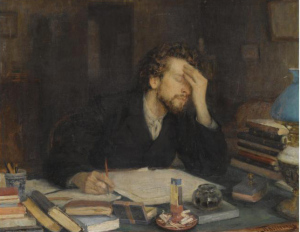
After Mr. Fay-guns, my sick 10th grade English teacher, finished talking (or rasping) about the writing assignment, we students just sat at our desks and wrote (or thought about writing). If anybody complained about writing, we were told to shut up. I think the cure for writer’s block back then was “Shut up!” “Shut up!” makes sense. You can’t talk yourself out of writer’s block, but you can write yourself out of it.
One English teacher (not Mr. Fay-guns) used to force students to write “I don’t know what to write about” until they thought about something to write about. I don’t know if that helps writers get good ideas, but it kept students from complaining about writer’s block.
The writing process has changed a lot since I was in high school. Back then, we had to hand-write everything. I’d try to cram my rough draft onto one sheet of paper. Then when I edited it, I’d cross a bunch of stuff out, jam new words and phrases between lines and write sideways on the margins. As ugly as it got (and it got ugly), I could always figure out I meant.
Back then, there were no graphic organizers for brainstorming. There was no color coding of sentences during the revision/editing process. There was barely even an editing/revision process. There was no peer editing where other students who knew nothing about grammar or punctuation try to make corrections and instead (probably on purpose) make things worse. We just wrote a sloppy rough draft and crossed out a bunch of stuff we didn’t like.
Since there were no computers (and nobody wanted to use a typewriter), students would then hand-write a neat final copy. The final copy would get graded with a bunch of red marks and (usually) a low grade. The student could then make corrections for a better grade. And that was it.
And if we ever complained about writer’s block, the teacher told us to shut up (or a more polite version of shut up).
I’m not the kind of guy who gets writer’s block a lot, so I wasn’t told to shut up very often. I usually have a lot of ideas when it’s time to write. The problem is that I have a lot of bad ideas.
So as I sat in Mr. Fay-gun’s English class while most students stared at their papers or at the clock or at Denise (the cheerleader with the really nice legs), I had several ideas floating around in my brain. But they weren’t any good.
I could write a story about Denise’s legs. It would be very descriptive, and I’m sure I could have added some conflict, but Mr. Fay-guns would read the story and maybe some other students would too, and then I would get a reputation as a pervert. Back then, I was a quiet guy, and people left me alone. If I became the pervert, then people would no longer leave me alone. I saw how (other) perverts got treated at school, and I couldn’t risk that by writing about Denise’s legs.
I had a fantasy story that I wanted to write. But back then, only weird kids wrote fantasy. I was considered quiet, but I wasn’t considered weird. The weird kids who liked fantasy talked about it all the time with each other (and sometimes to me), and they were okay, but I didn’t want to talk fantasy all the time (I wanted to talk football). I just wanted to read fantasy every once in a while. So I couldn’t write that story either.
Even back then, I considered my audience, and that’s very important for a writer.
Then there was Denise’s bad idea, the one about the girl who couldn’t think of anything to write for English class so she failed and it ruined her life. Denise was going to write it, and it probably wouldn’t be very good, but if she read it to the class, she’d nail the delivery so that the story would sound a lot better then it really was.
Yes, her idea was stupid, and I knew it, but I was still drawn to it, just like my eyes were drawn to her legs. It was a bad idea, but I could make part of her idea work. In fact, I could tweak the idea, combine it with some other bad ideas that I had, and maybe, just maybe, I could make a decent story out of it.
I do this a lot in my life. I have a lot of bad ideas. But I’ve learned that if I combine a bunch of bad ideas, then something good can happen. Or something really horrible.
And this is how Long Story was created.
*****
To be continued in Long Story: Bad High School Memory.
Or to start Long Story from the beginning, read Long Story (Part 1): Teachers with Funny Last Names .

When I was a kid, this was the only way I could read Moby Dick without getting reader’s block. Who am I kidding? It’s still the only way. (Photo credit: Wikipedia)
Reader’s block doesn’t get the respect that writer’s block does. People (especially writers and artists) can sympathize with writer’s block because a writer is creating something, and creating something can be difficult. Reader’s block gets less sympathy because all a reader needs to do to read is read. Complaining about reader’s block is like being the kid with all the toys in his room griping about being bored.
Reader’s block can be frustrating and deserves to be taken (just a little) seriously. Yes, reading is more passive than writing, but it still takes mental activity. Reading requires concentration and a willingness to get through difficult exposition/narration (hopefully with a payoff).
“Block” can happen with even the most passive of activities. I’ve gotten television watching block. The symptom for that is mindless flipping of channels. I’ve gotten video game block. The symptom for that is intentionally ending games early by getting myself killed (in gruesome, violent ways if possible). I’ve even gotten “music block,” when I change radio stations and playlists until I eventually give up.
I’ve never gotten “football watching block.”
But reader’s block is the worst because reading is the activity (that I can write about) that I enjoy the most (except maybe watching football, but nobody wants to read what I write about watching football). It doesn’t make sense that I can get bored with books when there are so many good books out there. There are enough good books out there that nobody (who really knows how to read) should get reader’s block.
Complaining about reader’s block doesn’t cure reader’s block. But there are several methods that can.
1. STOP READING.
Yeah, I know that writers are always supposed to read (especially when they’re not writing), but rules are made to be broken (every once in a while and only if nobody gets hurt). This doesn’t mean that a reader should stop reading altogether. Reading comic books, blogs, cereal boxes, or closed captioning on television counts as reading.
And if a reader does stop reading altogether, nobody cares. Last summer I went on vacation and deliberately did not read or write anything. I was told I was a much more pleasant person to be around when I wasn’t trying to read and write. There was no pressure put on me to start reading and writing again.
2. READ CLASSIC LITERATURE.
Readers who aren’t into classic lit should choose a short book. The Great Gatsby is great for reader’s block. Les Miserables might be a disaster.
Moby Dick? Haha! Moby Dick.
Classics that have gotten me out of reader’s block:
Frankenstein– by Mary Shelley
The Great Gatsby– by F. Scott Fitzgerald
Ulysses– by James Joyce (Okay, I’m kidding!)
3. READ A BOOK YOU KNOW YOU’LL DISLIKE.
Make sure it’s short. If you choose a long book, that’s okay too because you really don’t have to finish it.
Books that I knew I’d dislike that got me out of reader’s block:
Gorilla Beach by Snookie- supposedly written by somebody else.
I really don’t like admitting that I actually read a few pages of that.
4. READ A BOOK YOU’VE READ BEFORE.
This is risky. Sometimes staying in a comfort zone is what causes the rut in the first place. Reading a familiar book may only prolong the reader’s block. Or it may kick-start a reader’s enthusiasm for reading.
Favorites that have temporarily cured my reader’s block:
Marathon Man– by William Goldman
The Godfather– by Mario Puzo
The Thin Man– by Dashiell Hammett
5. DO A LOT OF WRITING.
This might seem like bad advice. If a reader can’t muster enough energy to read, how can the reader find the enthusiasm to write? Sometimes writing can get the brain going. And if it doesn’t, then maybe the reader will get so frustrated by writing that reading will become an easy alternative.
I had reader’s block when I started writing “Long Story” for Dysfunctional Literacy. It’s only been a few weeks, but I’ve been eagerly reading ever since. I’m not sure what the cause-effect relationship is, but writing may have influenced my enthusiasm to read. Or maybe I don’t know what I’m talking about.
*****
Thankfully, I don’t have reader’s block right now. Not having reader’s block is a great time to write about having reader’s block. Next time I have reader’s block, maybe I’ll come back and read my own solutions. Or I might not… because I’ll have reader’s block and won’t feel like reading it.
It’s not cool when I get reader’s block on my own stuff.

(Photo credit: Wikipedia)
My tenth grade English teacher Mr. Fay-guns got sick the day that he was going to give us the lesson about gerunds. I don’t know if he had the flu or a bad cold, but whatever he had made his voice raspy, and it hurt him to talk.
When Mr. Fay-guns stepped out of the classroom at the beginning of the period to blow his nose, we stayed quiet out of curiosity. What sound would Mr. Fay-guns make when he blew his nose? Would it be snorty and snotty? Or would he have an elephant horn sound? To our disappointment, we barely heard it. Even his nose blowing sounded monotone.
“He should have stayed home,” Denise (the cheerleader with the nice legs) said. “He can barely talk.”
“But the rasp sounds cool,” I countered. “If he talked like that every day, this class would be interesting.”
“Nothing would make this class interesting,” Denise said, eyes stalking the door to make sure Mr. Fay-guns wasn’t close enough to hear.
Since Mr. Fay-guns couldn’t lecture us all class long, he gave us an assignment that would take us the whole period. We had to write a story. It could be about anything. He wanted us to write the story in class. We had to write quietly. That was it for details. I was ready to start thinking about my story, but other students had questions.
“How long should the story be?” some kid asked.
“At least a page,” he struggled to say through what was probably a sore throat.
“Can it be more than a page?” another student asked.
“Yes.”
“If it’s less than a page, how many points are you going to take off?”
“It has to be at least a page, or I’ll give you a zero.”
“I don’t know what to write. Can you give me any ideas?”
“No.”
“I have writer’s block.”
“Be quiet.”
It was obvious that Mr. Fay-guns was getting annoyed, and I could understand why. He had given us the freedom to write, hoping that he wouldn’t have to explain a complicated assignment (like gerunds). Instead, the freedom that he gave us caused a bunch of students to ask him a bunch of questions that he was trying to avoid in the first place. If I remember correctly, that’s an example of irony.
Once Mr. Fay-guns told us to be quiet a couple times, we shut up and started thinking about what to write. A few students started writing immediately. Somebody on the other side of Denise asked her what her story was going to be about.
“I’m going to write about a girl who has to write a story but can’t think of anything to write and she fails English class because of it,” Denise answered.
I whispered to Denise, “And at the end the girl can wake up and it was all a bad dream.”
Denise smiled at me, turned to her friends on the other side and said, “And then at the end the girl wakes up and it was all a dream.”
Even Mr. Fay-guns laughed. Denise could deliver a line. Having nice legs didn’t hurt her either.
A couple minutes later, a kid named Tony asked out loud, “Will we have to read our stories in front of the class?”
Mr. Fay-guns paused. The class waited silently for his answer.
“Yes,” he finally said. “Tomorrow, you will read your stories to the class.”
Several students groaned. One kid called Tony a moron. Another kid called Tony a dick. Tony flipped off the kid that had called him a dick, but Mr. Fay-guns didn’t see him do it.
I wasn’t worried. I didn’t want to read my story (however it turned out) to the class, but I had already figured out the probability. Tomorrow would be Friday. It was a 45 minute class. There were 27 of us. It would take at least 5 minutes for each kid to get up, read his/her story, and then return to his desk. At least 5 students would volunteer. That would take up at least 25 minutes, probably even longer. That would leave no more 20 minutes for Mr. Fay-guns to call out the unwilling volunteers.
On Monday, Mr. Fay-guns would feel better and we’d get back to gerunds. No more than 4 of us would get called. 4 out of 22? I liked my odds. I would write my story, no matter what, but I was pretty sure I wouldn’t have to read it in front of the class.
*****
Yes, I ended up having to read my story in front of the class, but I’ll get to that later.
To be continued in Long Story: The Writing Process.
*****
Or to start Long Story from the beginning, see

When a guy is THAT angry, “crap” might not be one of the words that he says. (Photo credit: Wikipedia)
In the hierarchy of profanity (or vulgarity), the word “crap” is pretty low. It’s probably not quite as bad as “damn” but a little worse than “hell,” depending on the context.
Times have changed. When I was a kid, “crap” was higher up on the list. It wasn’t as bad as “sh*t,” but it was still pretty bad. “Sh*t” was what you said when you accidentally bonked your head against a cabinet door. “Crap” was what you said when you forgot something but could easily go back and get it .
Either way, I would have gotten my mouth washed out with soap. Looking back, getting punished for saying the word crap ticks me off so much that I even wrote this book about it, Crap Is NOT a Bad Word!: and Other Topics Polite People Don’t Discuss.
*****
THE MEANING OF CRAP
Kids today think “crap” means “stuff,” or “stuff of low quality.” I don’t think they realize that “crap” is/was the kinder, gentler version of “sh*t.” When I tried to explain to some friends of my kids why “crap” was vulgar (I was the chaperone in a public place), I ended up engaged in a circular argument.
“’Crap is a bad word?” a friend of my daughter said loudly in public.
“Yes,” I tried to explain. “It’s a word you should not say out loud in public.”
“I say ‘crap’ all the time,” my daughter’s friend blurted out.
“Maybe you do, but please don’t say it around us.”
“Why can’t I say ‘crap’ around you?”
“Because ‘crap’ is a mild form of profanity, and you’re too young to say it.”
“‘Crap’ is a bad word?”
“Yes! Now stop saying ‘CRAP,’ YOU LITTLE SH*T!”
I try to be patient, but when I snap, I go all out.
I was probably fighting a losing battle. And maybe I shouldn’t have been fighting it at all. If “crap” is losing its vulgarity, it doesn’t affect my life at all. If all vulgar words lost their vulgarity, then I wouldn’t have to keep a checklist of what my kids (and their friends) can’t say around me.
*****
WHAT MAKES “CRAP” VULGAR?
That question could be asked about all profanity. The way I understand it, vulgarity comes down to syllables and body parts/functions. The root of almost every profane word and expression has one syllable. For example, “sh*t” and “crap” both have only one syllable, and both are synonyms for “defecate” (or “defecation”) which is not considered profane or vulgar.
Yes, “crappy” is two syllables, but the root word is “crap.” Yes, “crapfest” is two syllables, but the root word is “crap.” “Defecate” is three syllables, so it is automatically more sophisticated (and less vulgar) than “sh*t” or even “crap.”
*****
WHY CRAP ISN’T VULGAR
The word “crap” (according to Merriam Webster) goes back all the way to Medieval Latin (crappa). Old French converted it “crappe” (It probably sounds elegant).
In its original form, “crappa” meant chaff or residue or waste. Somewhere along the way, “crap” went from trash waste to human waste. Trash isn’t vulgar. Chaff isn’t vulgar. But crap is vulgar. This is where “sh*t” and “crap” are different. From what I’ve researched (and I’m no linguist or etymologist, so I could be very wrong), “shit” has always meant defecate or defecation. Since one syllable words for body functions are often considered vulgar, it makes sense that “sh*t” would be considered profanity.
But “crap” originally meant residue or chaff or trash. The original definition (as I understand it) had little to do with a body function. So maybe (just maybe) “crap” shouldn’t be considered vulgar after all.
I’d love to go back in time and say “crap” in front of my mom and then explain to her why it isn’t vulgar.
Etymology or no etymology, I’d probably still get my mouth washed out.
*****
IS CRAP VULGAR OR NOT?
I rarely change my mind about things anymore. My mind is pretty much set when it comes to politics, religion, and sports. I rarely even discuss a couple of those topics anymore because my (few) friendships are more important than my opinions, but I’ve just changed my mind about something.
All my life I’ve believed that “crap” was a (mildly) vulgar word. But since it did not originally mean “human waste,” then there’s no reason for it to be considered vulgar. “Crap” may be a clean word, and I admit that I may have been wrong all these years.
But I still won’t let my kids say it.


 Dysfunctional Literacy