(image via wikipedia)
This is a good time for the 4th of July. Some people say the United States is divided worse than it’s ever been since the Civil War. I wasn’t around during the Civil War, but I was a kid in 1976, and there was divisiveness back then. Watergate and the Vietnam War had just happened. Watergate and the Vietnam War were both kind of divisive. Yeah, the protests were winding down a little in the 1970’s, but if cable news and social media had been around back then, they could have fanned the flames a lot worse.
Politics can be toxic and turn normal people insane. That’s why we need unifying events like holidays and celebrations. The 4th of July is a great unifier for the United States. It doesn’t matter what our political beliefs are; we can celebrate our love of liberty together. Law abiding citizens can watch stuff get blown up legally, and in a few places, law abiding citizens can legally blow up the stuff themselves. It’s awesome, as long as you don’t get hurt.
And if you’re in the United States and can’t stand celebrating the 4th of July, if you feel like you can’t associate with others because of political beliefs or other differences, then… YOU ARE UNAMERICAN AND YOU SUCK!!!!
Okay, I was just kidding about that last part (people can’t tell when I’m not serious because of my monotone voice), but… USA! USA! USA!
And now for the story!
*****
4th of July Story

(image via Wikipedia)
I was 10 when the United States turned 200 years old. It was a big deal back then, but at the time, the meaning of the 4th of July was lost on me. As an adult, I understand July 4th is the annual celebration of the signing and approval of the Declaration of Independence by the Continental Congress.
I understand how important the following sentence from The Declaration of Independence is:
“We hold these truths to be self-evident, that all men are created equal, that they are endowed by their Creator with certain unalienable Rights, that among these are Life, Liberty and the pursuit of Happiness.”
That one sentence had a bunch of concepts that were unique way back in 1776.
The Declaration of Independence is also known for John Hancock’s really big signature. As an adult, I appreciate how momentous the signing of that document was and how it began the process of liberating the colonies and forming one of the greatest nations in the world. I also appreciate John Hancock’s really big signature. Several jokes have been made about how a guy named John Hancock had a really big signature.
When I was a kid, I didn’t understand all this, including the John Hancock jokes. Back when I was 10, the 4th of July was about shooting off fireworks. And 1976 was a great year to shoot off fireworks.

(image via wikimedia)
This date had several warning signs before it even started. The first was that we’d met at a football-watching party at a sports bar (we were fans of the same team but hadn’t previously known each other). The second was that she had been drinking when we met. The third was that she was obsessed with Garth Brooks.
Keep in mind, this date happened in 1991, before Garth Brooks was a household name. I didn’t like country music, so I had no frame of reference when she first mentioned him. I usually can’t stand drunk women, but she seemed to handle liquor pretty well (another warning sign) and understood my sense of humor. Most people take me literally all the time, so when a nice-looking drunk chick understood my humor and laughed appropriately (she didn’t laugh like a drunk), I blindly hoped she would understand my humor when she was sober, and I asked her out.
Back then, you had to write down phone numbers (or memorize them), and women would often give guys fake numbers (usually to a Pizza Hut or Dominoes) and I had all those local pizza place phone numbers memorized. Asking her out wasn’t awkward (that was a good sign), and I didn’t recognize the phone number she gave me. At the end of the party, she left with a friend who hadn’t had much to drink, and she reminded me to call her. I didn’t walk her out because I didn’t want to seem overly eager.
I called three days later (that was supposedly the number of days that was appropriate in the 90’s), and she answered before the machine picked up. Even though I’d made an outline for our possible conversation, I didn’t need it. She asked me a bunch of stuff, and she seemed to like my answers, and we set a date for the upcoming Saturday. Dinner and a movie.
Yeah, I know that sounds lame, but that’s what she wanted. There was a movie she wanted to see and a restaurant she wanted to go to. As long as we stayed out of country bars, I figured things would work out okay.
I showed up on a Saturday night at her apartment, and she held my hand as she led me in. She maintained some eye contact but allowed me plenty of time to check out her cleavage as she showed me around her place. I’m not the kind of writer who describes cleavage, but hers was pretty good. Plus, she kept a really clean apartment. I had dated a slob before, and that had caused issues (that’s for another “Awkward Moments in Dating” episode). She suggested a Mexican restaurant that I’d never heard of, which was surprising because I considered myself an expert on restaurants.
I was driving, and as we were pulling out of the apartment complex, Jenny (I guess I should mention her name) pulled out a CD from her purse and asked, “Do you mind if I play this?”
“Garth Brooks?” I said, looking at the CD. “You keep Garth Brooks in your purse?”
“It’s never a bad time for Garth Brooks,” she said, as she looked through the mini-collection of CDs in my car. “I don’t know any of these people.”
She put the Garth Brooks CD in, and I really didn’t like the music. When you don’t like a music genre, there’s no logical way to explain it. I’d even grown up around country music, and it still didn’t appeal to me.
“It’s groovy,” I said.
“Is this guy groovy?” she said, holding a David Bowie CD from twenty years earlier (the music and the album cover were from twenty years earlier, not the CD itself) .
“He was going through a phase.”
“Oooookay. You pick the music after dinner then,” she said.
“Groovy Garth is fine with me,” I said. When I was dating, the lady always picked the music. That was one of my rules. “This Mexican restaurant, you’ve been there before?”
“I think you’ll like it,” she said.
“How do you know this place?” I asked.
“My ex-boyfriend.” She said it so casually that I wanted to slam the brakes and stop traffic.
“Your ex-what?”
This wasn’t good. She was taking me to a place that her ex-boyfriend used to take her to. It wasn’t going to matter if I liked the place. It could serve the best food in the world, but in the restaurant’s mind, I would always be sloppy seconds.
“Boyfriend,” she laughed. “Ex. We’re not dating anymore.”
“I don’t know,” I said. I didn’t want to sound snide. “I don’t want to intrude on your special place.”
“It’s not ‘our’ place,” she said cheerfully. “He works there. He’s the manager.”
THAT MAKES IT EVEN WORSE, I wanted to yell, but I could only stammer, “Is he gonna… uh… be there?”
“He’d better be,” she said. “I’m counting on it.”
At that moment, I didn’t care what kind of cleavage she had. I was too ticked off to concentrate on cleavage. I was ticked off that this first date that hadn’t felt awkward at all was now going to be really strange because of an ex-boyfriend. I didn’t know that in the next few hours, though, an ex-boyfriend was going to be the least of my worries.
*****
To be continued in Awkward Moments in Dating: Meeting the Ex-Boyfriend!
And while you wait, you can read earlier episodes of Awkward Moments in Dating!

(image via wikimedia)
This is one of those topics where it’s not really necessary to have an opinion, but people will anyway. Last week the American Library Association changed the name of its children’s literature award from the Laura Ingalls Wilder award to the Children’s Literature Legacy award. That by itself might not seem like a big deal. I read a lot of books, and I had never heard of (or don’t remember hearing about) the Laura Ingalls Wilder award before. Under most circumstances, most people wouldn’t care what the name of the award is.
Then people found out that the award name was changed because of some stuff in the Little House on the Prairie books that is considered racist.
RACIST?
Did you say RACIST?
Did you say The Little House on the Prairie books are RACIST?
AW, CRAP!! That means everybody has to have an opinion!! Look out!!!!
Before everybody starts taking their predictable sides, let’s try to get some of the facts… and then we can take our predictable sides.
The Laura Ingalls Wilder award was first given out in 1954 to Laura Ingalls Wilder, which is kind of cool, I guess, to win an award that was named after you. This also shows that in 1954 the Little House on the Prairie books weren’t considered racist. Or it might mean that racism wasn’t an issue that the ALA paid attention to. Or it might mean that the ALA was an organization filled with racist librarians. Racist librarians are the most dangerous racists because they control the books. Plus, I always hear that it’s those quiet people you have to watch out for, and that includes quiet librarian racists.
The ALA thought about changing the name last year, but didn’t actually do it until last week. That means the ALA wasn’t concerned about racism until last year, which means they… Okay, I’m kidding. It might mean nothing. It might mean they had other stuff to worry about. It might mean that standards have changed since the books were originally published. Ugh, this could go on forever.
Anyway, here are some of the controversial quotes. I should mention that I found these quotes and commentary from this article . I didn’t read a bunch of Little House on the Prairie books to find them myself:
The phrase “the only good Indian is a dead Indian”, is repeated three times in Little House on the Prairie,
Well.. that expression isn’t nice, but it’s a common expression that’s not used exclusively about Native Americans. A Native American (or any demographic) can say the exact same thing about white people (and probably has).
In On the Banks of Plum Creek, Mary tells Laura: “You’ll be brown as an Indian, and what will the town girls think of us?”
Comparing skin tone isn’t necessarily racist, but the character makes a disparaging remark about darker complexions, so that’s problematic (I hope I’m using the term problematic correctly).
In Little Town on the Prairie, Laura’s father takes part in a minstrel show, while Laura’s mother’s dislike of Native Americans is made clear: “She looked as if she were smelling the smell of an Indian whenever she said the word. Ma despised Indians. She was afraid of them, too.”
Okay, those characters would definitely be racist by today’s standards, but you can have racist characters without the author or the book being racist. A few years ago, talking about this topic would have been considered a “teachable moment” (which is a term I despise because it’s often used in a condescending way). Literature is supposed to deal with difficult issues and give us those “teachable moments.” Bad literature runs away from difficult issues. I didn’t live on the United States prairie in the 1800’s like Laura Ingalls Wilder did, but I bet settlers thought and talked like that.
Personally, I don’t think it’s right to apply today’s standards to people living in the past. Settlers on the frontier (and pretty much everyone in existence) had to deal with the everyday possibilities of starvation and being murdered. When those are your two main worries, gentle language is not a priority. Being a settler was a brutal life by our standards. We’re privileged to live in a time where starvation and being murdered aren’t quite as high on our daily list of worries.
Having said that, I’m a believer that people can name their awards whatever they want to name their awards. If librarians want to change the name of their award, why should I care? They’re not trying to ban the books. They’re not discouraging anybody from reading the books. I might question their logic (especially since Laura Ingalls Wilder was such a prolific female writer during The Great Depression and people still read her books almost 100 years later), but I’m not part of the ALA, so I’m not going to get overly-opinionated about it.
I’ll say one thing. I’m glad the ALA finally got rid of all those racist librarians. They used to make me really uncomfortable.
*****
What do you think? How much should we judge people from the past by today’s standards? How strong should people’s opinions about this be if they have nothing to do with the ALA?

(image via wikimedia)
Things don’t look good for Brick & Mortar Booksellers. Last week Barnes and Noble announced that total sales are down 6% compared to this time last year. There’s some other bad news (and you can read it here ), but I think almost everybody has an idea about how bad it is. Things might not get better. A few weeks ago, a study claimed that binge watching from streaming services is causing people to read a lot less. Streaming services probably aren’t going away. And Amazon, Brick & Mortar’s competition, isn’t going away either.
A lot of people don’t remember or don’t know, but twenty years ago Barnes & Noble was the bad guy. Barnes & Noble was the giant putting the Ma and Pa book shops out of business. Does anybody still remember the movie You’ve Got Mail? Sometimes people get it confused with Sleepless in Seattle. Anyway, Tom Hanks and Meg Ryan’s rom-com You’ve Got Mail told the story of the B&M giant owner falling in love with the small-time book store owner. It was sweet, but that story probably wouldn’t be told the same way today. Now it would be Tom Hanks B&M Booksellers character falling in love with the female Jeff Bezos (if you can picture that) who’s using the cinematic version of Amazon to destroy the former bookselling giant and gain world domination. I might watch that movie, as long as it was funny and didn’t get preachy.
Amazon’s original strategy, when Amazon was seen as an underdog, was to sucker people with low book prices and encourage them to then buy other products. Now Amazon doesn’t have to worry as much about book prices because it has wiped out so much competition in that market. Don’t get me wrong. I like Amazon. I use Prime a lot in many different ways, but I can also see why people think of Jeff Bezos as a diabolical figure. The Amazon warehouses have a bad reputation for horrible working conditions. Amazon has been able to avoid taxes that other businesses have to suffer with paying. That’s what diabolical figures do, screw over employees and avoid taxes. But as long as Amazon keeps prices down, people use its services.
Bezos also owns The Washington Post newspaper and now can control any negative news about Amazon (such as the previously mentioned warehouse conditions or tax avoidance). I’m not saying that Jeff Bezos would use a prominent newspaper to contain negative information about his company, but it could happen, especially if he’s a diabolical figure. I’m not about to research the Washington Post to see if/how it’s reported on these matters (I’m not that kind of blogger), but it’s an… interesting question.
This is a problem for B&M Booksellers. They’re competing against a company that controls the news, controls a major streaming service, has investors who don’t care about short-term losses, and sells a bunch of items others than books and coffee. What advantage does B&M Booksellers have?
The local booksellers have a community, if they choose to take advantage of it. More people are sympathetic to B&M Booksellers than they were 20 years ago. It’s not quite like Blockbuster, where consumers mockingly waited for the dinosaur to finally go instinct. Most book buyers actually want B&M Booksellers to succeed. Most people see the value of having a local book store. But the local book store owners have to take the initiative and take advantage of this goodwill.
Our local B&M Bookseller hosts a bunch of school book fairs, with games and drawings. It’s also pretty good about hosting book signings. The sales consultants (I don’t know what to call cashiers anymore) talk about books when we check out. These stores also… Yeah, I’m not sure what else they do, but they’d better think of something.
B&M Booksellers isn’t the same thing as Sears or Blockbuster. When those old stores fade away, nobody really misses them. There might be some nostalgia, but very few customers yearn for the day they could browse through rows of videos or wander aimlessly through a department store that sold jeans and washing machines right next to each other. Book stores are different. The world needs book stores. Maybe the world doesn’t, but I do. Even though I don’t buy as many books as I used to (the publishing companies could help by not pushing so many $16.00 paperbacks), I buy them at B&M Booksellers. Yeah, I still have my own ebooks on Amazon, but we aspiring authors have to use the resources available.
I’m not putting B&M Booksellers on higher moral ground than Amazon. I’m sure the owners of B&M Booksellers are just as diabolical as Jeff Bezos. Right now Jeff Bezos is simply better at being diabolical. Me? I’m just rooting for the diabolical owners of B&M Booksellers to get their act together.
*****
What’s the best thing to say to somebody who disagrees with you?
“You suck!” HaHaHa!
No, no, no! You can learn better ways to handle this and other situations by reading the book…
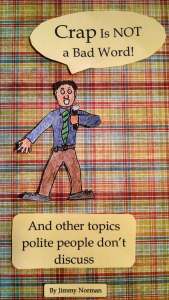
Now available on… you guessed it… the Amazon Kindle!

When I first saw the book When Life Gives You Lululemons by Lauren Weisberger, I didn’t know what Lululemon was. I don’t like to start off a review by admitting that I didn’t know something that’s common knowledge, but I believe I should be upfront about these things.
Anyway, I was in the bookstore with my daughter while she was picking up books for her summer reading list (summer reading list, haha!). As we stood in line, I dramatically read the titles of bestsellers that were propped near the entrance. I admit, that sounds obnoxious of me, but I wasn’t loud. With my quiet voice, only my daughter could hear, and it’s a parent’s job to be obnoxious to the kids in public.
“The… President… Is… Missing” I said, trying to imitate a movie trailer professional.
She ignored me.
“The… Out…Sider,” I said.
Nothing.
“When… Life… Gives… You… Lululemons,” I said.
Still nothing.
“What… the… heck… is… a… lululemon?” I said, maintaining my movie trailer tone.
My daughter finally snickered at me. “You’ve never heard of Lululemon?” She was talking normally.
“I… have… NOT!”
“It’s a store… at the mall… and you walk past it all the time… when we go. Are you okay?”
She asks me if I’m okay whenever she thinks my memory is getting bad.
“I’m fine,” I said. “I’m pretty sure I’ve never known what Lululemon is.”
And that was it. Since the book title caught my attention, I figured I’d give it a try. I’m not sure the store Lululemon will be around in 20 years, but a lot of bestselling authors don’t care about stuff like that. So far, When Life Gives You Lululemons is an easy novel to read, except for some of the dialogue.
Much of the dialogue in When Life Gives You Lululemons is in block paragraphs. I don’t speak in block paragraphs, and the people I know don’t speak in block paragraphs. We keep things brief. Maybe there really are people who speak in block paragraphs. To show you what I mean, here’s a scene where Emily (who I think is some kind of consultant for celebrities) finds out in a phone call that somebody else’s client has dressed like a Nazi at a public event and needs immediate advice. Here’s a quick sample of dialogue starting with Emily:
“Okay, then right now I want you to text your colleague and have him get Rizzo into the men’s room and out of that getup. I don’t care if he’s wearing a gold lame’ banana hammock, it’s better than the Nazi thing.”
“I already did that. He gave Riz his button-down and shoes, confiscated the armband, and let him keep the trousers, which apparently are bright red. It’s not perfect, but it’s the best we can do, especially since I can’t reach Rizzo directly. But someone will post something any second, I’m sure.”
“Agreed. So listen up. Here’s the plan. You’re going to jump in a cab and head over to 1 OAK and forcibly remove him. Bring a girl or two, it’ll look better, and then get him back to his apartment and don’t let him leave. Sit in front of the damn door if you have to. Do you have his passwords? Actually, forget it-just take his phone. Drop it in the toilet. We need to buy ourselves time without some idiotic tweet from him.”
The entire dialogue is a lot longer than this (a lot longer) and could have easily been cut by a few pages. Do people really talk in block paragraphs? Block paragraph dialogue sounds unnatural to me, but it could be my own experience. If the rest of the book is like this, it would be a tough read for me. But maybe it’s not so tough for the actresses and actors who’ll be in the movie.
To fix block paragraph dialogue, all you have to do is get rid of a bunch of unnecessary stuff. If details like the red pants play a part in the story later, keep those references, but I bet most of those details don’t matter later on, so you can probably get rid of them. And you don’t have to say “idiotic tweet” because the “idiotic” is implied when you say “tweet.” Anyway, here’s my quick fix:
“Okay, get Rizzo out of that get up right now.”
“Done, but someone will post something any second.”
“Agreed, so here’s the plan. Get him out of there and back to his apartment. Bring a girl or two, and don’t let him leave. Take his phone. We need to buy ourselves some time without him tweeting.”
Maybe I’m wrong. Maybe people really do talk in block paragraphs, and I’ve just never noticed. I wouldn’t be surprised. After all, a few days ago I didn’t know what Lululemon was.
*****
What do you think? Do people really talk in block paragraphs? Or are long block paragraphs of dialogue a necessary evil? If you think this was bad dialogue, what would you do to fix it?
The summer reading list has always struck me as odd, unless it’s a school assigning books over the long break. If you’re an adult and you give yourself a summer reading list, that means you’re planning out what you’ll read ahead of time. I’ve never done that. I improvise my summer reading. I try to plan out everything else in my life (usually unsuccessfully), but my reading is spontaneous.
Last week, former President Obama released his summer reading list, and a few news outlets reported on it. Even though Obama isn’t president, a lot of people wish he still were, so this kind of story probably gets views. Our current president doesn’t really put out book lists, so news junkies who are into that have to go to other politicians.
Like me, President Trump doesn’t have a summer reading list, but that’s because he doesn’t read books. A lot of people make fun of President Trump for not reading books. They think it’s a sign of willful ignorance or stupidity. Even though I write a lot and have a book blog, I disagree. I’ve known a lot of people who don’t read books, and intelligence has nothing (or little) to do with it. Just as we book readers don’t understand how somebody DOESN’T read books, non-book readers wonder why we’re wasting our time. From their point of view, you’re not accomplishing anything worthwhile when you’re reading a book. You could be fixing something, creating something, building relationships with other people (or destroying them). Instead, we’re sitting in a quiet corner or room by ourselves reading.
It’s a different perspective. At least Trump isn’t lying about the books he reads. If anything, he might be lying about not reading books. Maybe he reads lots of books but lies about it so that nobody can figure out his mindset by looking at his reading list. It’s a stretch, but I’ve seen paranoids do a lot more to keep secrets.
Former President Obama isn’t just putting out a book list. He’s also signed a huge deal with Netflix to produce some stuff, even though nobody in the general public knows what that stuff is yet. Obama has claimed that education is a priority to him, but a study (that I wrote about last week ) shows that the use of Netflix and other streaming services is leading to a huge decline in reading. Maybe that study was wrong. Maybe that study was financed by BIG PUBLISHING to fit with their pro-reading agenda. Those dirty SOBs!
Maybe Obama plans to turn his favorite recommended books into Netflix programming, but some of the books that Obama has on his reading list might not make for the best binge watching. Books like Why Liberalism Failed by Patrick Deneen or In the Shadow of Statues: A White Southerner Confronts History by Mitch Landrieu sound like they would bore the average person. That’s okay. When he was president, Obama bored the average person too. When he got off script, he rambled, said “Uuuh,” and cameras caught audience members falling asleep. I think President Obama even fell asleep a couple times during his speeches.
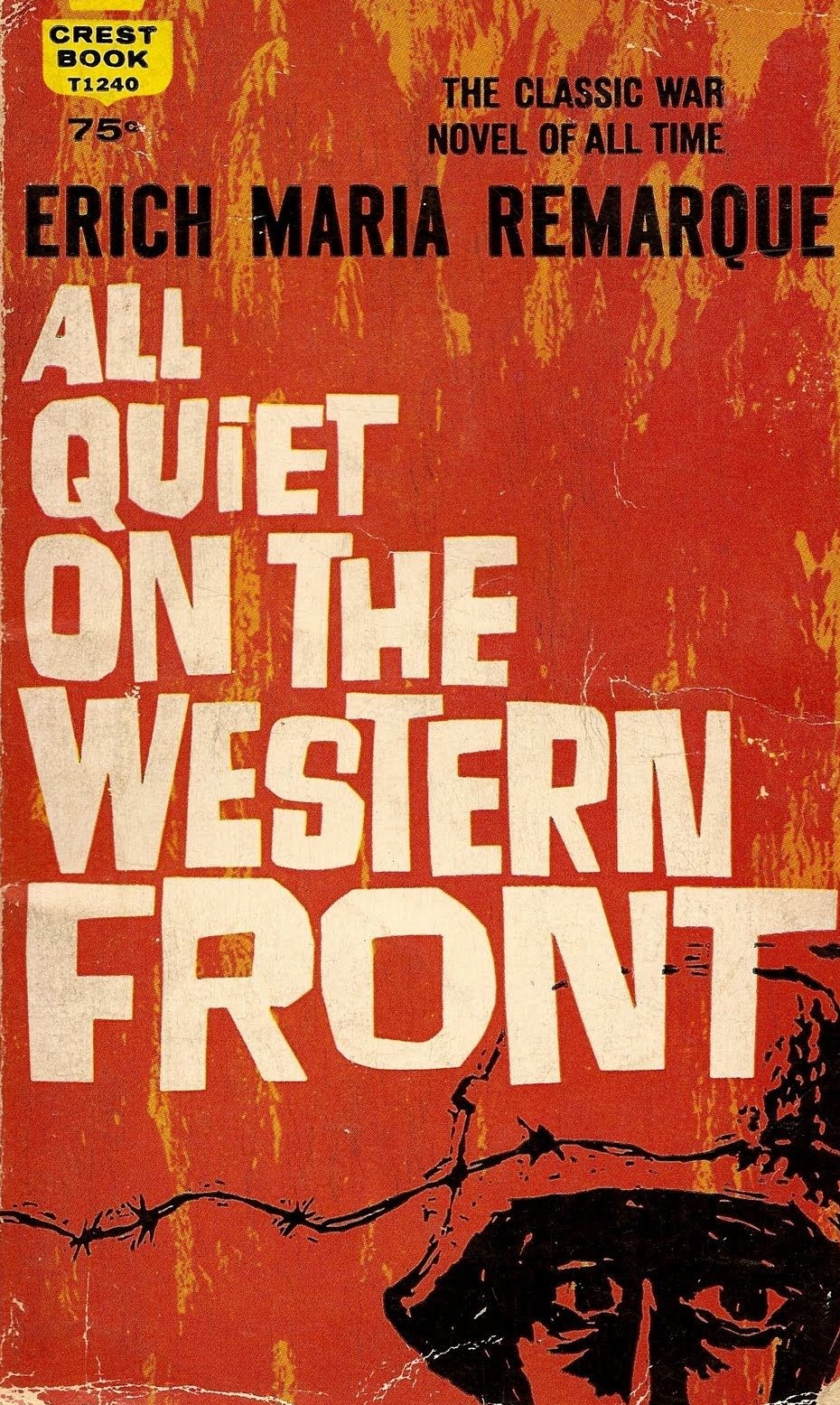
At least nobody gets bored during a Trump speech. People get mad. People get high blood pressure. People get into fights. But people don’t fall asleep. And the two(?) books on Trump’s reading list would be more interesting to the average person. All Quiet on the Western Front by Erich Maria Remarque is universally accepted as a great novel. It’s thought of as the first anti-war novel, so Trump critics who think he’ll get us into a war can feel better about that (unless you think that selection is a feint, which it could be). The Bible is kind of widely read as well. Whenever I make a book list, I add The Bible, just to be on the safe side. Maybe that’s what Trump is doing when he includes The Bible, negotiating for the afterlife. That’s Trump for you, always negotiating.
If I had to choose between reading lists, I’d take Trump’s over Obama’s. It’s not that I prefer him as a president. It’s just that his reading list is much shorter, and it never changes. Next summer, when Obama comes out with another collection of books, most of which won’t interest me, I can know that I’ve already read everything on Trump’s list and move on. That’s what I like to do with most reading lists, ignore them. I like to write about reading lists, but I don’t actually like to read the books on them.
*****
What do you think? Do you ever get influenced by anyone else’s reading lists? What recommended books have you enjoyed in the past?

The only reason I know about this book is because a website article billed it as a ONE-SENTENCE NOVEL. That was a selling point in the headline. It’s a ONE-SENTENCE NOVEL!!! I usually don’t ALL CAP stuff, and I don’t usually use a bunch of exclamation points, but I think a ONE-SENTENCE NOVEL is worth both. I’m talking about a book called Solar Bones by Mike McCormack. At first, I wasn’t sure that this book would have been taken seriously because of a gimmick like the ONE-SENTENCE NOVEL, but Solar Bones has won a bunch of awards (especially in Ireland), so I guess somebody in the literary community thinks highly of it.
At first glance, Solar Bones looks like poetry to me. There’s lots of repetition, the lines are uneven but appear as stanzas mixed in with prose-looking paragraphs. There’s no punctuation or capital letters used to begin clear thoughts.
When I read Solar Bones as a poem, it makes sense. When I read it as a ONE-SENTENCE NOVEL, then it’s almost gibberish. I can understand why it was promoted as a ONE-SENTENCE NOVEL. When you announce that a book is a ONE-SENTENCE NOVEL, curious people will want to read it. And it worked with me. I thought, a ONE-SENTENCE NOVEL… I bet that sucks to read. But I looked at it anyway
I don’t know if Solar Bones is any good or not. I admit that in certain matters, I can be literal. There are some nuances I pick up on and others that go way past me. There’s a part of me that thinks literary authors write borderline gibberish just to see what they can get away with. I think that with art too. If enough critics refer to a dot as brilliant artwork, then enough common people might believe it so that the dot becomes valuable. I’m not saying this happens; I’m just wondering if this happens.
I mean, James Patterson writes garbage novels that become bestsellers because his name on the cover means (to some people) that the book will be worth reading. This can work the other way too. If enough literary critics say that the ONE-SENTENCE NOVEL is brilliantly written, then it’s brilliant to a bunch of other people who might not understand they’re being scammed.
Don’t let me try to persuade you. Here’s an excerpt:
yes, I know this man and I know his sister Eithne and I knew his mother and father before him and all belonging to him
or more intimately
of course I know him-Marcus Conway- he lives across the fields from me, I can see his house from the back door
or more adamantly
why wouldn’t I know him, Marcus Conway the engineer, I went to school with him and played football with him-we wore the black and gold together
What do you think? Does that look like poetry? Or can you see that as being part of ONE-SENTENCE NOVEL?
When I read this, I saw a couple logical sentence breaks. To me, this isn’t a long sentence. It’s an interesting style, maybe, but it’s not a ONE-SENTENCE NOVEL. Maybe somebody will claim it’s a run-on sentence, but that’s an incorrectly written sentence, and any uneducated hack can do that (except maybe the part about making an entire novel out of it).
If Solar Bones had been promoted as a 270+ PAGE POEM, I would have thought, I’ve already read The Iliad and The Odyssey… I think I’ll pass. Therefore, I believe the ONE-SENTENCE NOVEL was a brilliant marketing campaign to turn a long poem into a groundbreaking, world record breaking sentence. But it’s really a poem.
The ONE-SENTENCE NOVEL isn’t the worst idea I’ve seen for a book. A long time ago, some guy wrote a novel that didn’t include the letter E. It was a great gimmick but a lousy book. I even called it the Worst Book Idea Ever! I think I hurt somebody’s feelings when I did that. I didn’t mean to. I forget sometimes that words can hurt, whether they’re in poetry, a ONE-SENTENCE NOVEL, or an obscure blog post.
*****
What do you think? Is Solar Bones really a ONE -SENTENCE NOVEL, or is this just poetry promoted as a gimmick, or is it something in between?

(image via wikimedia)
This one is tough to write. As popular as Netflix is, the binge watching that it’s encouraged has some really bad side effects. Viewers get bad posture and poor eyesight from staring at their phones. Viewers are too eager to spoil details, and binge watchers get too angry when something is ruined.
The latest side-effect (and maybe the worst) is that binge watchers end up reading fewer books. This comes from a German study (discussed here) that might or might not be flawed. I’m not an expert on these kinds of studies. I always assume a study is flawed in a major way, unless I agree with its premise, and then I’ll give it a chance. The results of this study make sense to me. Plus it’s a German study. The stereotype is that Germans are efficient (maybe TOO efficient), so if I’m going to believe a study, I’d believe a German study. Even without the study, I can understand why Netflix would lead to less reading.
There’s been a progression in TV viewing over the last 50 years. At first, there were only three television stations (PBS didn’t count), and they’d go off the air sometime between 11:30 and 1:00. In other words, TV was over for the day. When that happened, kids would either read or go to bed. Then we got cable, with hundreds of stations, most of which were on 24 hours a day. You could sit with a remote control and click indefinitely to see what was on. Then came the internet, and then you could click and scroll indefinitely. Now with social media, you can click, scroll, comment, and post pics of yourself indefinitely.
Next comes the binge watching. The word binge has always had a negative connotation. If you binged food, you ate too much and sometimes had to purge (and that is really disgusting). If you binge drank, you intentionally got drunk, and then got into fights, passed out, crashed your car, or slept with somebody else who was drunk. All of that is bad. Binge watching is bad too because ten hours straight of almost anything is bad. Even ten hours of reading is bad (Get up and exercise, you bookworm!).
Of course, all that Netflix binge watching is going to keep people from reading. According to the study mentioned earlier, the number of people buying books in Germany decreased almost 20% between 2013 and 2017, and a major reason was the binge watchable shows provided by Netflix and other streaming services. There’s only so much time in a day. If a person is going to spend three hours a day online (and much of that binge watching shows), then that doesn’t leave much discretionary time for reading books.
Netflix has a weakness, though, which I call Netflix Syndrome, and it applies to a lot of current TV shows. When you design a TV series around binge watching, individual episodes become meaningless. I’ve seen a few series where you can fast forward through unnecessary subplots and watch a ten-episode series in less than three hours. Binge watching turns into speed watching, and you can release spoilers before anybody else has finished watching the whole thing. My daughter has already started doing this (“Nothing really happens until episode 8, and then OH MY GOD!!”- I’ve overheard her say) With so much dead time in their shows, viewers can become bored very quickly.
This Netflix Syndrome gives books an opportunity to make a comeback. If my daughter and I are bored by Netflix Syndrome, others will be too and pretty soon. As much as I hate to say this, famous author James Patterson has a decent model to compete with Netflix users. Ugh, James F***ing Patterson. I hate giving James Patterson credit for anything, but he kind of has the right idea; write short, simple books with lots of action. Unfortunately, Patterson overdoes it with two-page chapters, overuse of clichés and mixed metaphors, bad unrealistic dialogue, and over the top cheesiness.
For example, his Bookshots a couple summers ago had potential, but the writing was so cheesy/crappy that the books couldn’t be taken seriously. Bookshots was a stupid name too, and I couldn’t tell who the intended audience was. Even though the books were short (as if intended for YA), the subject matter in some of the books was adult. If I were a fiction author with clout (and maybe more talent), I’d follow the Patterson model without insulting the readers. I’d be clear/consistent with the intended audience. And I wouldn’t call it Bookshots.
Despite all that, James Patterson has a chance to save readers from the addiction of binge watching. I can’t do it. I have only a blog. He has millions of dollars, millions of readers, and relationships with politicians. If anybody can save the book industry from Netflix, it’s James Patterson.
Who am I kidding? He’ll probably sign a 50 series deal with Netflix. Why save books when you can help take over the world?
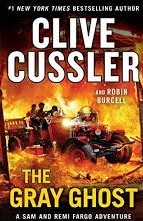
Clive Cussler and who?
When I first saw the cover of The Gray Ghost by Clive Cussler and Robin Burcell, I thought, wow, Clive Cussler’s name on the cover was really huge. I mean, I used to like Clive Cussler and he’s written a bunch of bestsellers, but he’s not an author whose name should be that big. Plus, you can barely see the co-author’s name. Even James Patterson gives his coauthors a larger font! This one’s almost disrespectful.
When I was a kid, Clive Cussler was a stud. His novel Raise the Titanic was a mega-bestseller (I don’t remember if we really had mega-bestsellers back then). I think that was the first novel that I read in one day. To be honest, we didn’t have cable (and the internet and video games didn’t even exist) at the time and it was raining outside (I liked to read, but I’d rarely finish a book in one day). The movie Raise the Titanic sucked, and that was disappointing, but I don’t blame the book for a bad movie.
Now Clive Cussler is one of those authors who seems to write two books a year, and they’re just mediocre. He (and his coauthor) could do better. I know some research goes into Cussler’s books, and that can take some time, but Cussler was writing books like this before the internet existed. Research is easier now. Maybe that’s why he’s able to churn out so many novels. Even though the internet can make research easier, it can’t really turn mediocre writing into mesmerizing prose. For some authors, that’s what the coauthor is for (or vice-versa).
To show you what I mean, here’s a scene early in the novel where a boy named Toby is watching some suspicious behavior at night in 1906 England:
As he neared the tracks, he saw a wagon stopped just on the other side, a stack of lumber strewn across the rails. Stars faded from the predawn sky, still too early for anyone to be out to help the driver who’d spilled the load. The man seemed unconcerned about moving the wood, instead just sitting there, holding the reins of his team, as the train approached.
Why would someone be moving lumber at this hour…”?
His eyes flew back to the horseman in time to see him lifting a mask over his face. In the distance, on the other side of the tracks, he saw two other horseman, both masked.
“Blimey…”
The train squealed to a stop, sparks flying up the rails. He looked at the men, saw the pistols they held. Fear coursed through his veins. He pivoted, about to run off when someone grabbed him from behind, clamped a hand over his mouth, and dragged him beneath the wooden staircase near the corner building.
Technically, this might not be a poorly written scene by the standards of a typical thriller. There’s a lot going on, and it’s easy for me as a reader to follow/visualize it. As I was reading these first couple chapters, however, I felt nothing for any of the characters. There was no sense of suspense.
The sentence “Fear coursed through his veins” probably made the scene even less suspenseful than it could have been. I felt none of the fear that a reader should feel when empathizing with a character in distress. It was almost like the authors didn’t know how to describe a person in fear (or were too lazy to do it).
Reading this Clive Cussler novel is like watching a movie with too much CGI; the ideas for a good story might be there, but the storytelling is lifeless. Most of the pieces were there in The Gray Ghost for a decent story. The Rolls Royce engine theft was interesting. The relationship between a couple of the characters could have been interesting. The orphanage stuff could have been interesting. I don’t know. Maybe I was just in the wrong mood.
When I review a Clive Cussler book, I usually mention how cool his name is. Clive Cussler, man! But after giving The Gray Ghost a literary glance, I don’t even feel like doing that. On the bright side, it’s still a bestseller!

(image via wikimedia)
Decades ago if I read a book in public, people looked at me like I was the crazy one. Back then, only losers and social outcasts read books in public. If you were normal, you either talked to others (and not to yourself), listened to your music, or stared blankly. But you didn’t read. The exceptions were at airports and… that was about it. If you were in a public place like a restaurant or a movie theater lobby and you brought a book, everybody else thought something was wrong with you.
Some guy 25 years ago called me a loser just for reading a book in public. I was minding my own business in a movie theater lobby, and this guy tapped me on the shoulder and called me a loser. I should have gotten mad, but then I saw he was wearing an REO Speedwagon t-shirt. That took some nerve, I thought, a guy wearing an REO Speedwagon t-shirt calling me a loser. To be fair, I knew the guy (a friend of a friend), and he could barely read the movie titles on the posters, but he was okay (except for his REO Speedwagon wardrobe).
When I was a kid, I even got yelled at in my own home for reading while the family was watching TV (and I was reading quietly). I never could figure that one out. I understood why reading in front of other people was rude because it looked like I was ignoring their company (I was). But getting mad at me for reading while we were watching TV made no sense. I was ignoring the TV, not my family.
As an introvert, I have always tried to avoid pointless interaction with others. I can talk when I need to, but it drains my energy more than exercise. Even though I can explain it now so that it kind of makes sense, I didn’t understand all of this when I was a kid. I just knew I wanted to read. I wanted to read at dinner. I wanted to read in restaurants. I wanted to read in the car (but I got nauseous).
Why did my parents want to talk to me anyway? Most of my responses were kind of mono-syllabic (is it ironic that mono-syllabic has a lot of syllables?)-
Mom: How was your day?
Me: Good.
Mom: How was school?
Me: Fine.
Mom: What did you do?
Me: Nothing.
Mom: What did you learn?
Me: Nothing.
Mom: Why are you giving me one-word answers?
Me: I don’t know.
“I don’t know” isn’t a bad answer coming from a kid. It’s three words, so it shows that the kid is trying. Kids use one-word answers because they’re safe. If I had actually talked about my feelings (“School sucks, it’s boring, everybody’s ugly and they all have bad breath”), I would have been called a whiner. I would have gotten speeches about how lucky I had it (that was probably true), how kids all around the world wish they could go to school (that’s probably not true), and how rough my parents had it (also maybe true, but my dad embellished his stories a lot). No kid wants to hear all that. Awkward silence is better than hearing that.
Awkward silence is an oxymoron anyway. Silence isn’t awkward. It’s what was said or what happened before the silence that makes it awkward. People should stop blaming silence. In some ways, the world would be better with more silence. If people didn’t talk so much and say inappropriate stuff, there wouldn’t be awkward silence. There would just be silence, and that would be awesome!
Speaking of silence, that’s what I see (or hear) a lot now. When I see families in a public place like a restaurant, they often aren’t interacting; they’re staring at their phones. Couples sit at booths and tables, staring at their phones. Even the restaurant employees stare at their phones between taking orders, bringing out food, and cleaning tables. I think, this is good. This is how life should be.
Yeah, I know, just because people are staring at their phones doesn’t mean they’re reading. They could be watching videos. Or they could be spreading gossip (which means they’re reading). Or they might actually be reading. Truthfully, it doesn’t matter to me. I can read, and nobody else cares. Now when people see me staring at my phone in public… they’re not actually seeing me stare at my phone because they’re staring at their own phones. The only people who’ll notice me are the traditional holdouts who don’t believe in technology or the criminals who want to conk me on the head (I always keep my back to the wall when I read in public).
The ironic part now is that when my own family eats out, I’m the one who talks the most. My wife and daughters stare at their phones, and I go into Dad mode, watching the entrances for weirdos and keeping an eye out for suspicious behavior. I have to protect my family. I can’t allow them to get conked on their heads while they’re staring at their phones. If reading in public is accepted now, somebody has to be vigilant. That’s okay. It’s my job, to provide my family with the childhood I wish I’d had. All that time when I was kid, I wished that I could read in public. Now my wish has come true. Technology has created the world I’ve always dreamed about.
But growing up in a world where people were expected to talk to each other in public and NOT read? That’s getting really tough to explain today.
*****
For more “Old Things That Are Tough To Explain,” go to Old Things That Are Tough To Explain: The Home Page.