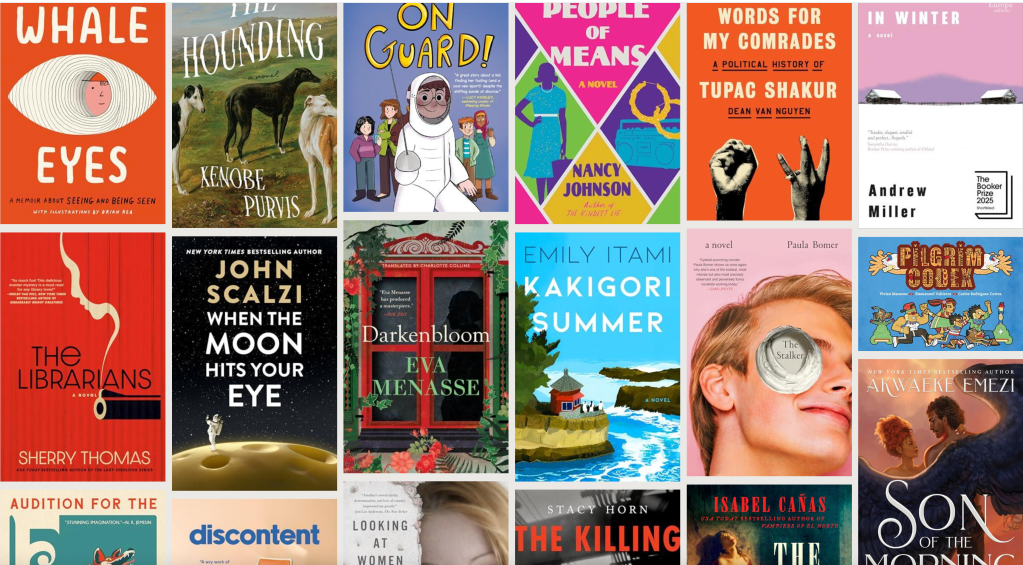
Now that 2025 is over, it’s okay to decide what the BEST NOVEL of 2025 was. The BEST NOVEL of 2025 isn’t going to be my favorite novel of 2025. I haven’t read enough novels from 2025 to have an opinion (not that lack of information/experience has ever stopped anyone from having an opinion). The BEST NOVEL of 2025 should be a novel with some kind of mass appeal but also have some literary value. Or it should be a novel with literary value but also have a certain degree of mass appeal. The important thing is that it would appeal to both critics and normal people.
I don’t want to say that the BEST NOVEL OF 2025 is the one that sold the most copies because I recognize that most bestselling authors are hacks. If you think I’m a book snob, you’re wrong. This blog is called Dysfunctional Literacy. I enjoy crappy books (“crap” is NOT a bad word). I began reading because of crappy books (kind of). Without crappy books, I wouldn’t want to read as much. At the same time, I know that none of the crappy books I’ve read are the ‘best’ books of any given year.
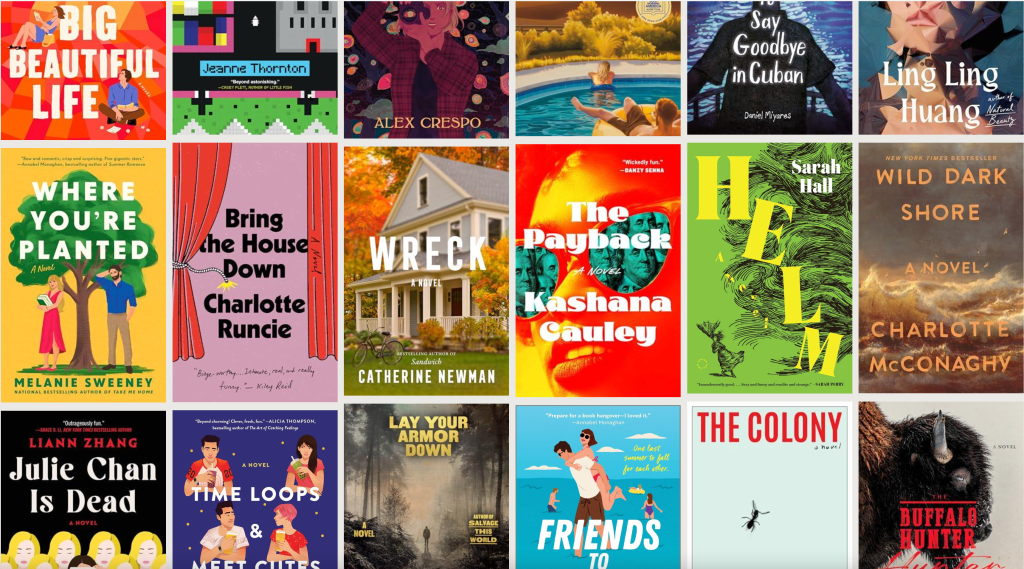
When selecting the BEST NOVEL of 2025, I wasn’t sure whether to start with the bestselling books and find the one with the most literary value or if I should start with literary fiction and find one with the most mass appeal. Luckily, the blog Literary Hub started before me. Literary Hub, (check it out at Literary Hub » The Ultimate Best Books of 2025 List) began by looking at what the literary critics said. That makes sense because the name of the blog is… Literary… Hub.
Since Literary Hub already collected data from a numerous BEST BOOKS of 2025 lists, I didn’t have to spend time reading what a bunch of literary critics thought (Thank you!). Literary Hub simply collected a bunch of BEST BOOK LISTS of 2025 (more lists than I would have had patience for) and ranked the books by how many lists each book had been chosen for. Then I took the top ten novels from Literary Hub’s book list and put each novel’s list number in parenthesis. For example, the novel that critics picked most frequently was The Loneliness of Sonia and Sunny by Kiran Desai, which showed up on 21 BEST BOOKS LISTS.
Keeping that in mind, below are the TEN BEST NOVELS of 2025, according to critics BEST BOOKS of 2025 lists:
1. The Loneliness of Sonia and Sunny by Kiran Desai (21)
2. Audition by Katie Kitamura (20)
3. Heart the Lover by Lily King (19)
4. A Guardian and a Thief by Megha Majumdar (18)
5. What We Can Know by Ian McEwan (16)
5. Flesh by David Szalay (16)
7. Flashlight by Susan Choi (15)
7. A Marriage at Sea by Sophie Elmhurst (15)
9. The Wilderness by Angela Flourney (14)
10. The Director by Daniel Kehlmann, tr. Ross Benjamin (13)
I don’t trust critics, though. They can be pretentious. They can be biased. They can be bought. They can be frauds. They can be completely sheltered from reality. Literary Hub’s achievement here is awesome, but I wanted one more step, to see which of these top ten books was the most mainstream. I don’t trust the mainstream either, though. The mainstream likes generic, easy crap. But like I mentioned earlier, so do I. I’m capable of reading the literary stuff (I’m not capable of writing it), but I prefer the fun stuff.
For the next step, I went to Amazon (the mainstream of the mainstream) and began looking at sales rank of each of the top ten books on Literary Hub’s list. Unfortunately, all of these novels came out at different points of the year, which meant there was no standard benchmark for either sales figures or sales rank. The best I could think of (and I know it’s flawed) was to use review scores and number of reviews. Again, I know that number of reviews would be affected by the publication dates, but at least we have the review scores to balance that.
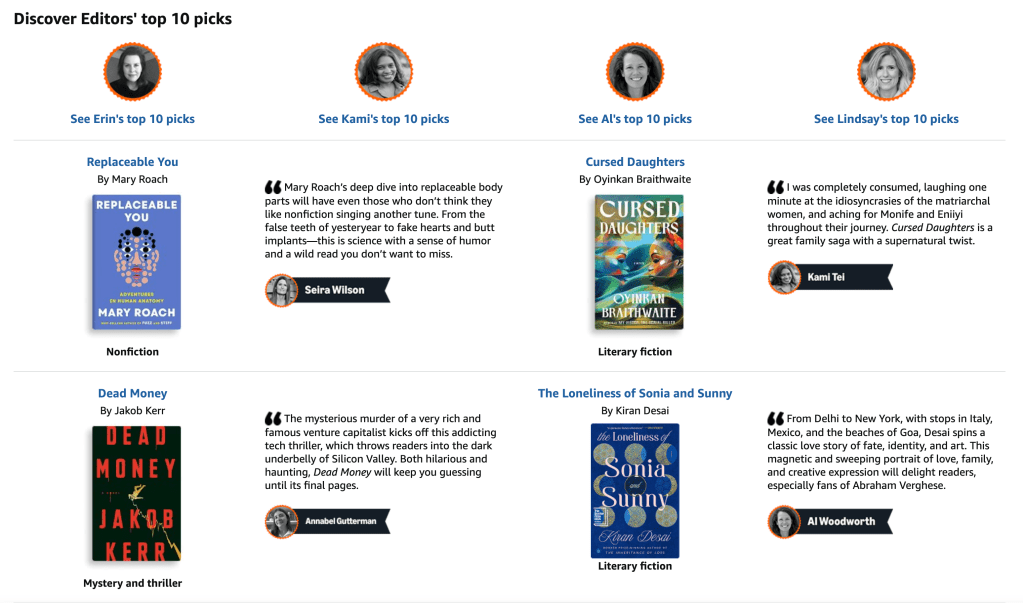
I know that reviews on Amazon might not reflect a novel’s quality, especially with literary fiction, which can be especially polarizing. Sometimes literary fiction is supposed to be polarizing, and that by itself can lead to negative reviews. Sometimes authors of literary fiction use devices that readers aren’t familiar with or don’t understand or flat out don’t like. Authors of literary fiction experiment with their writing, and everybody knows what can happen when experiments go wrong. This means that the book with the highest review score could just be the safest book.
But what else can I do? 2025 is going to be irrelevant soon, if it isn’t already, so I have to make a decision.
Aaarrrgh! I’d really like to wait 50 years and see which books from 2025 are still being read and are still relevant, and use that to make the decision, but I probably won’t be around. Maybe next week I’ll answer the question: what was the BEST NOVEL OF 1975?
Anyway, here are the top ten novels according to Literary Hub with Amazon review scores and review numbers:
1. The Loneliness of Sonia and Sunny by Kiran Desai (21) 4.2 stars from 2,200 reviews
2. Audition by Katie Kitamura (20) 3.6 stars from 2,056 reviews
3. Heart the Lover by Lily King (19) 4.5 stars from 8,920 reviews
4. A Guardian and a Thief by Megha Majumdar (18) 4.0 stars from 1,064 reviews
5. What We Can Know by Ian McEwan (16) 4.2 stars from 1,358 reviews
5. Flesh by David Szalay (16) 4.0 stars from 6,996 reviews
7. Flashlight by Susan Choi (15) 4.3 stars from 1,608 reviews
7. A Marriage at Sea by Sophie Elmhurst (15) 4.3 stars from 4,218 reviews
9. The Wilderness by Angela Flourney (14) 3.7 stars from 231 reviews
10. The Director by Daniel Kehlmann and Ross Benjamin (13) 4.2 stars from 784 reviews
Well, that was easy. Heart the Lover by Lily King had by far the highest number of reviews and the highest review scores. That MIGHT just mean it’s the easiest book to read (that isn’t necessarily bad). It MIGHT be in the most popular genre (it’s categorized in women’s literary fiction, so I guess I’m not the intended audience).
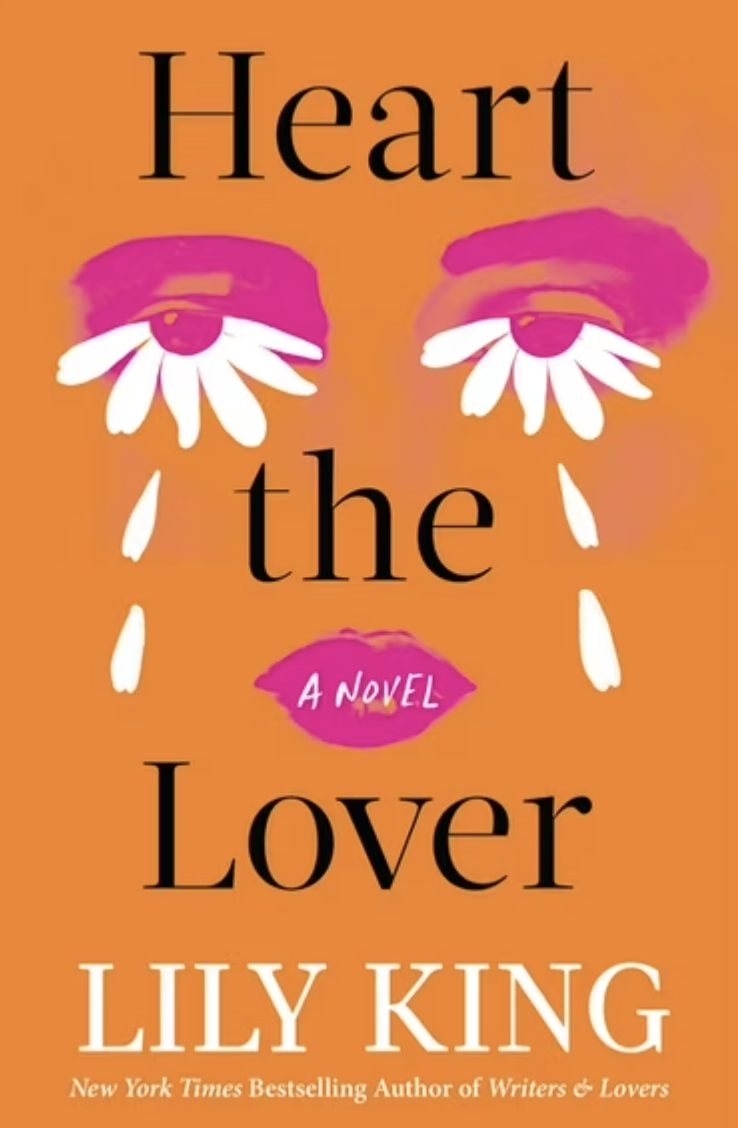
This kind of sucks, though. Since I’m a sixty-year-old male, I sense that Heart the Lover isn’t really meant for me. You might disagree, and that’s fine, but this novel HAS been characterized as ‘women’s literary fiction,’ and I’m male and somewhat sometimes anti-literary. That doesn’t mean Heart the Lover is not the BEST NOVEL of 2025, though. Being the BEST NOVEL of 2025 has nothing to do with my tastes or my opinion of the book or whether or not the book was meant for certain audiences.
According to the data that I chose to use, Heart the Lover by Lily King is the BEST NOVEL of 2025, and I’m going to stick with that (unless I change my mind later).
*****
What do YOU think? What is the BEST NOVEL of 2025? What improvements could be made to the process of determining the BEST NOVEL of 2025? If such a task is impossible, what was your favorite novel of 2025? If you haven’t read any novels from 2025, what novel from 2025 are you most likely to read? If you have no intention of reading any novels from 2025, then what novels will you… never mind.
Here are some other observations about literature from Dysfunctional Literacy:
How to Write an Award-Winning Novel starring… The Pulitzer Prize for Fiction
Pulitzer Prize for Fiction, 2018-2008: A Review
Pulitzer Prize for Fiction 2012 vs. the Oscars and the Heisman Trophy
Hondo by Louis L’Amour vs. Lonesome Dove by Larry McMurtry! What is the best western ever?
*****
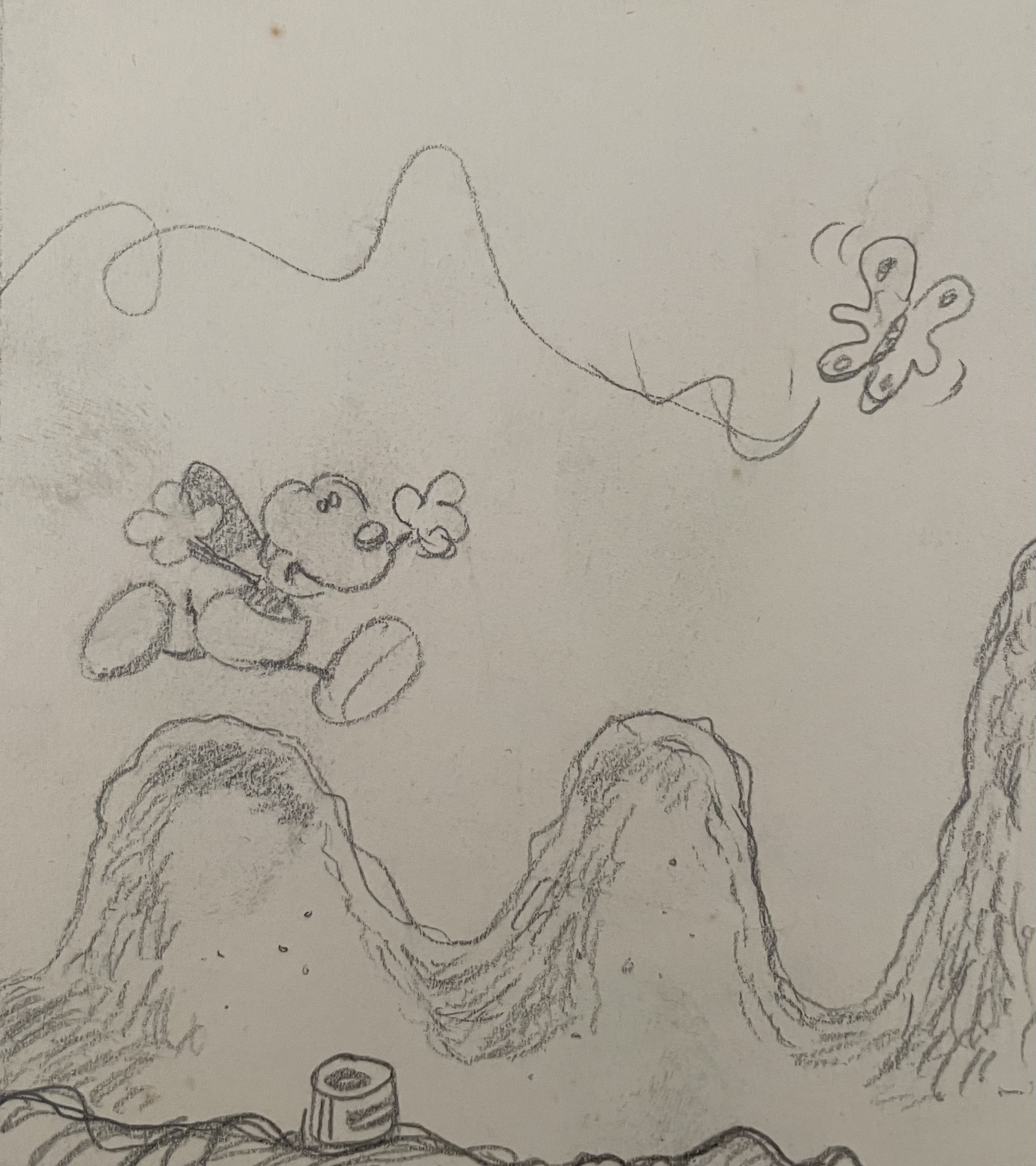
Why Dummo Mouse relentlessly pursues the butterfly, nobody knows, not even Dummo Mouse. No matter the reason for it, this simple mindless activity will lead Dummo to begin the greatest quest a junkyard mouse has ever undertaken!
*****
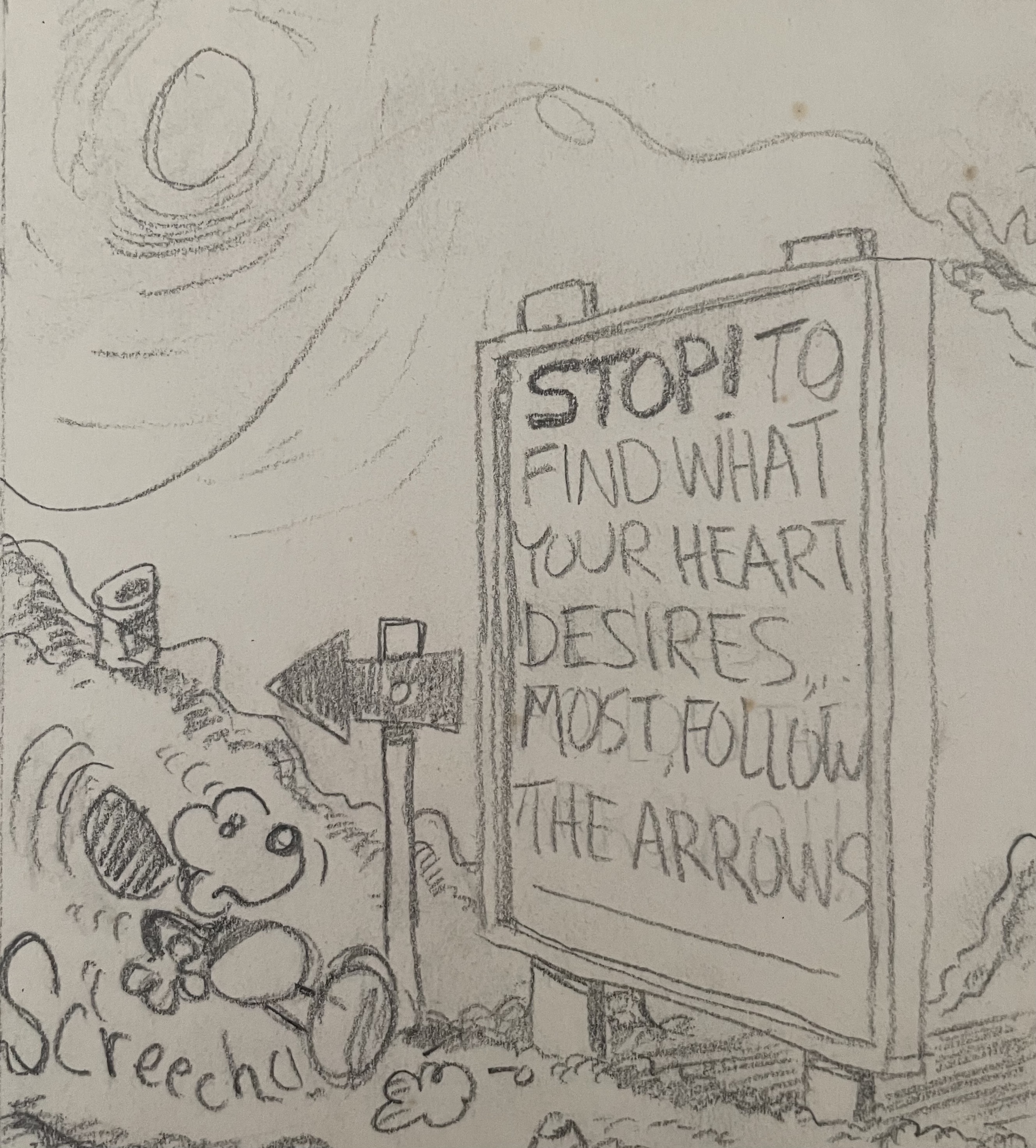
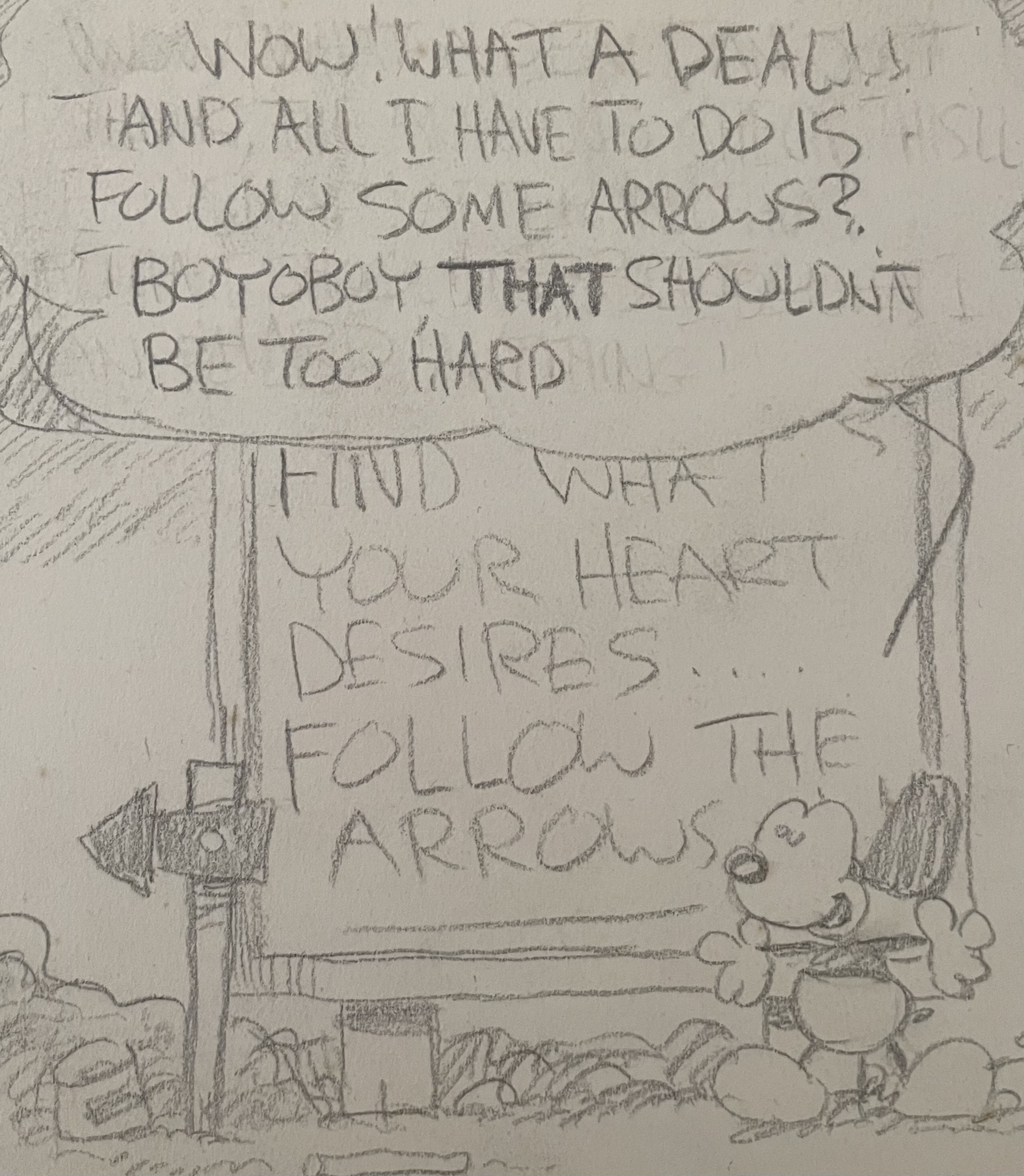
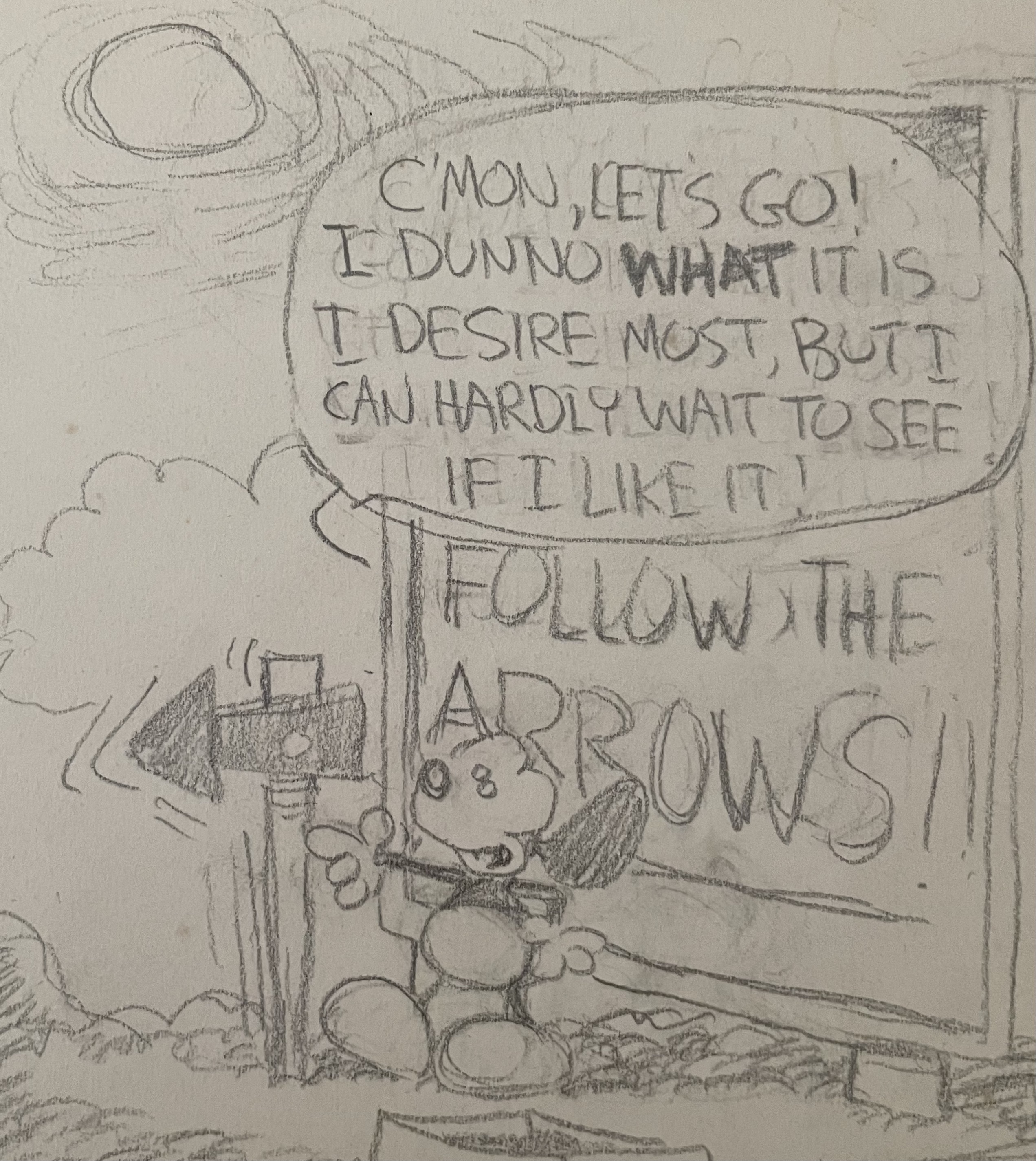
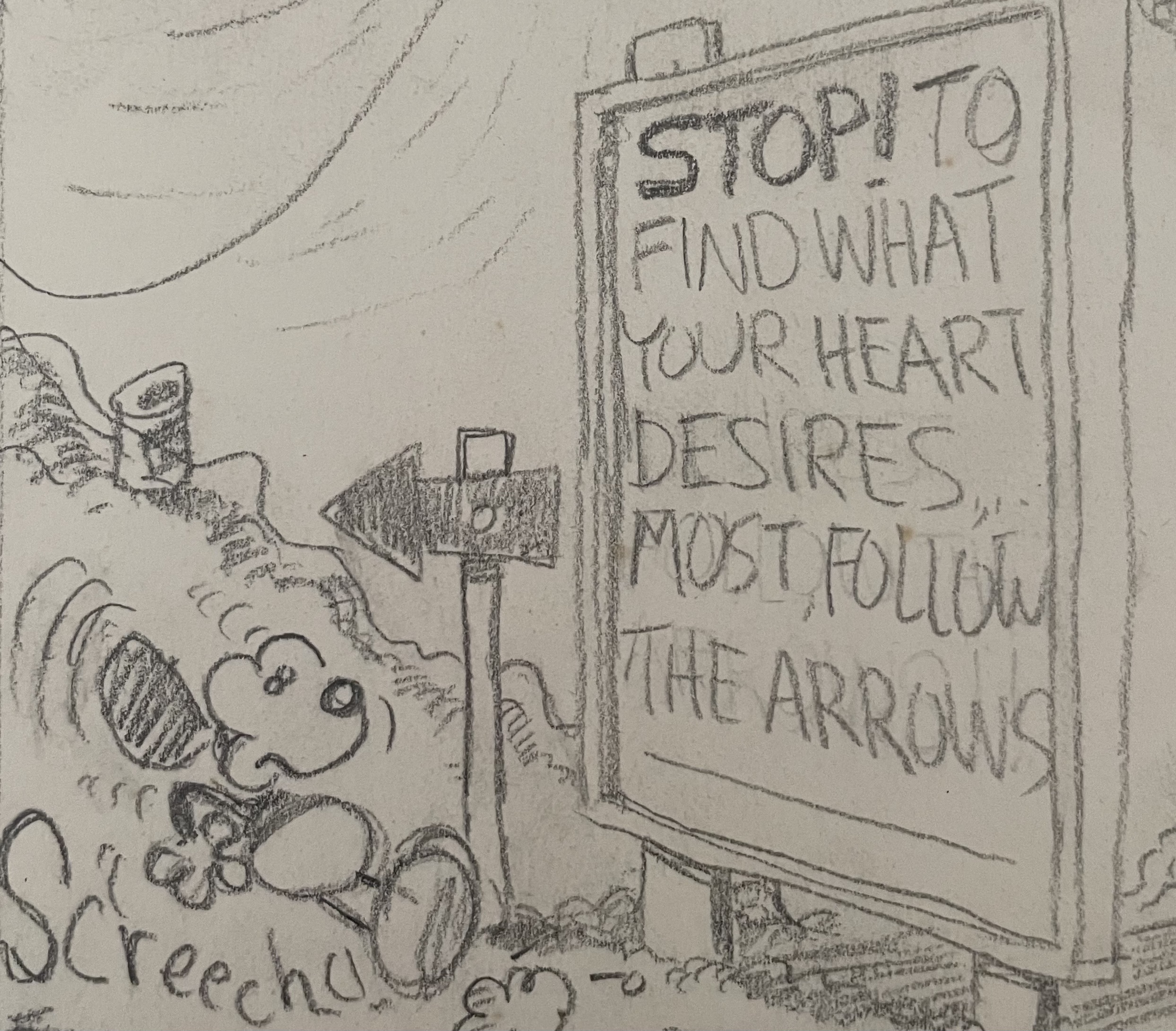
Yes, Dummo, following the arrows shouldn’t be that difficult. Keep thinking that… for as long as you dare!
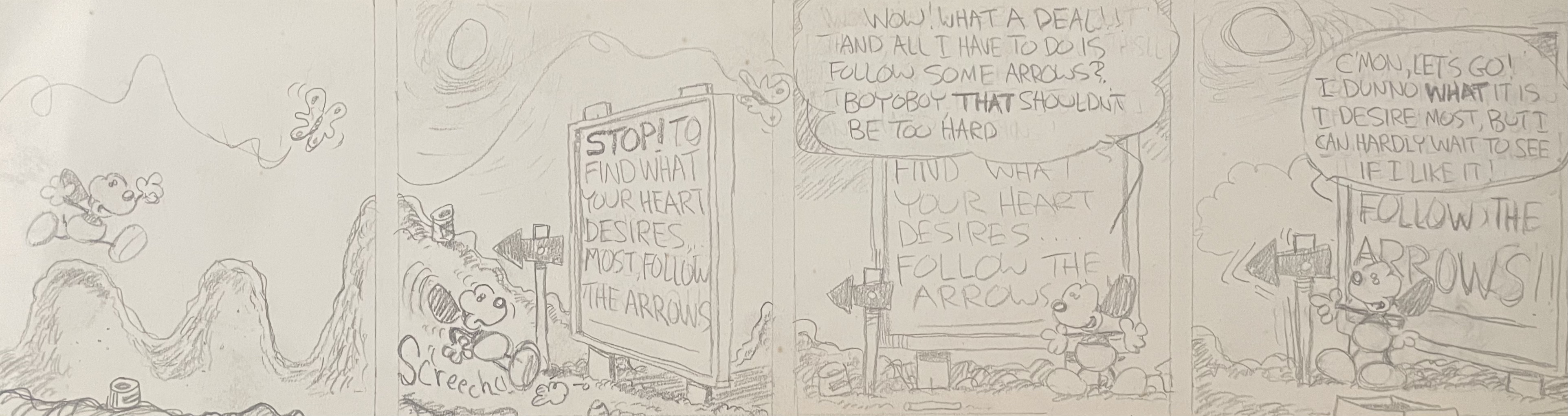
To be continued!!!
Writer: My older brother
Artist: My older brother
Creation year: 1983
Status: Unfinished (penciled, not inked)
Publication date: Today
For more original comic strips, see…
Comic Sunday: Dummo Mouse and Friend(s)
Dummo Mouse and the Daily Strip
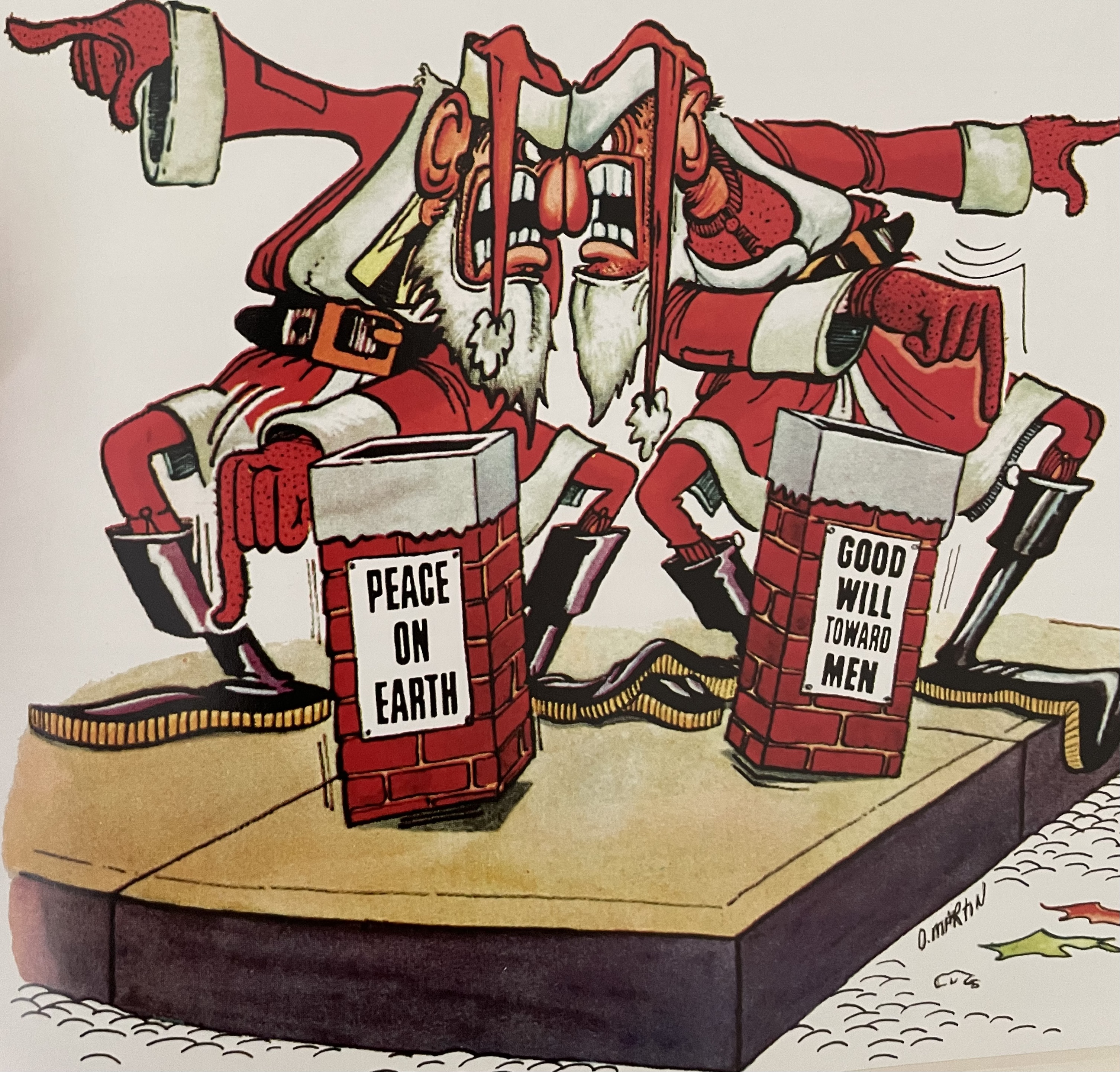
Everybody who celebrates Christmas knows what I’m talking about. There’s always somebody in the family or friend group that “ruins” Christmas (or at least tries to). This can come in many behaviors, and I’ll get to some of them later. I have decades of Christmas memories, and most of them are good, but some of the memories that stand out the most are of those goofs who ruined Christmas with their antics.
The term “ruined” comes from a grandma of mine who said a younger relative of ours “ruined” Christmas with his horrible behavior (basic temper tantrums, rookie stuff compared to future behavior). I was ten at the time, and little did I know that there were plenty more ruined Christmases to come.
Sometimes I have sympathy for the people who ruin Christmas. Some of these goofs associate Christmas with bad childhood memories. Some get annoyed at the overwhelming atmosphere. Some can’t hear the same happy (or solemn… or outdated) song repeatedly. I understand all of that, but none of these circumstances justifies bad behavior.
Me? I enjoy the Christmas Season. I like spending time with family members whom I haven’t seen for a long time. I enjoy the anticipation of the upcoming events. I savor the time of reflection that comes with The Season, and I get a slight wave of nostalgia, even for those goofy relatives who have ruined past Christmases.
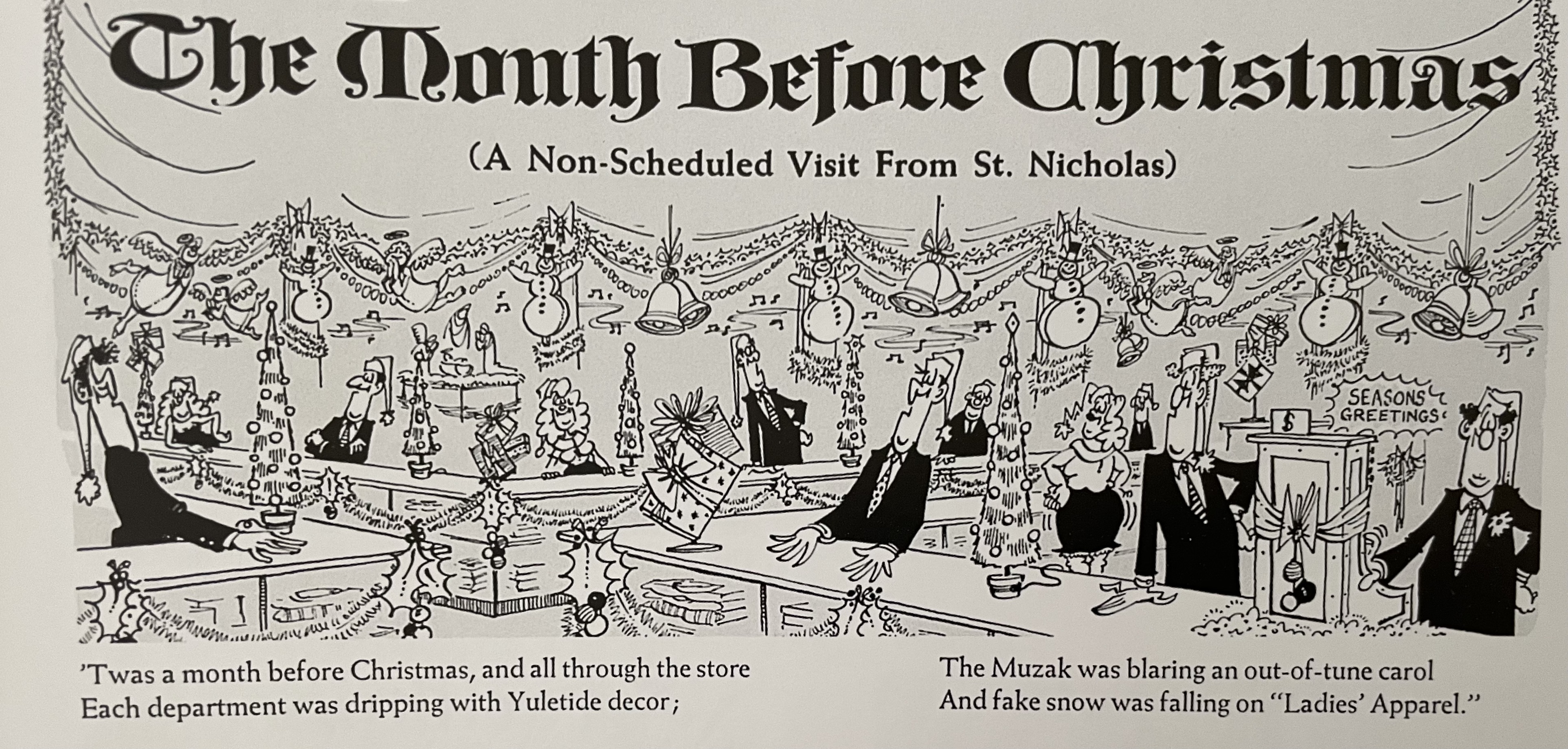
For these anecdotes of ruined Christmases, I’m going to refer to everybody as a ‘goof’ and use male pronouns for them even though some of the ‘goofs’ will be women. Yes, women are just as capable of ruining Christmas as men are, but sometimes they’ll cry and act like victims afterward, so you might accidentally blame a man for the woman’s infractions. To be fair, we men would pull the same trick if we could get away with it, but most of us can’t.
Most of the goofs I refer to today are no longer with us, but I still don’t want to name names or gender genders because I don’t want to incriminate/alienate any family members who are still around and might read this (but probably won’t). If they do read this, they’ll probably know whom I’m talking about but will still appreciate not being called out specifically. They’re aware of their social crimes. They probably are/were proud of their social crimes.
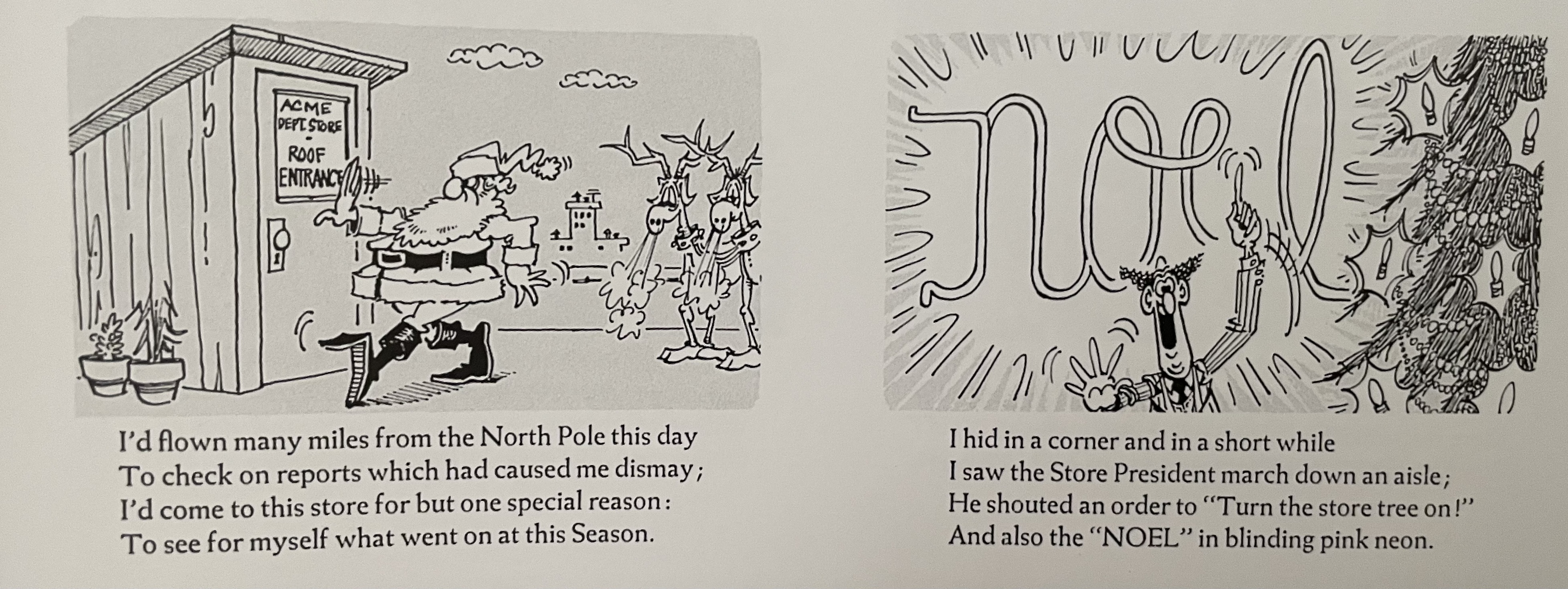
Decades ago, one goof would drink too much at Christmas. He would be fine during Christmas Eve because we would go to church during the late Christmas Eve service, and he knew it was bad to show up to church slurring his speech and smelling like a brewery. He would be fine, sometimes even jovial, on Christmas morning, but as Christmas Day wore on, he would become cranky and at some point he would throw an overreacting fit at something stupid (hearing the same Christmas song repeatedly, somebody else eating the last piece of pie, etc…)
Years later, after everybody had moved out and gone separate ways (we didn’t stick together like some families do), this goof admitted that he drank because he always felt like Christmas was a letdown after all the buildup. Looking back, I think he should have known better. He was old enough at that point in his life to know that almost everything is a letdown after all the hype. The key is not to build up the hype; then you can enjoy what you get (unless it really sucks… like somebody else getting the last piece of pie. In that case, it’s okay to feel let down. By the way, I’m sorry about that. It was good pie).

There was another Christmas where a goof (a family guest) ruined a Christmas Day by starting an argument over politics. Instead of rolling eyes or changing the subject, a second goof ( a family host) further ruined that Christmas Day by taking the bait. Neither backed down, both of them ranted and screamed at each other, and both of their moods were foul the rest of the day. They didn’t talk to each other afterward. They snapped at others not involved in the spat. Then the rest of us quietly mocked them when they were in other rooms.
To me, both of the Christmas combatants were wrong. When you’re a guest, you don’t bring up a contentious topic that you know the host will disagree with. If you do, you make your statement and move on. If you’re the host, you let the guest commit the social infraction and let it go. Luckily, everybody else stayed out of it, so escalation was only between two people. But the family had to suffer with the foul moods of the two goofy nutjobs (though I love both of these nutjobs… it was a bad moment for both). And we were right to mock them.
If I had to choose who was worse, it’s the goof who started it, but adults should figure out at a certain age… YOU DON’T TAKE THE BAIT!!! If you take the bait, you’re a goof too.

Another Christmas, some goof complained about the presents that he got. A bunch of us had taken some time and effort being creative (and even spent a fairly significant amount of money) coming up with a variety of gifts that we thought he’d appreciate. He acted like he liked them at first and then a couple hours later declared that it was weighing on his mind that he didn’t like his gifts at all and that it was important to us and to him that we should know. He said he felt like we hadn’t put any thought into it. And then he fumed.
Sometimes I’ve been puzzled by gifts I’ve received, but I never felt like others had to know about it. And it never “weighed on my mind.” I realized later that this goof was very unhappy about something else (of course), so this incident was a one-time deal. But yeesh, what a downer. And what a goof!
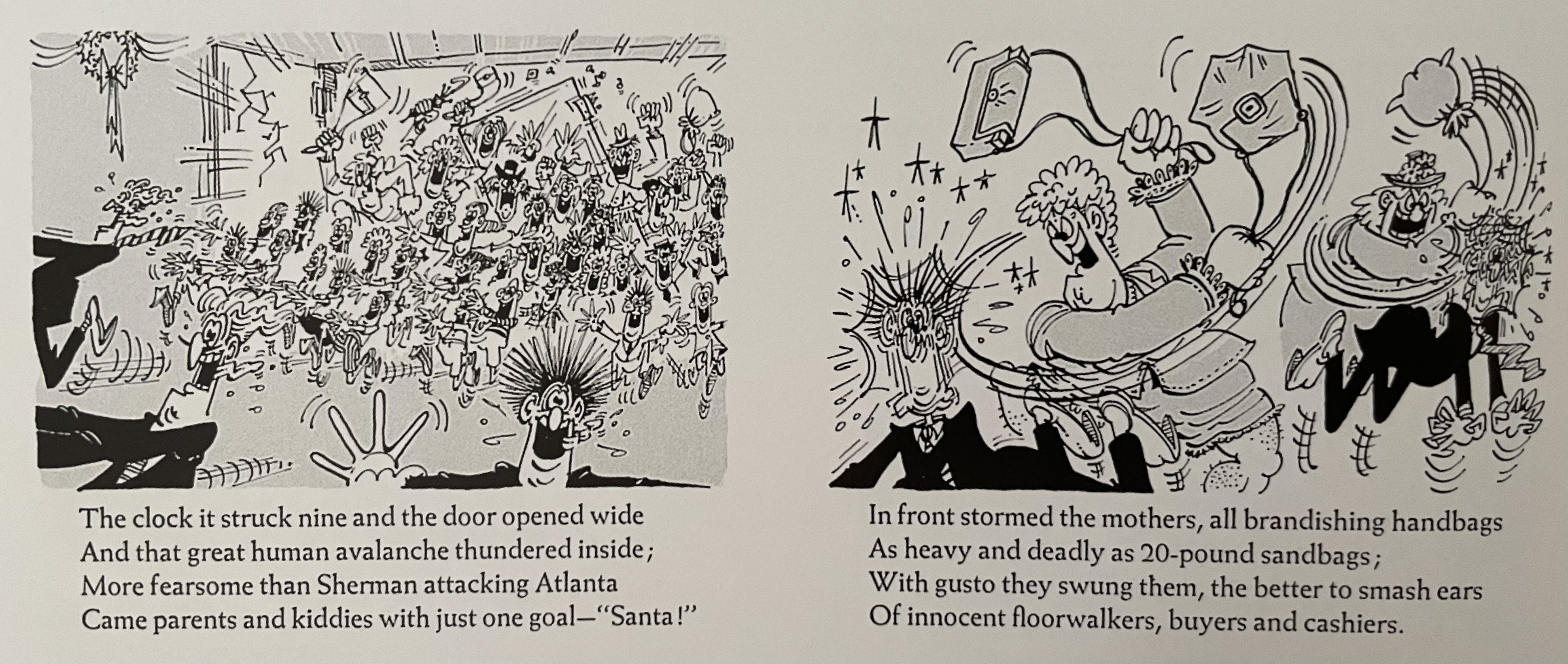
One year there was some national tragedy on Christmas Day (or Christmas Eve), so this goof in our family kept the tragedy on tv with the volume up for the entire day. At every top of the hour, he tried to shush us when the 24 hour news channel would lead with its BREAKING NEWS, and most of the time the BREAKING NEWS was the exact news from the previous hour or two. Eventually, we mocked the news network for obsessing (and capitalizing on) a tragedy. And then we mocked the goof for falling for it. Tragic stuff happens on holidays, and you can’t pretend that you know everybody in the world.
It struck us as weird because this goof usually doesn’t get that concerned when people that he knows dies. He didn’t like hearing that from us. Truth was our Christmas gift to him.
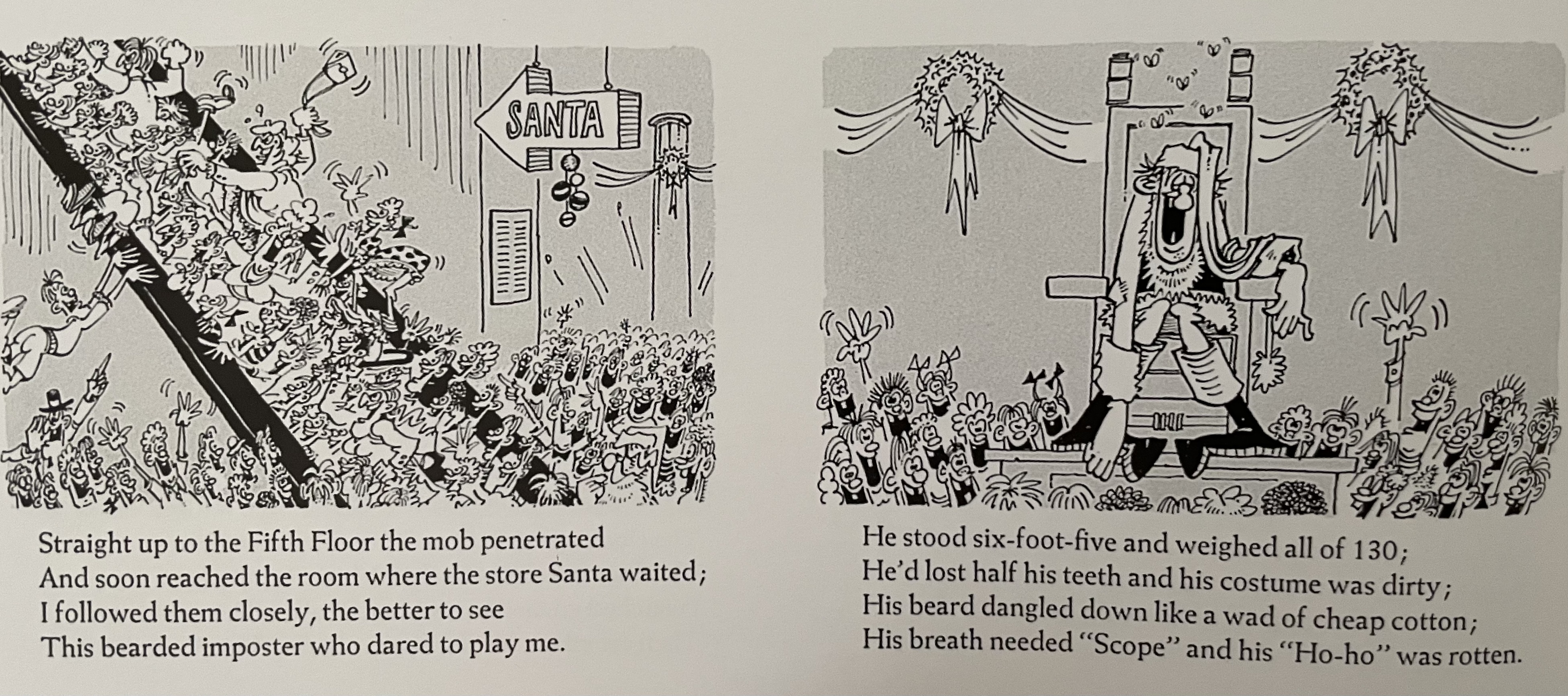
There are a lot of ways that goofs can try to ruin Christmas, but you don’t have to let them. You can ignore. You can banish. You can mock. Mockery is my favorite, except I couldn’t use that tactic when I was a kid (the retaliation would have ruined Christmas even more!). If you’re a goof who thinks he might ruin Christmas, maybe you shouldn’t stay at gatherings very long. If you have to stay for a long time, find good reasons to temporarily leave (run an errand, take a walk, etc…). Everybody appreciates the anti-Christmas goof who tries NOT to ruin the mood. If they don’t appreciate your efforts, that’s their fault, not yours.
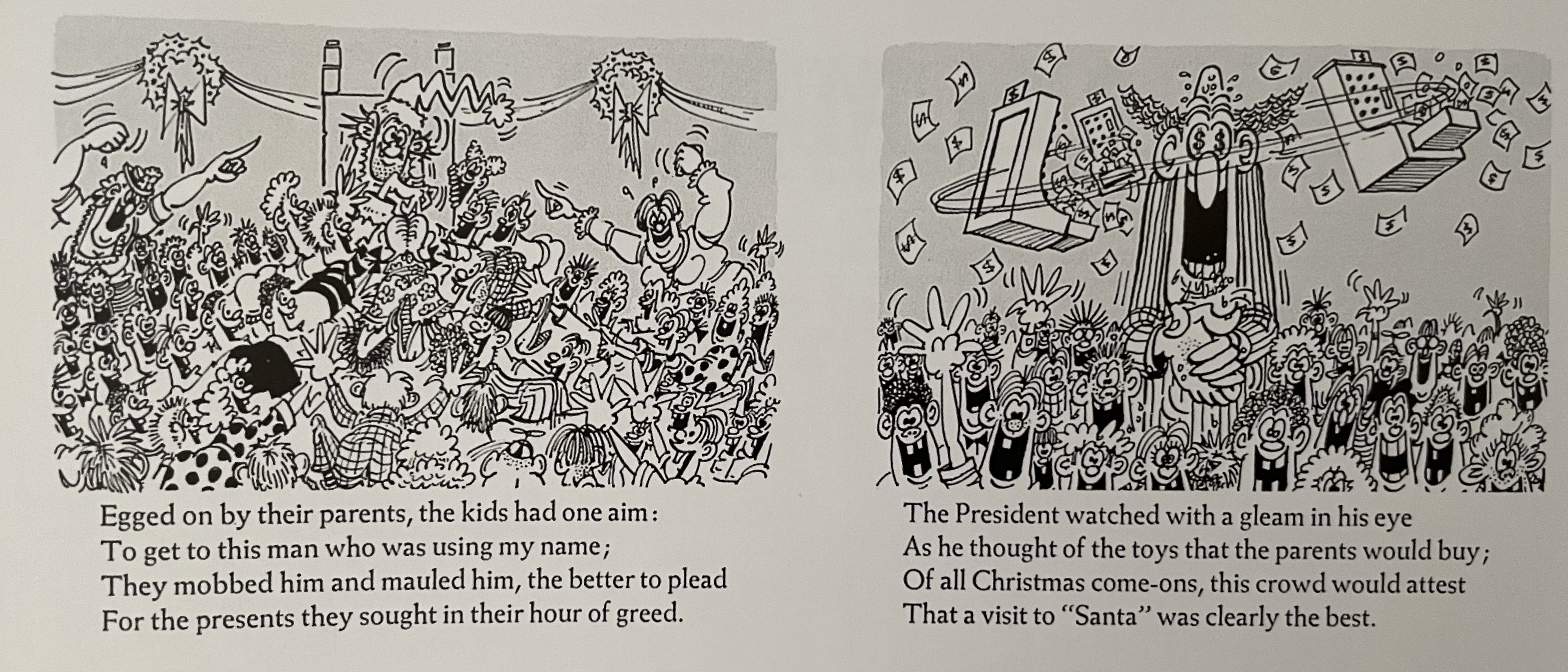
Even though several previous Christmases have been ‘ruined’ by bad behavior, I smile whenever I think about them. Most of these goofs are kind of funny, except for the political argument (the two family members were unnecessarily distant with each other after that). And these incidents didn’t truly ruin Christmas (except for the political argument). They were usually blights on otherwise wonderful days (unless I’m repressing my true feeling and don’t know it). I miss these goofs. And I wouldn’t want them to be judged solely for their bad moments (just like I don’t want to be judged solely for mine).
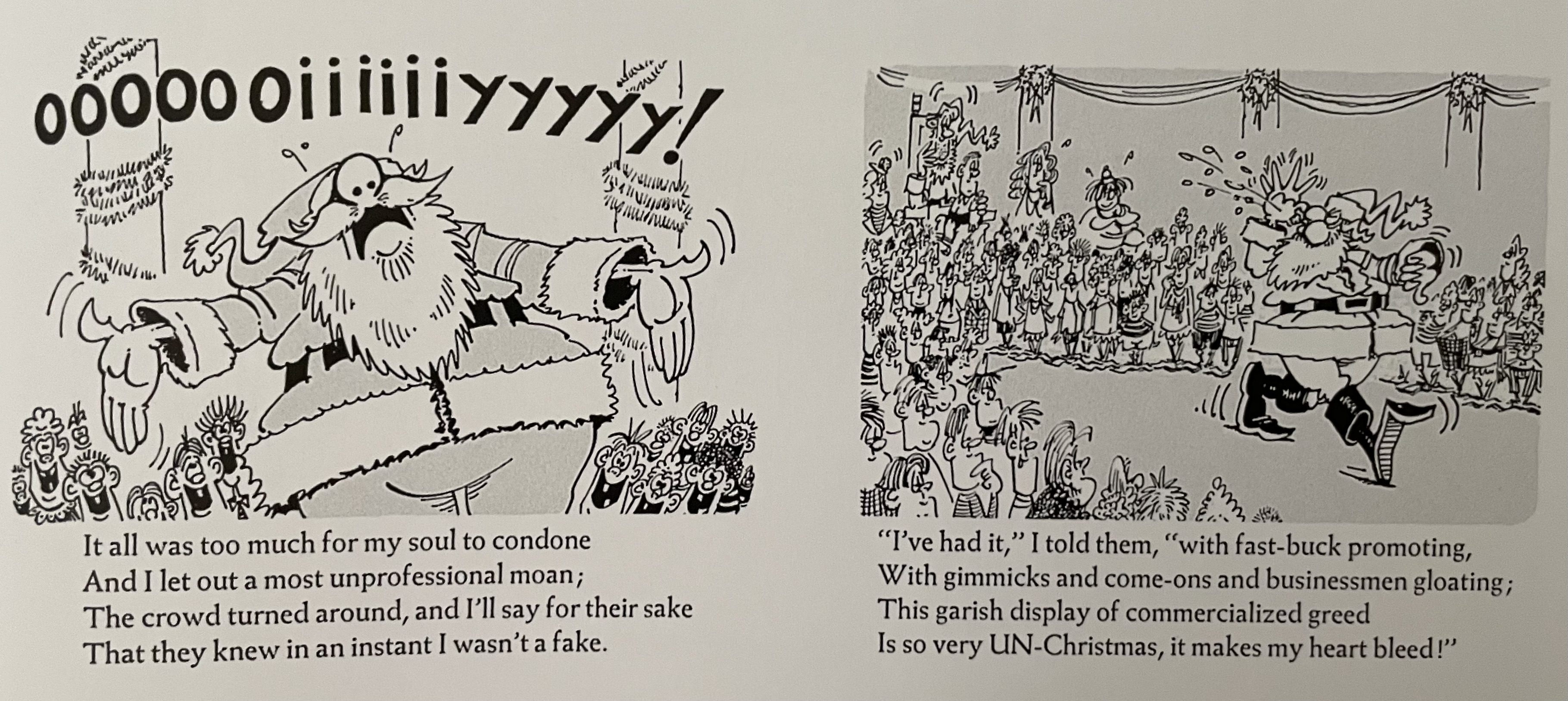
To those of you current goofs who intend to ruin Christmas, I hope your antics are foiled, but I also hope you still find a way to unintentionally have a… MERRY CHRISTMAS!!!! And maybe find a way to have a good new year too. I know it might be a challenge for you, but there’s always hope!

*****
For more nostalgia (or in some cases anti-nostalgia), see…
Old Things That Are Tough To Explain: The Divisive 1960s
Old Things That Are Tough To Explain: The Ugly 1970s
Old Things That Are Tough To Explain: Research Before The Internet
Old Things That Are Tough To Explain: You Could Only Watch It Once
Old Things That Are Tough To Explain: Why Did So Many People Smoke Cigarettes?
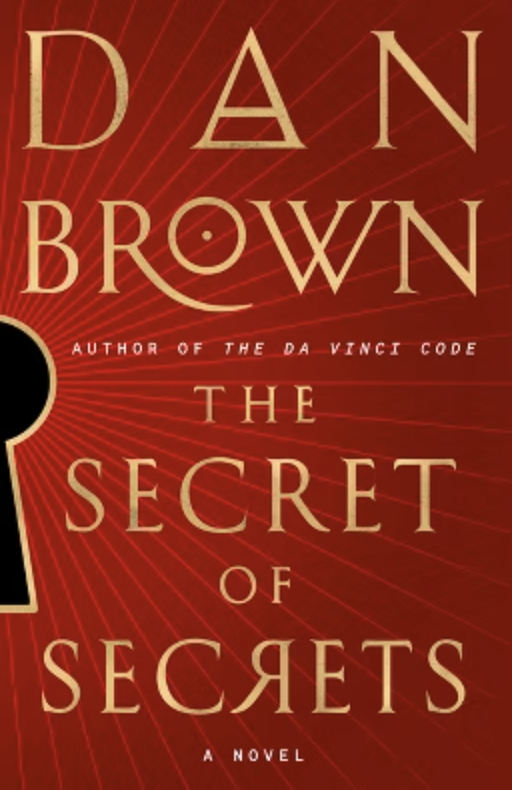
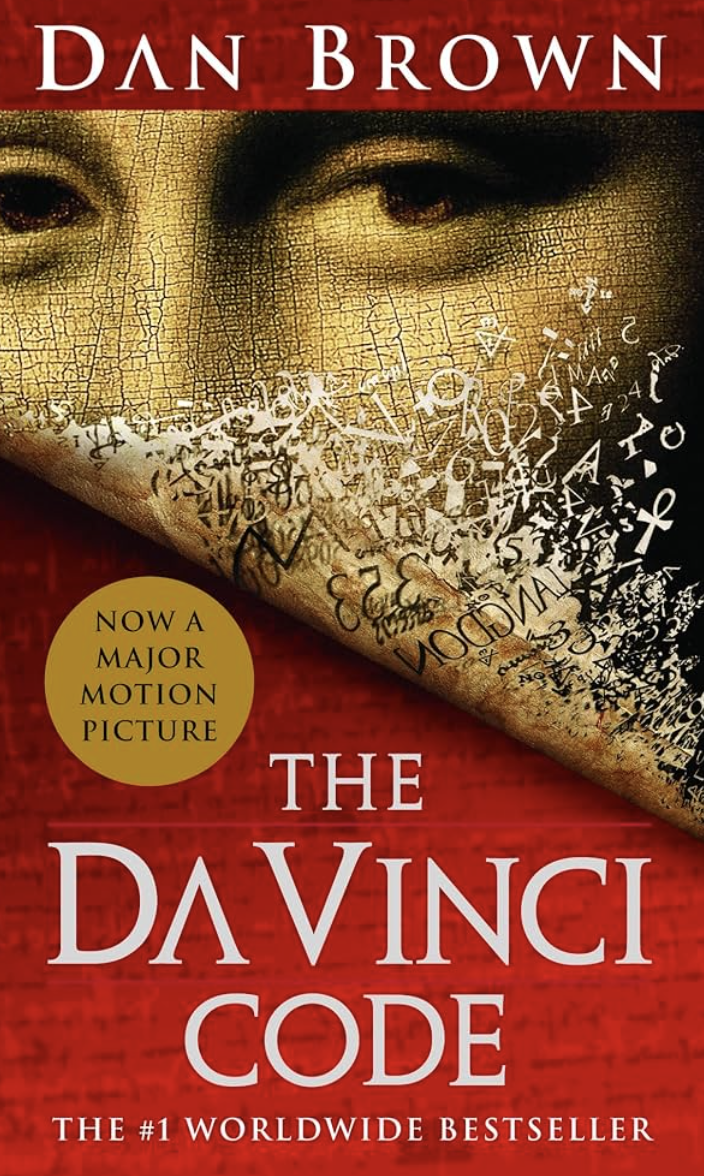
I haven’t read a Dan Brown novel since The DaVinci Code way back maybe in 2005. The DaVinci Code was huge in the mid-2000s. It was one of those novels that everybody read, and I kind of liked it (that’s my book review). I didn’t know much about the Leonardo DaVinci stuff and the conspiratorial stuff involved, and I figured a bunch of it was fake, but I didn’t care about what was real and what was fake if it was a good book.
The DaVinci Code was so huge back then that even some of my students were reading it (or they claimed that they were). Since they were also interested in Leonardo DaVinci, I bought a couple copies of books about Leonardo DaVinci (I think I bought them cheap at the Scholastic Book Fair and kept them in my classroom), and students borrowed them, until eventually a couple students just kept them permanently (I think that was called stealing back then, but I had gotten some mileage out of those books and didn’t really care at the time. I’m not going to go back and try to figure out who took them).
I have to give author Dan Brown credit. Leonardo DaVinci was an interesting guy. If you’re going to write a thriller based on a historical figure, Leonardo DaVinci gives you a lot to work with. Dan Brown made a good choice.

Dan Brown’s new book The Secret of Secrets seems to focus on noetic science, which I knew nothing about going into this, but noetic science so far is kind of interesting. In fact, the topic of noetic science is more interesting than the characters in The Secret of Secrets. Robert Langdon from The DaVinci Code is back, but I’m not really interested in his career. He’s got some relationship going with another famous doctor/scientist, but I’m not really interested in her.
When I’m reading The Secret of Secrets, I find myself skimming the plot (I’m not sure what’s going on) and reading the noetic science and theology stuff. Those topics are more interesting than the romance and the plot. I mean, this is fiction; I know there’s supposed to be a plot in a novel, and there’s usually some type of relationship involved between the characters in the novel (otherwise, what’s the point?), but so far the plot and relationship are just getting in the way of the interesting nonfiction topics.
I guess I could just stop reading The Secret of Secrets altogether and read about noetic science from a few websites. Or I could grab a nonfiction book or two. Who needs Dan Brown?
A couple/few of Dan Brown’s Robert Langdon books have been turned into movies, but I don’t know if they’re any good. I always thought that Tom Hanks was miscast in that role of Robert Langdon. When I originally read The DaVinci Code, I visualized Langdon a lot differently, but that could be my fault. I still associate Tom Hanks with 1980s comedies, so my brain doesn’t always connect with him playing serious roles. During Saving Private Ryan, I was waiting for him to do a pratfall on Omaha Beach. It’s probably in the director’s cut.
The Secret of Secrets is being adapted into a series on Netflix, but I think they’re getting a new guy to portray Robert Langdon. That’s probably a good idea. I was hoping that Tom Hanks would pratfall in the series, but he’s getting kind of old for that. He’s older than I am, and the last time that I pratfell, I couldn’t move my neck for six months. The next pratfall I do will probably be unintentional, and that’s going to suck.
Here’s a good Tom Hanks pratfall. Just think of this as Robert Langdon in college.
*****
I’m probably not going to finish reading The Secret of Secrets, but I might brush up on noetic science. With the internet, I don’t need Dan Brown or Robert Langdon.
For more Dysfunctional Book Reviews involving books and movies, see…
Top Gun: Maverick with Tom Cruise vs. The Right Stuff by Tom Wolfe
Charlie Brown in Peanuts vs. Crash Davis in Bull Durham
The Godfather by Mario Puzo vs. The Godfather by Francis Ford Coppola .
If I’m not an ‘old man’ yet, I’m getting close to it. I just turned 60, and I’ve always thought that 60 was at least getting there. Despite my age, I’ve never told kids to get off my lawn, even when I had a lawn. I had to shake my fist at a couple people who’d driven on my lawn, but a pickup truck leaving muddy tracks on grass is a lot different than a couple kids retrieving the occasional football.
Even though I’d never read manga until recently, I’ve been aware of manga for at least twenty years and have noticed how the manga sections of bookstores seem much larger and more popular than those that carry the typical American graphic novels that I’m used to. Even though I was raised on Silver and Bronze Age Marvel Comics (1960s and 1970s), the stuff that a lot of today’s trade paperbacks reprint, I understand why manga is more popular than the Marvel/DC/indie trades at the bookstores.
Manga is generally much less expensive (not so true for Vinland Saga hardcovers, though), and the stories are easier to follow. I don’t mean that as an insult. Marvel/DC stuff can get very convoluted over decades and decades, and it’s almost impossible to find a good starting point, while manga stuff seems to have an easily determined beginning and end, even if the stories can go on and on as well. Manga seems to move at a pretty good clip, and some American comic books can plod through the same storyline over several issues and then a few years later just tell the same story again.
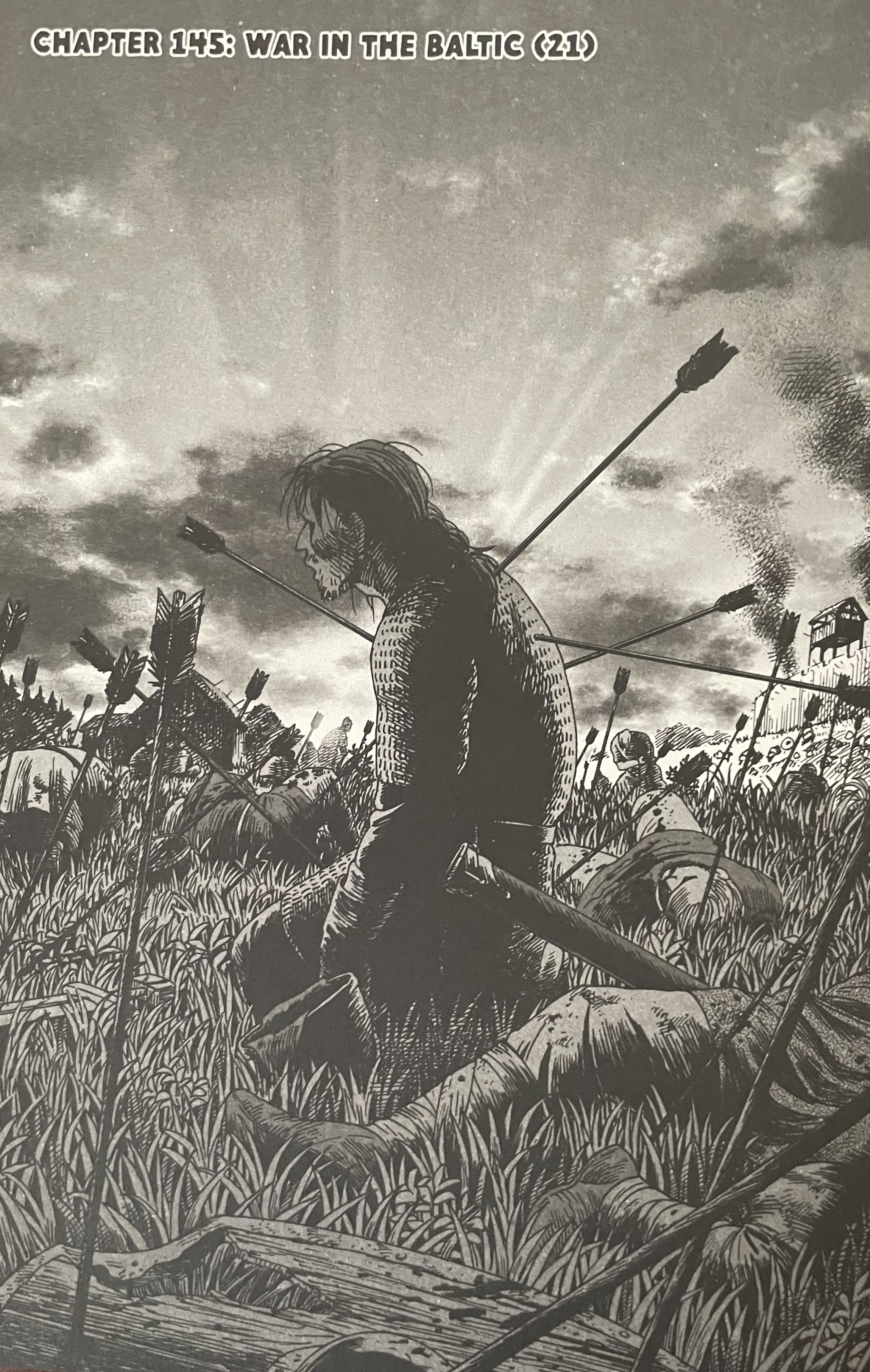
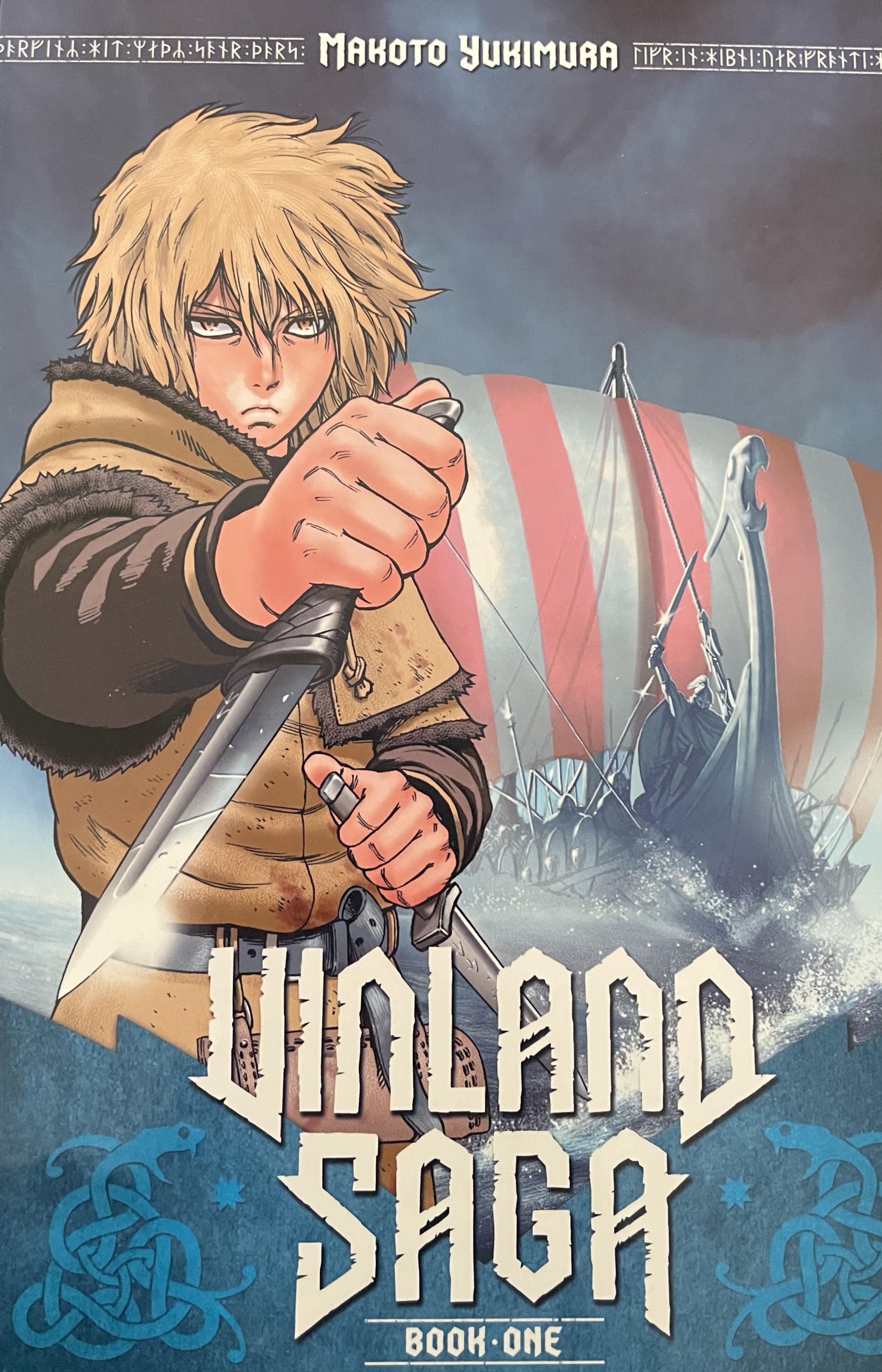
The only reason I know about Vinland Saga by Makoto Yukimura is because some tall youngster guy in the produce section of a grocery store I used to work at suggested it as a way to introduce myself to manga. He told me that I could thank him after he read them. He didn’t lend me any of the books, though. He just said that I could thank him for suggesting the books. Then he quit before I even had a chance to find the books and read them. I don’t blame him for quitting. The grocery store was pretty good when compared to most retail type jobs, but his skill sets would be better used in a different environment.
When I finally started reading Vinland Saga, I didn’t have an issue with adjusting to the right-to-left reading in manga. The storytelling and illustration styles in the series were a little jarring at first, though. Yukimura’s drawing style is a little more cartoony (imprecise word) than what I’m used to, especially in Bronze Age and Modern Age comic books (Silver Age can get cartoony but in a different way). I’m not saying it’s bad. It just didn’t always seem to go with what were supposed to be emotional scenes.
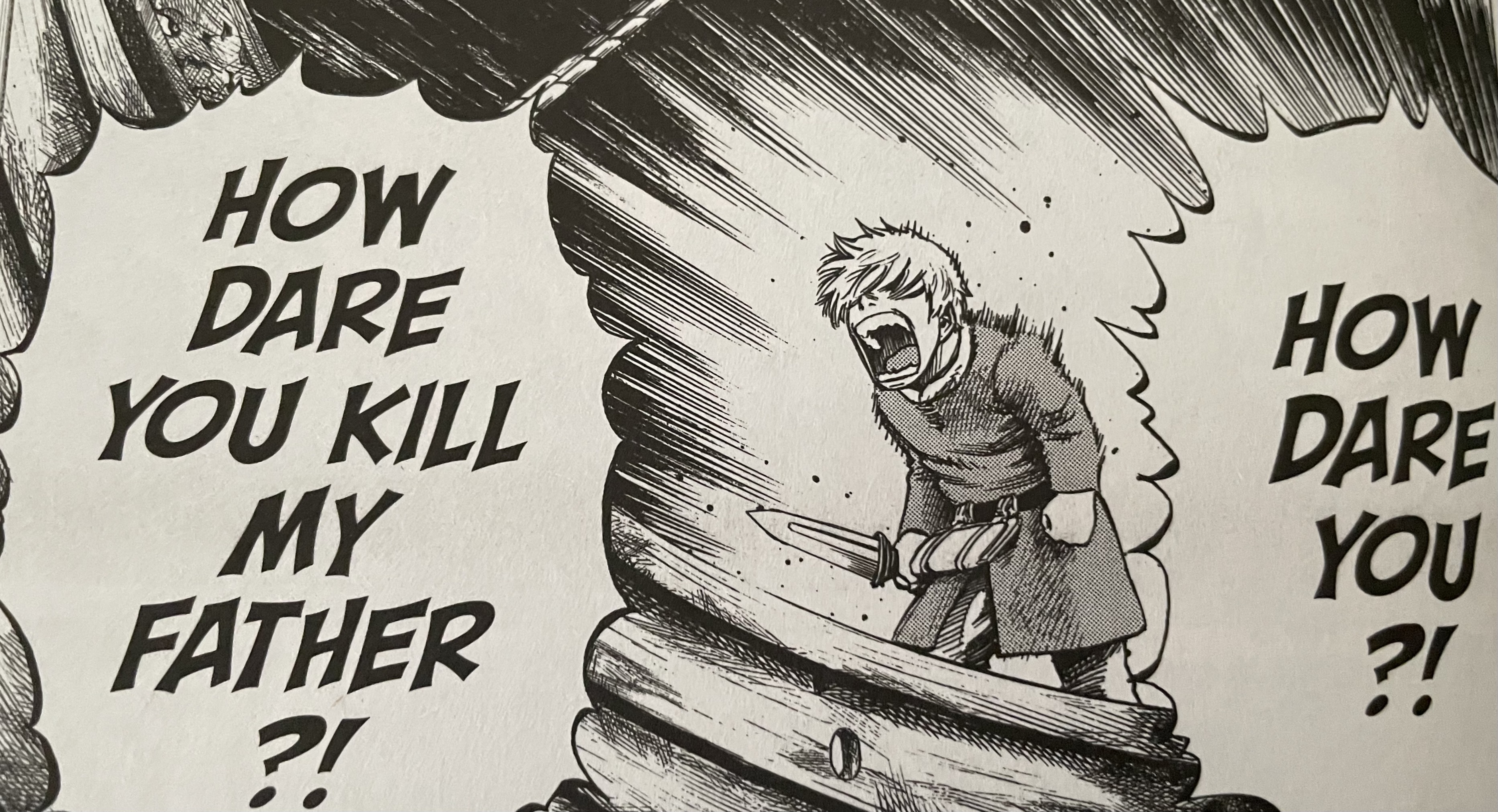
Anyway, Vinland Saga by Makoto Yukimura is good. I like it a lot. That’s my review.
Yeah, the art flips from realistic/serious/grim to cartoony, sometimes from page-to-page, and that can occasionally take me out of the story, but most of the art is good to great (and I’m kind of picky about this stuff). Some of the characters look alike. A few of the thin blond warriors look the same, and I had to flip back and forth a few times to see which character was saying what to whom. Yukimura has said in an interview that he likes to draw hands distinctly, but sometimes I think his faces are really similar. Then again, maybe we Anglo-Saxon warrior types really do all look alike.
Honestly, I didn’t like the first chapter of Book One at all. I won’t go into the reason why because it might sound stoopid (I admit it), and it’s not that important (especially if it makes me look stoopid). Overall, I was lukewarm to Book One, except for the ending, but I wasn’t yet hooked on the series when I was done. Book Two was better, and then somewhere around Book Three or Four, the series took a huge turn, and then I understood what the tall guy in the produce section was talking about.
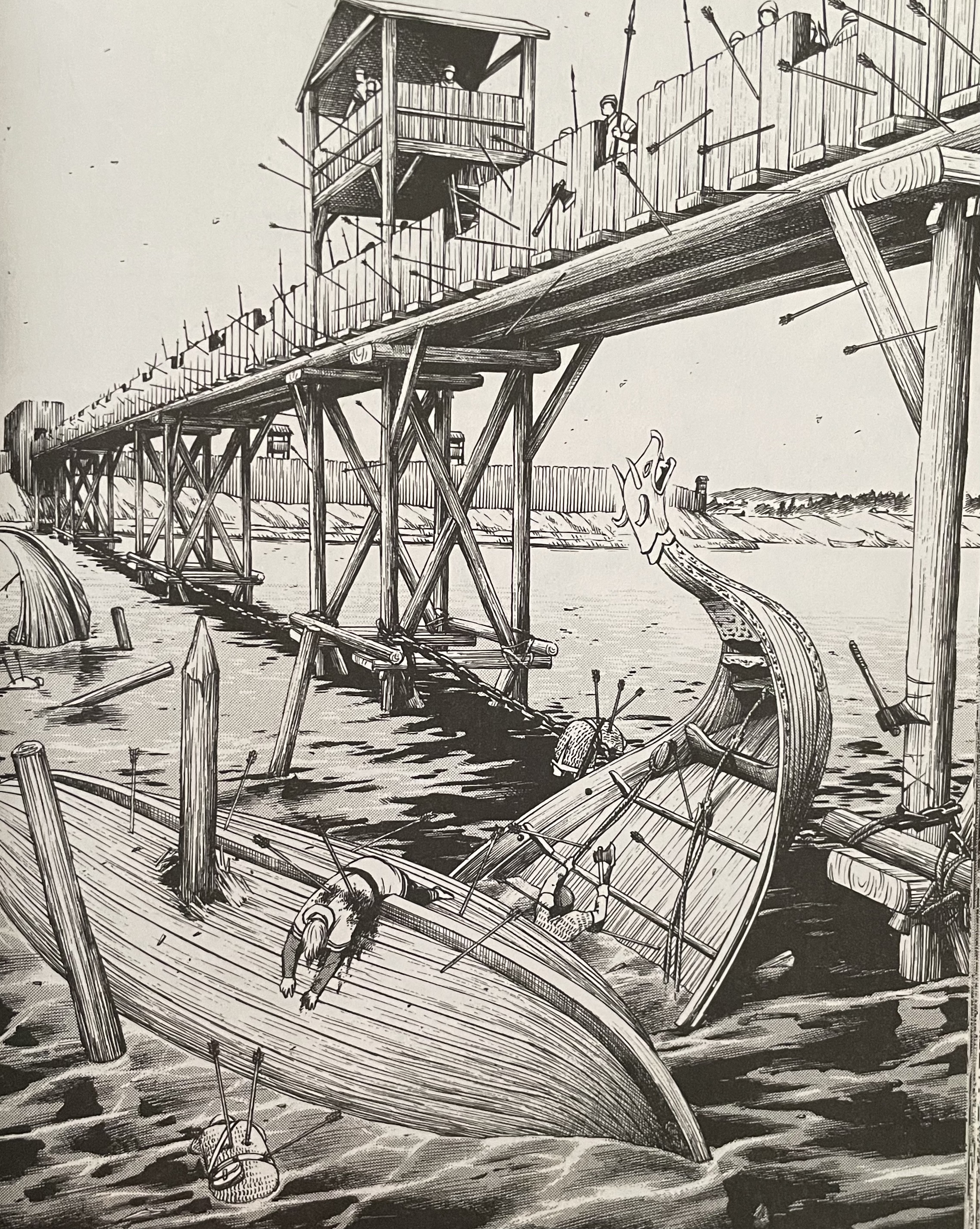
Despite what I claimed earlier about manga and simple stories, Vinland Saga has a lot of stuff going on. The story takes several unexpected turns and gets more interesting than I expected it to be. Unfortunately, I’m not sure the characters are going to actually get to Vinland. They seem to be getting farther (distance wise) and further (accomplishing goals) away during each book. Fortunately, Vinland Saga is done, so I know I won’t have to wait years to get to the ending. Remember, I just turned sixty. I don’t mind waiting, but I’m not sure how much longer I’ll be around. I mean, I’m not worried about it; I’m aware, not worried.
Even though I’m not finished reading Vinland Saga, I’m pretty confident in it. I’m certain it’s not going to have a Game of Thrones Season 8 drop off (I really thought it was Seasons 5-8). I’m pretty sure the ending won’t suck, so I’ll review the series now while I feel like writing about it (that’s how I do things). If the ending indeed DOES suck, I’ll be sure to tell you about it.

Tall youngster guy from produce, I know you’ll never see this, but maybe somehow you’ll just know (if you even remember me). I am reading Vinland Saga now. I like it a lot. Thank you for suggesting it. Now go read some Robert E. Howard Conan stories. You’ll thank me for it later.
*****
For more about comic books, see…
Why The Fantastic Four was once “The World’s Greatest Comic Book Magazine!”
Mag-NETT-o vs. Mag-NEET-o: The Magneto Supervillain Pronunciation Debate!

Sometimes people didn’t believe me when I talked about the stray dogs that my family adopted when we lived in Sewanee, Tennessee in the 1970s. They didn’t think that the stories about the growling one-eyed dog with the fierce underbite were true. They didn’t believe that we named a stray dog after a troublemaking kid in our neighborhood. They thought I was exaggerating the household chaos and carnage another dog got away with.
That’s the problem with the truth; sometimes it’s too unbelievable to believe. Back then we didn’t have cell phones to record everything, so we were either believed or not believed. We had cameras, but most families went through picture-taking phases and picture-taking droughts. My family’s time in Sewanee was a drought. A lot was going on. I was only 10 at the time and don’t remember everything. Maybe we were too busy to take pictures.
For decades afterwards, I had witnesses to corroborate my stories, but most of those friends and family members are gone now (or I just don’t know where they are), so I have to rely on my memory and the benefit of the doubt from readers when I talk about our three lost dogs of Abbo’s Alley.
The first lost dog was Johnny, the hound (see Childhood Ghost Story- The Prologue). Johnny was an emaciated hound dog that started following me home from Abbo’s Ally, the forest short cut that we took when we walked from our neighborhood to the other side of the college town (I don’t remember if Johnny just followed me or if I encouraged her). Since she seemed terrified of adult men and my dad was kind of big and loud, she wouldn’t go into our house for weeks once we ‘adopted’ her. For a while, we just fed her and she’d hang out in our yard overnight.

We named this emaciated hound after a kid named Johnny (previously mentioned in The Lost Dogs of Abbo’s Alley: Rocks) after the dog ate Johnny’s lunch in the local park. Johnny was a kid, maybe a year older than I was, who got into trouble a lot, both at home and everywhere else. I guess he wasn’t the type to eat at the dinner table with his family, so one night Johnny’s older sister brought him a plate of decent-looking food and left it on a park bench while she acted like she was looking for him (I think she was more interested in flirting with the guys at the park).
As soon as she turned her back on the dinner (possibly to flirt with the guys at the park), the emaciated hound dog climbed up on the park bench and devoured Johnny’s meal. Johnny’s sister just named the dog Johnny right there so that she could tell her folks that Johnny ate the dinner. Johnny the kid ended up hating Johnny the dog and would throw rocks at her when he got the chance. Even though Johnny wasn’t officially my dog yet, everybody knew that she hung out in our yard (when she wasn’t stealing dinners in the park), so I got to decide if the name stuck.
Johnny (the human), if you’re still alive (doubtful if you kept throwing rocks at dogs), I’m sorry that your sister named my stray dog after you, and I’m sorry I agreed to the name. And I’m sorry that my stray dog ate your dinner. I should have replaced it for you, and I should have renamed the dog. I was in fifth grade and didn’t have manners. In my defense, you were kind of a jerk. You hit me with a rock unprovoked once, but still…
*****
Another dog was Muff, the black terrier mix. He was probably the dumbest, funniest, friendliest dog I’ve ever seen, a thick straggly black terrier mix of something big. He would walk through people, head-butt doors, climb on tables, knock down stuff, and eat anything he wasn’t supposed to with impunity. And nobody ever got mad at him. Even my dad with his unpredictable bad temper laughed whenever Muff destroyed something. He seemed indestructible. And then one day Muff just disappeared. We figure he got poisoned. I guess he couldn’t eat everything after all.

It’s not implausible that Muff got poisoned. It was common practice for homeowners in Sewanee to leave poison traps for the stray dogs that kept getting into the outdoor trash at night. Like I said in an earlier episode, Sewanee had a stray dog problem. And maybe a poison problem too.
Since I never saw Muff’s dead body, I don’t consider this a “dead dog’ story. If he was indeed poisoned, then I never saw him in his final moments. I didn’t cry over him as he gasped desperately for his final seconds of life. He just disappeared. He wasn’t very smart, though. He could have just gotten lost in the endless forests surrounding Sewanee and found another family to charm. Now that I think about it, I like that version better.
*****
Our final lost dog was Friday, the one-eyed lhasa apso. Supposedly, ‘lhasa apsa’ means ‘little lion.’ If you only had Friday as an example, ‘little turd’ might seem more appropriate. He was probably the most unlikeable dog we’d ever met. We only kept him because we felt sorry for him, but he warmed up to us… after a few years.

People had to see Friday to believe what I said about him. When I described him as a tiny cyclops with a vicious underbite, my friends imagined a dog with an eye in the center of his head, but the reality was worse. He had been beaten so badly (not by us) that he had lost an eye. In its place was an empty socket with a thick clump of hair dangling out of it. Friday was kind of sensitive about that thick clump. He didn’t like people playing with it or trying to get rid of it either.
The short version of Friday’s origin story is that my uncle found this straggly mini-hellion beaten up (I don’t remember if the eye was hanging out or already gone) on a street corner in a suburb of St. Louis on a Good Friday. My uncle wrapped up the abused dog, took him to the vet, and got him healed up at home, but his family already had a male dog in the house, a bossy dachshund named Sergeant. Once Friday healed, Friday and the Sarge had territory disputes and lined the house with pee borders. Since my family was taking care of dogs anyway, (Muff didn’t stay in the house all that much), we agreed to take Friday.
Sewanee didn’t have any leash laws at the time (or if it did, the laws were ignored), so Johnny and Muff ran loose during the day and usually would stay with us at night. Friday was too small to let run loose (we tried walking him on a leash through Abbo’s Alley, but he growled at everybody, people and dogs alike, and ruined everyone’s vibe. All the dogs wanted to fight him. So did a couple people.), so he stayed in the house all day. He probably thought the house was his and that the bigger dogs were intruders.
All three dogs deserve their own stories. I’ll probably give each one a blog post with the actual unbelievable but true stories. Johnny has already been mentioned here and was my favorite and has the most ‘unbelievable’ stories (not related to her name). Friday was the most interesting (with the happiest ending). Muff will be the most difficult; I don’t remember much, but everybody liked him except Friday.
Ironically, Friday was the only dog we kept when we moved away from Sewanee after three years. Johnny wouldn’t have handled the leash laws where we were moving (she would have kept digging her way out of our yard or something if we’d tried to keep her locked up), so another family in Sewanee kept her. At least, I hope they did. I felt kind of funny about that when we moved, but I couldn’t do anything about it. I was 12. And of course, we would have liked to have taken Muff, but he… he… he found another family to charm.
I occasionally think about getting a dog, but it’s probably not a good idea for me now. I have a bad back, so I wouldn’t be able to rough house with a medium or big dog like I used to. Little dogs are okay, but I’d probably trip over it or hurt my back bending down or something stupid, and any one of those situations would potentially cause a whole new set of problems. I like other people’s dogs, though. That brief time when my family had three former stray dogs in the house gave me a lot of stories to tell, but people often think I’m exaggerating.
Sometimes it’s easier just to tell plausible lies that everybody will believe.
Oh yeah, my house in Sewanee had a ghost too, but I never said anything about it at the time. Nobody would have believed me.
For more, see…
“Real men don’t read bestsellers,” a young guy said to his female friend at the local Brick & Mortar Booksellers.
I don’t know if the two youngsters were going out or if they were married or if they were just friends (just friends… haha). I didn’t look that closely. Once I decided to eavesdrop, I made sure to stare only at the Legos magazine I was paging through in the periodical section as I braced myself for the couple’s discussion about gender specific book genres in the nearby Military/History section.
This B&M Bookseller is only ten minutes from where I live. I feel kind of lucky that I live only ten minutes from a real bookstore. Unfortunately, the closest used bookstore is 30 minutes away and has unpredictable hours. The closest GIANT used bookstore is over an hour away. That’s the biggest problem with getting away from the city. I really miss used bookstores, even though I don’t buy nearly as much as I used to.
The “real men don’t read bestsellers” conversation had all started when… I’m not sure how it started. I think I came in at the middle of the discussion. I just heard the “real men” remark and tuned in.
The rest of the conversation was kind of surprising. The girl laughed, and that was it. No speeches about toxic masculinity. No discussions about gender roles. Just a laugh. That was a cool response, I thought, she must really like him.
Even though I didn’t take the guy’s comment seriously (the woman with him didn’t, so why should I?), I took a glance at the bestsellers in fiction, and I could see why “real men” aren’t reading them. Bestsellers are expensive, especially when they come out in hardcover. It’s impractical to read a bestseller in that situation. Most “real men” would wait for the bestseller to come out in paperback. Or they could get it from the library. Buying a new bestseller is a sucker’s move, and “real men” aren’t suckers.

“Real men” read cheap nonfiction because cheap nonfiction is practical. Cheap nonfiction doesn’t cost much. Plus, you can learn something from nonfiction. Fiction is for entertainment, and there are better, more practical ways for “real men” to entertain themselves than reading fiction. Maybe reading fiction helps build empathy, and women might say that men need more empathy (“real men” don’t always pay attention when women are talking, so “real men” might not be sure what women are saying).
Empathy could be overrated, though. Empathy is a good quality, but too much of it can be harmful. Not everybody is empathetic, and in a conflict between an empathetic person and a selfish person (I think nowadays they’re referred to as ‘narcissists’), the selfish person almost always wins, unless the empathetic person also has the ability to beat the hell out of the selfish person (and not get arrested for it).
Empathy must have the possibility/probability of violence behind it in order for it not to be taken advantage of in a general low trust population. That’s why ‘good cop, bad cop’ can be so effective. Empathetic ‘good cop’ doesn’t work in every situation. Neither does authoritarian ‘bad cop.’ Put them together, and you can have law and order. Without ‘good cop,’ you have tyranny. Without ‘bad cop,’ you have chaos. Real men don’t like chaos. “Real men” might not have a problem with authoritarianism (it depends on what kind of authoritarianism it is), and that’s why the world needs a balance.
The man who made the comment had been browsing through the Military/History section of the bookstore. Of course, the “real man” would read military stuff. Men have had the historical obligation to serve in the military, and women haven’t. Why would women read about a genre that doesn’t directly affect the vast majority of them? A military history book might occasionally be a bestseller, but it usually won’t stay there long, so a “real man” goes browsing through the History section, where the book is more likely to be in paperback or at a discounted price, rather than wasting time and money in the Bestsellers section.
The “real man” doesn’t have to serve in the military, but he respects it and understands its necessity. That’s why he thinks about the Roman Empire (though that’s overstated). He’s fascinated by armies outnumbered 100-to-1 slaughtering their enemies without breaking a sweat (also overstated). He’s also fascinated by how that empire collapsed (decadence and debt) and doesn’t want to repeat that empire’s mistakes.
Spend $30 for a new bestselling book? That’s too much money for a book that will be discounted in a few months. Impulse buying is the first step (or one of them) towards economic ruin. And the “real man” protects his money.
I probably put more thought into the young guy’s “real man” comment than he did. It was just an offhand remark, and the couple moved on to other things. I’m not sure if they bought anything.
I’m not even sure he was a “real man.”
*****
Here are some other blog posts you might like:
In Defense of the Grammar Nazi

Today is Charles Schulz’s birthday. I mean, it would be Charles Schulz’s birthday if he were still alive today. Or maybe today would have been Charles Schulz’s birthday if he were still alive today. I’m not sure what tense the ‘be’ verb should be in this situation. Maybe I actually knew at some point when I was an English teacher.

Anyway, I’m not a fan of wishing “Happy Birthday!” to celebrities (celebrities get enough attention), especially deceased celebrities, but Charles Schulz is different for me. Charles Schultz was great at drawing the daily comic strip Peanuts consistently for decades. Most people will never be truly great at anything (I have no statistical data to back this up). At least, I never was. That’s why I respect/admire Charles Schulz’s achievement with his comic strip Peanuts so much.
I’d like to say “Happy Birthday” to the average person every day, but I can’t say “Happy Birthday!” to everybody every day. That would be impractical: I don’t know everybody’s birthday, and if I did, it would take too long to do it. Still, I like the sentiment of wishing everybody a “Happy Birthday!” Sometimes people could use a random birthday greeting, and it’s better when the recipient doesn’t expect to get it from you. So if it’s your birthday today… HAPPY BIRTHDAY!

When I was teaching, Peanuts pocketbooks that collected Charles Schulz’s Charlie Brown comic strips were great because there would always be a student or two who would pick them up and read them. Sometimes a student would read them during instruction, but I’d pretend not to notice, especially if the student was the type to cause distractions. Peanuts books were great at pacifying students. I don’t know if the Peanuts books would work with todays kids, though.

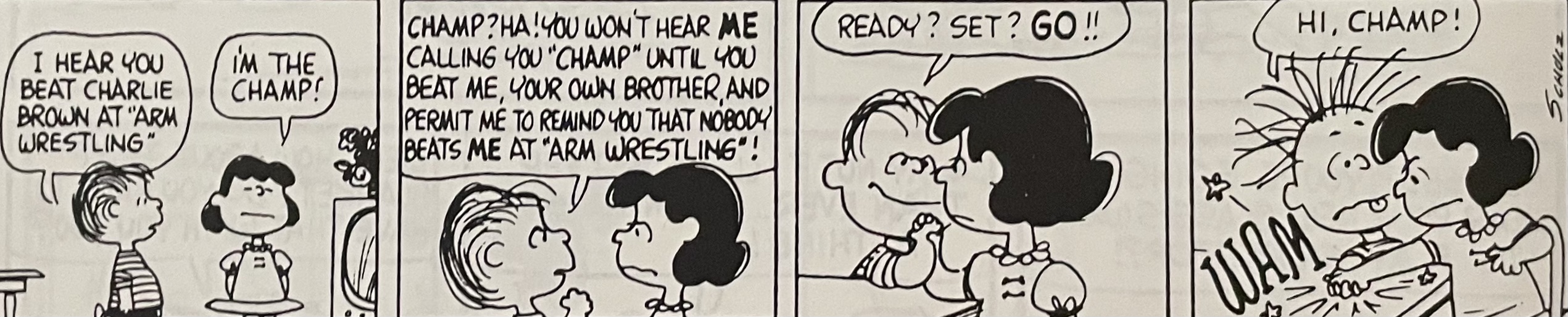
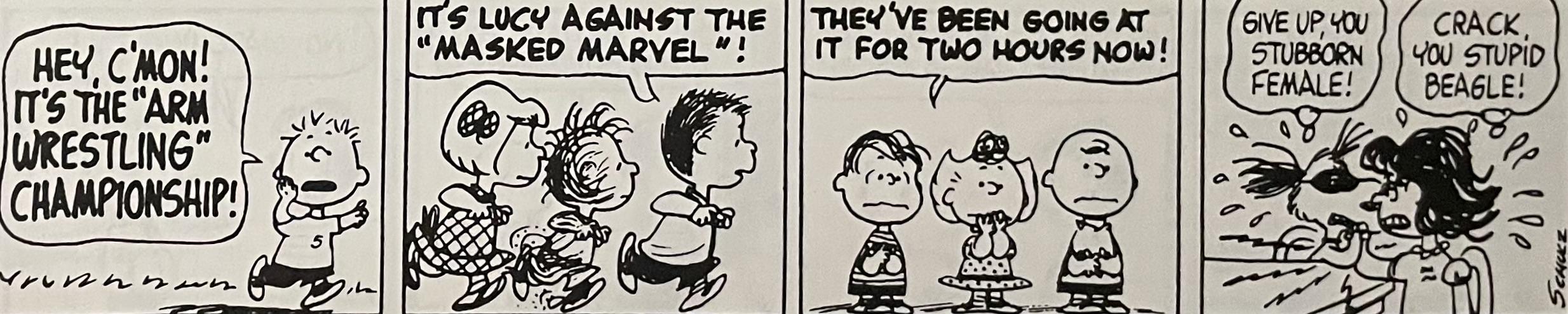
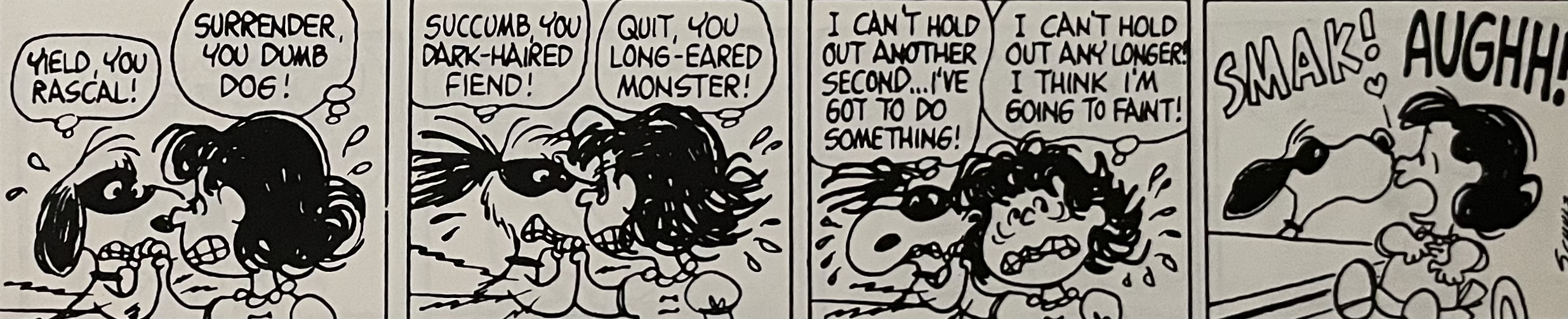
This comic strip sequence is one of my favorites out of the many that ran during Charles Schulz’s tenure on Peanuts. I didn’t have to follow this particular arm wrestling sequence day by day when these strips came out in the 1960s(?). I had a giant Peanuts treasury edition so that I could read everything in this sequence at the same time. I still have the book. I think I received it as either a birthday or Christmas gift. For today’s blog, I’ll just say it was a birthday gift, probably in 1973 or 1974, so thank you to whoever gave me this book! I hope I wrote you a decent thank you letter.

Last year at this time I wrote a blog post titled Charles M. Schulz, Peanuts, and the Five-Minute Birthday Party. It’s good to get a little recognition or attention on a birthday, but I wouldn’t want to devote a whole day to it anymore. Or even an hour. Maybe five minutes is good. No singing, though, especially in public.

My mom and step-dad used to call and sing “Happy Birthday” to me over the phone when we lived hundreds of miles away from each other. Nobody in my family can sing, so they sounded like a couple drunks. One year I couldn’t answer the phone in time, so they left a message. Luckily, I managed to save it. It used to make me a little sad to listen to it for a few years after they died, but now I laugh. They still sound drunk (even though they weren’t).
On my 16th birthday, my parents split up. It was kind of a surprise. I’m not going to get into too many details, but somehow that was the day when one parent discovered something incriminating about the other parent, and everything hit the fan. Cutting and eating the birthday cake that evening was a little awkward. It was a good cake too. Maybe it sounds a little callous to focus on the cake the day my parents split, but you have to appreciate the good things in life, especially when the bad stuff is going on. The bad stuff doesn’t take the day off for birthdays and holidays.
A good Peanuts book (or any kind of book that you really like) can get you through rough times. I was lucky that my house (or apartment) growing up always had stuff to read, and my parents encouraged my comic and book collecting. I know everybody has his/her own way to temporarily escape reality, but some of those ways kind be kind of unhealthy. Reading seems to be at least a benign form of escape. Personally, I think it’s F*CKING AWESOME!
I apologize for using profanity (even though it’s censored) in a Charles Schulz Peanuts post.

I’m surprised that Charlie Brown was this harsh with Snoopy. With all the times that Charlie Brown was the goat or the blockhead, you’d think he would have been more supportive of Snoopy’s efforts. I like Snoopy’s attitude. That’s the way it goes sometimes.
And before I forget… if today is your birthday, HAPPY BIRTHDAY!
And if some other day is your birthday… just… ummm… come back to this blog post on that day.
*****
For more about Charles Schulz and Peanuts, see the following:
Charles M. Schulz, Peanuts, and the Five-Minute Birthday Party,
Charlie Brown in Peanuts vs. Crash Davis in Bull Durham,
and G.O.A.T. vs. Goat: The Battle of Generational Slang
.

In my final year of teaching, I promised other teachers that I wasn’t going to go full-hermit during retirement. I said that I might go hermit-adjacent, but I’d still keep somewhat socially active. Well, I think I’ve gone full-hermit. I don’t keep up with anybody on social media. Since most of my friends/family from the 1990s and 2000s have moved or have died, I’ve had to find a new circle of friends/acquaintances, and it’s a much smaller circle of friends/acquaintances. In other words, I have a very quiet life.
Don’t get me wrong. I like the quiet life, and I’m coming back to that in a couple paragraphs.
One of my post-retirement goals was to write/publish a novel, a goal that I’d had since I was in college. I finished the entire process at the beginning of 2024 when I officially self-published The Sunset Rises: A 1990s Romantic Comedy. When I was putting the final touches on my book, I knew that I’d have to come up with a new goal. I don’t like the idea of marketing my book, so I needed new goals that had nothing to do with writing:
I like my goals: working odd jobs and traveling to quiet places.
My post-teaching jobs haven’t been that odd. I’m not sticking my face into sewage or anything like that. I have worked part-time at several retail type jobs (not at the same time). I have used my education background for a few part-time jobs. I’ve also monetized a couple of my non-writing hobbies (but not to the point where my hobbies are stressful). None of those jobs by themselves are odd, but people seem to think the combination is odd, especially if you consider my writing; I’m not really making money off of it, but it’s part of what I do.
I’ve been doing the odd jobs consistently for the last few years. Now I’ve started focussing more on the quiet places. I’ve lived in a pretty big city for over 35 years, and it’s not very quiet. Even when you can find a spot surrounded by trees and chirping birds, you can still hear cars in the background (and usually voices too, often women yelling at their boyfriends/husbands over the phone. Why go to a quiet place just to yell at somebody on the phone? Haha!). I had to drive about 90 minutes to find a good spot where I didn’t hear cars in the background. Even then, I occasionally saw helicopters flying overhead. Don’t worry; they weren’t black, and I’m pretty sure they weren’t following me.
After 36 years, I’ve finally moved out of the city. Now I’ve found a town that’s not necessarily quiet (it’s quieter than the city), but it has easy access to lots of quiet places. The town is a decent size, so I can do the odd combination of jobs that I did in the city. Maybe I’ll even add another odd job. There’s always sewage.

Even though I’m keeping up with my blog, my current friends, co-workers, and employers don’t have to worry about me spilling secrets. I’m not the type who sits in my car and complains. I wait about twenty years after something happens to write about it. The exceptions are after a death because the person involved won’t care. If I do write about something, I change names and settings so that nobody (except me) gets associated with anything negative. The only real employment I’ve written about was my first school job in 1989, and I didn’t write about that until 2021. That’s 32 years. In that time, the school was torn down, rebuilt, and then renamed. It’s no longer called Hellhole Middle School. It still might be a hellhole, but I don’t know. A new building can only do so much.
Anyway, the tone on this blog might be changing because the structure of my life has changed. I’m not in a constant state of anxiety while stuck in one of the largest cities in the country. Now I’m in a smaller place and have found quiet places that are only a few minutes away. Even at the quiet places here, women yell at their boyfriends/husbands on the phone. I guess that’s universal.
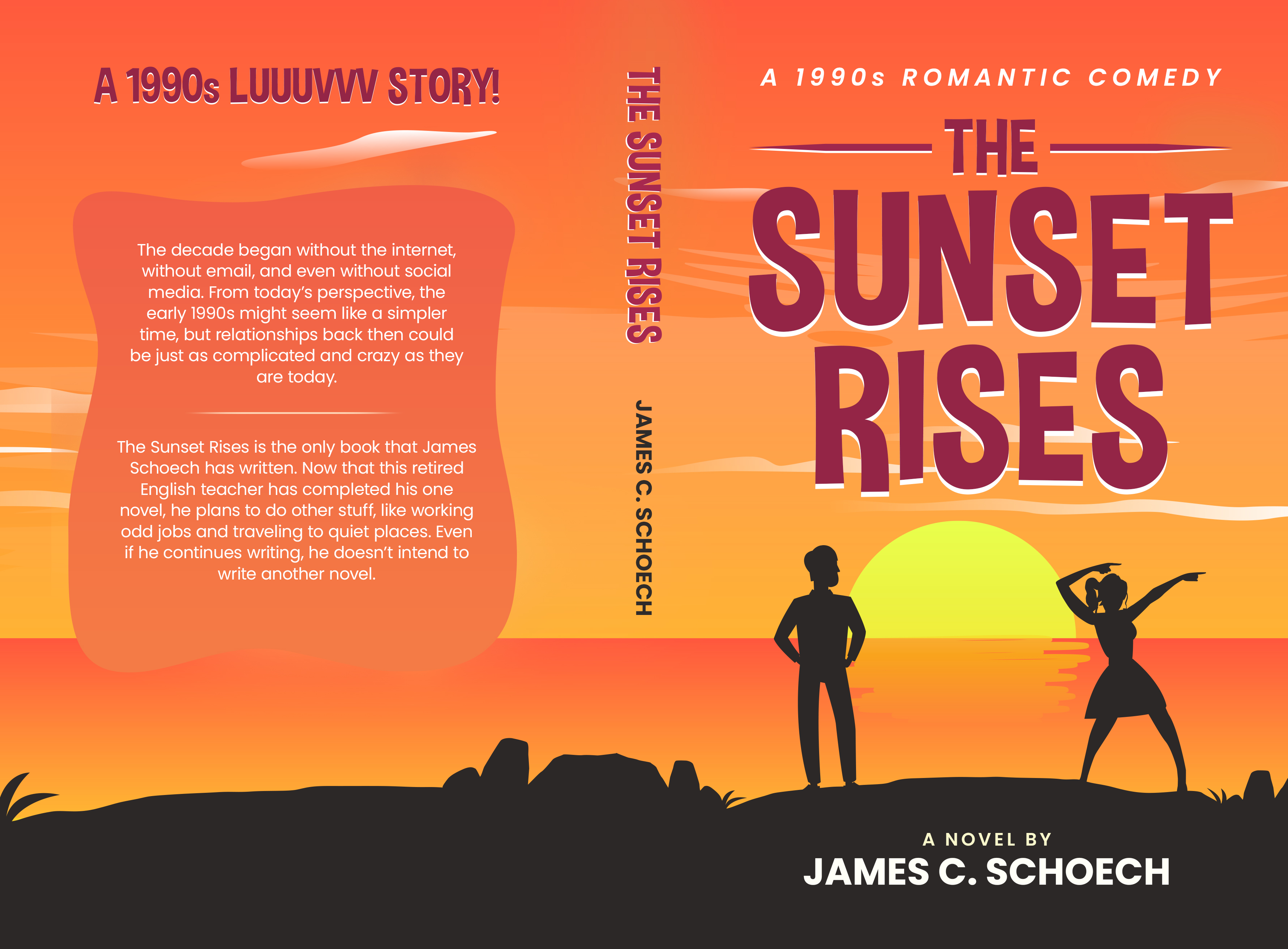
Here it is! The book that inspired me to work odd jobs and travel to quiet places! It’s now/still available on Amazon!
*****
For more somewhat related blog posts, see…
I Just Walked Into Another Crazy Situation! (Egads! This happened almost 5 years ago!)
University Library: Scooter (Egads! This happened 40 years ago!)
The Tale of the Almost-Expired Milk (Egads! This happened almost 50 years ago!))
Cartoon animal violence has always been kind of funny. Whether it was cat vs. mouse, duck vs. rabbit, road runner vs. coyote, or ant vs. aardvark, my childhood/adult years were filled with watching cartoon animals commit hilarious atrocities against each other on television. Cartoon animals in comic strips, however, usually weren’t quite so bloodthirsty. They were more likely to try non-violent but clever means to achieve their goals, or they might even have philosophical discussions (those were often kind of boring to me).
So when cartoon animal Shmitty Cat was plotting to eat cartoon animal Dummo Mouse in my older brother’s unfinished 1983 comic strip, my brother came up with a solution that was the best of both worlds.
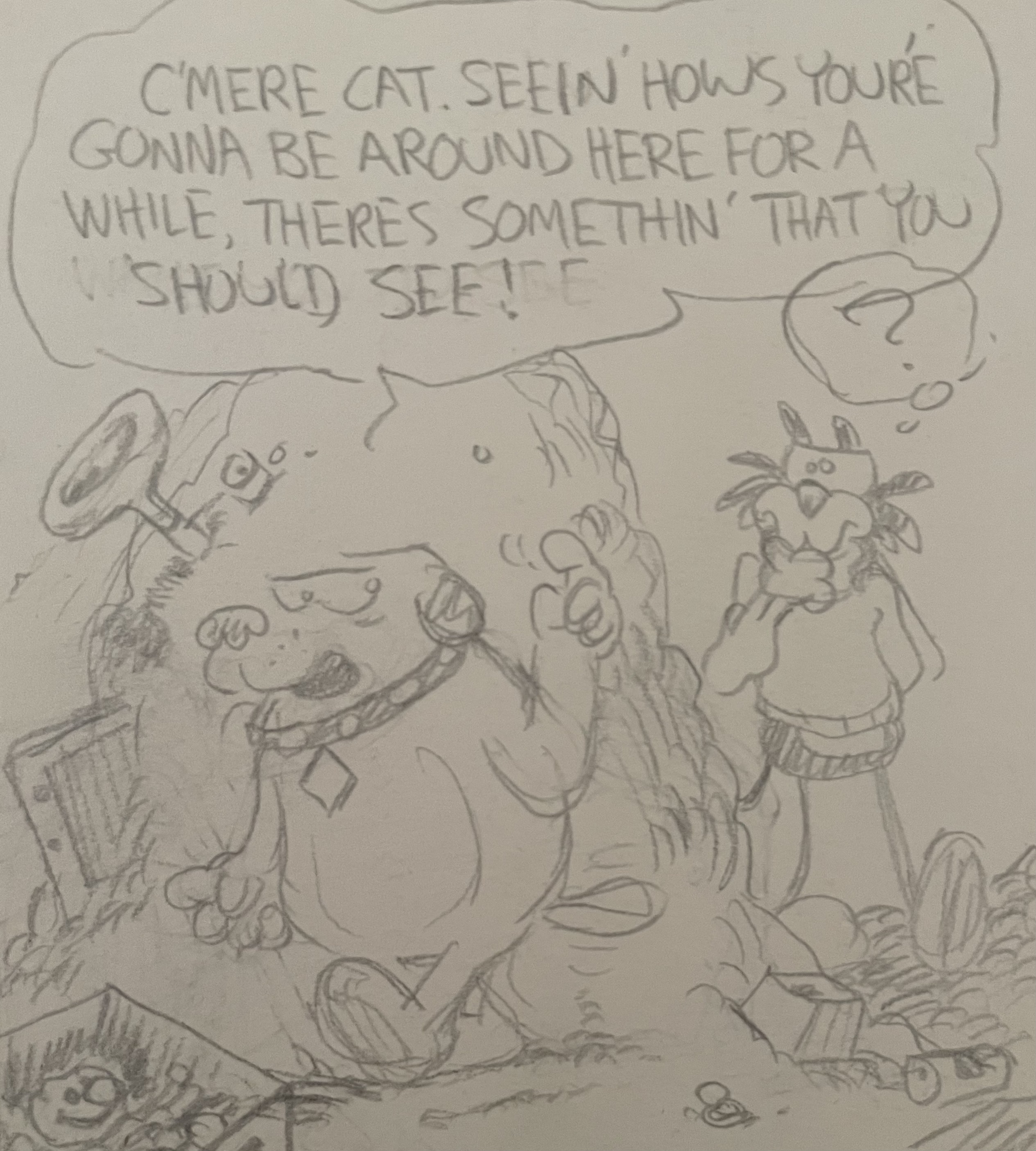
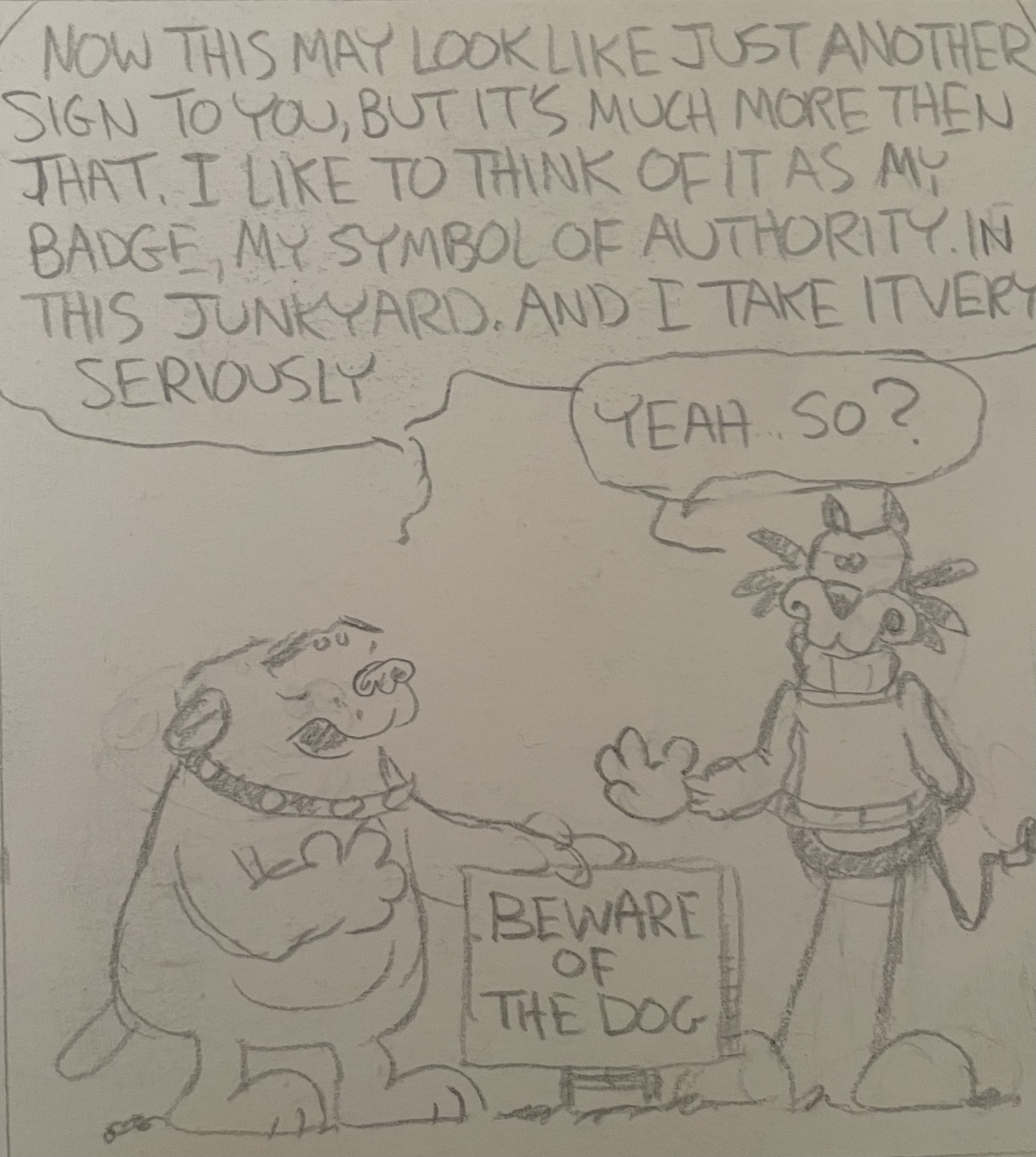
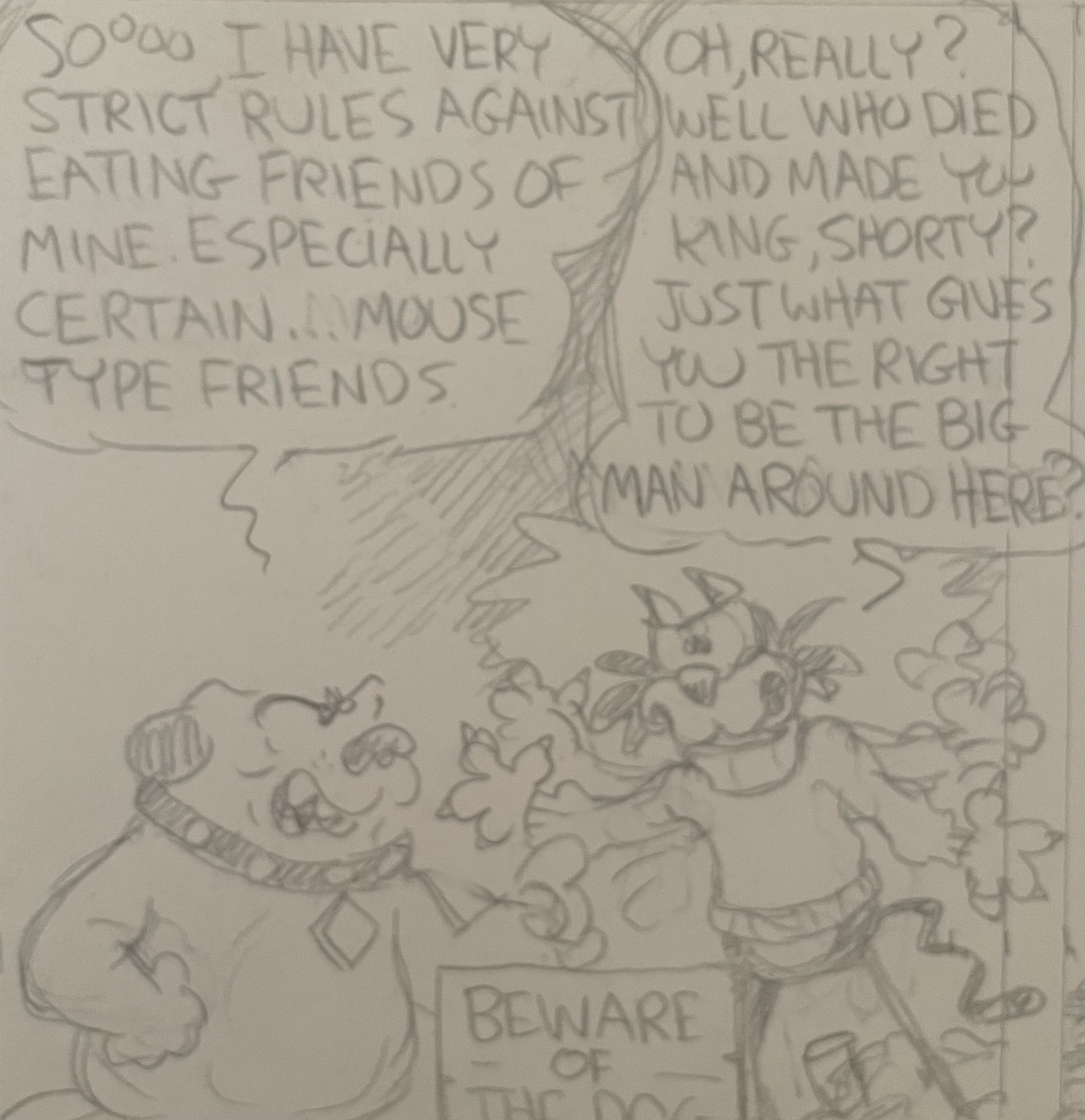
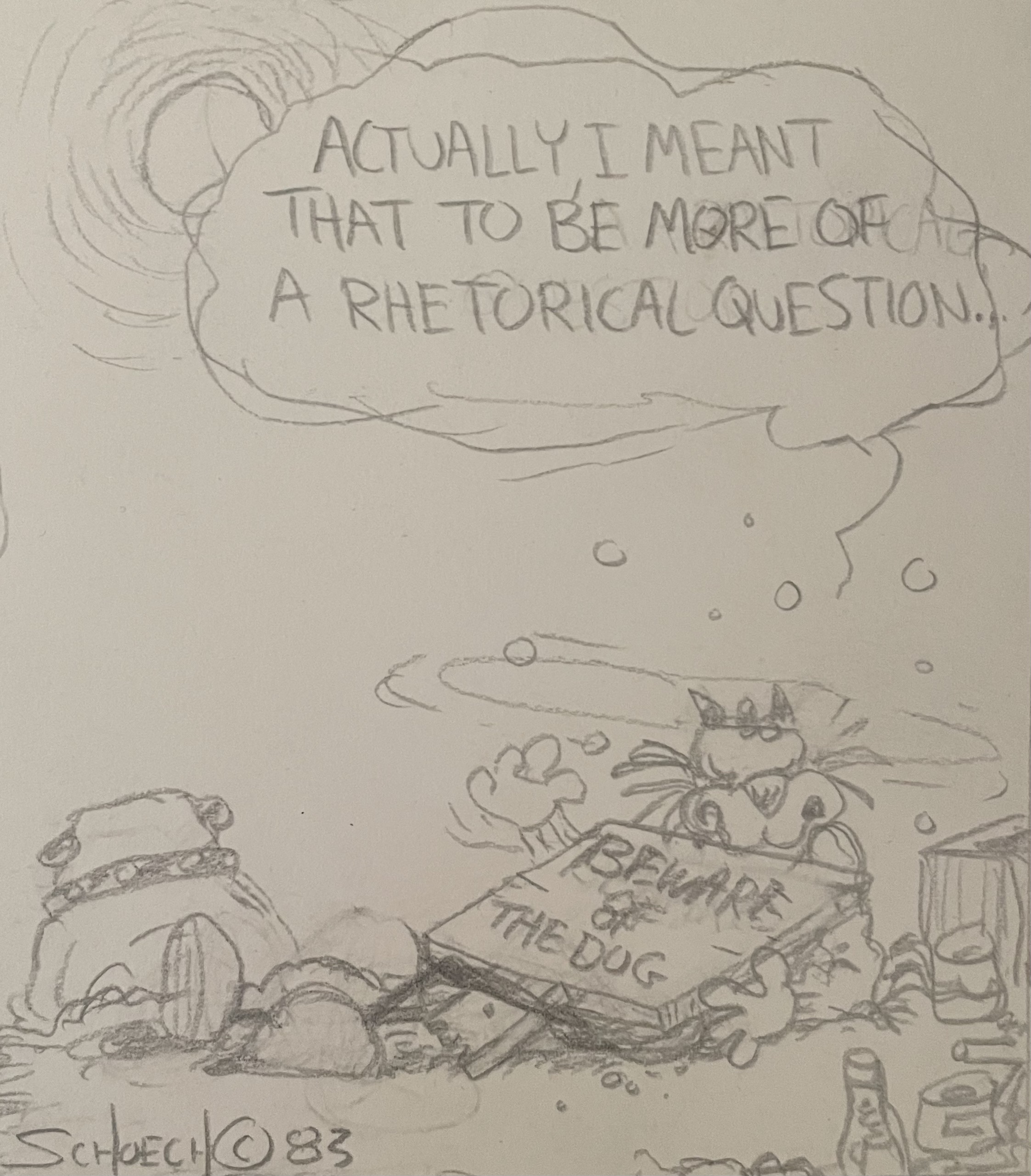
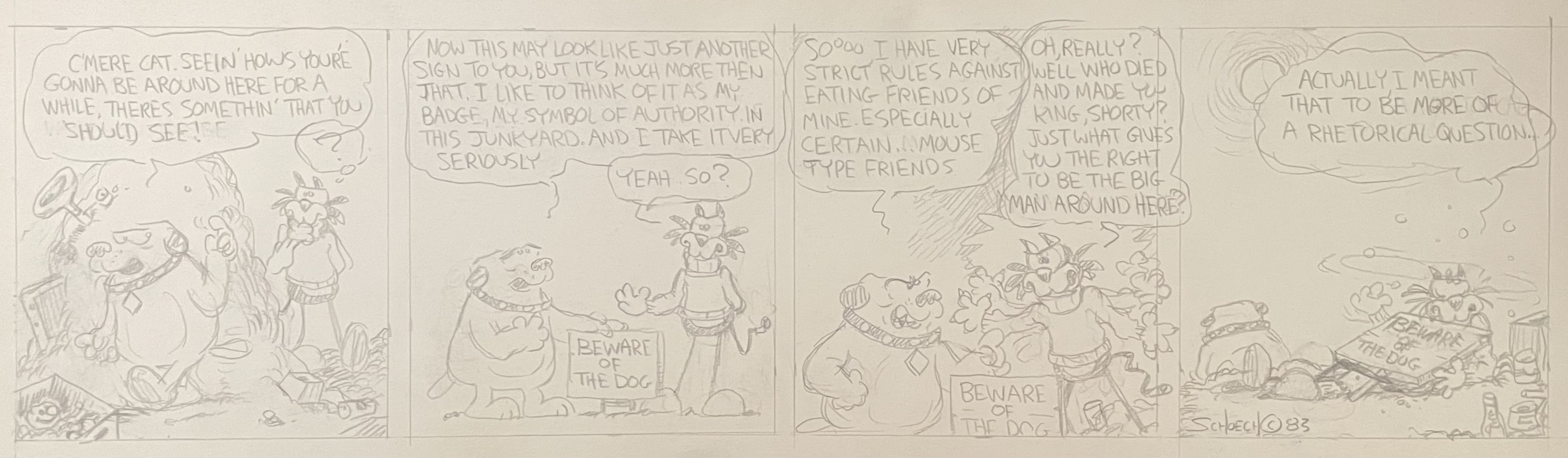
Here’s an early finished stand-alone version of the same strip: Comic Sunday: Dummo Mouse and Friend(s).
And you can find even more Dummo Mouse (finished and unfinished) here at Sunday Funnies.


 Dysfunctional Literacy