Jonah Lehrer, swearing to the audience and media that he isn’t the NSA leaker . (Photo credit: Knight Foundation)
Before Jonah Lehrer signed a new book deal with Simon & Schuster, I had nothing against him. I didn’t care that he had to resign from The New Yorker for allegedly recycling stuff in his articles. I didn’t care that two of his books (Imagine and How We Decide) were pulled from circulation because of plagiarism. I didn’t read his books, I wasn’t interested in his books, and I didn’t give him a second thought (except maybe “That’s what you get”) when he was punished for his literary transgressions.
But it’s been less than a year and he’s already gotten a book deal, and that ticks me off. It probably shouldn’t. If Simon & Schuster wants to take a financial risk on a plagiarist, that’s their gamble. I’m not going to buy the book, but Jonah Lehrer isn’t buying my books either, so I guess that evens out.
Part of Lehrer’s new book (titled The Book of Love) is about Jonah’s emotions as he got caught plagiarizing. According to a short excerpt, he threw up a little. That doesn’t seem too dramatic, and it’s a little gross. Maybe if he streaked a baseball game out of guilt, I’d read about that. But I’m not really interested in the thought processes of a plagiarist, especially if it leads to throwing up. If I want to read about someone’s guilt, I’ll read “The Tell-Tale Heart.” It’s short, and the guilty guy didn’t get a book deal afterward.
I don’t care if a plagiarist gets more books published after he (or she) gets caught plagiarizing, but a year seems too short to be a good punishment. I’m a fan of punishment. Rehabilitation is okay, but sometimes rehabilitation is tough to measure because you can’t always tell what’s in a person’s heart. But a punishment is concrete. It can be measured. After a punishment, you know that even if an apology is insincere, the offender has still served his time. A punishment can be proven. I’m a concrete kind of guy. That’s why I like punishments (as long as I’m not on the receiving end of one).
There’s only one way to punish an author, and that’s to not let him/her publish. If all the publishers agreed not to publish a plagiarist’s book for ten years, that would be worse than a ten-year prison sentence (maybe not, but it would still be pretty bad). Ten years where nobody would read any of the plagiarist’s words. Ten year’s where the plagiarist would have to self-publish his own books and write his own 5-star reviews (like the rest of us).
I’m not an unforgiving guy. If I see Jonah Lehrer on the street, I’m not going to scream “PLAGIARIST!!” and chase him down with a mob carrying stones and pitchforks. If Jonah Lehrer does a book signing, I’m not going to picket the bookstore. I’m just not going to read a Jonah Lehrer book for at least ten years.
****
How can plagiarized books get published with today’s technology? My kids in public school write essays that are run through a website that checks for signs of plagiarism. In reality, nobody really cares if my daughter copied her essay about One Direction from a 1D website, but her paper still got checked. I thought at first from her spelling and sentence structure that she wrote her own paper, and then I read the fansite and I wasn’t so sure. Fan websites have lots of spelling and sentence structure errors. All this shows is that my daughter’s public school checks for plagiarism more closely than some publishing companies do.
I’ll be honest, though. If my kids ever get caught plagiarizing, I’ll probably still read their books, even before their ten years of punishment are up.
If the title were shorter, we might not have to squint to see it.
One of the first books I reviewed for Dysfunctional Literacy was The Murder of the Century: The Gilded Age Crime that Scandalized a City & Sparked the Tabloid Wars by Paul Collins. The title is kind of long. I couldn’t remember the whole thing so I simply referred to the book as The Murder of the Century: (with a really long subtitle). That, I could remember.
The Murder of the Century (with a really long subtitle) was a pretty good book, and I said in my review that I would probably read Paul Collins’s next book.
It’s been two years, and Paul Collins has written another book. This one is titled Duel with the Devil: The True Story of How Alexander Hamilton and Aaron Burr Teamed Up to Take on America’s First Sensational Murder Mystery. Paul Collins likes long book titles.
While author Paul Collins might take long titles to the extreme, nonfiction books seem to have long titles nowadays. Here are a few titles from nonfiction books I’ve read in the last couple years:
Quiet: The Power of Introverts in a World that Can’t Stop Talking by Susan Cain (12 words)
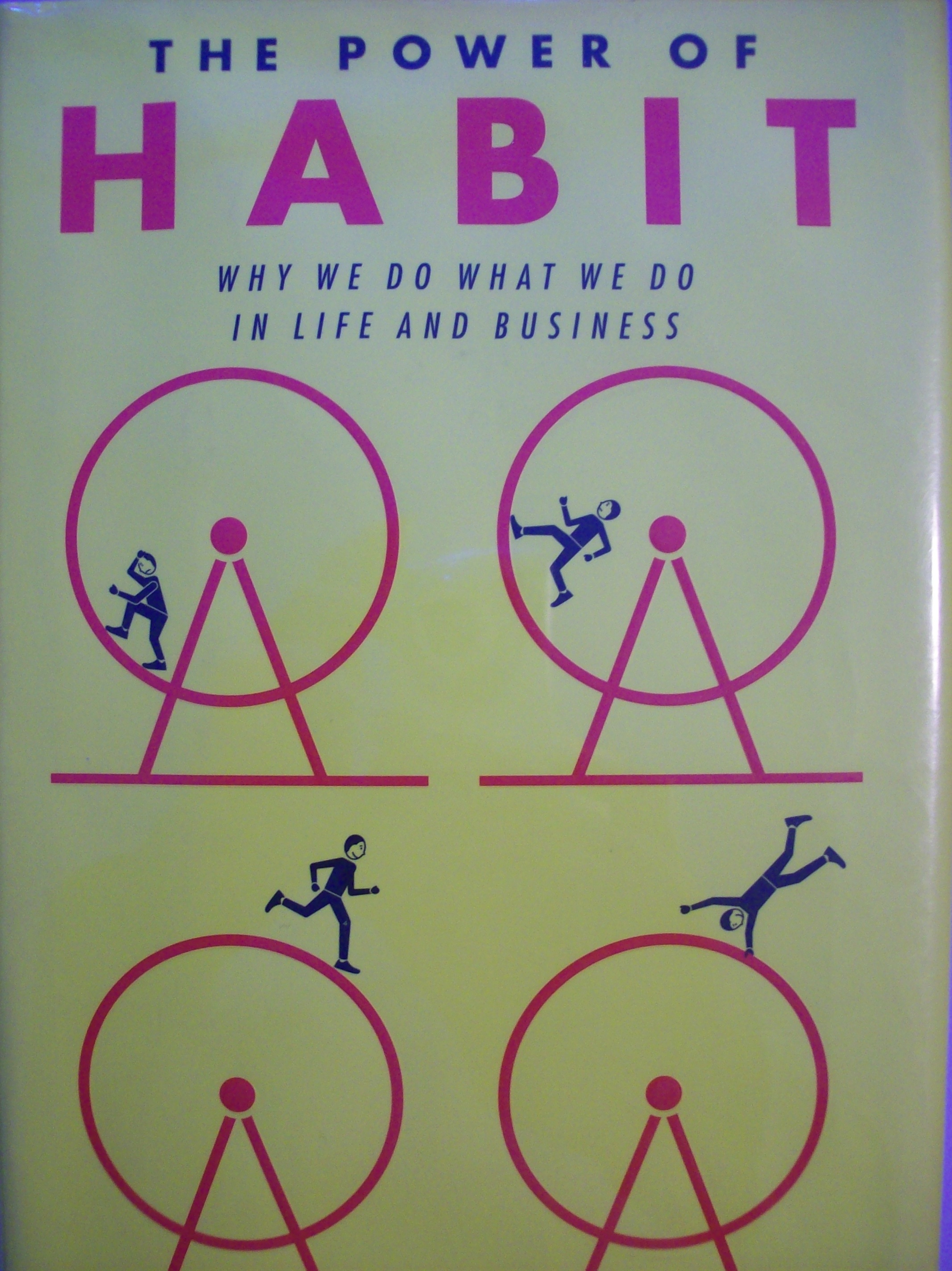
The Power of Habit: Why We Do What We Do in Life and Business by Charles Duhigg (pictured above at 14 words)
Unbroken: A World War II Story of Survival, Resilience, and Redemption by Laura Hillenbrand (a relatively short 11 words)
My Greek Drama: Life, Love, and One Woman’s Olympic Effort to Bring Glory to Her Country by Gianna Angelopoulos (I haven’t read this one, but I couldn’t resist a 16 word title)
Even without the titles of Paul Collins’s books, these nonfiction titles average over 10 words. I have a tough time saying more than 10 words in one breath, but I should probably work out more.
Compare this to a list of fictional book titles (as in titles of real books in the fiction section, not fake book titles):
Gone Girl by Gillian Flynn
Something Prey by John Sandford
12th of Never by James Patterson and Somebody Else
Fiction titles need to be short. Otherwise, the title risks containing spoilers. It’s bad enough that book blurbs and book reviews can contain spoilers; we don’t need them in titles as well.
If Gone Girl were nonfiction, its title might be: Gone Girl: How a Wife’s Mysterious Disappearance Led to (Spoiler, Spoiler, and yet another Spoiler).
See? It doesn’t work for fiction.
The good thing about having a really long book title is that the author doesn’t have to explain what the book is about. For example, here is a fictional conversation between author Paul Collins and a potential customer at a book store.
*****
Customer (who asks this question despite the giant sign with the title of the book on it): “What’s your book called?”
Paul Collins (reading from the sign because he can’t remember the title of his own book): “Duel with the Devil: The True Story of How Alexander Hamilton and Aaron Burr Teamed Up to Take on America’s First Sensational Murder Mystery.”
Customer: “Really? What’s it about?”
Paul Collins: “The time that Alexander Hamilton and Aaron Burr teamed up to take on America’s first sensational murder mystery.”
Customer (after a pause): “That’s good enough for me!”
*****
I don’t remember nonfiction books having long titles when I was a kid. I’m Okay, You’re Okay was a huge best-seller decades ago (when I was a kid), and just from those four words I knew I didn’t want to read it. Then again, my memory can be pretty bad sometimes. I just looked up this book (I did research!) and discovered the title is I’m Okay, You’re Okay: A Practical Guide to Transactional Analysis.
Now I really don’t want to read it. I don’t know what “transactional analysis” is, but I’m pretty sure that I’m not going to be “okay” with it.
The point is, long nonfiction book titles don’t seem to be new. But Paul Collins is probably taking it to a new level.
*****
DISCLAIMER: Despite my gentle mockery, I’ll probably read Duel with the Devil: The True Story of How Alexander Hamilton and Aaron Burr Teamed Up to Take on America’s First Sensational Murder Mystery. I figure I’m halfway done just by getting through the title.
Related articles
- “Duel With the Devil”: Murder in Old New York (salon.com)

There’s nothing wrong with reaching for the stars, but you might want to do it in your spare time. (Photo credit: Wikipedia)
With graduation season comes lots of rambling speeches and lots of advice. Most of the advice that I’ve heard (from snippets on television and videos) is pretty bad. “Reach for the stars” is bad advice. “Find a job that you love” is bad advice. The problem with this advice is that it’s coming from people who probably shouldn’t give advice to college or high school graduates.
Colleges should make a guy like me their graduation speaker (except I’m not a good public speaker. They should get a guy LIKE me who is NOT me). I’m not a celebrity or any kind of famous person. I’m just a moderately successful guy that nobody has heard of. I’ve held the same kind of job for 25 years. I’ve (somehow) stayed employed through several recessions. I’m married with kids.
From a graduate’s point of view, I’m a boring guy with a boring life. But I’m also the person that most graduates will become (or should hope to become).
Most college graduates will not become famous or super wealthy. They will become like me. And they should go out into the world with aspirations to become like me (that sounds really arrogant, but I hope this makes sense).
So if I were to give a graduation speech (and I won’t, but if I did), it would be a short speech with lots of (hopefully) amusing anecdotes and one piece of (maybe really bad) advice:
- Be content with having a job that sucks.
This can be taken the wrong way, so I’ll try to explain my bad advice.
Too many famous people (whose names I won’t mention because they’re already rich and famous and get mentioned too often anyway) advise students/listeners/viewers that we should strive to find a job that we love.
I disagree. Trying to find a job that we love (or “reaching for the stars”) leads to disappointment, disillusionment, and bitterness (I couldn’t think of another “dis” word).
Instead, find a job that pays you enough to do the stuff that you love… in your spare time.
I love reading, writing, and watching football (and spending time with my family, of course), but few jobs will pay me to do all three. The “reading” jobs would require me to read a bunch of boring stuff that would make me hate reading. The “writing” jobs would require me to write a bunch of boring stuff that would make me hate writing. The “spending time with family jobs” would… I’d better stop right there.
Everything I love to do requires somebody else to do a job that sucks. If I go to a restaurant, a bunch of people have to do jobs that suck in order for me to enjoy myself. If I take my family to the mall, a bunch of people have to do jobs that suck in order for us to enjoy ourselves.
In fact, most jobs suck (even the ones that require a college education), but most jobs are important.
This notion that we must find a job that we love is self-destructive. Somebody has to do the jobs that suck. If everybody did only the jobs they loved, then nobody would do the jobs that sucked, and there’d be a lot of trash outside because waste management jobs suck.
So that’s my bad advice to graduates: find a good job that sucks, and then do the stuff you love in your spare time.
*****
I don’t remember many of the speeches from my graduation ceremonies. The graduation speakers weren’t famous, they had monotone voices, and my mind was on other things. The only thing I remember is that our high school valedictorian started off his speech with a bad (almost offensive) joke that nobody laughed at, and his face turned red, and it threw him off for his entire speech. I had never seen him flustered before. Our valedictorian was a likable guy, and I felt bad for him.
I’m sure somebody suggested to my school’s valedictorian that he start his speech with a joke. That was bad advice.
What other bad advice can we give to today’s graduates?

Even though people love moist cupcakes, they supposedly hate the word “moist.” I’d like to share a word that I think is even more annoying than “moist.” (Photo credit: Wikipedia)
Life is full of annoyances. People who chew with their mouths open are annoying. Little dogs with high-pitched barks are annoying. I’ve even been told that I’m annoying. But it took me a long time to realize that individual words could be annoying.
Scribit has a list of words that bloggers and websites shouldn’t use because readers find them annoying. To be honest, I don’t know what a Scribit is; I just accidentally found this list (I’m pretty sure Scribit doesn’t know what a Dysfunctional Literacy is either).
Most of the words on the Scribit list don’t bug me. I have no reaction to the word moist (supposedly the most hated of words). I say slacks a lot because I wear slacks a lot, and I’d rather say slacks instead of trousers, no matter what a list says. I understand that awesome is over-used, but a lot of that is hyperbole, and most people understand that awesome doesn’t really mean awesome anymore. I understand why irregardless is on the list, but I understand what people mean when they say it, so that doesn’t bug me either.
The list didn’t include any racist words. I think racist words (which I won’t use) are universally hated, except by racists, but everybody is afraid to use racist words, even when they’re talking about racism because they don’t want to be accused of being racist. I don’t even read Huckleberry Finn in public because I don’t want to be accused of being racist.
But once I started thinking about potentially annoying words, I realized there was indeed a word that I hate. There is a word that makes me cringe whenever I hear it.
AND THE MOST ANNOYING WORD (in my opinion) IS…
Share.
Over the years, I’ve come to hate the word share. In school it meant giving up something I owned for somebody else who probably didn’t deserve it. In my professional life, it means giving my coworkers the chance to get credit for my ideas.
I guess I should explain.
I once had a boss that used to say share by extending the sound over two syllables (shay-air) in a nasally tone at brainstorming sessions. I cringed whenever she said “Shay-air,” and it didn’t help that I was usually the first person she called upon. I think she enjoyed watching me say “Uh…. Errr….,” with my face turning red.
I felt bad when this boss got demoted (or laterally moved), but I didn’t shay-air my sentiment with anybody else because she was unpopular and had added a bunch of unnecessary and counterproductive procedures to our jobs.
Now whenever I hear the word share, I hear shay-air, no matter how the word is uttered. It’s like the fingernails on the chalkboard (which might be a bad example because that never bugged me).
Now that I think about it, I don’t even like the concept of sharing. I’d rather just tell somebody my idea than share it. I’d rather just let somebody borrow my stuff than share it. In some cases, I’d even give my stuff away before I share it. At the very least, I’d buy somebody the same thing that I have instead of sharing mine.
Very few words have both an annoying concept AND an annoying sound. Because of this, the word share is in an annoying league of its own. Maybe it’s just me.
I don’t know. Are there any words more annoying than share?
And please don’t share your ideas with me. Just tell me what you think.

Warning! Misleading title alert! (Photo credit: Wikipedia)
I knew I had no chance romantically with Danielle, the hot chick in a clingy black t-shirt. She was way out of my league. So when she unexpectedly said she was coming up to my apartment, my goal was simply to not embarrass myself. I had been sick when we first met and hadn’t made a good impression. I had fumbled through my explanation when I told her why I had her undergarments. And now when we walked into my apartment, the first thing she saw was a giant roach on the wall.
It was the cockiness of the roach that ticked me off. Here it had two humans staring him down, and it just stood in place as if it had paid the rent.
“You going to do anything about that?” Danielle asked quietly.
I sighed and strode to the kitchen, grabbed a can of bug spray from a cabinet, and shook the can as I approached the roach.
“You know you can just use a shoe,” Danielle said.
“That’s for savages,” I proclaimed, aiming the can at the arrogant roach who hadn’t yet moved. But when I pressed the nozzle, it bent to the side and released no spray. It was too full to get nothing. If there had been nothing, it would have a sppfffft sound. I didn’t even get the sppffft sound. I would have peeked inside the nozzle to see what was going on, but I’d watched enough cartoons to know how disastrous that could be.
Danielle pointed to my feet and mouthed the word “Shoe.”
Instead, I smashed the can against the roach. It dropped to the floor and remained still.
“You still should have used a shoe,” Danielle said, her arms folded.
“I spent my own money on this,” I replied, dropping the can into my waste basket in the kitchen. “It’s going to kill a roach one way or another.”
Now that the roach was gone, Danielle looked around the apartment. She glanced at my television and vcr sitting on a low wooden table. She eyed the two bookshelves filled with hardcover classic literature bought from used bookstores. She shook her head at two old couches that I had purchased from some guys moving out just as I had been moving in. This looked like it was an apartment for a college student, not a young professional.
“What do you do?” Danielle asked, looking at my shoes again. There was a contrast between my clothes and my furniture.
I started walking down the hallway to my bedroom. I hoped Danielle would stay in the living room, but she followed me to the end of the dining area. I really didn’t want her to see the bedrooms.
I told her what I did for a living. It was a boring job, and people usually yawned or nodded while saying something like “That’s nice.”
Instead, Danielle said, “You must make pretty good money.”
“Yeah, I do.”
“Then what do you spend it on?” Obviously, it wasn’t on furniture.
“My student loans are paid off. My car’s paid off. So now I’m saving for a house.” I was talking loudly because I thought she’d be hanging back in the dining area, but then I realized that Danielle was a couple steps behind me, so I lowered my voice. “You can stay right there while I’m getting your stuff.”
“But I want to see what’s in your bedroom,” she said, tilting her head and sticking her lips out.
“A bed and a dresser and a walk-in closet.”
“No, the other one.” Ah, the second bedroom was a mystery to her. Really, it was just stacks of books piled up because I was too cheap and lazy to buy more shelves, and there were a few thousand comic books in long white storage boxes.
“I’m sorry,” I explained, shutting the mystery bedroom’s door just in case Danielle got too bold. “Even I don’t want to look in there most of the time.”
“Not even a peak?” she asked with a whisper.
“Just stay right there,” I said as I went into the main bedroom. I left that door open so I could see out of the corner of my eye if Danielle got too curious. I stepped into the walk-in closet and grabbed a shoe box from the corner shelf. When I presented the shoe box, Danielle was where I had left her in the hallway and the second bedroom door was still closed.
“Shoes?” she said, but the box was too light and when she shook it (I laughed when she did that and she frowned at me) there was no sound. Then it dawned on her. “Are you serious?”
“I’m sorry. I thought you’d want me to keep them seperated from my stuff,” I said. “Maybe I should have had them gift wrapped.”
I hadn’t wanted to simply hand Danielle her three undergarments back. That would have just seemed classless. She scooped the panties out of the shoe box and handed it back to me. For some reason, that almost offended me. “I’ll… I’ll walk you out,” I said.
“Thank you,” she said. I didn’t know her well enough to judge, but she sounded sincere. She walked slowly so that I couldn’t help but almost catch up, and her arm brushed up against mine again. My imagination had to be messing with me.
When we reached the living room, Danielle stopped and faced me. “Have you read all of these?” she asked, pointing to my bookshelf.
“Yes, of course,” I said. I had read a few of them completely, but I had at least glanced through all of them. I had read enough about each one to hold a quick conversation before I’d need to change the subject.
“You’ve read Moby Dick?” she said.
“Yes. I didn’t enjoy it, but I read it.”
“You’ve read…” She squinted at a large volume at the top of the shelf. “You’ve read The Brothers K… The Brothers K….”
“I don’t know how to pronounce it either,” I said. “When I get to those long Russian names, I just change them to Smith and Jones in my head.”
“I like books,” Danielle said. “But I didn’t go to school… college.”
“So, what do you do?” I asked.
Danielle paused and narrowed her eyes at me. “I dance at Nero’s.”
I didn’t know why, but I knew this was a pivotal moment. Nero’s was a topless club, one of the most prominent in the city. It wasn’t as sleazy as most, but still, it was a topless club. Danielle studied my face, probably judging me by what I was about to say. Mentioning Nero’s would usually bring a smirk to my face, but I quickly tightened my mouth. I had to think of the right response, nothing too patronizing. The silence was about to turn awkward as I thought about what to say. I really needed to think of something to say.
“You probably make more money than I do,” I declared, somehow maintaining my straight face.
Danielle gazed out the patio window to a view of the apartment across the sidewalk. It looked exactly like mine.
“I have some good nights,” she said quietly. Then before I could change the subject, she turned to me again with a startlingly wide smile. “Jimmy, it was nice to meet you.”
She extended her hand (the one NOT holding her undergarments), and I was relieved that she wasn’t going for the insincere hug. I hate the insincere hug. As we shook, she said, “You’re cute. And you’re fun to talk to.”
“Thanks,” I said. She called me cute? And fun to talk to? I get complimented for several things, like being cooperative, reliable, and a good listener, but being fun to talk to was a new one. I had such a difficult time grappling with that that Danielle was out the door before I could get an appropriate response out.
I muttered a lame “It was good to meet you too” but I don’t think she heard. She was already halfway down the steps. I watched as she power walked in her tight jeans and black t-shirt down the sidewalk back to the parking lot. I couldn’t even enjoy the view because I kept wrestling with the last part of our conversation. Nero’s? Cute? Fun to talk to?
Once I cleared my head, I realized that she talked to guys for a living. She probably told every guy she met that he was cute and fun to talk to. I told myself to get over it. I might have been cute on a good day, but I probably wasn’t fun to talk to. Besides, I wasn’t going to see Danielle again. I didn’t go to topless clubs. I didn’t have anything against them except they were expensive. I couldn’t save my money if I was blowing it on strippers and overpriced beer. Danielle was a hot chick who wore clingy t-shirts (when she wasn’t working), and we weren’t going to see each other again.
As far as I knew, that was the end of the story.
*****
To be continued in… The Literary Girlfriend: Football Season.
Or to read “The Literary Girlfriend” from the beginning, start here.

One way to take the fun out of writing is to put a lot of your own money into it.(Photo credit: Wikipedia)
The problem with writing about legal stuff is that it’s boring. I was planning to go to law school once, but when I worked at the law school library as an undergrad, I saw lots of really tired, bored students who could barely find a copy of the Federal Register when the volumes were already in proper numerical order (because of me).
Even though legal stuff is boring, it’s often really important. Boring stuff is usually really important. It’s why people who handle important stuff get paid lots of money; it’s so boring that the rest of us don’t want to deal with it.
There are several boring legal issues in the literary world right now. The United States Justice Department is suing Apple for collusion on ebook prices with publishing companies (who have already settled). Publishing companies and authors are suing each other for the rights to make electronic versions of books from decades ago. And now self-published authors are jumping into legal battles by suing a self-publishing company for (allegedly) not doing what they were supposed to do (read here for a little more information).
There are going to be a lot of boring details in this lawsuit. What was the publishing company supposed to do? What did they NOT do that they were supposed to do? What’s the proof that the publishing company didn’t do what they were supposed to do?
The company getting sued is Author’s Solutions. Any company that that has the word solution in the title is probably going to cause a lot of problems (don’t sue me, I’m just kidding around!). I don’t trust a company that has Solutions in its name, just like I don’t trust a company that starts off with AAA just to be first in listings. Maybe I’d trust a company that starts with ZZZ, but I’d probably want some references first.
Since I’m a writer, my impulse is to root for the author plaintiffs. I can see how a self-publishing company (especially one with the word Solutions in its name) would be unethical and offer service after service to milk as much money from authors as possible. However, I also know that writers (but not all) can sometimes be whiney and blame others for their lack of success. Unfortunately, I don’t have enough facts to know which way to lean.
When I was younger, that wouldn’t have mattered. I would have chosen a side, defended it, doubled down if necessary, and impugned the character of anybody who disagreed with me. However, I’ve learned that NOT having an opinion for a while actually makes life easier.
My advice for this (just as it is for MOST political/legal issues) is to not have an opinion for six months, then come back and see what’s going on.
*****
A tough issue for any self-publishing author is how much (if any) money to spend. We writers might complain about how traditional publishing companies suck (because they won’t accept our books), but at least these companies invest their own money so that authors don’t have to. I’ve never invested a bunch of my own money on my writing, but I imagine that it takes some of the fun out of writing, especially if the self-published book isn’t successful.
If I were a self-published author who had spent hundreds (or maybe thousands) of dollars and wasn’t happy with the services I paid for, I’d be angry too. I don’t want to be angry when I write. Anger sometimes can help me accomplish certain tasks (I can fold laundry like origami when I’m angry), but writing isn’t one of them. Since I don’t want writing to become a source of anger for me, I probably won’t spend a lot of money on self-publishing.
*****
Seriously, I originally meant to write an insightful piece about literary lawsuits, but it was just too boring. I guess I ramble when I’m bored.

(Photo credit: Wikipedia)
Despite being a writer, I’m not a good conversationalist. Talking to regular strangers is difficult enough for me, but this situation was really awkward. I’d been holding on to this hot chick’s underwear for almost a month (not literally holding it), and she was walking with me to my apartment to get them. In the meantime, I had to talk to her.
Politics and religion were out of the question. We’d already discussed football a few weeks ago. I refuse to talk about the weather. That left… silence?
*****
I figured the hot chick in her clingy black t-shirt would want to keep a slight distance from me as we walked through the apartment complex parking lot. After all, I was a strange guy (from her point of view) with her undergarments. If I had been her, I would have thought of myself as a strange guy; I would have kept myself a couple arm length’s from me. But she strolled right next to me. She walked so close to me that our arms touched. I didn’t mind. It was a cool feeling, her smooth brown arm brushing up against my sleeve, but I thought she’d want her space.
When we reached the sidewalk, I stepped to the right edge, and she took the center, and our arms kept brushing. This couldn’t be right. I thought about moving off the sidewalk altogether, but that seemed too much. If she were determined to brush up against me as we walked, then that was her issue, not mine.
“I’m really glad I ran into you,” I said. “It will be good to get your undergarments off my hands.” I paused. “Not that I ever had them on my hands… or on any part of me. I mean that I want to be absolved of all responsibility for your undergarments.” I paused again. “I don’t want to feel responsible for your clothes.”
“I know what absolved means,” the hot chick said gently.
Ouch! Sometimes I over-explain things that don’t need explaining. Here I was worried about the hot chick thinking I was a pervert, and instead she thought I was condescending. At least that was the lesser of two evils, but not by much. I needed to change the subject.
“Hey, thank you for running my clothes through a second cycle in the dryer,” I said. “That was very thoughtful of you.”
“Oh, that,” she said, lowering her voice. “Some fat mom was giving me the evil eye when I took my clothes out, so I started a new cycle just to piss her off. I hope you made her wait.”
There had been only one working dryer at the time, so starting a new cycle would have meant 40 more minutes of waiting for the mom.
“Yeah, I got there late,” I said. In reality, I had taken my clothes out maybe five minutes after the hot chick had left, and the fat mom had grabbed the dryer right away, but I didn’t have the heart (or fortitude) to tell the hot chick in a clingy t-shirt that she had paid for the fat mom’s dryer cycle. She was better off not knowing.
“I probably shouldn’t have done that to her,” the hot chick said. “My friends say that I’m too vindictive.” She nudged my ribs with her elbow. When I made eye contact, she gave me a toothy smile, the first real smile of our conversation. “That means evil.”
I couldn’t tell if she was kidding or not, so I just nodded. “I don’t see you around much. Do you live here?”
“Kind of,” she said. “But I’m moving out. Like I said, some crazy shit’s going on in my life.”
“Crazy shit?” I asked, fishing for clarification.
“Crazy shit,” she repeated, meaning that she wasn’t giving out any more information.
“Crazy shit,” I said, acknowledging that I understood.
I thought she was going to say “Crazy shit” again, but instead she said, “You live in one of those two-bedroom apartments?”
My place was in an eight apartment unit with four apartments on each side. My apartment was an upper level, and we had just reached the stairs leading up to my entrance. “Yeah,” I said.
“How much do these run?”
After I told her my monthly rent, she asked, “How do you and your roommate split that? Those second bedrooms suck.”
“I don’t have a roommate,” I said, motioning her to walk up the steps before me.
“Interesting,” she said as she brushed her arm against me again. “What do you do with the extra room?”
I kept my answer as vague as possible as I followed her up the steps. “Storage. I have a lot of stuff.”
“What kind of stuff?” she asked.
We had just reached my door, and I wasn’t ready to answer her question yet. “Hey, I usually introduce myself before I let strangers come into my apartment,” I said. “My name is Jimmy.”
‘I’m Danielle,” she said, extending her hand. We shook. Her grip was firm and dry. Mine was a bit clammy, so I kept the handshake short and hoped she didn’t notice.
I unlocked the door and let Danielle enter first. I was about to explain why my apartment was so sparsely furnished when Danielle exclaimed:
“Jesus Christ, that’s a big roach!”
At least I wasn’t going to have to explain my furniture situation. And I didn’t have to worry about making small talk anymore.
*****
To be continued in… The Literary Girlfriend: The End of the Story?
And to read “The Literary Girlfriend” from the beginning, start here.

Buy a bunch of these, and you may be considered to be “well-read.” (Photo credit: prolix6x)
It doesn’t take much to make people believe that I’m a well-read literary type. I put a bunch of thick hardcover classics on my bookshelf in my living room, so all my guests assume that I’ve read them. I’ve memorized a few quotes from literature to make me sound smarter than I really am. And I make sure not to talk about football around my intellectual literary friends.
So when I heard there was a list of the 20 most well-read cities in the U.S., I thought, what would it take to make a well-read city? After all, if I can fool my intellectual literary friends into thinking I’m well-read, what can a city do?
Being well-read is a trait that a city would probably want to have. When other city lists come out (fattest city, city with the most crime, highest taxes city), most cities don’t want to be on those lists (except a couple cities are proud of their high taxes).
After a little research (because a little research is all that I’m willing to do), I found out what the four factors were in being on the Most Well-Read City list:
1. Book sales
2. Magazine sales
3. Newspaper sales
4. Amazon Kindle sales (This list of well-read cities was compiled by… Amazon. I guess that’s important.)
Magazines count as being well-read? I feel cheated. All these years I spent finding used, yellowed hardcover editions of classic literature so that I could be considered well-read, and all I had to do was put a bunch of Newsweek and Playboy magazines out there. If you count comic books as magazines, I could have put my complete collection of The Avengers out there, and I would have been considered well-read by all friends and colleagues.
Newspapers also count? I didn’t even know people bought newspapers to read them anymore (except in the bathroom). Evidently, clipping coupons and looking for store sales makes a person well-read. All those years, I could have been saving money instead of pretending to read big books.
To me, the fact that Amazon used its Kindle sales as part of its criteria (while ignoring digital sales from other booksellers) invalidates its own list. If Barnes & Noble comes out with its own list, cities that have lots of Barnes & Noble stores might be the Most Well-Read Cities.
It’s not that Amazon has put out a highly flawed, publicized list that chaps my hide. It’s that I spent years of effort convincing my friends, peers, and coworkers that I was well-read. Now Amazon has changed the meaning of well-read and made all that effort wasted. That really ticks me off.
Now just because Amazon has redefined well-read doesn’t mean their version has to stick. We traditionalists (even a fraudulent traditionalist like me) can still influence what well- read means and what it doesn’t. What characteristics go into being well-read?
- Does any book count?
- What books are worth more than others?
- Should newspapers and magazines count?
- If digital books count (and they probably should), shouldn’t ALL of them count (not just the ones on Kindle)?
- Should the digital-only books count as much as traditionally published books?
- What kind of scoring scale should be used to rate the varying kinds of literature?
I probably don’t have the right to be upset. After all, I’ve always faked being well-read. It’s the well-read literary types who have actually read the classics that should feel cheated. Or should they? Is all reading considered equal?
That’s probably for people much smarter and much more well-read than me to decide.

Man, I bet you could find some great cuss words in these old dictionaries. (Photo credit: Wikipedia)
I’ve always loved the dictionary, even if I’ve loved it for the wrong reasons. When I was a kid, I liked to look up dirty words and laugh at the definitions. As I got older, I appreciated the giant unabridged dictionary at the back of the library. It was always attached to a table or podium so it wouldn’t get stolen (who’d steal a dictionary?) or dropped (yeah, I could see that happening, and a kid gets squashed, and a parent sues).
Anyway, the guy who runs the Oxford English Dictionary (the formal position is called Chief Editor) is retiring after 37 years at OED and about 20 as Chief Editor. 37 years is a long time at any one place. 20 is a lot at any one position, so I hope they at least get him a big thesaurus as a parting gift.
In the BBC article reporting this retirement, the retiring Chief Editor chose a few words as examples of what he does, which is to figure out word history. The selected words were pom, Etaoin shrdlu, and New Model Army.
Even though the history behind these terms/phrases may be interesting, I was turned off by my lack of familiarity with them. How can I be interested in these words if I never use them? That’s not a complaint against the Chief editor. That’s simply my reaction.
As an American, I probably wasn’t the author’s intended audience anyway, but these examples probably would not inspire people NOT interested in the dictionary to become interested in the dictionary.
To help out, I’ve chosen three simple words, each with an interesting history. Despite my past fascination with profanity and vulgar words, I’ve chosen three common words that aren’t dirty, profane, or vulgar. Since I’m American, I’m using a Merriam-Webster Intermediate Dictionary, an abridged version that my kids use at school and at home.
1. Nice-
Short Version: Nice used to mean “stupid.”
Nice comes from the Latin word “nescius” which means (or meant) “ignorant.” In the 15th century, the English word nice meant “stupid.” By the 16th century, the meaning of nice had changed a bit to “finicky.” Then by the 19th century, nice had come to mean “pleasant” or “agreeable” which is still one of nice’s most common meanings.
2. Snob-
Short Version: Snob used to mean “a guy who made shoes.”
Snob used to be an English dialect word for cobbler (a person who makes or repairs shoes). Snob then came to mean “a common person” since cobblers were thought of as common or lower class. Then snob became “a lower class person who pretended to be upper class or imitated the mannerisms of noble people” (kind of like how I used to pretend to have read literature that I really hadn’t). Now snob is “a person who looks down on others.”
3. Travel-
Short Version- Travel used to mean “to torture” (kind of).
Travel starts from the Latin (of course) word tripaliare which meant “to torture.” The French word travailler also meant “to torture” but also meant “to work really hard”. The Middle English word travaile meant “to work hard” but also “to travel” (maybe because travelling was so difficult… and this was BEFORE airline screening). Travailen eventually split into two different words, travail for “hard work” and travel for “to go on a trip.”
*****
See how easy that was? I spent five minutes with a dictionary and learned a bunch of word history. Maybe next week I’ll spend five minutes with a thesaurus.

Men will almost always stare at women in tight jeans, even if the women are topless mannequins. (Photo credit: Wikipedia)
Even though I try to be tactful, sometimes there is no easy way for a guy to say something to a woman. It’s tough to tell a lady she has bad breath. It’s impolite to tell a female she has a booger dangling out of her nose. And I had no idea how I was going to tell a hot chick in a clingy t-shirt that I’d been holding on to her panties for the last month. But I was determined to do it.
*****
I was returning home from work on a weeknight when I saw her. I was parking my car in the tenant’s covered section in the middle of the lot, and as I glanced to my right, I spotted a hot chick in tight jeans. I wasn’t sure if it was the right hot chick, but the jeans looked like they belonged to a hot chick.
Side view glances can be misleading, so I stopped my car in mid-turn into my spot so that I didn’t sideswipe the car next to me while I was checking her out. Sure enough, it was the hot chick, in tight faded jeans and a black t-shirt. She opened the trunk to a red sports car about 10 car lengths from me in the diagonal guest parking section. She bent over, but I was too far away from her to enjoy it, and she picked up a box, threw it into the trunk, slammed the trunk door shut, and power-walked away into the labyrinth of sidewalks through our apartment complex.
I was pretty sure it was her (long, wavy dark hair and light brown skin), but her body language was different. In the laundry room, she had strolled leisurely (until she had found out that there was only one dryer and I had already claimed it). Now she was darting around on a mission. I carefully resumed parking, and as I was shutting off the engine, I saw the hot chick already returning to her car.
Whatever was going on, the hot chick walked with purpose. She threw another box into the trunk, slammed it shut, and stormed back toward the driver’s side of her car. I didn’t have time to think about what to say. I jumped out of my car and ran toward her, yelling:
“Hey! Hey! Excuse me! Hey!”
She turned toward me in a defensive stance, both fists tight, her eyes narrowed right at me. “What!” she said.
I stopped. I even backed up with my open hands in the air. Her sharp tone kept me from checking her bra status, which would have been difficult with her black t-shirt anyway. I maintained eye contact. Yeah, this woman had flawless brown skin and curves perfect for jeans, but she was also angry, and it’s not a good idea to get caught checking out a pissed off hot chick.
“Hey, I’m the guy you shared the dryer with a few weeks ago,” I stated carefully.
“What are you talking about?” she said, not blinking. This close, I could see that the edges of her eyes were red.
I took a step back and said, “I’m the guy with the monotone voice.”
She squinted even more, but looked at my tie and then my shoes. When we had met in the laundry room, I’d been sick. I had worn rancid casual clothes, was unshaven, and probably had a nasal stream flowing to my upper lip. This evening, however, I was in my professional attire: long sleeved button down shirt, tastefully colorful tie, khaki slacks, and polished dress shoes. My hair even looked good, gelled back enough to have life but not so much that it seemed slick. When I dressed up, I was probably in the top 50% of my age bracket appearance-wise (I was in my mid-20s back then), but I had to work to get there.
This hot chick, on the other hand, was top 1% without even trying.
“I remember you,” she said, but it took a moment. She dropped her hands a little.
“I wasn’t at my best, that day we met,” I explained. “Anyway, you left some clothes… well, underwear… in the dryer, and I still have them.”
“Jesus Christ, that’s what this is about?” she said. “I thought you were a mugger or some pervert pretending to be a photographer.”
“No, I’m not a pervert photographer,” I laughed nervously. “I just have your panties…. I mean, undergarments. I’ve kept them since the other day.”
“The other day? That was a month ago,” she stated.
“Three weeks and four days,” I said, looking away. “I promise, I didn’t know I had them. I was sick, and didn’t fold my laundry for a few days. I just didn’t want you to think I was the kind of guy who would keep your underwear.”
She didn’t respond. I felt really uncomfortable, so I changed the subject. “Those guys who say they’re photographers, I was wondering, are they really photographers?”
“I don’t know,” the hot chick said. “I always tell them to fuck off.”
I was surprised at her language, but then I remembered how she had over-cursed in the laundry room. The good thing about the pervert photographer topic is that it was even more awkward than talking about women’s undergarments, so I went back.
“Let me go get your … items,” I said. “They’re okay to wear. I mean, they’re okay for YOU to wear. I promise, I didn’t wear them or do anything weird with them.”
“This is funny,” she said with just a trace of a smile. “All this shit’s going on in my life, and you’re worried about my panties.”
“Just stay right here,” I said quickly. “I’ll be right back with them.”
She studied my shoes and then made eye contact again. “No, I’ll walk over with you,” she said.
“Are you sure?” I said. “I mean, it’s okay if you do, but don’t get the wrong idea about me when you see all the photography equipment around my place.”
“You’re kidding,” she said, but not as a question. She knew I was kidding.
“Yes, I am,” I said, nodding. I turned around and walked back toward the covered parking in the direction of my apartment. I was surprised when the hot chick actually followed me.
The hot chick in a clingy black t-shirt was coming over to my apartment. And I hadn’t had a chance to clean it up yet.
*****
To be continued in… The Literary Girlfriend: Small Talk And I promise the hot chick finally gets a name. I mean it!