Last year I wrote a short story on this blog about something that happened to me on July 4, 1976. It’s been year since I wrote this story, and I still haven’t thought of a better title.

 USA! USA!! USA!!! (image via wikipedia)
Even at a young age, I was taught to be proud that I was a United States citizen. I knew to stand up while reciting the Pledge of Allegiance. I made sure our United States flag never touched the ground. I even tried to sing along as the Star Spangled Banner was being performed, but I was told to mouth the words instead because my singing voice wasn’t good and I sounded disrespectful.
Some people are uncomfortable expressing pride over being an American. Maybe they even feel like it’s arrogant to feel pride in a country. I don’t think my pride is arrogance. I simply recognize that I’m fortunate to live in a country where our U.S. Constitution guarantees certain freedoms and human rights that our government may not arbitrarily take away. This freedom allows Americans to reach our potential in ways that may…
View original post 1,016 more words
When I think back about my childhood, I often remember doing stuff that I’d never let my kids get away with. This is one of those stories.
 This picture was published in 1902. It was okay for kids to fire off guns back then. (image via Wikipedia)
I was 10 when the United States turned 200 years old. It was a big deal back then, but at the time, the meaning of the 4th of July was lost on me. As an adult, I understand July 4th is the annual celebration of the signing and approval of the Declaration of Independence by the Continental Congress.
I understand how important the following sentence from The Declaration of Independence is:
“We hold these truths to be self-evident, that all men are created equal, that they are endowed by their Creator with certain unalienable Rights, that among these are Life, Liberty and the pursuit of Happiness.”
That one sentence had a bunch of concepts that were unique way back in 1776.
The Declaration of Independence is also known…
View original post 817 more words
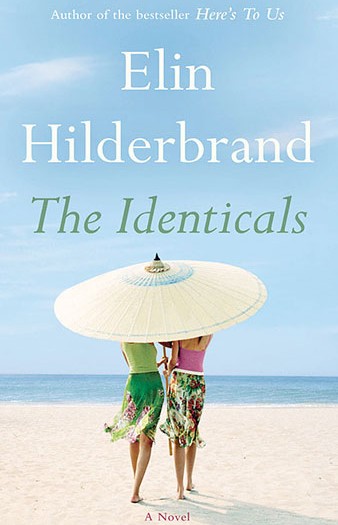
Oh God, please don’t let my wife read the beginning of this book.
The book is The Identicals by Elin Hildebrand, and the prologue reads like an advertisement for Nantucket. My wife wants a nice vacation this summer, and if she reads something nice about a place like Nantucket, she’s going to want to go. Nantucket is expensive, and we don’t have that kind of money. I was hoping for one of those nice places that nobody has heard of (I can’t think of an example because I haven’t heard of it yet). Those types of places are less expensive, and that’s what my family needs right now, less expensive.
Here’s what I mean about The Identicals. I open the novel to the first page, and I already get a bunch of nonsense about how wonderful Nantucket is.
Like thousands of other erudite, discerning people, you’ve decided to spend your summer vacation on an island off the coast of Massachusetts. You want postcard beaches. You want to swim, sail, and surf in Yankee-blue waters. You want to eat clam chowder and lobster rolls, and you want those dishes served by someone who calls them chowdah and lobstah. You want to ride in a jeep with the top down, your golden retriever, named Charles Emerson Winchester III, riding shotgun. You want to live the dream. You want an American summer.
My wife would read that paragraph and want to go to Nantucket. I read that paragraph and think: DON’T TELL ME WHAT I WANT!!!
Plus, there’s namedropping in this book. My wife is a sucker for name dropping. There are a lot of names in the first couple chapters, the names of people, the names of places, and the names of specific food. I think most of the names are real, but I’m not sure. I’m not familiar with Nantucket, Cape Cod, and Martha’s Vineyard.
Here’s an example. After all the bragging about Nantucket, you turn to the next page and get a smothering tour guide for Martha’s Vineyard.
The Vineyard has diversity- of races, of opinions, of terrain. We have the Methodist campground, with its colorful gingerbread houses; the Tabernacle; Ocean Park; Inkwell Beach; Donovan’s Reef, home of the Dirty Banana- and that’s only in Oak Bluffs! We have dozens of family farms that harvest an abundance of organic produce; we have the Jaws Bridge and the cliffs of Aquinnah; we have the East Chop and the West Chop, the Katama airstrip, and a neighbor in Edgartown who keeps llamas on his front lawn. We have…
That’s enough. I can’t take it.
I don’t know much about these places, but I know we can’t afford to go there this summer.
I’m not sure what the book is even about. It’s probably about identical twins. Maybe one lives in Nantucket and one lives in Martha’s Vineyard (or Cape Cod). Maybe the twins are really different from each other or maybe they’re estranged. Maybe something bad happens that forces the twins to resolve their differences.
I don’t know any of that stuff. All I know is that I can’t leave this book lying around the house.
Maybe there’s a good bestselling novel about Tulsa that I can leave lying around the house instead. I’ve heard Tulsa’s a nice city, and it’s not expensive.
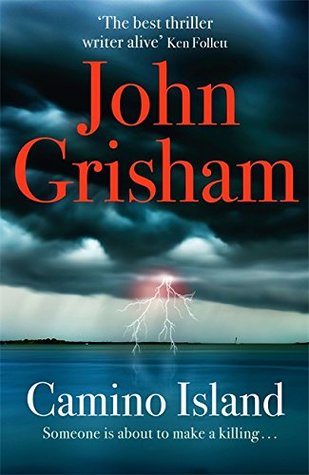
John Grisham usually writes about one thriller a year, and if you’ve been following his career since the early 1990’s, the novels can kind of blend together. His latest book Camino Island isn’t a legal thriller like a lot of his books, but at least it starts off with a unique crime.
The first chapter is called “The Heist,” and sure enough, it’s about a small group of thieves stealing something. The something in this case is “interesting,” especially for a guy like me who reads a lot of books. If you like literature, you might enjoy reading the first part of Camino Island, just to see what these thieves are stealing.
It can be tough to write a scene where a lot is going on. The writer has to juggle several characters and explain what each is doing without confusing the reader. In this heist paragraph, Grisham begins to describe the heist quickly without getting bogged down in details:
By nine o’clock on a Tuesday night, Denny, Mark, and Jerry were inside the Firestone Library posing as grad students and watching the clock. Their fake student IDs had worked perfectly; not a single eyebrow had been raised. Denny found his hiding place in a third-floor women’s restroom. He lifted a panel in a ceiling above the toilet, tossed up his student backpack, and settled in for a few hours of hot and cramped waiting. Mark picked the lock of the main mechanical room on the first level of the basement and waited for alarms. He heard none, nor did Ahmed, who had easily hacked into the university’s security systems. Mark proceeded to dismantle the fuel injectors of the library’s backup electrical generator. Jerry found a spot in a study carrel hidden among rows of stacked tiers holding books that had not been touched in decades.
That’s the actions of four characters getting described at once. All four are in different locations, doing different stuff, and it was easy for the reader to follow. At least, it was easy for me to follow.
The author didn’t get bogged down describing how Ahmed hacked the security system (I wouldn’t have understood it). The author didn’t worry go into step-by-step details about how Mark took the fuel injectors apart (my eyes would have glazed over). He simply explained what happened. As a reader, I appreciate that.
As a writer, I might have changed a couple things (here comes the usual nit picky part of the Literary Glance). I was taught never to use the phrase proceeded to. Instead, I was taught that a writer should just state outright what the character did. In this paragraph, Grisham wrote:
Mark proceeded to dismantle the fuel injectors…
I was taught (by writing instructors and writer’s groups) to say:
Mark dismantled the fuel injectors…
There was also a passive-verb sentence that caught my attention.
Their fake student IDs had worked perfectly; not a single eyebrow had been raised.
That could have written as…
Their fake student IDs had worked perfectly; no one even raised an eyebrow.
My writing instructors years ago would have gotten on my case about using such a cliché (nobody raised an eyebrow), but Camino Island is a bestselling novel. I’m not sure how an author can write a novel without using the occasional (or even frequent) cliché.
I haven’t read everything by John Grisham, but I read a lot of his early stuff. I still have a soft spot in my heart (cliché, I know, but this is a blog post, not literary fiction) for The Firm because it was pretty good and it came out of nowhere. I might have to read The Firm again and see if it’s as good as I remember it.
Or maybe I should leave the fond memory alone. I can get nit picky sometimes.
*****
What do you think? How difficult is it to write a scene with several characters in it? Should a bestselling author worry about nit picky stuff like passive voice verbs and clichés?
A couple weeks ago, I saw the new Wonder Woman movie. A couple weeks before that, I saw Guardians of the Galaxy II. Last week, I watched Logan. Last night, I watched Dr. Strange. Seeing all of these superhero movies within a short time reminds me of this question I asked last year.
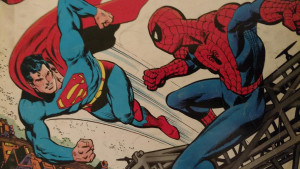 The Superman/Spider-Man movie hasn’t happened yet, but you never know.
There are a lot of superhero movies coming out in 2016 (and 2017… and 2018). Marvel has a bunch of superhero movies coming out. DC has a bunch of movies being released too. As much as the general public love superhero movies, at some point the novelty is going to wear off. And when it does, the superhero movie bubble will burst.
As a former comic book fanboy, I would have loved this superhero movie glut 40 years ago. When I was a kid, there were no superhero movies, except for the cheesy Adam West Batman movie that local TV stations played on Sunday afternoons. Other than that, there was only the Lynda Carter Wonder Woman and Lou Ferrigno as The Incredible Hulk. Lynda Carter and Lou Ferrigno were great, but their shows were low budget. I wanted to…
View original post 841 more words
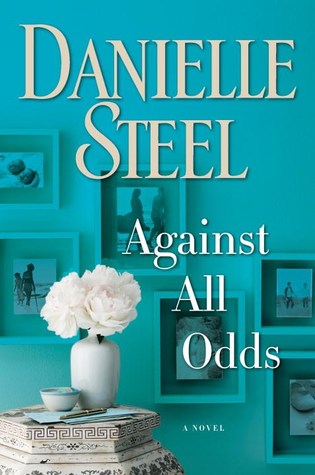
Even though I’m probably not part of Danielle Steel’s intended audience, I picked up a book of hers to see what her writing is like. She has to be doing something right as an author, and I’d like to know what it is.
Against All Odds is a recent novel, but maybe not Danielle Steel’s most recent. That’s tough to tell because she writes so many books. Maybe not as many as James Patterson (but most of her books don’t have coauthors, so she’s at a slight disadvantage).
Within the first few pages of Against All Odds, there’s a noteworthy block paragraph, a description of the protagonist’s business:
Kate carried a lot of Chanel at the store, Yves Saint Laurent from Paris, and Dior from the days when Gianfranco Ferre’ designed it in the eighties and nineties. She also had Balmain from when Oscar de la Renta had done their haute couture, and Christian Lacroix before they closed, both haute couture and ready-to-wear. And Givenchy, from both the days of the great designer himself, and its more recent incarnations by Alexander McQueen and Ricardo Tisci. There were designers others had forgotten, the many young designers who had died in the seventies and the eighties, and some later, at the height of their talent, Patrick Kelly and Stephen Sprouse among them. And she sold the American brands of ready-to-wear that everyone loved, Donna Karan, Calvin Klein, Michael Kors, Oscar De la Renta, Carolina Herrera, and here and there a nameless brand that she bought not for the label, but because it had style, or gueule or chien, as the French called it. That ephemeral something you couldn’t really describe but that made a woman look special when she wore it, if she had the guts to pull it off. Kate also found wonderful basics like simple black coats, pea coats, expertly cut Prada, and skirts and pants and sweaters that were timeless.
I have no idea what this paragraph just said. I mean, I understood the first page of Finnegans Wake more than I understood this list of… fashion stuff?
This isn’t the first time I’ve been puzzled by the details in books. When I read military novels, my eyes glaze over at the pages of weapons’ descriptions. When I read science fiction, I skim past the descriptions of how the new technology works. When I read fantasy, I ignore the intricacies of the made up languages and maps, and spells that the authors create. In a lot of ways, I’m probably not a good reader.
I have to give Danielle Steel credit. She knows her fashion stuff. At least, I think she knows her fashion stuff. Maybe she made up some of it (but I doubt it). If she just made up all the names, I wouldn’t know the difference, but somebody would.
Maybe it’s better to have the specific details in your story than not to have them. Interested readers can enjoy the author’s expertise, and skimmers who just want to get to the point can move on to the next paragraph/page/chapter. That’s what I did in this case, skim it. And that’s what I usually do, no matter what the genre is.
When I write fiction, I tend to leave out these kinds of details and let the readers fill in the blanks themselves. I think it’s easier for everybody that way. The writers don’t have to do a bunch of research to get everything correct, and the reader can go straight to the good parts of the story.
But Danielle Steel probably disagrees with me. And she’s sold a lot more books than I have.
*****
What do you think? Do you enjoy block paragraphs of specific details? Or do your eyes glaze over as your skim for the good stuff?
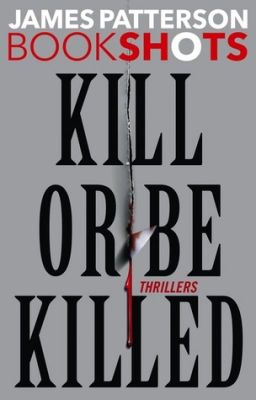
Maybe I’ve been wrong about James Patterson. For so many years, I thought his co-authors did all the work and Patterson just put his name on all those novels he gets published every month. After glancing at four Patterson BookShots from his collection Kill or be Killed, I’m not so sure.
All four stories in this collection sound so much like they’ve been written by the same author that I’m not sure Patterson even needs coauthors. All four bookshots have 2-3 page chapters. All the stories have outlandish situations with almost no basis in reality. And the writing is kind of… cheesy.
You can turn to any random page from any story in Kill or be Killed and find cheesy writing. Here are some examples:
The Trial by James Patterson and Maxine Paetro
Chapter 28 (out of 34 chapters in a 95 page story)
We were alive not just because of what we knew about bad guys with guns, or because Conklin and I worked so well together that we were like two halves of a whole.
That had contributed to it, but mostly, we were alive and drinking because of the guy who’d dropped the AK and given us a two-second advantage.
After I’d downed half my second beer, I told Conklin, “We weren’t wearing vests, for Christ’s sake. This is so unfair to Julie.”
“Cut it out,” he said. “Don’t make me say she’s lucky to have you as a mom.”
“Fine.”
“Two dirtbags are dead,” he said. “We did that. We won’t feel bad about that.”
“The guy with the AK.”
“He’s in hell,” said Rich, “kicking his own ass.”
Or maybe he’s reading James Patterson books. Either way, that last line was cheesy.
And you don’t have to look hard to find more cheese:
Heist by James Patterson and Rees Jones
Chapter 30 (out of 35 chapters and an epilogue in a 109 page story)
Barret’s world was black.
A hood had been pulled over his head and the former Commando recognized the dank, musty smell of wet burlap. It was a sandbag that was hiding his captors from his eyes, and Barret could almost laugh at the irony that he’d pulled the same bags over the heads of dozens of Iraqi men.
But Barret wasn’t laughing.
Barret was scared.
But Barret wasn’t lactose intolerant, which was good, because that entire story was cheesy.
The cheese continues in…
The Women’s War by James Patterson and Shan Serafin
Chapter 21 (out of 39 chapters and an epilogue in a 127 page story)
We let loose on six AGM Hellfire missiles. The dope field had no chance. The power of a Hellfire is unreal. Think of the impact of a monster truck barreling through a pillow fort in the middle of a freeway.
Overkill.
My favorite type of kill.
Cheese. My favorite type of dairy product.
Little Black Dress by James Patterson and Emily Raymond
Chapter 5 (out of 26 chapters and an epilogue in a 95 page story)
You don’t even know his name, Jane! said the small voice of my sanity.
So ask him, and then see when he gets off work, said a different voice entirely.
When he put the popcorn in front of me, we both took a big handful. But suddenly we were both too shy to speak.
Then I said, “I think-” at the same time that he said, “Do you want-”
We laughed awkwardly. It was like being in seventh grade again.
We were saved by a pearl-bedecked waitress, who appeared by my elbow with a cheese plate.
A cheese-plate? That sounds perfect for the occasion.
Don’t get me wrong. I like cheese. I eat, read, and write cheese. I’m just surprised James Patterson gets away with writing so much of it. He really ought to slow down. Too much cheese is bad for you.
*****
What do you think? Do all four writing styles sound alike? What is a good definition of cheesy writing?
Quizzes aren’t so bad if there are no repercussions for wrong answers. It’s even better when there are no wrong answers at all!
 The quiz below is proof that my wife and daughters have brought way too many women’s and girl’s magazines into our house.
Reading habits can explain a lot about your personality. Take the quiz below, keep track of the points as you go, and see what kind of reader (and human being) you really are!
A. A friend declares that a book he/she has just read is “THE BEST BOOK EVER!!!!!” What do you do?
- Trust your friend’s judgment and try reading the book.
- Tell your friend that you’ll read the book but then never get around to it.
- Calmly tell your friend that you know he/she has not read every book ever written so he/she is in no position to judge whether or not a book is the best ever.
- Tell your friend about another book that you think is “THE BEST BOOK EVER!!!!” just so he or she knows how…
View original post 805 more words

Sometimes I read books from decades ago just to see if they’re as good as I remember them. I’d like to do that with It by Stephen King, but I don’t remember reading it. I had it in my house for a long time. I remember looking at it. I remember some friends talking about how great It was. But I don’t remember reading It.
I remember enough about The Stand to know that I’ve read it. I remember enough about The Shining to know that I’ve read it. But It? I don’t know.
I think It was the book that ruined clowns. That’s too bad. Before It, clowns were still kind of socially acceptable. They were annoying, but there wasn’t quite the universal hatred for them.
Back then before It, everybody hated mimes instead of clowns. Mimes were way worse than clowns. Mimes wore the facial makeup with a weird expression, they got too close to you, they made invisible boxes around themselves and others, and they didn’t talk. Where I grew up, if somebody looked at you funny, got too close, and didn’t talk, you punched them out. I’m surprised more mimes didn’t get beat up.
I’d like to read It (maybe for a second time), but when I started, I got distracted by the first sentence:
The terror, which would not end for another twenty-eight years-if it ever did end- began, so far as I know or can tell, with a boat made from a sheet of newspaper floating down a gutter swollen with rain.
Is it my imagination, or did that sentence interrupt itself a lot? By my count, it interrupted itself three times. If I had written a sentence like that in school, it would have come back with teacher lines through it like this:
The terror, which would not end for another twenty-eight years-if it ever did end– began, so far as I know or can tell, with a boat made from a sheet of newspaper floating down a gutter swollen with rain.
The new sentence would read:
The terror began with a boat made from a sheet of newspaper floating down a gutter swollen with rain.
As much as I mock the strict rules my writing teachers enforced, I think they might have had a point. If you read that first sentence out loud, it’s all over the place. And some of the narrator’s uncertainty could have been included in the following sentences.
The terror began with a boat made from a sheet of newspaper floating down a gutter swollen with rain. At least, as far as I can tell, it did. And the terror would not end for another 28 (I was taught to use numerals for anything greater than 10/ten.) years, if it ever did end.
I think that’s a little easier to read, but who am I to criticize Stephen King’s writing? He’s written almost as many books as James Patterson, and I only have a blog, so there’s not much of a comparison.
Or maybe Stephen King could get away with that sentence because he’s Stephen King. Maybe Stephen King can write any sentence he wants, and the editor just approves it. If I were Stephen King’s editor, I wouldn’t want to put a bunch of lines through his first sentence. That would probably be a career killer. I’d hate to explain that to my wife, that I got fired for putting a bunch of lines through the first sentence in Stephen King’s epic masterpiece.
It wouldn’t be worth it… or It.
*****
What do you think? Is the first sentence in It kind of rambling, or is it just me? Are there any books that you’re not sure whether or not you’ve read?
*****
I don’t remember reading It, but the two books below are so memorable that I remember writing them myself!
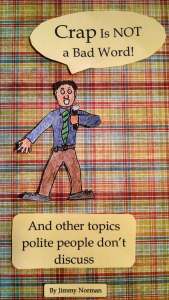

Now only 99 cents each on the Amazon Kindle!
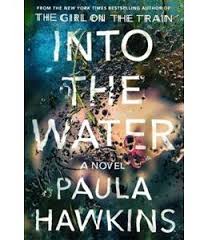
As soon as I found out that Paula Hawkins had a new book out, I knew that a bunch of people were going to hate it. It wouldn’t matter if the book were actually good or not; a huge percentage of book buyers were going to hate it on principal.
A couple years ago, Paula Hawkins broke through big time with The Girl on the Train. Advertised as the next Gone Girl, a lot of readers had high expectations and then were disappointed. Maybe that wasn’t fair to Paula Hawkins. Maybe she didn’t ask to be compared to Gillian Flynn, but she was, and that’s what happens when a new author’s book gets compared to a blockbuster bestseller. The Girl on the Train sold a lot of books and even was made into a movie.
I’m not justifying the hate Into the Water was going to get. I just had a feeling it was going to happen. A lot of people thought The Girl on the Train was overhyped and nothing like Gone Girl, the novel to which it was most compared.
I like to get my own impression of a book before I read the reviews, so I glanced at Into the Water. I read a few chapters and got an idea of what the book was like. And then I went to Amazon to see what the reviews were like.
Holy crap! That’s a lot of one-star reviews!!!
To be fair, some of the poor reviews are also two-star reviews, but still, it’s quite significant.
I know that Amazon reviews aren’t always fair, especially with its star system. But if you read the content of each review, you can usually tell who has actually read a book and who is pushing an agenda.
I agree with some of the one-star raters in their criticisms. There were maybe too many characters crammed into really short chapters. Some readers said that the characters were tough to keep track of, but I didn’t really have a problem with that. My issue was that most of the characters sounded the same, and the author seemed to use verb tense changes and 1st and 3rd person variations to make the chapters feel different. Unless there was a deeper reason for these variations (which I didn’t get to), it seems like cheating.
But one star? One star seems harsh. From what I’ve read, Into the Water wasn’t that bad. I’m not even sure it was bad at all. It wasn’t my style of book, but I wouldn’t give what I’ve read a one-star. A book has to be truly crappy material for me to give it one star (even though I don’t use that system).
Then again, a lot of raters give five stars to books that might not deserve them, so maybe the one-star is meant to strategically negate the five-star that somebody else left. I understand that logic, but if I rated books, I’d want my rating to reflect what I thought, not to negate somebody else’s rating.
Or maybe I’m wrong. Maybe those raters truly hated this book.
I usually feel bad for authors who get bad reviews. It’s tough to see your writing get criticized. I’ve been in some brutal writing groups (before the internet and blogging existed) where writers left in tears because of harsh criticism. I never caused any of those tears because I was gentle with the criticism, but I was on the receiving end of brutal critiques. I never cried, but I almost got into a couple fist fights over some brutal comments about my writing (that’s for another blog post).
I don’t feel bad for Paula Hawkins though. She’s probably made a lot of money from these two books. Maybe she’ll use the criticism to write better books. Or maybe she’ll sip wine and shrug it off. I’m pretty sure she won’t get into any fist fights over it.
*****
What do you think? What rating do you think Into the Water deserves? Do you think one-star and five-star ratings on Amazon are overused?


 Dysfunctional Literacy