I retired from teaching over two years ago, and I’m just now mentioning it on this blog.
Before today, I’ve referred to my former job as “a profession that has nothing to do with writing.” Maybe “nothing” was too strong a word. I taught 7th and 8th grade English for 30 years, but I didn’t do much writing myself (lesson plans and suggestions for improvement on student essay margins don’t count as writing).
Here’s the short version. I went into teaching straight out of college, not because I had a passion for education, but because I needed a guaranteed job. I didn’t want to be an unemployed writer with college debt and other bills to pay. I wanted to be a writer of some kind, but I still didn’t know what kind of writer and I wasn’t confident enough in my abilities to make that commitment.
My first semester of teaching was a disaster. I almost quit a couple times and even tried to get myself fired without getting blamed. My devious plan almost worked, but an experienced teacher interfered with it. If you’re a first-year teacher and you come up with a devious plan to get fired in a way that won’t follow you to other jobs, don’t tell an experienced teacher about it. I learned that lesson my first semester.
I got my act together during the second semester (with some help from that experienced teacher, to be fair), so much so that students who had given me grief during the first semester shook my hand or hugged me at the end of the year. My first impulse was “Back off; kid, don’t touch me!” but I didn’t want to be rude on the last day of school.
I was never a high-profile teacher. I was never nominated for awards like Teacher of the Year (I probably was never even considered). I never had a Mr. Holland’s Opus. In fact, I dislike teacher movies, especially those centered around supposedly true stories. Most inspirational teacher movies are based on personal accounts of educators who left the profession after their books/movies made it big.
If a teacher movie is based on a former educator who immediately left the profession (or became a consultant), then that former educator is probably a fraud. I don’t blame the former educators for scamming the public, but I don’t have to fall for it.
Even though I taught writing (kind of), I never mentioned my blog to any students or other teachers. This blog is filled with profanity (in dialogue or in posts about the etymology of bad words), and I’ve even written a sex scene. When you’re a public school teacher, you can’t go around promoting your blog that has profanity and a sex scene.
I didn’t mention my teaching on this blog because I didn’t want Dysfunctional Literacy to become a teacher blog. I was writing stuff to get my mind off of teaching. I’ve been out of the classroom for over two years now, but I still haven’t told anybody outside of my family about Dysfunctional Literacy, so maybe it’s not really a teacher issue.
I pretty much retired as soon as I could, but at the time I wasn’t sure if it was the right thing to do. I was in a great situation at my school, and my philosophy has been to not mess with great situations. Still, I was struggling with certain aspects of teaching, and I wanted to try something different, so one morning late in my final school year, I asked the heavens for a sign. What decision should I make; continue teaching or retire?
That morning in second period class, a kid threw up in my classroom. One part of me was disgusted (the vomit had almost started a domino effect, but I’d read the room properly and gotten three kids out before they yakked too.). The other part of me was relieved. The vomit was my sign. At least, I interpreted it as my sign. That afternoon, I talked to my principal after school and told him my plans to retire at the end of that semester.
Since I’ve retired, my bloods pressure has gone back to normal (without medication). My arrhythmia is gone (without medication). Some of that is related to diet changes, but those changes happened because my mind has been freed up enough to consider making those changes in the first place.
So… thank you kid who threw up. I still remember his name, but I won’t put it on my blog. In my brain, I refer to him by his name, not as “kid who threw up.” Without him, I might not have had the guts to retire when I did.
*****
This morning I found some teacher memorabilia in my car, and I don’t know what to do with it. Even though I know I’m not going back into the classroom, I still feel wrong getting rid of it. Maybe every once in a while, I need to remember and acknowledge those days. I really don’t feel compelled to write much more about it, though. This might be it. Or this might be the first of many blog posts about my teaching years. I’m not sure yet.

Whenever I finish reading an award-winning novel, I ask myself, “Why do other people think this so great?” Sometimes the answer is obvious. Sometimes it isn’t.
I originally read Lonesome Dove by Larry McMurtry in the early 1990s because somebody whom I respected recommended it. I’ve started reading Lonesome Dove again recently just because I saw a copy lying around at work and I thought, oh yeah, I remember that.
This time while I’m reading, I’ve pictured actors Robert Duvall and Tommy Lee Jones as the main characters because of the television mini-series. I don’t like visualizing Hollywood actors when I read books. As far as that goes, I’d rather imagine Robert Duvall and Tommy Lee Jones in Lonesome Dove (good casting) than Kevin Spacey in The Shipping News (bad casting) or Robert Redford in The Natural (really bad casting, but nobody cares because it’s Robert Redford).
I don’t know if authors decide ahead of time to write award-winning novels. Maybe winning the Pulitzer Prize for Literature was Larry McMurtry’s goal when he began writing Lonesome Dove. Maybe just finishing the damn thing on time was good enough for him back then.
Regardless of all that, if you’re an author and you’re determined to write an award-winning novel, here are four aspects that the author of Lonesome Dove nailed:
1. Setting- The American West is a great setting for a Pulitzer Prize Winning book. Maybe it wouldn’t work as well for a British author trying to win a British literary award, but it’s great for an American literary award. Even though the title Lonesome Dove is the name of the small town/settlement in Texas where the book starts, the characters don’t stay there for long, and things get very interesting when the characters venture out West (or north… or wherever).
2. Lots of Memorable Characters- Lonesome Dove has a lot of characters, not enough to post a list of them at the beginning of the novel as some epics do, but a lot. And the author switches point-of-view frequently, often during mid-scene. Despite this, it was easy for me to keep track of everybody while I was reading. I’m not bragging about my reading ability; I’m giving credit to the author for managing a bunch of characters without confusing readers.
3. Great dialogue- A strength/weakness of Lonesome Dove is the details about frontier life, especially about how dull it could be. The dialogue, even though it’s overly clever at times, breaks up what could have been very boring slog. You don’t necessarily need great dialogue in an award-winning book, but you do if your book has a bunch of details that can bore your readers.
The novel Moby Dick might be more popular today if Hermann Melville had written lots of clever/humorous dialogue for Ahab and his crew.
4. Genre- Lonesome Dove is sometimes referred to as a western for readers who don’t like westerns. I have nothing against westerns, but it’s never been my first genre choice. I wouldn’t be surprised if a lot of fans of westerns didn’t like Lonesome Dove. Its pace is slower than that of most westerns. It doesn’t follow the typical western formula. And it’s a little condescending to its characters.
There really isn’t another book like Lonesome Dove. Once you’re done, there isn’t anything that I know of that is quite the same. Even the attempted sequel isn’t close to the same thing (but to be fair, I don’t think the author was trying to write another Lonesome Dove). If there had already been a lot of books like Lonesome Dove, then there wouldn’t have been any reason to award it with a Pulitzer Prize for Literature.
Unfortunately, the sequel to Lonesome Dove is really bad. I don’t remember the title, but I remember what happened to some of the characters, and I felt like the author was just throwing them away. I know people die in seemingly pointless ways in life (seemingly pointless unless you have a strong faith in God), but it still felt unnecessary in fiction, so now I pretend the sequel doesn’t exist.
Lonesome Dove isn’t perfect. It drags at the beginning. The writing gets a little self-indulgent at times, winking with condescension to the readers about a few characters who aren’t too bright. Some of the dialogue was unnecessary, but that’s okay. Lonesome Dove is still a pretty good book, and I can see why it was an award-winning novel.
*****
Enough about me! What do you think? Am I overpraising Lonesome Dove, and am I too hard on its sequel? What other novels did or did not deserve the awards they won or the accolades they received?

A game called “Smear the Queer” probably sounds like hate speech today, but it wasn’t meant that way by the kids I knew who played it in the 1970s.
Smear the Queer was a simple game. All you needed was a bunch of guys and a football. You’d throw or toss the football, everybody would scramble for it, and the kid who picked it up would run around with it until he got tackled. Then the kid who got the tackle (or successfully scrambled for the ball afterwards) would run around with the football until he got tackled.
Whoever had the football would be the target. The target was the “queer.”
Smear the Queer was great because you didn’t need a particular number of guys to play. Anywhere from two to infinity would work. You could play it anywhere, in a yard, in a park, in the street. You could stop whenever you wanted, and newcomers could join. All you needed was a football and a bunch of guys willing to run around and get tackled.
Playing smear the queer is a pleasant memory for me, so much so that I almost included a reference to it in my ONE novel, The Sunset Rises: A 1990s Romantic Comedy, but the scene didn’t quite work, so I had to delete it (I mean, I deleted the scene with smear the queer; I didn’t delete the book).
Even though people today might associate the name with hate speech, “Smear the Queer” has a nice sound to it. The words “smear” and “queer” rhyme. It’s good to have a rhyme when you name your game.
“Tackle the Guy with the Ball” is kind of a boring name for a game. Yeah, it might not be considered hate speech and it’s an accurate description of the game, but it’s not very imaginative.
Despite the negative connotations of the word “queer,” even back when I played Smear the Queer, everybody wanted to be the queer. The whole point was to get the ball and then get tackled. It would have been a short game if nobody had ever gone for the ball. With no queer, there would have been nobody to get smeared.
Even if you think the name “Smear the Queer” is a form of hate speech, I’m not going to blame my pre-teen self for saying the name or playing the game. Somebody else named the game, and we didn’t have an alternative name. Maybe if we can ever find the person who came up with the name “Smear the Queer,” maybe we can blame him. Until then, I’m just the messenger.
I’ll admit, Smear the Queer would be considered sexist today because girls never played. We never asked girls to play, and they never volunteered. If a girl had ever asked, we probably would have let her play and then gone easy on her. If she had then lectured us about how she demanded to be treated equally, we probably would have broken her arm.
Not on purpose. It just might have happened that way.
I’m too old to play Smear the Queer now. I’d probably blow out my knee or get a herniated disc or do something else stupid. But I still have fond memories of Smear the Queer. I guess that when I talk about it from now on, I’ll have to call it something else.
*****
There was another game that we played when I was a kid, but I don’t remember the name of it. A group of us would sneak up on a neighbor’s porch, ring the door bell, and run away.
What was that called again? Uh, something to do with… knocking?
Uh…
Umm…
Yeah… Never mind. I just remembered what it was called. I’m not going to write about that particular game. That one would be way too tough to explain.
*****
Read more “Old Things That Are Tough To Explain” below!
Old Things That Are Tough To Explain: The Divisive 1960s
Old Things That Are Tough To Explain: The Ugly 1970s
Old Things That Are Tough To Explain: Research Before The Internet
Old Things That Are Tough To Explain: You Could Only Watch It Once
Old Things That Are Tough To Explain: Why Did So Many People Smoke Cigarettes?
*****
Enough about me! What do you think? Is there another name for “Smear the Queer”? Is there anything wrong with the name “Smear the Queer”?
*****
It’s the oldest story in the world, 1990s style!
Man meets woman; man falls in “luuuvvv” with woman; man gets blindsided by reality!
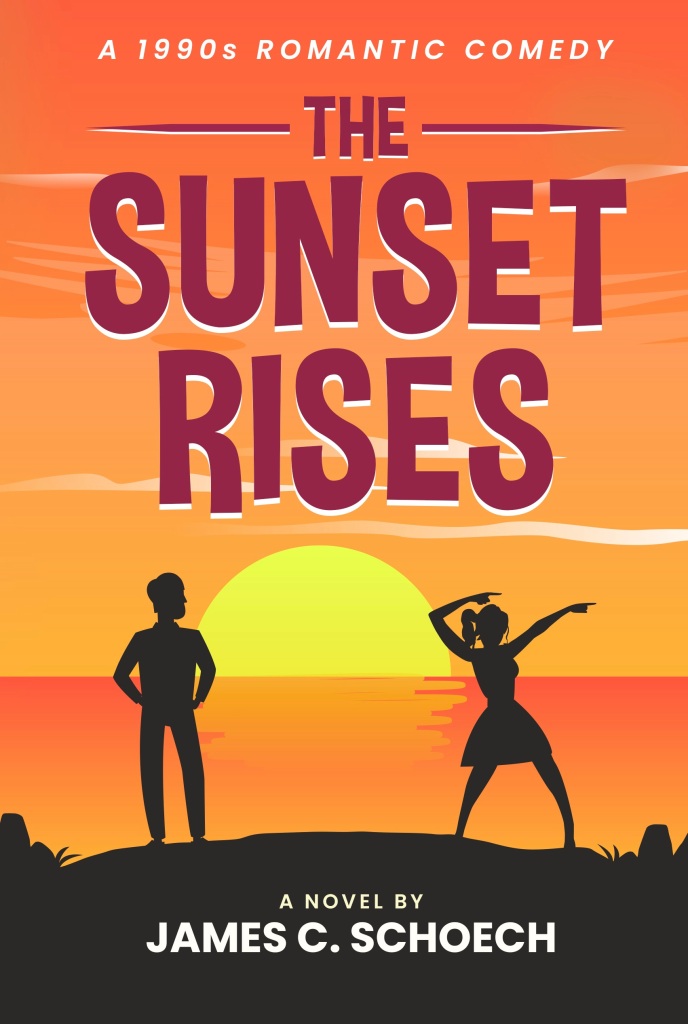
The Sunset Rises: A 1990s Romantic Comedy is now available on Amazon !

My daughter switched radio stations as soon as she realized the song was “Manic Monday” by The Bangles.
“Ugh,” she said. “They rhymed ‘Sunday’ with ‘fun day’ and ‘run day’.”
We were driving to the university that my daughter is attending, and my daughter was in a hyper-critical mood. I had no problem with that. Even back in the 1980s, I disliked “Manic Monday.” Yeah, supposedly Prince wrote the lyrics, but he probably knew the lyrics sucked, so he gave them to some desperate singer. Everybody loved Prince so much that his fans thought his garbage was great. If you said anything by Prince sucked, people told you to shut up. At least, they told me to shut up.
I never said Prince sucked: I said some of his songs sucked.
Anyway, my daughter can get hyper-critical about pop culture stuff too, even when I’m not around. I’m proud of that.
My daughter has a lot of my personality. I think my personality works better for a female than a male. I’m not saying I want to be female. I’m just saying that my personality seems to work better for a female. My daughter has more friends than I’ve ever had. She’s more outgoing. She says the same kind of stuff that I do/did, but when she says stuff, people respond more favorably.
I STILL DON’T WANT TO BE A FEMALE!!
Last year I wrote a blog post about my daughter declaring that she might not go to college. Her indecision didn’t last long. She knew a few weeks later which university she wanted to attend and what she wanted to major in.
College isn’t for everybody, but it might be good for her. My daughter knows what she wants to do. The university she’s attending has a great program (the best, according to the university, if you can trust it) for what she wants to do. My daughter has already demonstrated a talent for what she wants to do. As negative as I can be about the university system (if it’s not a scam, it is at least scam adjacent), attending is probably the correct decision for her, based on what we know right now.
My daughter’s dorm room was just as tiny and muggy as I remembered mine decades ago. I recalled why some students panic in college; not everybody is designed to live like a lab rat. I was able to find quiet places and times (I was willing to get up earlier than most students), so I could fake some semblance of a quiet life.
My daughter’s college town was cool, but my wife and I have aged out of cool, so we just followed our daughter around and paid for stuff.
My wife told my daughter that we could visit her every few weeks, but that might not be a good idea, even though the university is less than three hours away. My wife would be a hardcore mom if I let her. A hardcore mom is like a helicopter mom but knows better. When I suggest to my wife that she should back off a little bit, she does without arguing about it but begins meddling again when I’m not around.
I understand why my wife is a hardcore mom. She didn’t have a lot of support growing up and had to take care of all her college details herself. Because of that, she missed out on some opportunities, and my wife doesn’t want my daughter to miss out. I get it. But still, my daughter is 18 and has to take care of most of the details herself now. We can help, but she has to do it herself.
Hugging my daughter goodbye in her dorm room was a little rough. She’ll probably be a different person the next time I see her, and I won’t have witnessed the changes taking place. I felt a wave of sadness when I walked into my daughter’s empty bedroom after we had returned home.
My wife, the hardcore mom, was more practical.
“Tomorrow,” she said, “I’m turning this into my office.”

It’s easy not to read The Great Santini by Pat Conroy. The novel came out decades ago, and statistically nobody reads it anymore. I don’t even know if many people read The Great Santini when it originally was published. All I know is that I can proclaim that I’ll never read The Great Santini and nobody will care.
I sometimes read books that I say I’ll never read. I said I’d never read A Song of Ice and Fire until George R.R. Martin finished the series, but I went ahead and read sections of each book anyway. I wasn’t lying when I announced I wasn’t going to read the series. At the time, I didn’t intend on reading the books. But I’m still pretty sure I’ll never read The Great Santini.
Back in the early 1980s, my dad and I were watching the movie version of The Great Santini starring Robert Duvall, and my dad quit half-way through. He said it was too tough for him, that the title character reminded him of his dad. That was funny, I thought; the title character reminded me a lot of my own dad, but I didn’t tell him. We didn’t talk about the movie after that.
In some ways, my dad was worse than the movie’s title character (I’m not going to get into the details), but he wasn’t worse all the time. I have some good memories of my dad. I’d rather focus on those instead.
I don’t like to think of my dad as a version of The Great Santini. Instead, I refer to him as an extreme parent. He was extremely funny sometimes. He could also be extremely angry, extremely generous, extremely violent, extremely selfish, and especially extremely unpredictable.
I’ve noticed recently that some people seem to love reliving trauma. I get suspicious of people who announce their past traumas to the world. I’m very suspicious of people who profit off of their alleged traumas, especially writers. Whenever I hear a famous person talk about how he/she has suffered in the past, I think he/she is making it up or exaggerating.
I know not everybody with extreme stuff in their past is like me and keeps quiet about it, but I’m still suspicious of post-trauma profiteers when I see them.
I’m also not going to watch the movie version of The Great Santini again. If I had to choose (and I don’t), I’d rather read about trauma than watch it. I have cut out a bunch of stuff like that in my life, gratuitously violent movies, sexualized videos, cable news (TV news in general) because all of that stuff increases fear or anger or other negative emotions. I’ve been sleeping a lot better recently because of these sensory input changes, I think.
I might not ever write about the extreme stuff that happened to me growing up. I don’t want to put that on people who know me who might read my blog. On the other hand, writing about it now wouldn’t hurt anybody because almost everybody involved with the extreme stuff has died already. Even so, I don’t think it does the younger generations of my family much good to get into explicit details.
I don’t care if other people read The Great Santini. I’m not calling for a boycott or anything like that. It might be a great book. I’m simply not going to read it, and I think I have a good reason.
*****
Enough about me! What do you think? Is The Great Santini worth reading (when your dad doesn’t remind you of the title character)? What books won’t you read and why not?

A co-worker asked how I was doing last week, and I said, “I don’t know.”
It just slipped out that way, but it was the truth. I really didn’t know how I was. There’s some turbulence in my personal life, and I have a lot of conflicting emotions about a lot of stuff. I had just started the work day and wasn’t sure how mentally prepared I was for the tasks ahead.
“I’m great!” would have been a lie.
“Fine” is too generic for somebody with my vocabulary.
“I can’t complain” sounds like there is a lot to complain about.
“None of your business” is a bit negative.
“I don’t know” is almost perfect. It’s the truth. Everybody knew what I was talking about. And it’s a somewhat original answer.
At least it used to be original. Now it’s my go-to response.
“I don’t know” works in most situations:
*****
“How are you?”
“I don’t know. Ask me around 4:30.”
*****
“What do you think about the economy?”
“I don’t know. It will either get better or get worse.”
*****
“Who’s going to win the big game?”
“I don’t know. We’ll probably know after they play the game.”
*****
“What are you doing with your life right now?”
“I don’t know. Hopefully it’s what God wants me to do.”
*****
“Do I look fat in this?”
“I don’t… No, you definitely don’t look fat. You look fantastic!”
*****I
“I don’t know” is honest at least. I’ve tried faking enthusiasm, but I seem to get punished for it. The worst example was when a co-worker asked how I was doing, and I said “Great!” and then I walked face-first into a wall. I wasn’t doing so great then. “I don’t know” would have been a perfect answer because I hadn’t known that I was going to walk into a wall.
I also like “I don’t know” because too many people act like they know things that they don’t. Life became much easier for me when I realized that almost everybody is incompetent in most things. A person is lucky if he or she is an expert in one or two areas, but even then, people could still lie about their fields of expertise for their own advantages.
I spent 30 years in my field of expertise, and to my credit, I didn’t pretend to know stuff I didn’t. My “I don’t know” honesty might have worked against me a few times, if you look at things from a financial/professional perspective, but I didn’t harm anybody with my honesty.
Yes, I have my opinions. This blog is filled with my opinions. But I usually state that they’re my opinions, and I don’t pretend that my opinions are facts. Opinions are less stressful when you can admit that you really don’t know stuff.
*****
A few weeks ago, I wrote a post about The Answer Book, a book that answered a bunch of science and history questions in long-winded fashion; at least the answers seemed long-winded at the time when I was a kid reading The Answer Book. Nobody would have bought The Answer Book if every answer in the book had been “I don’t know.”
If you want to make money from being a know-it-all, “I don’t know” isn’t a very good answer.

It’s almost unfair to make fun of a dead guy’s writing. The author isn’t around to defend himself, and his fans are either dead too or don’t see the point in defending him.
Ernest Hemingway’s writing gets mocked, even though (or maybe because) many of his novels are required reading at a lot of schools. Being required reading isn’t usually the author’s fault, but that’s how it goes.
I know Hemingway gets mocked because when I was in college, a friend of mine gave me a “Best of Bad Hemingway” book as a gift. It was a cool gift. I had no opinion of Ernest Hemingway at the time, but I knew enough about his writing style to get the joke.
I recently chose to start reading The Sun Also Rises by Ernest Hemingway, partially because I read East of Eden by John Steinbeck a few months ago. So far, I’m not enthusiastic about The Sun Also Rises. It seems that Hemingway doesn’t like his characters. Or maybe I don’t like his characters and I’m projecting onto the author.
Plus, there’s way too much dialogue. Don’t get me wrong; I like dialogue. I’ve read several Fletch books. The dialogue in The Sun Also Rises, however, seems to be more like self-indulgent chit-chat than storytelling.
Take a look at six straight pages!
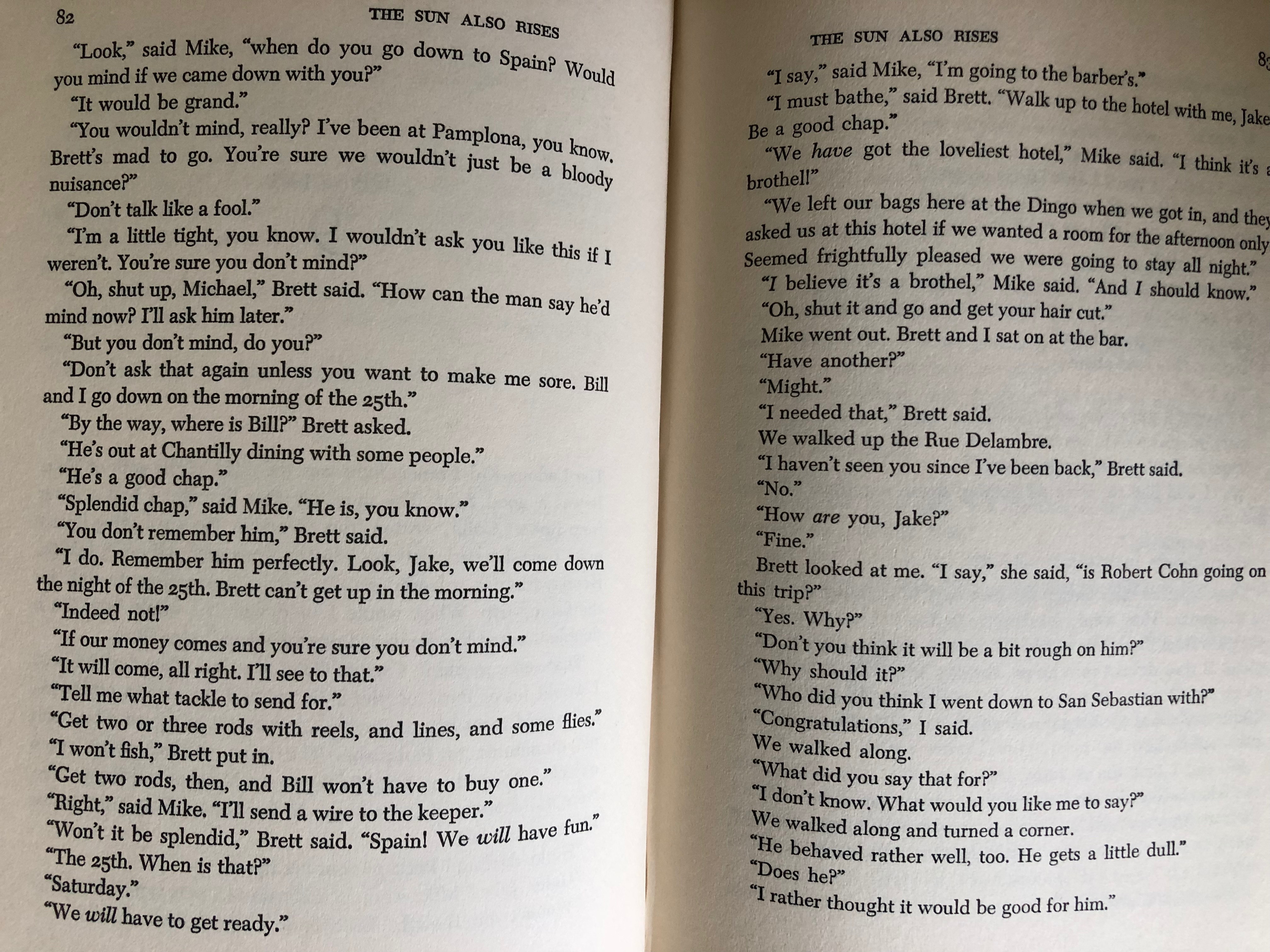
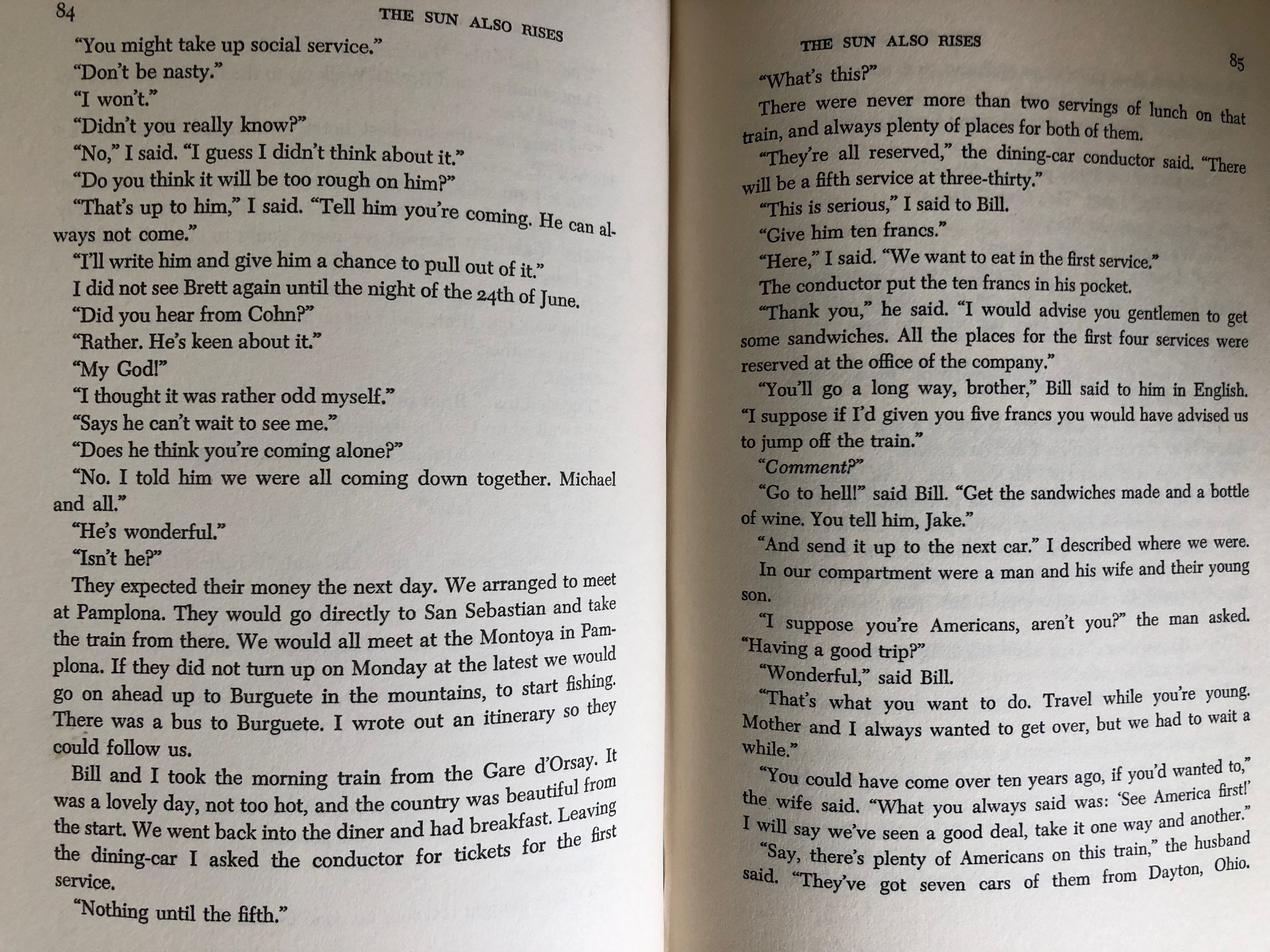

Maybe this dialogue shows character development. Maybe this was Hemingway’s way to show without telling. Maybe it’s good dialogue but a bad use of it. Or maybe Hemingway should have listened to an editor (if the editor wasn’t afraid of him).
Whatever is going on, I’m not looking forward to continuing The Sun Also Rises. Dialogue can be a great storytelling tool, but I think this is the stuff that gets an author mocked, even/especially after the author has died.
*****
What do you think? Is this bad use of dialogue? Or should I shut up because I’m just some random blogger?
*****
After more than ten years of blogging, I’ve finally written a novel.
A grammar-obsessed English teacher falls in ‘luuuvvv’ but discovers how chaotic and dangerous ‘luuuvvv’ can really be.

The Sunset Rises: A 1990s Romantic Comedy is now available on Amazon and from the trunk of my car at various local bookstores… until parking lot security kicks me out. Buy it now while supplies last!

The 4th of July is the only national holiday that I’ve written a story about. It’s a memoir type of story, maybe more like a personal narrative. If I ever write a full blown memoir, I’ll probably include this.
The title “4th of July Story,” is important. Yeah, I know there’s already “A Christmas Story.” That movie was called “A Christmas Story” because everybody has a Christmas story. The letter “A” in the title was an acknowledgement that there were countless other Christmas stories and that “A Christmas Story” was merely one of many.
This is simply “4th of July Story.” I don’t have a good reason for leaving out the letter “A” at the beginning. I’m not implying that this is the only 4th of July story out there. It might be the only 4th of July story I have, though.
“4th of July Story” is one of the shortest blog serials that I’ve written. “Long Story” was 16 episodes. “The Literary Girlfriend” was 60. Several “Awkward Moments in Dating” segments run four or five episodes. “4th of July Story” is only three episodes. But I like it, and it’s stayed relevant.
So here we go, without the “A” in the title.
4th of July Story

I was 10 when the United States turned 200 years old. It was a big deal back then, but at the time, the meaning of the 4th of July was lost on me. As an adult, I understand July 4th is the annual celebration of the signing and approval of the Declaration of Independence by the Continental Congress.
I understand how important the following sentence from The Declaration of Independence is:
“We hold these truths to be self-evident, that all men are created equal, that they are endowed by their Creator with certain unalienable Rights, that among these are Life, Liberty and the pursuit of Happiness.”
That one sentence had a bunch of concepts that were unique way back in 1776.
The Declaration of Independence is also known for John Hancock’s really big signature. As an adult, I appreciate how momentous the signing of that document was and how it began the process of liberating the colonies and forming one of the greatest nations in the world. I appreciate John Hancock’s really big signature. I even remember a couple jokes about how a guy named John Hancock had a really big signature.
When I was a kid, I didn’t understand all this, including the John Hancock jokes. Back when I was 10, the 4th of July was about shooting off fireworks. And 1976 was a great year to shoot off fireworks.
Read more at 4th of July Story: The Box of M-80s
*****
What do you think? What great (or traumatic) 4th of July stories do you have? Should I add the letter “A” to the title “4th of July Story”?
When I was six, I received a copy of The Answer Book for Christmas. I liked The Answer Book. It had answers to a lot of questions that I never asked.
I asked stuff like this (keep in mind this was the early 1970s):
- Who would win in a fight between Hulk and Superman?
- Was professional wrestling fake?
- Why did people think that Fonzi was cool?
- Why were afternoon cartoons always preempted by Watergate hearings?
Instead, The Answer Book answered science-related questions. Pffft… science.
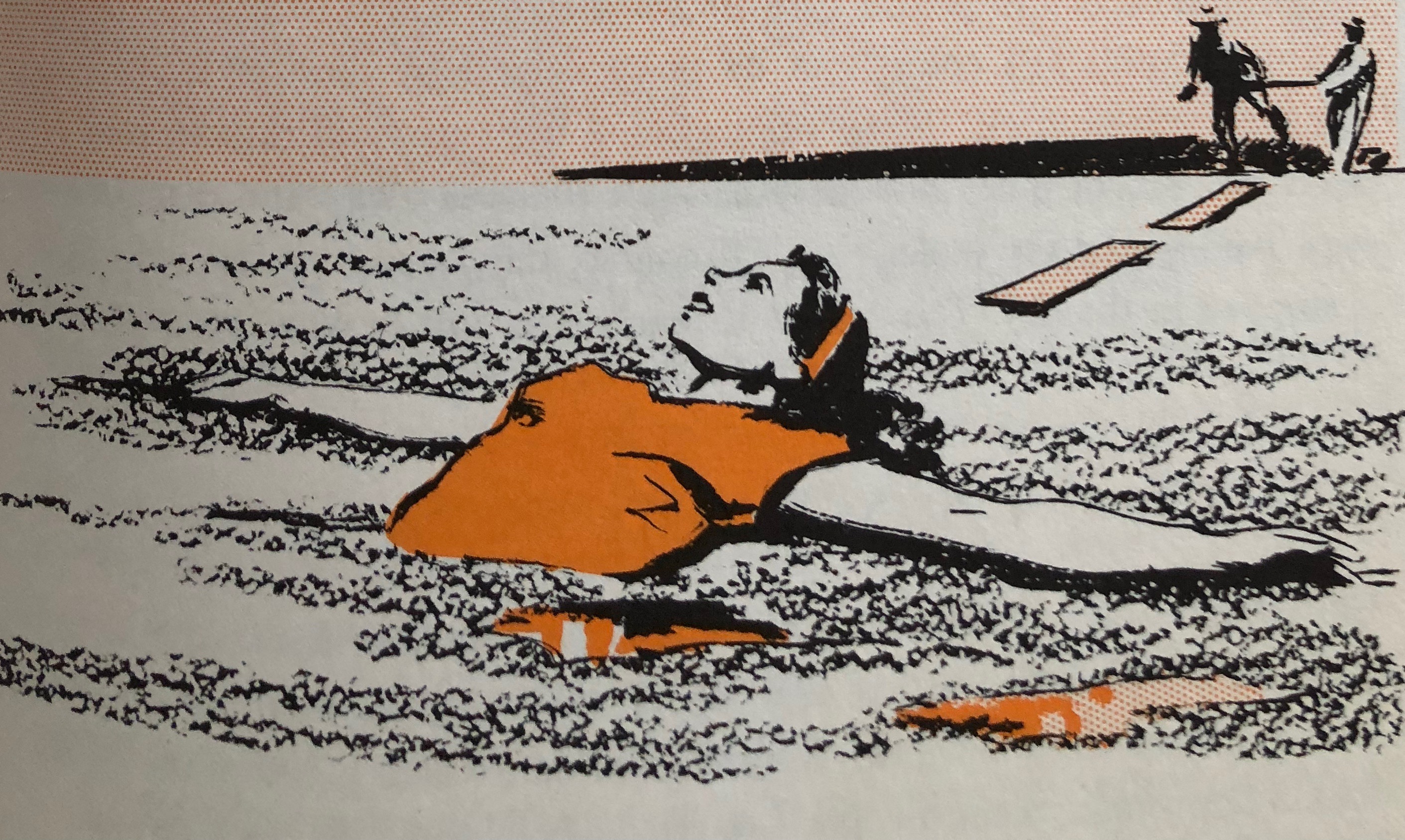
While flipping through The Answer Book book recently, I discovered the answer to the question “What Is Quicksand?”:
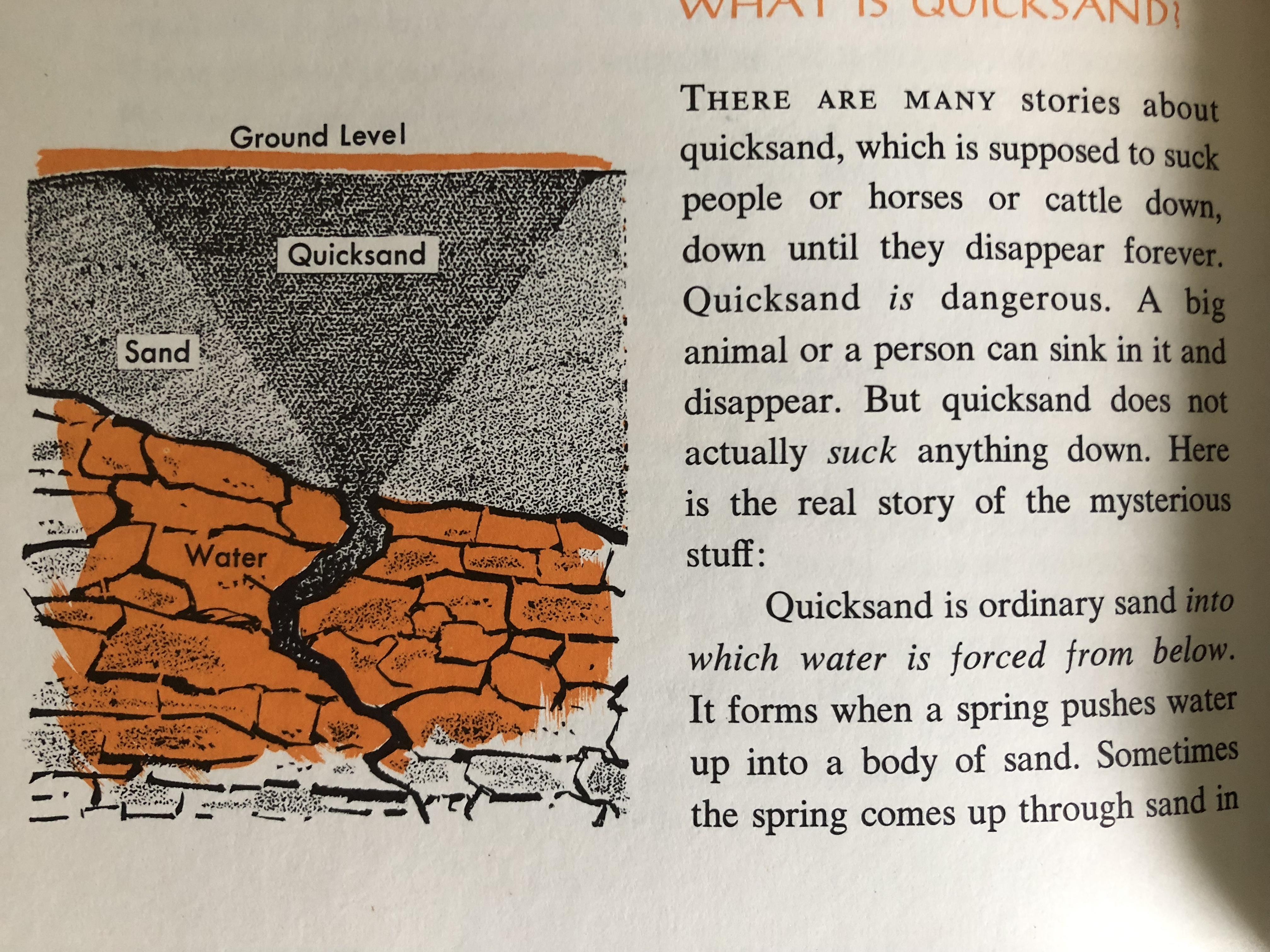
Because of this book and a few movies, I believed for a long time that the dangers of quicksand were real. But according to several sources on the internet, there aren’t any documented cases of anybody sinking into quicksand and disappearing forever.
I don’t know who to believe, the book from the 1970s or the internet of today. The book said it can happen; it doesn’t say that it actually has happened. That’s a sneaky word trick to play on a kid. I don’t blame movies for trying to scare kids with quicksand. Movies are supposed to scare people. But a science book should know better.
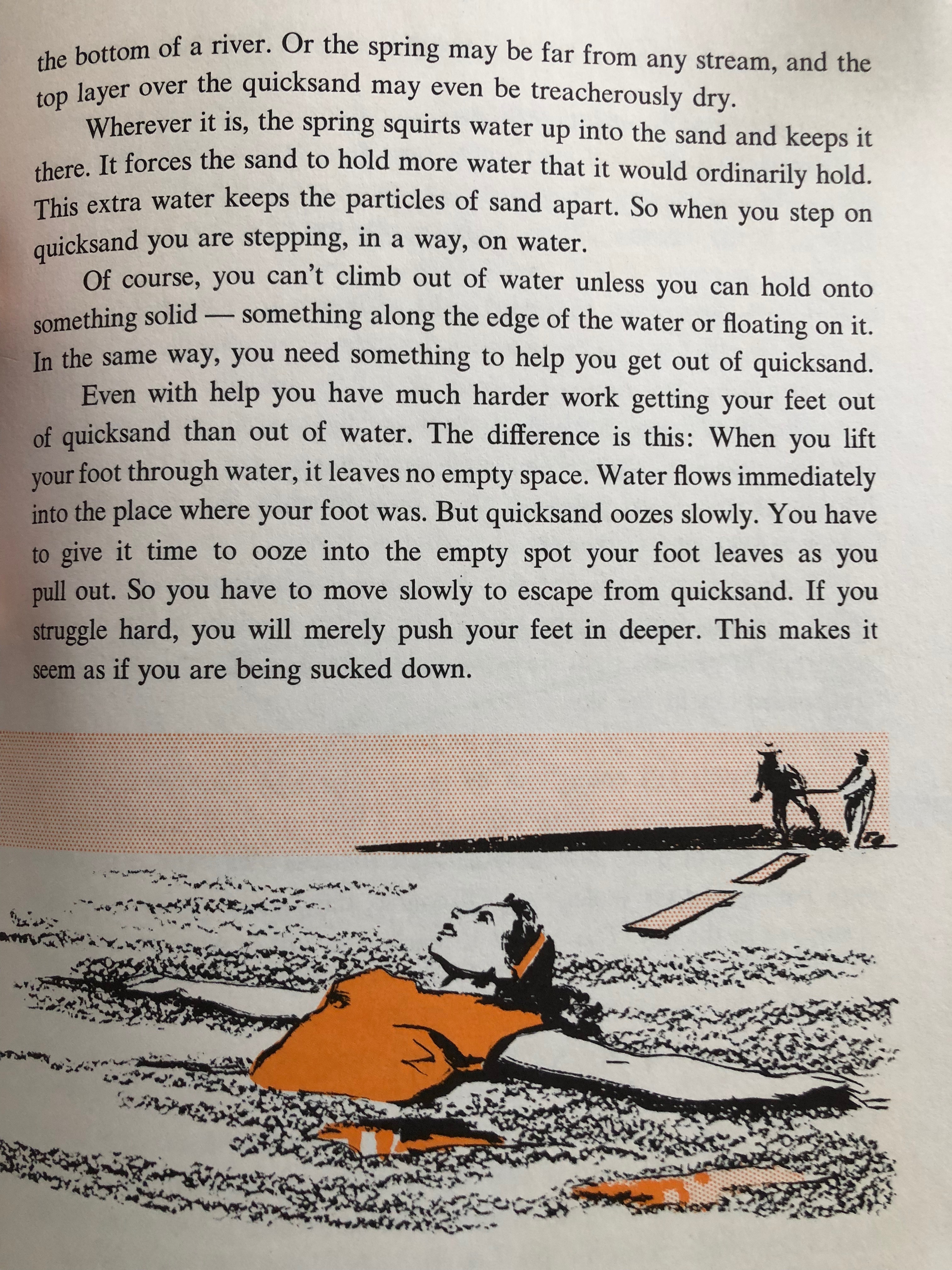
Even if quicksand is/was technically dangerous, it’s statistically never hurts/kills any kids who read The Answer Book. There are scientific things that are way more dangerous for kids than quicksand. The fear of quicksand seems kind of manufactured to me and unnecessary.
If they did know that quicksand wasn’t statistically dangerous (and they probably knew), why would they legitimize this urban legend?
I still like this copy of The Answer Book. I just wish it had a section on Bigfoot!
*****
It’s the oldest story in the world, 1990s style!
Man meets woman; man falls in “luuuvvv” with woman; man gets blindsided by reality!
The Sunset Rises: A 1990s Romantic Comedy is now available on Amazon !

Don’t read any further if you get sick to your stomach easily.
Don’t look at the picture below! Whatever you do, don’t look at the picture.
Don’t look at it!
If you look at it, it’s your fault.
*****
Opening a library book is like being the first cop at a crime scene; you never know what you’re going to see.
Below is a picture from a library book I just checked out. The book itself is titled (not that it matters all that much for the purpose of this blog post) Don’t tread On Me: A 400-Year History of America at War, from Indian Fighting to Terrorist Hunting by H. W. Crocker III. This book is unabashedly pro-American (whatever that means) and approaches America’s history of violence with no shame or guilt. According to this book, at least from what I’ve read so far, the Native Americans almost had it coming.
I mean, the Indians had it coming.
At any rate, a previous reader must have been disgusted by the author’s point of view. I was pretty disgusted when I saw this. I don’t even know what this is, but my imagination has a few ideas. Is it nose debris? Partially chewed food/condiment droppings. Or is it simply a set of mustard stains?
My gag reflex didn’t kick in or anything, but I’m not showing this to my wife. She watches pimple popping videos, but I still won’t show this to her. Her imagination can be just as vivid and as inaccurate as mine.
This is probably just mustard. It seems a bit flaky to be mustard, but I’m not tasting it to find out. I’m not that curious about it.

*****
What do you think that is? Nose debris? Spilt food? Would this be enough to keep you from checking out library books in the middle/end of a pandemic? What is the most disgusting sight you’ve discovered in a library book?


 Dysfunctional Literacy