
I have mixed feelings about author Robert E. Howard. He’s written some of my favorite short stories, but he also murdered one of my favorite authors. I’ll get to that a little later.
The first part is about two nerds who were fans of Robert E. Howard in the 1930s. I’m not 100% certain these two fans were nerds, but they definitely had nerd tendencies. One fan was an educator, and the other was a chemist. Plus, they read Conan the Barbarian stories from this pulp magazine called Weird Tales. Yeah, they were nerds.
I’m not making fun of these two Robert E. Howard fans by calling them nerds. I’m the last person who has any business making fun of somebody else for being a nerd. I’m just calling them what they probably were. It makes explaining things easier.
Back in the 1930s, nerds didn’t have the internet; there was no social media, no email, and no television. There weren’t any comic books yet and no video games. By today’s standards, life would seem boring. There was nerd stuff like math and literature and philosophy and history and classical music, but there wasn’t much fun nerd stuff, except for Weird Tales and other pulp magazines.
I understand the nerds’ admiration for Robert E. Howard. Most normal people know Conan the Barbarian only because of some mediocre movies, but Robert E. Howard’s short stories are really good. Since Howard’s death, other authors have been allowed to write Conan novels, but they’re not the same. Any Conan the Barbarian story written by somebody other than Robert E. Howard is just a story about a barbarian who happens to be named Conan.
Anyway, the nerds wrote Robert E. Howard a letter, and then Robert E. Howard wrote them back! And he didn’t just send a quick thank you note. This was a long, well-written response. Obviously, the nerds were thrilled because they kept the letter, and it was later published in this 1967 edition of Conan (which reprinted a few of Howard’s stories from the 1930s).

The letter itself is going to be boring to anybody who isn’t a Conan fan. Even if I weren’t a fan of Howard’s Conan stories, I’d be impressed that Howard wrote a letter like this to people he had never met.
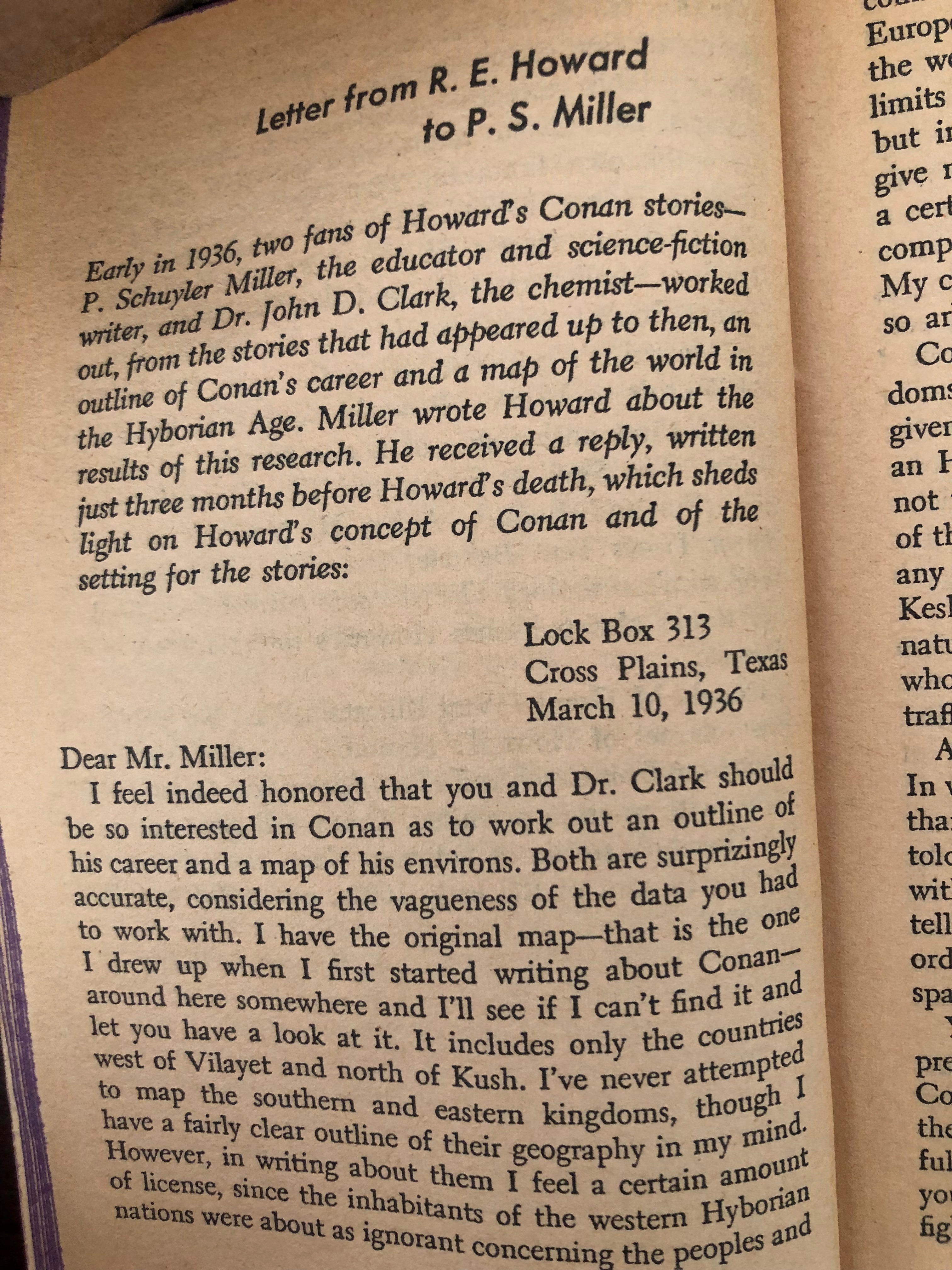

Robert E. Howard was just getting warmed up. Here’s more!
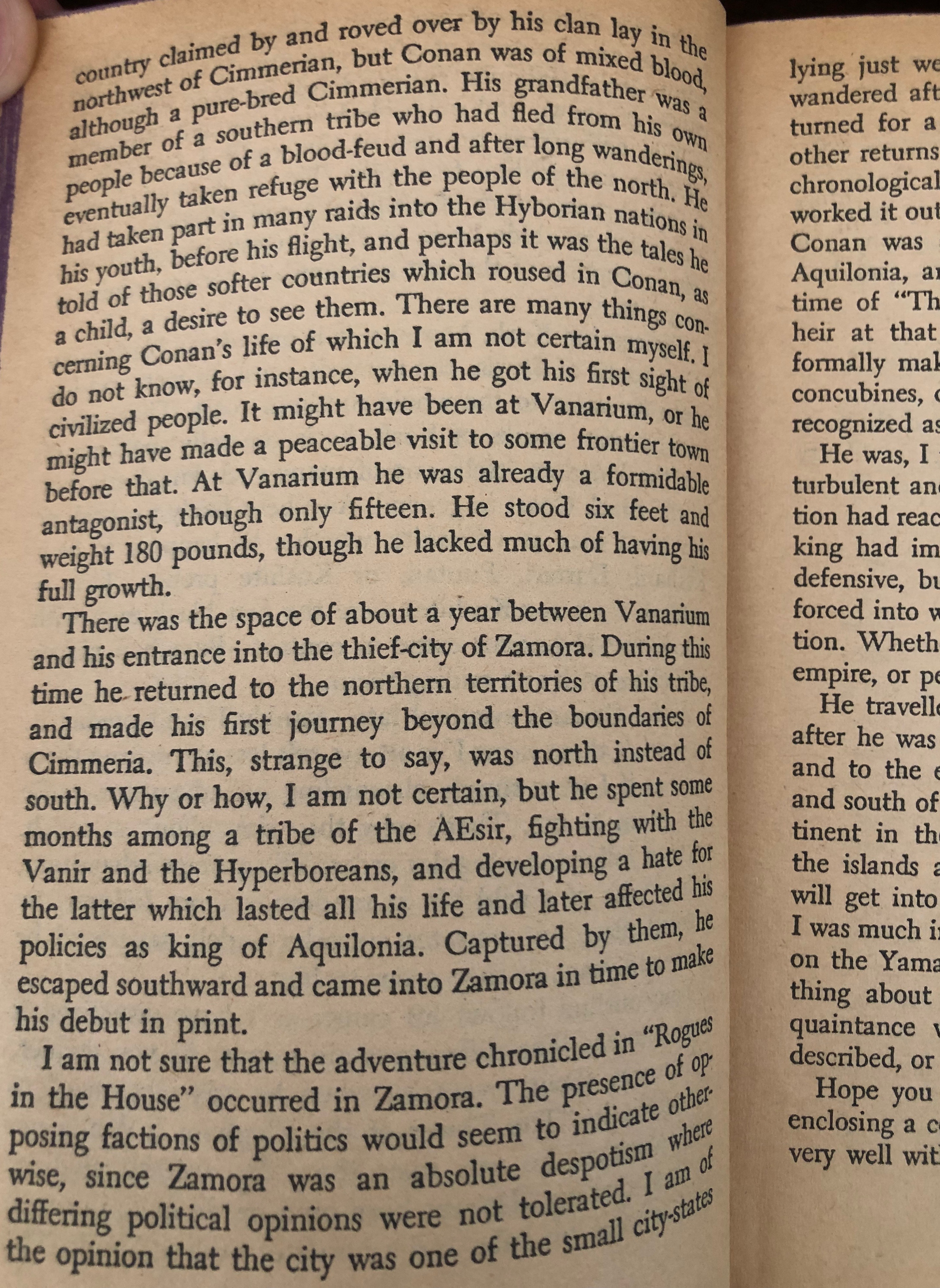
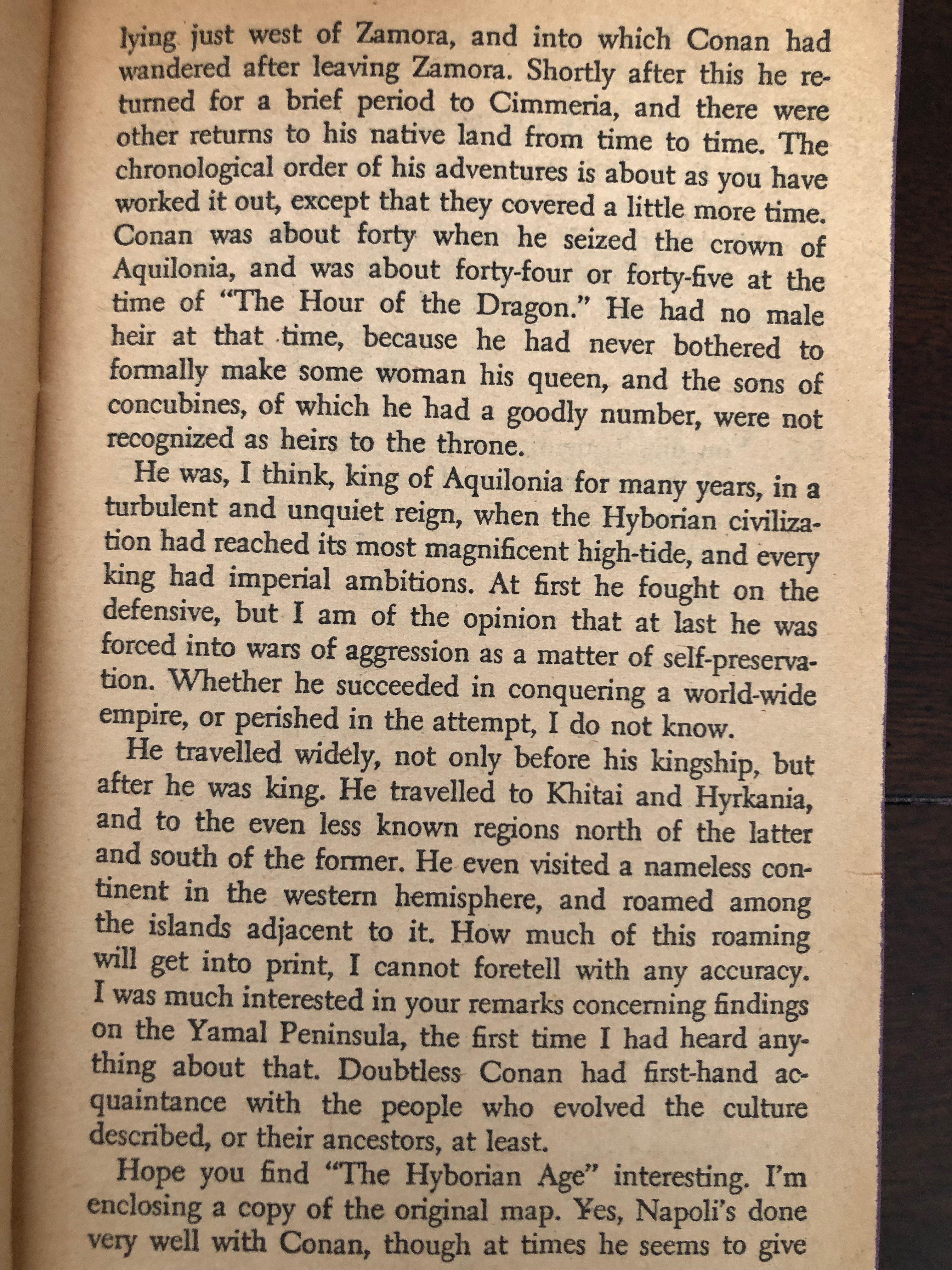
If you’re actually reading the letter, don’t worry; he’s about to wrap things up.

Unfortunately, Robert E. Howard committed suicide a few months after writing this note. That sucks. Robert E. Howard murdered one of my favorite writers.
The nerds had to have gone through a quick contrast of emotions: Oh my god! We’ve gotten this awesome response from a writer we admire! Oh my god! Robert E. Howard respects the work we put into our map and history! Oh my god! There’s the possibility of future correspondence with Robert E. Howard, one our favorite writers!
And then Robert E. Howard kills himself.
Shit.

My high school friends were shocked when I called my mom the devil incarnate to her face.
I don’t remember the reason. It was probably a curfew situation. All I know for certain is that a couple of my friends were with me at my mom’s apartment (this was after my parents divorced), and my mom had said no to something, and I responded loudly in a self-righteous tone, “YOU ARE THE DEVIL INCARNATE! YOU ARE NOT MY MOM!”
My friends were shocked at my seemingly disrespectful behavior. They were further shocked that my mom just smiled and rolled her eyes at me.
After my mom and I figured out the curfew situation (or whatever it was), I explained the DEVIL INCARNATE comment to my friends. The short version was that when I was in elementary school, my dad had gotten drunk and then had turned his drunken rage at my mom about something stupid and yelled in that same self-righteous tone: “YOU ARE THE DEVIL INCARNATE! YOU ARE NOT MY WIFE!”
And then my family laughed about it later whenever my dad wasn’t around.
That’s the short version. The longer version gets a bit more intense.
*****
When I was a kid in the first house that I remember, my bedroom was next to my parents’ room, and I could hear my parents fight in there when they got drunk. I couldn’t tell what they were fighting about, but I recognized the sounds, and that’s all I need to say. I’m not trying to relive the experience. I’m just trying to explain what happened.
Once I understood that my dad was slapping my mom around, my senses were alert to any sound from their bedroom. I’m still kind of a light sleeper because of it, but I’m not on any medication or anything like that. I just run a fan at night to block out random noise.
It didn’t happen every night. I couldn’t tell you how often I’d hear him hitting her. Maybe once every few weeks when he was with us and not stationed somewhere else. But it happened enough that every sound at night made me alert.
My dad was in the air force and would be stationed in Southeast Asia for months at a time because of the Vietnam War. We kids actually liked it better when he was gone. My oldest brother would act up a little more when my dad was gone, but there were lines he wouldn’t cross, so everything seemed okay from my perspective when my dad was gone.
There wasn’t much I could do about my parents fighting. I was in elementary school; I couldn’t bang on their bedroom door and tell them to keep it down, that I was trying to sleep. I just closed my eyes and tried not to listen. My older sister and brothers were aware of what was going on, but their bedrooms were farther down the hall or in the basement, so they could drown out the noise if they wanted to.
The physical aspect of the arguing ended one Friday night after my mom finally hit my dad with a fireplace poker stick. I wasn’t home when that happened. I had spent that night at my best friend’s house and then heard about the fight from my older siblings the next morning when I returned home.
The story goes that my mom and dad were at a party with a bunch of friends, and I’m sure everybody had been drinking. When my parents left the gathering, my mom had said something like “Let’s go home and screw.”
For some reason, this comment embarrassed my dad and the following argument at home escalated into physical violence with my dad shouting (according to my siblings) “YOU ARE THE DEVIL INCARNATE! YOU ARE NOT MY WIFE!”
I don’t understand the logic of a man getting violently angry that his wife wants to go home and screw (unless she was talking to another man). But that’s what supposedly set off the fireworks. Dad start hitting my mom in the living room, she bashed him in his knee with the fireplace poker stick, and I think that ended that. My dad never hit her again.
When I asked my mom about the incident years later, she admitted that she hit him with the poker stick (I didn’t ask about the “Let’s go home and screw” comment), and she verified the “YOU ARE THE DEVIL INCARNATE! YOU ARE NOT MY WIFE!”
My mom claimed that she was not the devil incarnate and that she was indeed his wife at that time of the incident. I understand that the devil incarnate would never admit to being the devil incarnate, so she could have been lying, but Dad was her only accuser, and he lacked credibility because he was the violent drunk in the family. Then again, the devil incarnate could have driven him to drinking.
As demonic as my father could get when he was drinking, I appreciate a good line when I hear it, and I have to admit, “YOU ARE THE DEVIL INCARNATE! YOU ARE NOT MY WIFE!” is a keeper.
I can’t use it on everybody, though. Without context, people can really misunderstand what we’re saying. When a family member and I have a disagreement, I can occasionally end the conflict with “YOU ARE THE DEVIL INCARNATE! YOU ARE NOT MY BROTHER/SISTER/MOTHER!” and they understand it. It’s our way of showing that there’s no hard feelings.
Like I’ve said, there are limitations. I’ve never said “YOU ARE THE DEVIL INCARNATE!” to my wife. She doesn’t see the humor in it. I don’t think I’ve ever brought it up with my daughter either.
Unfortunately, my mom died recently, and I don’t disagree with my older brothers enough anymore to use the line very often. I’d hate to see “YOU ARE THE DEVIL INCARNATE!” die out. It’s a good line, but… sigh… maybe it’s time for “YOU ARE THE DEVIL INCARNATE!” to go away.

My wife received this “petition” in the mail a couple days ago. I’ve seen this kind of fund raiser before. There will be a survey with a bunch of questions asking for her opinion, and then at the end they’ll probably ask her for money.
Just so you know, my wife is not white, so the political organization might think she is more concerned about white supremacy than I am. I’m white, but I have my own concerns too. First of all, I don’t like people who don’t like my wife, and I’m guessing white supremacists wouldn’t be too fond of her.
White supremacists wouldn’t like me either. I’m the one, according to them (not me), who has betrayed my race by committing myself to a woman who is not white. According to white supremacists, I’m the race traitor. I’m the sell-out.
Actually, nobody has ever called me a sell-out. My wife, on the other hand, has been called a sell-out, but not by a white supremacist. I think it was a different kind of supremacist.
This political organization that’s (claiming it’s) fighting white supremacy should leave my wife alone. She’s already done her job. According to the white supremacists, she’s destroyed my perfectly pure white bloodline by giving birth to our biracial daughter. What more can they want?
That’s the problem with these political organizations; once you contribute, they never stop bothering you. They never say “Thank you. You’ve done enough for the cause. Now we’ll leave you alone.”
I’m no fan of white supremacy. I avoid white supremacists as much as possible. But I also don’t like rich people who try to con me out of my money. I wouldn’t be surprised if the political organizations supposedly fighting white supremacy were run by white supremacists who think it’s profitable (and funny) to raise money off of people who are afraid of white supremacists. I’m not a con man or a white supremacist, but if I were both, that’s what I would do.
But I’m not. So I don’t.
It’s times like this when I’m glad I’m a cheapskate. I don’t get mail from scam artists asking for money anymore. Charities. Political groups. Anything that says it’s… (sniffle)…. for the children. It’s taken decades of throwing stuff in the trash (or recycling), but they leave me alone now.
Most (if not all) charities and political organizations are run by rich people, and they ask people who are not rich to give them money. Then these rich people use the money to pay their friends and maybe a little bit actually is used for its stated purpose. Maybe. It’s almost like legalized money laundering.
The best term I’ve heard for this is “weaponized empathy.” The charity or political organization picks something that you care about and says it will do something about it. In my wife’s case, the political organization says it’s fighting white supremacy. This organization has said recently that white supremacy is more of a threat than ever, yet this organization has been fighting white supremacy for decades.
Evidently, this political organization sucks at fighting white supremacy. I’d prefer to give money to a political organization that’s effective at fighting white supremacy.
I don’t know what I’m going to do with the petition. Since it’s addressed to my wife, I can’t just throw it out. I’ll leave it on the coffee table and hope she’s in a good mood when she sees it. I’ll make sure that the movie Mississippi Burning isn’t on the television when she sees the petition. If she sees Mississippi Burning and the petition at the same time, she might sell the house and give the profits away to fight white supremacy. I’ve been trying to get rid of the televisions for years, just so that we don’t accidentally see Mississippi Burning again.
On the other hand, if a Real Housewives marathon is on, the political organizations have no chance. Yeah, the needless bickering of the housewives can get on my nerves, but it puts my wife in a good mood, and our house has lots of doors so I don’t have to hear it. But no door can block out Mississippi Burning.
Ugh… Mississippi Burning… those damn white supremacists… Where’s my credit card?
Yeeerrrgh!… Those damn scam artists… Must not fall for their tricks…
Urrrrrrgh… Mississippi Burning…. I must not think about… scam artists…
Yeeeuuuaaarrrgh!

Even though I write a book blog, I’ve been staying away from the bestselling fiction lists for a while because I’d gotten tired of seeing the same authors write the same books repeatedly. After a couple years away from the bestselling fiction lists, though, I’ve checked back and have seen… that nothing much has changed.
First of all, former First Lady and Secretary of State Hillary Clinton has co-written a top-selling book. When I saw that Hillary Clinton’s book was called State of Terror, I thought it would be a memoir about her frame of mind during the Trump years. No, instead it’s a spy novel.
It makes sense that Hillary Clinton would co-write a spy novel. Her husband Bill has co-written a couple political thrillers with James Patterson over the last few years. There was no reason for her not to get in on some of that co-writing, money laundering action. If every FOX News contributor can get a book deal, then so should the politicians who actually make the news.
And from a sleazy, cynical publishing point-of-view, it could be worse. At least Hillary Clinton isn’t writing a children’s book. Ugh, children’s books. Those are the worst. At least Hillary Clinton hasn’t written a… oh yeah… It Takes a Village. Never mind.
To be fair, if Hillary Clinton called me and told me that she wanted me to write a book for her and that she’d share the credit with me, I’d gladly agree. For one, I don’t want to get murdered for saying no. Secondly, there would be decent money involved. I mean, I know she and her friends would get most of it, but a little bit of money for them is a lot for me, so I wouldn’t get greedy. And I’d keep my mouth shut if I accidentally overheard anything I wasn’t supposed to hear.
Hey, I try to stick to books and writing and stay out of politics; it’s not my fault when politicians wander into my territory.
Next, I saw that John LeCarre had a new book out, Silverview. At first, I was kind of disappointed. I had known that LeCarre has been dead for a while, and I thought maybe his estate was putting out books with another author using LeCarre’s characters. Fortunately, that doesn’t seem to be the case. LeCarre was working on Silverview when he died (supposedly), so the book is being promoted as LeCarre’s last one.
I’m not sure that I’ll read Silverview. I liked The Spy Who Came in from the Cold, but I’ve tried a couple of LeCarre’s latter novels, and sometimes I didn’t understand what was going on. I like to understand what’s going on when I read books. I’d feel disappointed if I didn’t understand what was going on in a dead author’s final book.
Speaking of dead authors, Danielle Steele has another book out, The Butler. I mean, I know that Danielle Steele isn’t dead yet, but I’m surprised that Danielle Steele isn’t dead yet. That old chick has been writing books since I was a kid. I don’t want her to be dead or anything like that. I’m just mildly surprised that she’s still churning out books.
I hope it’s actually the real Danielle Steele writing these books too. There’s no way for me to know, though, because I’ve never read a Danielle Steele book so I can’t compare her old stuff with her new stuff. I could, I guess, but I don’t care enough to do it.
Anthony Doerr’s new book Cloud Cuckoo Land is doing pretty well on the bestsellers list. I was initially worried about Cloud Cuckoo Land. I liked Doerr’s previous novel All the Light We Cannot See, and I respected Doerr for taking seven years to write another book, but that title Cloud Cuckoo Land… well… it sucks. Still, I’m glad Club Cuckoo Land is still selling copies, even if the title sucks.
There were a couple other familiar names with books on the list. Nicholas Sparks has a book on the list, The Wish. So do Amor Towles with The Lincoln Highway, Lianne Moriarty with Apples Never Fall (I’m suspicious of books with lies in the title; I’ve seen apples fall before), and James Patterson and some co-author with Jailhouse Lawyer.
There was one author I’d never hear of, Laura Dave with The Last Thing He Told Me. I hope I’m not the only book blogger who’s never heard of Laura Dave. It would be another astonishing gap in my knowledge.
Lastly, Stephen King has a book out called Billy Summers. I don’t know who Billy Summers is, so I probably won’t read the book. I think authors are lazy when they title their books after a character’s name and I don’t know who the character is. Now if Stephen King had written a horror novel called Hillary Clinton, I might read it. I’d at least know who the title is referring to.
I’m probably not going to read any of the above books, but if I have the chance I might read Cloud Cuckoo Land (despite the title) or Silverview (if I think I’ll understand what’s going on).

I’m pretty sure this wasn’t my first lie, but it’s the first lie that I remember. Growing up, I knew that my parents would punish me harshly if they caught me not telling the truth. My older sister had once brought home a rain-soaked report card from school and told my parents that the blotted out grades were all A’s and B’s. Unfortunately for her, my dad called the school and found out that two of her grades were D’s.
The punishment for lying was the belt, and that day my sister got a bad version of the belt. Back then, the belt was a common punishment. Every kid bragged about how bad his dad’s belt was. I had no frame of reference. I just knew my dad’s belt hurt, but I couldn’t compare his belt to anybody else’s.
Anyway, my sister got the belt, and I could hear her get the belt from her bedroom, and I knew I didn’t want the belt.
Still, no matter how cautious and quiet a kid can be, nobody could completely escape the belt back in the 1970s.
I don’t remember all the details of the first lie that I remember. I think it was summer because this had to have taken place on a weekday morning and I wasn’t in school. It was probably between kindergarten and 1st grade, and I was in my front yard, and a kid that I had known from school said hi to me as he was walking on the sidewalk past my house. I hadn’t seen this kid for a while, so I kept talking to him as he walked up the street. I don’t remember his name, and I don’t remember what we talked about.
I knew I was supposed to stay in my front yard. I’d always had to get permission from my mom before I left the front yard, and instead I’d followed this kid up the street. I knew I was breaking a rule, but I kept walking with this kid anyway.
The kid’s house was two blocks away, and as he stepped into his house, I turned to face my walk home, and my dad’s car stopped just in front of my house. I think he was on a lunch break from work, but he hardly ever came home for lunch. I guess this wasn’t my lucky day.
“Get in,” my dad said, or he said something like that. I think the passenger side window had already been down.
When I got into the car, my dad said something like, “Does your mom know that you’re here?”
“Yes,” I said immediately. It was a stupid answer. I had a delusion that he wouldn’t double check with Mom. Maybe something else would happen when we got home, I thought, and Dad would forget to ask her. I think I actually believed that delusion. I’ve believed in more far-fetched delusions since then, so I probably believed that one too.
As soon as we got home, Dad asked Mom if she knew that I had been two blocks away, and she said no, and I got the belt. I don’t remember much about the belt, except I know I got it.
When my older sister and brothers found out about me getting the belt, they laughed; I hardly ever got punished for stuff, so they were probably glad that I wasn’t safe from consequences like the belt.
Afterwards, I reflected on what went wrong. If I had told the truth to my dad, I still would have been punished, maybe even with the belt, because I had left the front yard without permission.
The Watergate scandal was going on around the same time (I didn’t know what it was about; I was just ticked off every afternoon because the hearings pre-empted afternoon cartoons on television.). After the scandal, political pundits always claimed that it wasn’t the crime, it was the cover-up. I don’t believe that’s true. I think it’s the crime and it’s who commits it.
I believe if I had told my dad the truth, I still would have gotten the belt. I believe if President Nixon had just outright said, “Yeah, those were my guys, and the Democrats deserved what I did, and LBJ did a lot worse than what I did and nobody gave a damn,” he still would have been forced to resign. I’m not sure my sister would have gotten the belt for a couple D’s on her report card, but she still would have been grounded for a week or two, so in her mind it was worth taking the risk.
This version of my first lie (that I remember) is kind of dry. The writer in me wanted to recreate the conversation between the kid and me. I could have made up his name. I could have made up dramatic details of the drive back home and the tension I felt as my dad discovered the truth from my mom. I could have added traumatic details about the belt. I could have thrown in a serial killer to make things really interesting.
I could have, but I didn’t… not this time.
So here’s what I’m getting at. At what point do an author’s embellishments become outright lies? Do embellishments really improve a story? Or is a story better if the author just admits that he or she doesn’t know all the details?

When I saw 1001 Books You Must Read Before You Die at the library, my first thought was, “What kind of arrogant prick put this list together?
Then I lightened up a bit and thought, “I’m probably not going to get to all of these books, but let’s see what’s on the list.”
Literary websites sometimes cover this topic, but they usually limit the books to ten. If there are ten books I must read before I die, I could probably get to all ten (unless I’ve severely underestimated my lifespan), but 1001 is a little aggressive. I mean, I understand that the authors have to sell books, and saying there are only ten books you must read before you die doesn’t give you much of a page count.
The international critics who contributed to this book discredited themselves by including The Corrections by Jonathon Franzen on this list. I started The Corrections, but I didn’t get very far, and I’m not going back to finish it. The Corrections is pretentious and usually the opposite of insightful. Plus, the author kind of acted like a jerk when his book was published. To be fair, that was 20 years ago, and he might have changed since then, but I’m pretty sure his book is still the same.
I’ll admit, I’ve learned about novels that I’d never even been aware of before by reading 1001 Books You Must Read Before You Die. For a reasonably intelligent person, I have astonishing gaps in my knowledge (and my brain glitches a lot, which doesn’t help), and these gaps apply to literature. I enjoy reading about books I’d never heard of. If anything, reading about these new books is probably more fun than actually reading the books.
For example, I’ve never had fun reading Finnegans Wake by James Joyce, but I enjoyed the listing in this book by the critic who pretended he’d read it. I don’t think anybody has actually read Finnegans Wake (I mean, statistically nobody has read it), but the critic was pretty convincing. If I didn’t know better, I might have believed that the international critics had actually read Finnegans Wake.
I’m never going to read Finnegans Wake. I know this. But if I absolutely had to read all 1001 books on this list before I died, I’d read Finnegans Wake last because that damn book would probably kill me.
I’ve been manipulated into believing a lot of things that I shouldn’t have believed in, but I’ve never fallen for the Finnegans Wake trap. And I didn’t fall for The Corrections hype either.
To Kill a Mockingbird by Harper Lee and Truman Capote is also mentioned. Of course it does. Every BOOK YOU MUST READ list includes To Kill A Mockingbird. If I ever create my own 10 BOOKS YOU MUST READ OR YOU WILL ROT IN HELL FOR ALL ETERNITY list, I’d probably leave To Kill a Mockingbird off the list just to be different.
Unfortunately, the 1001 books you must read before you die list keeps changing. The first version of this book came out in 2006. Since then, several updates have come out, each with new books added and old books taken off the list. That means the list of 1001 You Must Read Before You Die is fluid. If I had read all 1001 books from the 2006 edition and then found out later that there were over 200 new books that I still had to read, I’d be kind of pissed.
I mean, if you’re going to make a list of books that other people must read before they die, you should stick to the list. It isn’t fair to change the list. Readers won’t take you seriously. The next time the international critics publish a new version of 1001 Book You Must Read Before You Die, I’ll think, “Make up your minds already!”
*****
Hey everybody! Here’s another blog post about another book with another 1000 books to read before you die: 1,000 Books To Read Before You Die… That’s a lot of pressure!
I hope you book readers are leading healthy lives!

I work at a grocery story with a bunch of guys and girls in their 20s, and I’m occasionally baffled by some of the stuff they do. I’m in a low-level, high-turnover position (I’m easily replaced), and when these 20-year-olds quit, they just don’t show up for work. They don’t tell the boss ahead of time. They don’t make a scene and meltdown in front of everybody. They just don’t show up for work anymore.
A few weeks ago I missed a break because a guy had quit and hadn’t bothered to tell anyone. I had asked the shift manager if I could take my break, and the manager said “As soon as ______ gets here,” which was reasonable. The guy was already 10 minutes late, though, and I thought, “I bet he quit and didn’t tell anyone.”
Sure enough, nobody at the grocery store has seen _______ again.
Just so you know, I still took my break. There are ways to take breaks without management knowing about it; I mean, they might know about it, but they haven’t done anything to me about it yet (I use my powers judiciously).
I’ve always notified my bosses when I’m about to quit, even for the crappiest jobs. My first job was at an ice cream chain in the early 1980s. In May of my senior year of high school, I told my boss I’d be leaving, and I even recommended a couple sophomores who’d asked me about working there. Next, I worked at a crappy fast food hamburger joint, and even though everything about that job sucked (including my attitude), I gave the boss two-weeks notice.
I had a bunch of part-time jobs in college, law school library, telemarketing firm, local newspaper, and I gave all of them notice when I was leaving. I can’t promise it was two weeks, but I at least told them ahead of time.
Don’t get me wrong; I’m not griping about the 20-year-olds not giving notice. I don’t necessarily think they’re wrong. Maybe I was brainwashed by these corporate/business entities into thinking I owed them more loyalty than they deserved. Maybe I was a chump for playing by their rules. Maybe these corporations deserve to be treated with no respect. I just think it’s kind of amusing when employees quit without giving notice (even when I potentially lose a break because of it).
I’ve grown up following the post-World War II mentality of showing up on time, saving money, and showing some loyalty to my employers (even though the loyalty was often one-sided). Some people call it a Boomer mentality, or a Boomer template, but I think it was set up by the powers-that-be the generation before the Boomers.
Even though I might sound like I’m a Boomer, I’m not; I’m Gen X. I came home after school to an empty house because both parents worked (Boomer mentality: my parents weren’t quite Boomers, but they were Boomer adjacent). I was alone a lot because of that, but I made some damn good mix tapes.
As a Gen X, I’ve benefitted from the Boomer template. I admit it. I collect my teacher pension. I have my grocery store job for extra income, and my wife works. I’m probably in a much better financial situation than the people I work with (but I’m not going around telling anybody that at work; they’ll think I’m a Boomer).
Anyway, the Boomer template won’t work for these younger generations. The pensions and 401Ks probably won’t be there for the Gen Zs or the Millenials. The old ponzi scheme systems, like social security and pensions, are set up against these younger generations, so they don’t feel like playing by the same rules, and I don’t blame them.
Or maybe they’re just too damn lazy to call the boss. Haha! Now I sound like a Boomer.
Anyway, I’m not sure what the new template is. I’m trying to figure it out for my daughter so that she doesn’t end up in a bad situation when she gets out of college. Going back to some old ways might help: stay out of debt, stick together with your family if possible, keep expenses down, maybe go minimalist.
No matter what the new template is, though, I’m pretty sure giving two-weeks notice at work has nothing to do with it.
*****
For more “Old Things That Are Tough To Explain,” go to Old Things That Are Tough To Explain: The Home Page.

I’ve written a lot of stories on this blog. Some are basically true with a little bit of embellishment. Some are made up with bits of truth thrown in. Some are completely made up but might sound true because I’ve written the stories in first-person point-of-view.
Looking back, I wonder if I should have made it clear where each story stood as I wrote them. Sometimes authors get into trouble when they lie in their memoirs: I don’t want to be known for lying on my own blog. So now I’m going back to some stuff that I’ve written and being clear about what’s true, what’s embellished a bit, and what is completely made up.
The first one is…
*****
Awkward Moments in Dating: Asking a Girl To Prom (first published in Dysfunctional Literacy on February 21, 2019):
At the time, I thought that Francine was the right girl to ask to senior prom. I’d known her since elementary school. We’d always been friends. Even when I’d been at my social low point in junior high, she’d hang out with me at lunch sometimes. She’d laugh at my jokes, and she was as vulgar and sexist and bigoted as any junior high boy back in the early 1980s, so anybody could say anything around her and she didn’t care.
Francine became more attractive in high school (she was never ugly, but you know), and had a couple boyfriends (not at the same time) and had just broken up with some guy. Since I was an old friend and had a car, I drove her home after school a few times a week. We had an easygoing friendship. I knew that asking her to prom, however, could mess that up. I didn’t want to risk an almost lifelong friendship by asking her to prom.
On the other hand, it was senior year. The best time to potentially destroy that friendship was the end of senior year. I didn’t want to be a senior guy going dateless to prom, and I didn’t want to go with a sophomore girl who would go only because she’d be able to brag about going to prom as a sophomore.
My mistake was telling Keith and a bunch of friends on a Saturday night at a diner a few weeks before the big event. Keith had announced his intent to ask Karla, and I’d agreed that was a good choice. I didn’t want to reveal my own plans, but I guess peer pressure got to me (you can read more details here), and I messed up.
“I think I’ll ask Francine,” I said.
Keith stared at me, and then glanced around the table. “That’s brilliant,” he said.
At first, I couldn’t tell if he was being sarcastic, but he continued.
“She’ll go,” he said. “And you two will have a good time.”
I nodded, relieved that he understood.
“You’re not gonna get any, but you’ll have a good time,” he said.
I grimaced. “I know. I’ll have a good time, but not THAT good of a time.”
Keith grinned and then turned to some other guy at the table, peppering him with another round of prom questions. I let out a breath, glad to be done with my social interactions for the night.
The next day (a Sunday), I planned out how I’d ask Francine. My best chance to ask her was when I was driving her home from school, but I’d wait until I pulled my car into her driveway. That way, she wouldn’t feel pressured to say yes just to get out of the car safely. I didn’t want her thinking that I’d plow the car into a tree or steer into opposing traffic if she said no. I was pretty sure she’d know that I wouldn’t do that, but people did crazy stuff for prom.
I wrote out a mini-script with several variations and memorized them. I was ready to ask her on Monday, just in case I drove her home that day. I never knew ahead of time if she’d need a ride, so I wanted to be ready, just in case. But that Monday, she didn’t talk to me, not even in the classes that we shared. That was alright, I though. I’d see her sometime during the week.
But nothing happened on Tuesday either.
Wednesday? Nothing.
Thursday, I started to get anxious. Three days in a row without talking to Francine was really unusual. It could be a coincidence that this drought happened right after I’d told Keith about my prom plans, but I doubted it. Most coincidences are intentional, I thought. There was no way to prove it, but I was pretty sure this was no coincidence.
Anyway, that Thursday I was hurrying down a crowded hallway on my way to class (I don’t remember which one) when I spotted Francine walking side by side with a friend of hers. We didn’t exactly make eye contact because I didn’t have time to, but I was aware of her amidst all the other students moving around me. Her friend (I watched her from the corner of my eye and this happened quickly) looked right at me, said something to Francine while looking right at me, and then Francine… Francine… Francine…
Francine fake cried on her friend’s shoulder.
Her friend fake hugged her in consolation, and I rushed to class, pretending I hadn’t seen anything. Aaaargh! I was socially awkward, yeah, but I knew what that melodramatic hallway act had meant.
Francine knew I was going to ask her to prom.
And Francine was going to say no.
Even worse, the story isn’t over yet.
To be continued in Awkward Moments in Dating: Prom Rejection.
*****
THE TRUTH!
I hate admitting this, but I barely knew the girl I asked out to prom. There was a girl whom I occasionally drove home, but she was probably a little rough for a prom date. The girl I asked was almost random, just somebody that I got along with in a few classes. I added fake details into this story because I don’t remember much about the real girl. Maybe I should have just admitted that in the original version, that I chose to ask out a girl I barely knew.
I also don’t know why I picked Francine for a name in this story. I don’t think I’ve known anybody named Francine. I don’t even have an opinion about the name Francine. I don’t want to use real names because I don’t know how the people involved (if they’re still alive) would feel about these stories being told.
Most of the dialogue is made up. My friends discussed prom plans, and a friend who was NOT named Keith (though I had a friend named Keith) dominated the conversation with his plans for prom domination. Haha! None of them worked out.
*****
What do you think? Should I have been more honest about the details in the original version (even though the details make for a boring story)? When is it okay to make up details in a supposedly true story?

My mom’s obituary sucks. I can say it sucks because I’m writing it. If somebody else were writing my mom’s obituary, I’d probably be polite and say that it was fine, but I’m writing it and I’m supposed to be a decent writer, but what I’ve written is just another crappy obituary.
And from a writing standpoint, obituaries suck. They tend to have too many weak verbs. There are too many names for a person unfamiliar with the family to remember. Obituaries are predictable; somebody’s always died recently. Frankly, obituaries are kind of depressing.
Despite all that, I’ve known people who would read the obituaries every morning. These people tended to be on the older side. You rarely see/saw young people read the obituaries on a regular basis. Obituary aficionados claimed they just wanted to see if they knew anybody who died. Some obituary readers joked that they wanted to make sure they weren’t in the obituaries themselves.
The people whom I knew who used to read the obituaries every morning don’t do that anymore because they’re… uh… they made it to the obi… well… they don’t have newspaper subscriptions anymore.
This whole obituary mess is because of an unusual situation. My mom’s husband, my stepdad, died in April this year, and my mom knew at the time she would be passing away soon (I’m not getting into all the details… they’re not important; it’s the obituary that’s important here).
Anyway, I wrote my stepdad’s obituary (which sucked, but it was my first one, so I wasn’t too hard on myself about it), and when I sent it in to the local newspaper, I had to also cancel my stepdad’s subscription. That was awkward. The last newspaper delivered to my stepdad’s doorstep was the one with my stepdad’s obituary in it. At least, that was the way it was supposed to work. Instead, the delivery guy kept dropping the papers off at my stepdad’s house every day, even though nobody was paying for them anymore.
Maybe the newspaper guy thought he was being nice by giving free copies out to a former customer. If that’s the case, it’s probably bad business strategy. If you are determined to give away free samples of your product, you should make sure your recipients are alive.
Unfortunately, my mom died about a month later, and I wrote her first obituary the night she passed. I don’t blame myself for a sucky obituary back then because I was caught in an intense phase of the grieving process. I’ve had time to think about this second obituary, and it’s still no better than the first one. It’s hurting my ego a little bit.
We need the second obituary because we’ve finally managed to schedule a combined memorial service for my mom and stepdad next week. The delayed memorial service is a bit complicated. We have two families and special arrangements for the service, even though it will probably be small (and hopefully short… in a respectful way). We need a new obituary to remind local friends and acquaintances of the service since it’s taken so long to set up. Unfortunately, the obituary hasn’t gotten any better.
The big problem with the obituary is that I can’t make it as personal as I’d like to make it. I think I’m more qualified to write a eulogy than an obituary. That’s what I’ll probably do, write a eulogy. And maybe I’ll post it on this blog.
I won’t post my mom’s obituary, though. It sucks, and it’s not going to get any better.
******
2021 has been a rough year for me. Both my mom and stepdad passed away, and I was close to both of them. Writing about my struggles with the obituary rather than the struggles with my grief might seem a little detached or inappropriate. Just so you know, writing this blog post is not the only way I’ve dealt with my grief; it’s just been the most relaxing.

The idea of a mid-life crisis is kind of dumb. A middle-aged guy comes to understand his mortality so he does a bunch of juvenile, irresponsible stuff. As dumb as a mid-life crisis sounds, I’ve seen it happen.
When my dad had his mid-life crisis in his 40s, he bought a sports car and had an affair with a woman 20 years younger than he was. To be fair, he married that woman a couple years later, but he had to divorce my mom first, and that caused a few family problems.
I’m 55 years old, and I’ve never had my mid-life crisis. I almost feel like I’ve cheated myself.
I might be going the opposite direction, though. “Opposite” doesn’t mean that I’m going to have an affair with a woman 20 years older than me. I’m sure there a few horny 75 year-olds that would consider me a good cheap one-night stand, but that’s not really my thing.
Instead, I’ve strengthened my faith and I’m following the teachings of “The Sermon on the Mount” as best as I understand them. I admit, that’s kind of lame for a mid-life crisis.
Having an affair with a horny 75 year-old woman is way more interesting to most people than “The Sermon on the Mount.” At least, it would be more unusual. When I talk about my renewed faith, people nod politely and change the topic. When I mention the possibility of a horny 75 year-old woman, they get more interested.
I didn’t just decide to start examining “The Sermon on the Mount” out of nowhere. About a year ago, I started reading The Bible with the intent of completing the whole thing. As I was reading, I realized that I wasn’t interested in the stories in The Bible. The only part that stuck with me were Jesus’s actual teachings.
I didn’t care if Jesus walked on water or fed the multitudes or even if he existed; I only cared about the guidelines about how to live our lives. Now I have three versions of The Bible just to study the minor changes in word choice in Jesus’s words. I’ve even printed a few versions of ‘The Sermon on the Mount’ because each version has a word choice or an expression that fits better than what is used in other versions.
It might seem crazy (or lame) to collect versions of ‘The Sermon on the Mount.’ I’d rather do that than put on fake hair or buy a sports car or chase women who are 20 years younger (or older) than I am.
The optimistic side of me thinks maybe I haven’t hit mid-life yet. Maybe I’m going to live to 110 and beyond. I don’t know if my body can make it to 110, though. I’ve already had back surgery. I feel like I have the beginnings of arthritis and tendinitis. My brain glitches a lot (but my brain has always glitched, so that might not be age related).
On the other hand, I can’t be getting too old yet because I don’t drive with the left-turn signal on all the time. I don’t want to be one of those old drivers who cruise down the straightaways with the left-turn signal on. There’s a good work-around for that; I just don’t signal when I turn. I’d rather turn without signaling than signal and leave it on while I’m driving straight. Fortunately, that’s standard driving behavior where I live.
Just so you know, I’m kidding about not using a left-turn signal when I turn left. Some people can’t tell when I’m serious and when I’m not. That’s probably not good when I talk about the possibility of chasing women who are 20 years older than me… or when I talk about following the teachings of “The Sermon on the Mount.”
*****
Every once in a while, I write a blog post called “Old Things That Are Tough To Explain, and I almost categorized the mid-life crisis as an “Old Thing That Is Tough to Explain,” but the mid-life crisis is such a dumb idea, I don’t want to sound like I’m justifying it. Maybe the mid-life crisis is still a thing and maybe it doesn’t need to be explained, but from my point of view, even though it’s worth writing about and discussing, it’s still pretty stupid.


 Dysfunctional Literacy