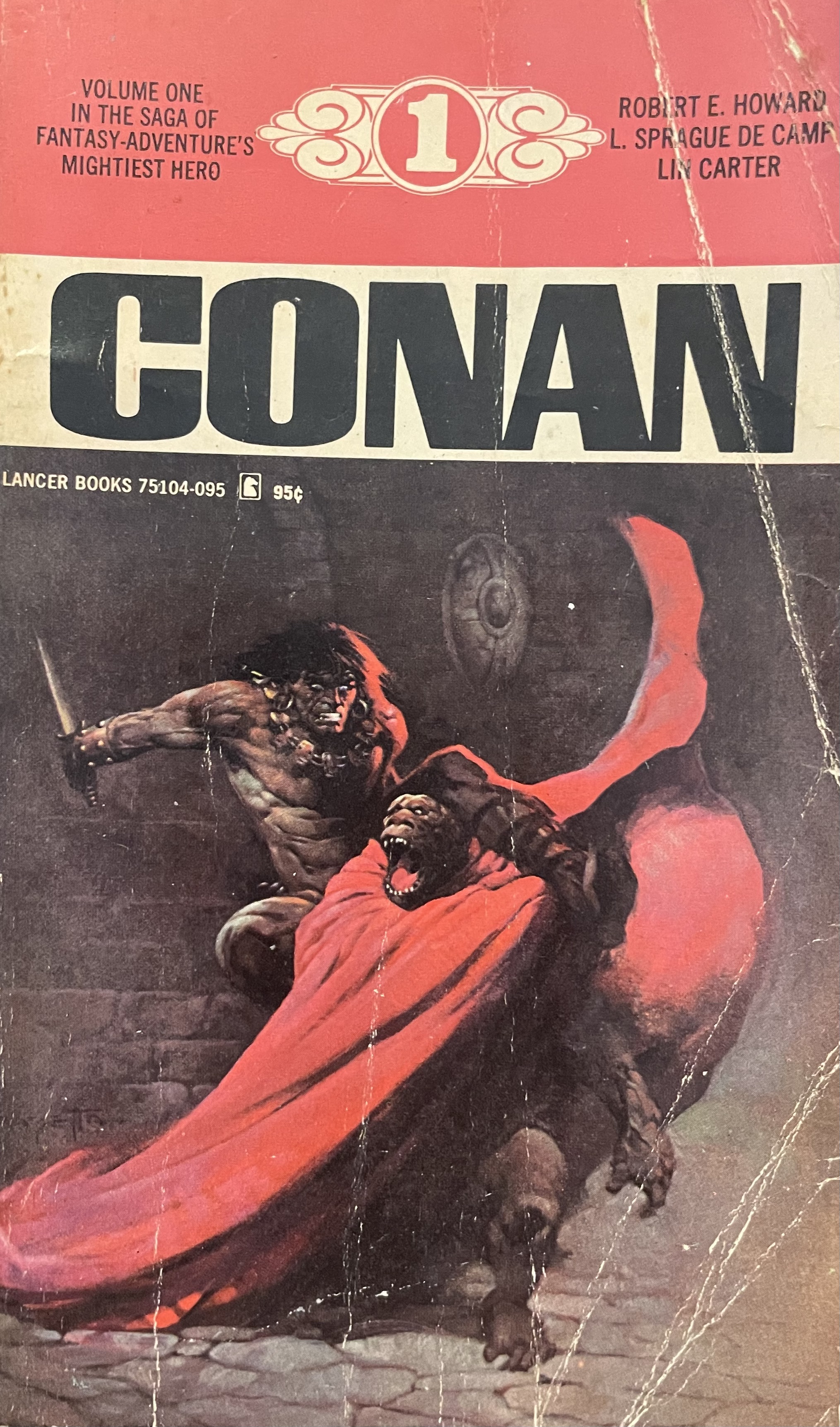
Robert E. Howard, creator of Conan the barbarian, didn’t give himself enough credit as a writer.
Yeah, he created Conan the Barbarian in the 1920s. Yeah, people still read his pulp stories almost 100 years after they were published. But Howard didn’t know that his stories were going to be republished after his death (which I won’t delve into here). And he also didn’t know Conan was going to become so popular decades later with comic books and movies based on his character.
In a letter to famous author H.P. Lovecraft in 1933, Robert E. Howard described how he thought of himself as a writer .
*****
“But I was the first writer of the post oak country; my work’s lack of merit cannot erase that fact. By first, I do not, of course, mean in point of excellence, God knows; I mean in point of time. There are some real writers growing up in this country now, whose work will be read and applauded long after my junk has passed to the oblivion it will earn.”
*****
If you want to read the entire letter, here it is.
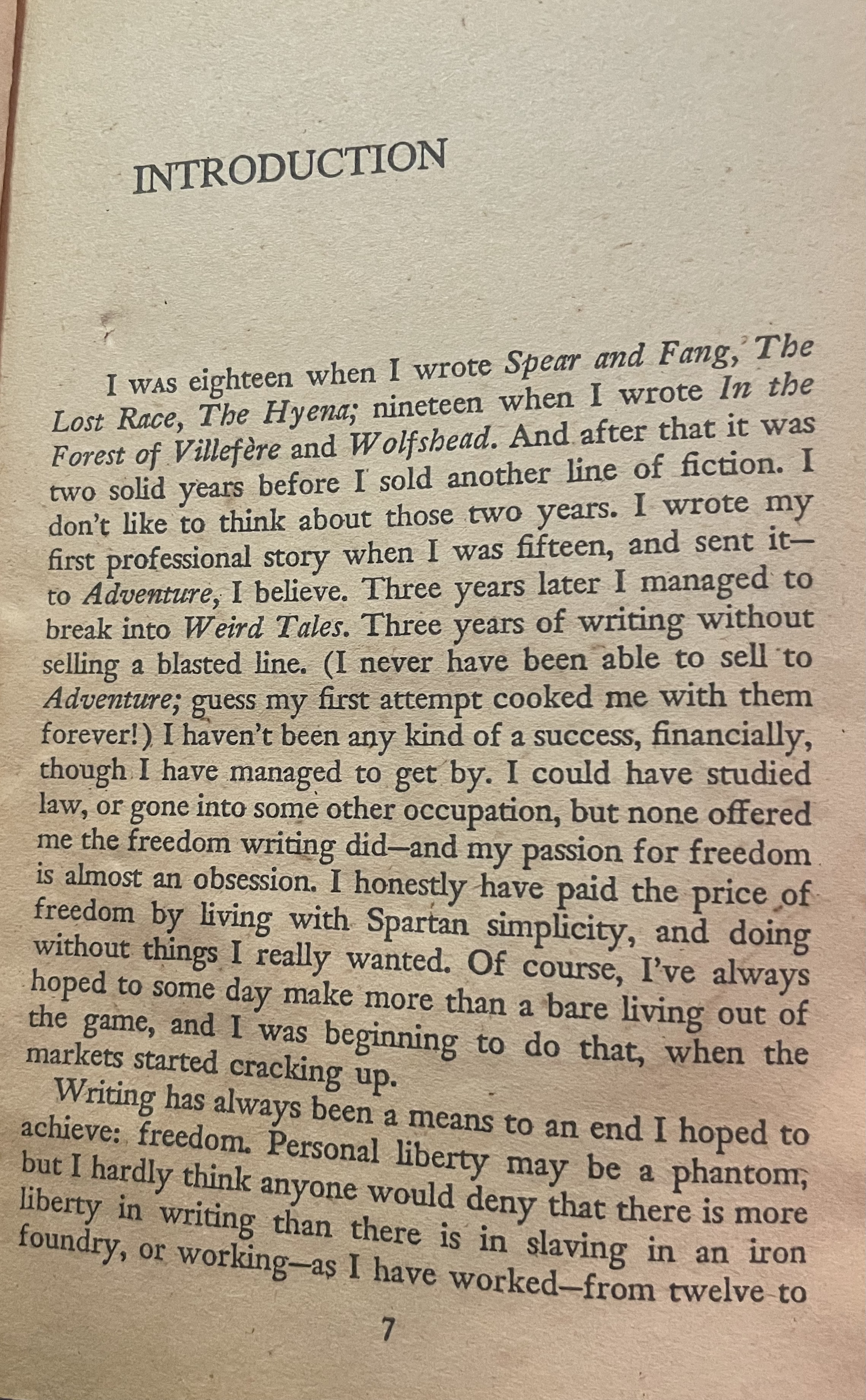

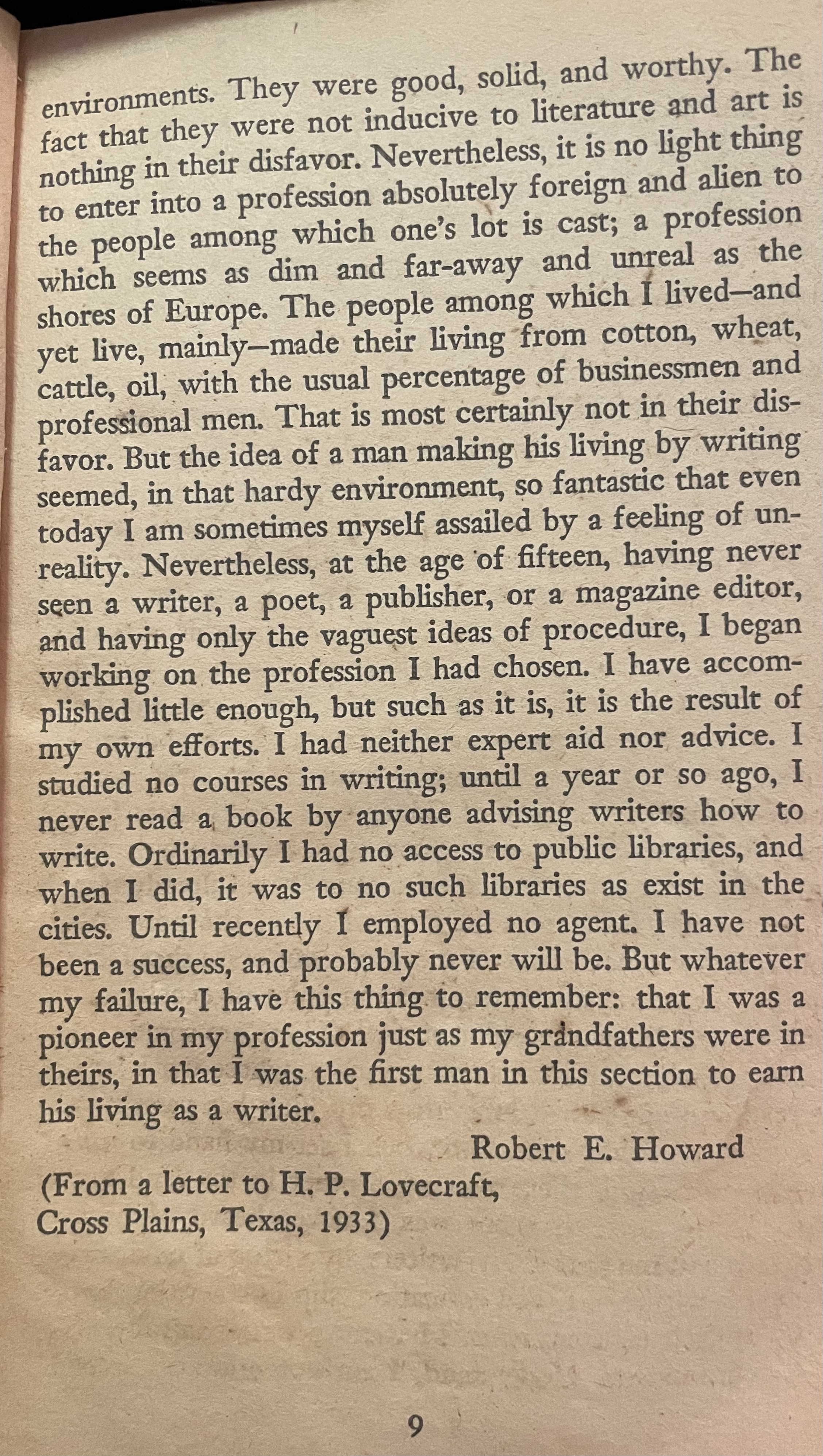
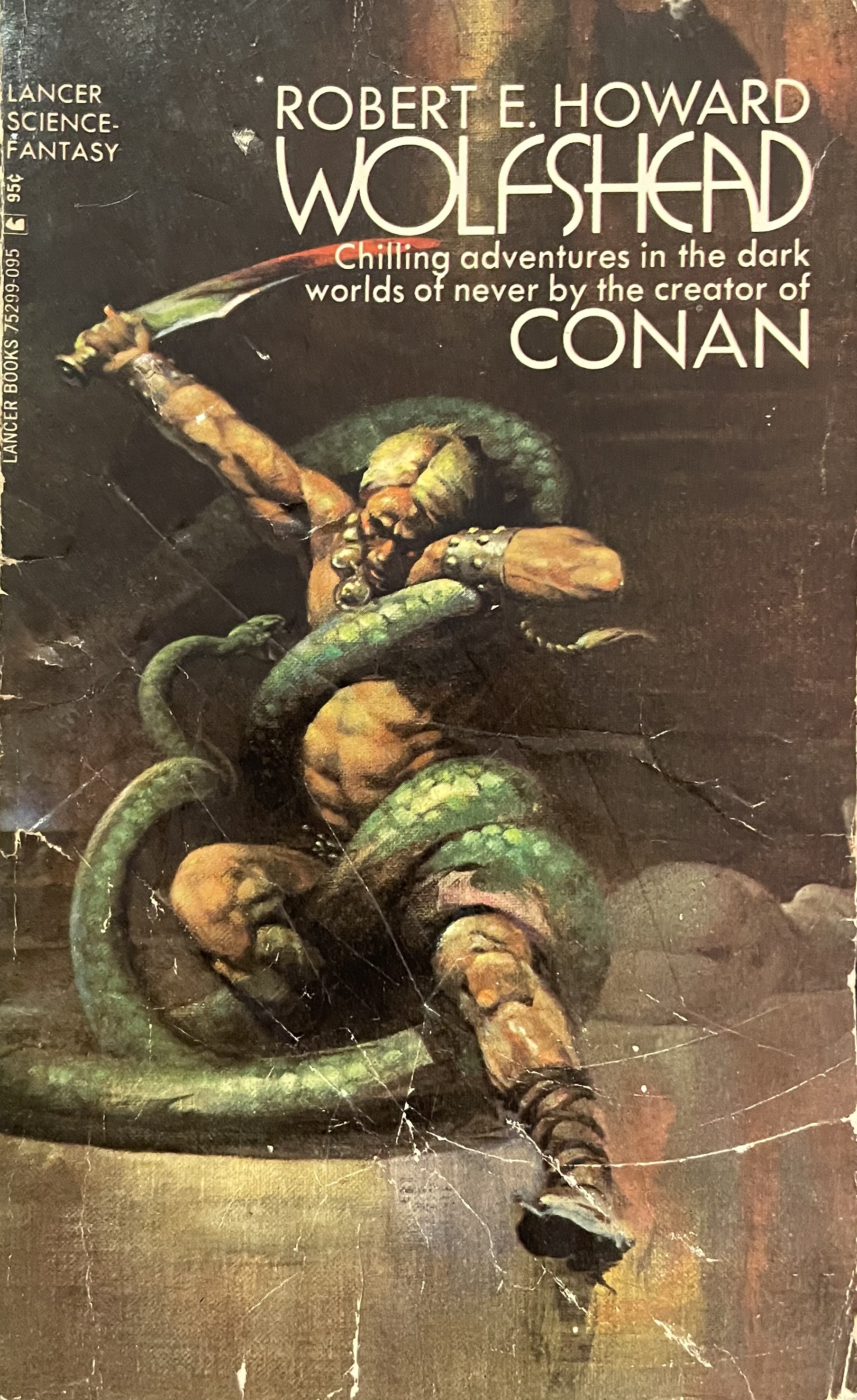
I can understand where Robert E. Howard was coming from. He was writing for pulp magazines. The magazines were made out of cheap newsprint and would fall apart within months if not handled carefully. Howard was reasonable in his expectation that his stories would pass into oblivion; the pulp paper would disintegrate, and his stories would fade away both literally and figuratively.
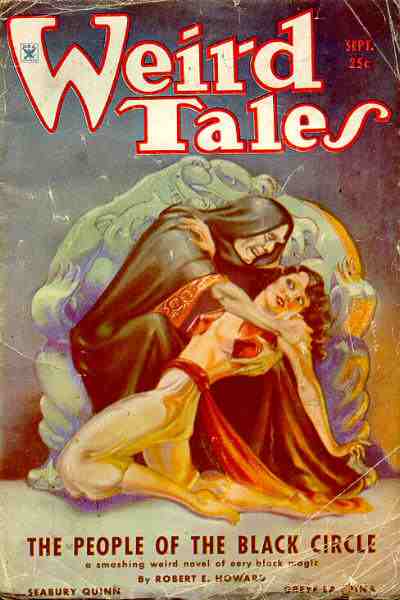
When critics complain about Howard’s sometimes sloppy prose, they aren’t considering (or don’t care) that he was writing for pulps, not for literary magazines. Compared to most pulp content, Robert E. Howard’s stories were literary fiction.
Some readers credit Robert E. Howard with creating the genre (or sub genre) of sword and sorcery. I don’t know if he ‘created’ it, and I don’t really care. All I know is that if somebody reads the stories you wrote a hundred years after you wrote them, then your stories probably aren’t junk.
But I guess there wasn’t any way for Robert E. Howard to have known that… unless he had decided to live longer… but I don’t want to delve into that here.
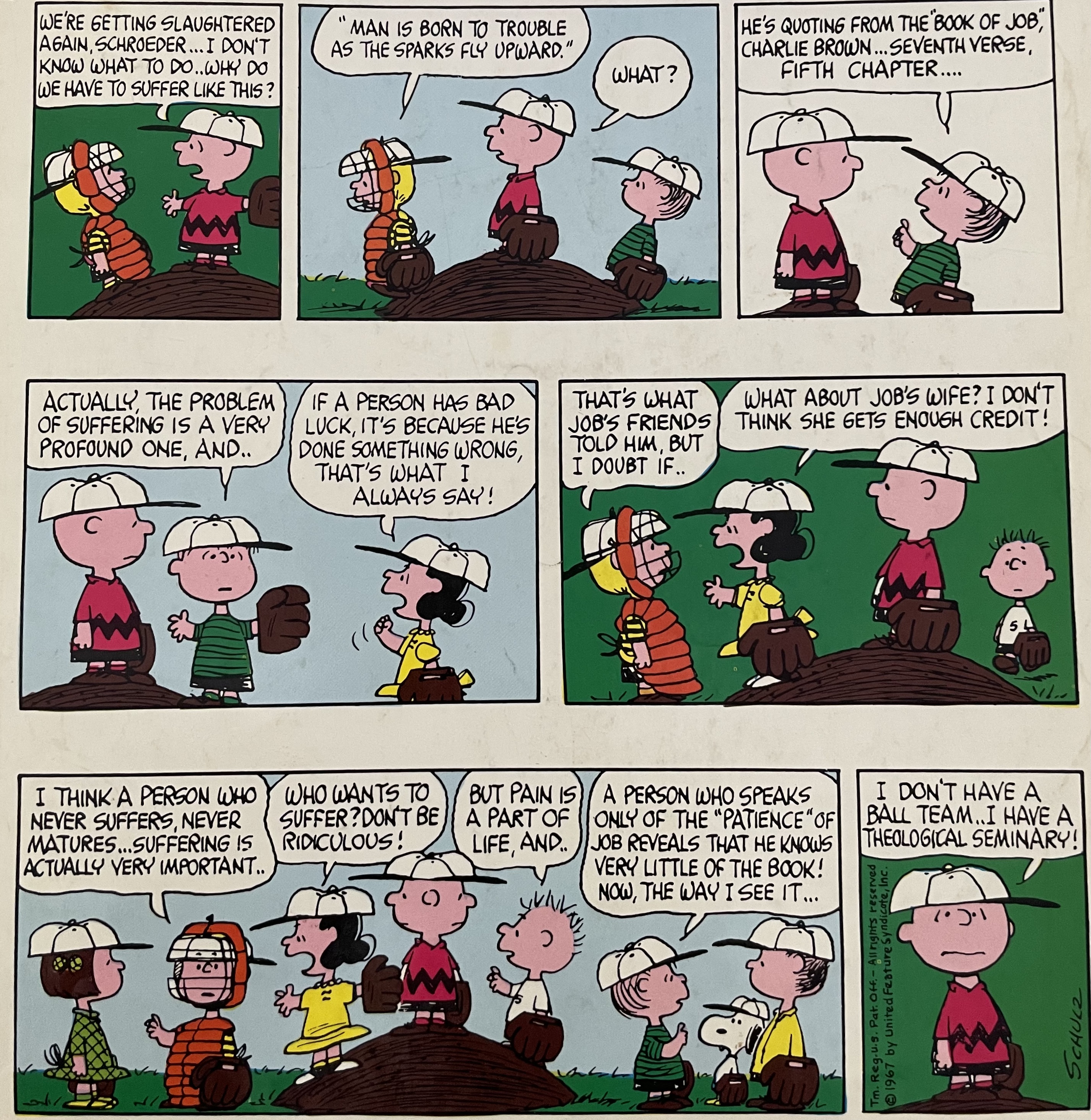
Since I have the same birthday as Charles Schulz, creator of Peanuts, I have been meaning to post my favorite Sunday strip on my blog on our shared birthday for the past couple of years, but I always forget. I sometimes forget my own birthday, so I’m not going to remember anybody else’s, unless that anybody else is a close friend or family member. I think I maybe remember five birthdays a year.
Besides, I’m not the type who wishes a happy birthday to celebrities online. I figure celebrities already have enough people wishing them a happy birthday. Yeah, I know it’s narcissistic to focus on one’s own birthday instead of a celebrity’s, but that’s just how I am.
I think I received this Peanuts book on one of my birthdays in the early 1970s. Or it might have been Christmas. Either way it was a cool gift.
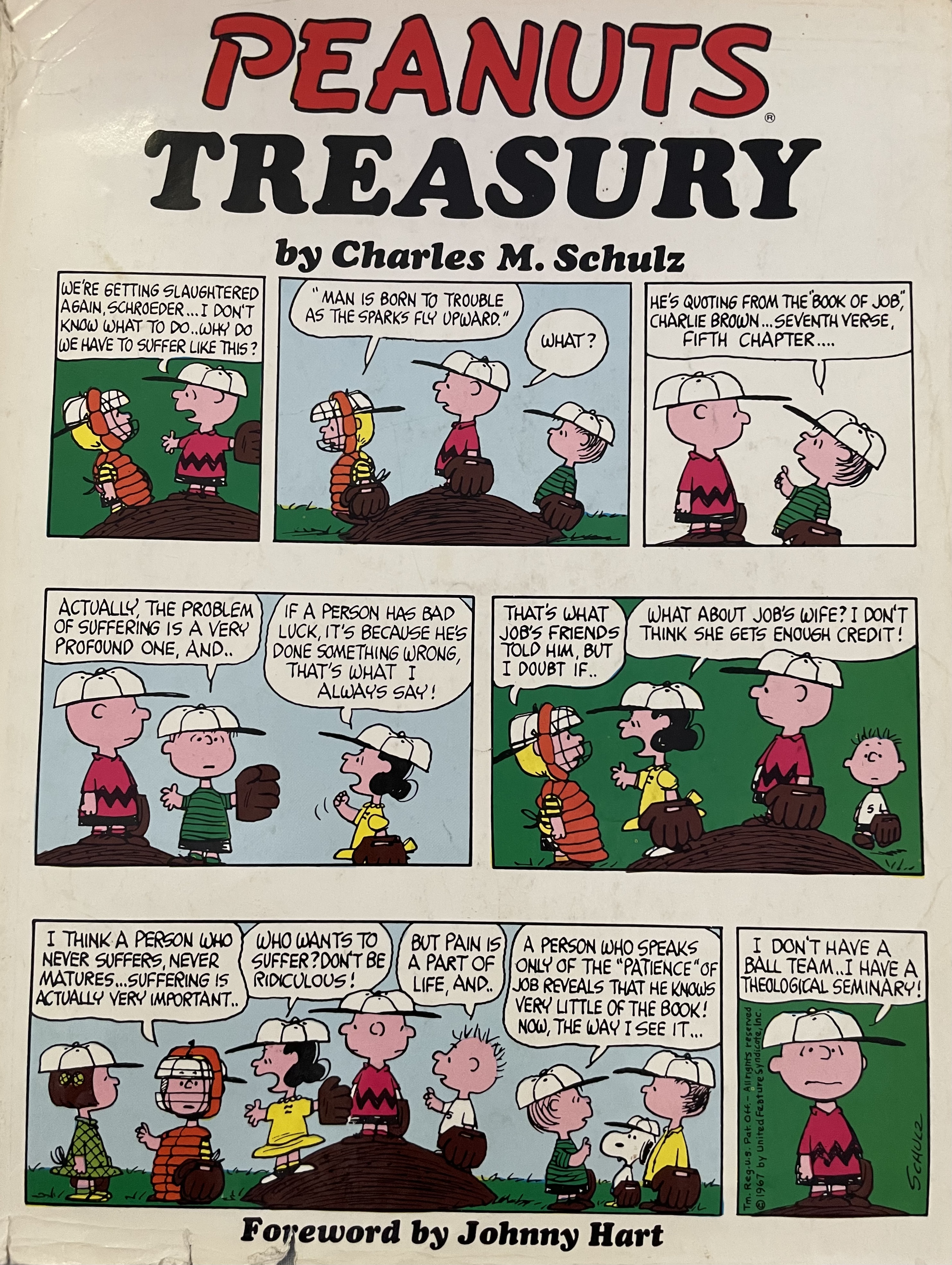
The cover of the book that has my favorite Peanuts strip reminds me of a scene from the movie Bull Durham, which came out in the late 1980s. From what I understand, conversations like this on a pitcher’s mound aren’t that uncommon, so I’m not going to accuse the scriptwriters of stealing from Charles Schulz.
Oh yeah, that Peanuts cartoon on the cover isn’t my favorite, but my favorite is in that book. I’m going to save my favorite for my birthday… if I remember to post it… which I probably won’t.
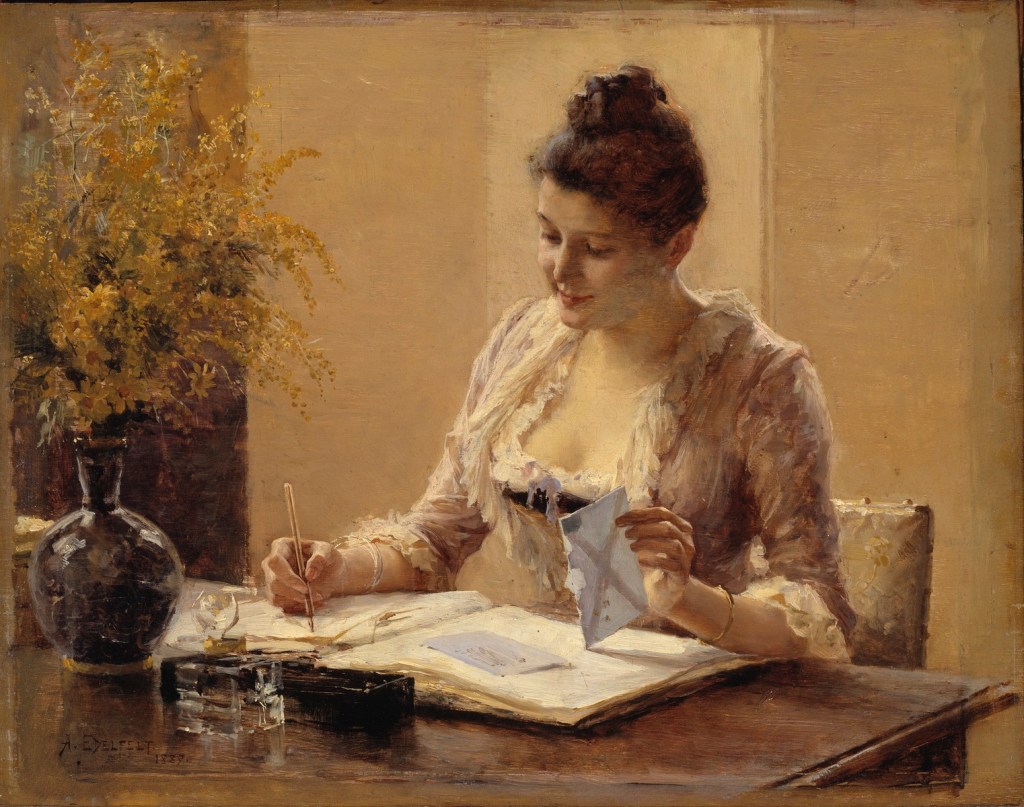
I found a bunch of long letters when I was going through some boxes a few days ago. The letters were mixed up with a bunch of old photographs that I’d been looking for and were a pleasant surprise.
Several letters were written by my parents in the 1990s. I found a 1987 letter from my Nan with a check for $10. Back in 1987, I could have bought a bunch of comic books with that $10. Nan passed away in 1997, so it’s probably not a good idea to try to cash the check. Instead, I’ll frame it, kind of like how some business owners frame the first dollar that they earned.
Now that I think about it, I’m pretty sure Nan needed that $10 more than I did, even back in 1987.
One letter was from a college girlfriend who wrote to me a year after we’d graduated.
The ex-girlfriend (it was a rough break-up) wrote me a four-page letter, rambling about how she had moved out to California with her new boyfriend and he was treating her like crap, and she was unhappy. No wonder I’d kept the letter. I remember that when I received that letter back in 1990, I was struggling badly in my first year of teaching. I was wondering if I’d wasted my college years preparing for a career that I hated. Then I got this letter, and it made me feel better.
Thank you, unhappy ex-girlfriend.
I also found a couple letters from my best friend in high school. He was a decent artist who didn’t do anything commercial with his talents, but his letters were filled with doodles that humorously made his point. It’s the type of letter that would be difficult to replicate on a text or email. People thought that this guy was kind of boring, but his letters were really funny. If he had been able to speak in ‘cartoon’ like he could write, then more people would have paid attention to him.
I found several letters written by my mom (I guess those are more important to me than the cartoon doodle-letters and ex-girlfriend whining). They were usually a page or two and not as interesting as the letter written by my ex-girlfriend. These were early 1990s, just before access to the internet and the use of email became common. Once my mom got an email account, she stopped writing long letters.
I’d forgotten that people used to write long letters to each other. That’s somethings that’s kind of tough to explain to younger people who might not see the point. When I mentioned finding the old letters and the emotions that I felt from discovering and reading them, some younger co-workers just gave me blank stares in a ‘that’s nice’ kind of way. That’s when I realized, ‘Oh yeah, they’ve probably never written long letters before.’
Way back in the previous millennium, writing a long letter to a friend or family member was pretty common, maybe even expected. And it wasn’t just famous authors like C.S. Lewis, artists like Vincent Van Gogh, or even political figures like Martin Luther King Jr. writing letters. Normal people wrote letters to each other. I have the proof. Maybe it’s not as much proof as I’d like to have, but I still have proof.
I think people wrote long letters in the previous millennium because you couldn’t really talk to anybody who lived far away. Even with landline telephones, long-distance calls used to be really expensive until about 20(?) years ago. Calling people outside your area used to be really expensive, especially during weekday hours.
Expensive long-distance phone calls are probably even more difficult to explain than writing long letters. People used to wait until weeknights and weekends to make long-distance calls because phone rates were so outrageous back then. It was just cheaper to write a letter and send it in the mail. Yeah, the post office might lose it (some things don’t change), but it was worth the risk.
And don’t get me started about what things were like before the telephone; I wasn’t around back then (that would be a REALLY old thing that’s tough to explain).
With cell phones, long-distance calls are no longer an issue (the phone itself is the expensive product instead). Now email and texts are instantaneous, and phone calls are cheap. There’s not much reason to write a long letter, unless it’s for the permanence. But I guess communication is seen as disposable now.
Just so you know, not EVERYONE enjoyed writing long letters. Famous author Ernest Hemingway admitted that he was bad at writing letters because he was usually tired from writing other stuff. Maybe he should have written his personal letters first. But then he might not have written so many famous books. When he was looking back over his life, I wonder if he regretted not writing all those personal letters that he could have written but didn’t. Did he think he had made the wrong choice? Probably not.
Even though I’ve never written long letters just for the sake of communication, I’ve always written great ‘thank you’ notes. When I was a kid, I took pride in writing more than the standard two-sentence ‘thank you’ letter. I made sure to write a full page, and I didn’t even have big hand writing. I told the gift-giver everything that was going on with my life (I was a kid in the 1970s; there was nothing going on). I probably even made up details just to get to a full page.
Even today, if I get a gift, I’ll buy a ‘thank you’ card and fill up the spaces with blather. I’m not sure if anybody reads the long notes that I write, but at least I give the gift-giver the option of reading about the mundane goings-on in my life. So if you want a long letter from me, just send me a cool gift.
I understand why people don’t write long letters anymore, though. It’s easier just to talk or text. I like writing more than I like talking, but I’d still rather have a short phone conversation than write a letter. To me, talking is work, and writing is kind of fun. If an introvert like me would rather have a short conversation on the phone instead of writing a long letter, what chance do long letters have?
I probably should start writing letters to people that I care about, just so that each person has ONE heartfelt message that can’t get deleted on a computer or other device. I don’t think I’ll write a letter to my ex-girlfriend, though. I’m sure she’s moved since 1991.
*****
For more “Old Things That Are Tough To Explain,” go to Old Things That Are Tough To Explain: The Home Page.
*****
After more than ten years of blogging, I’ve finally written a novel.
A grammar-obsessed English teacher falls in ‘luuuvvv’ and discovers how chaotic and dangerous ‘luuuvvv’ can really be.

The Sunset Rises: A 1990s Romantic Comedy is now available on Amazon and from the trunk of my car at various local bookstores… until parking lot security kicks me out. Buy it now while supplies last!
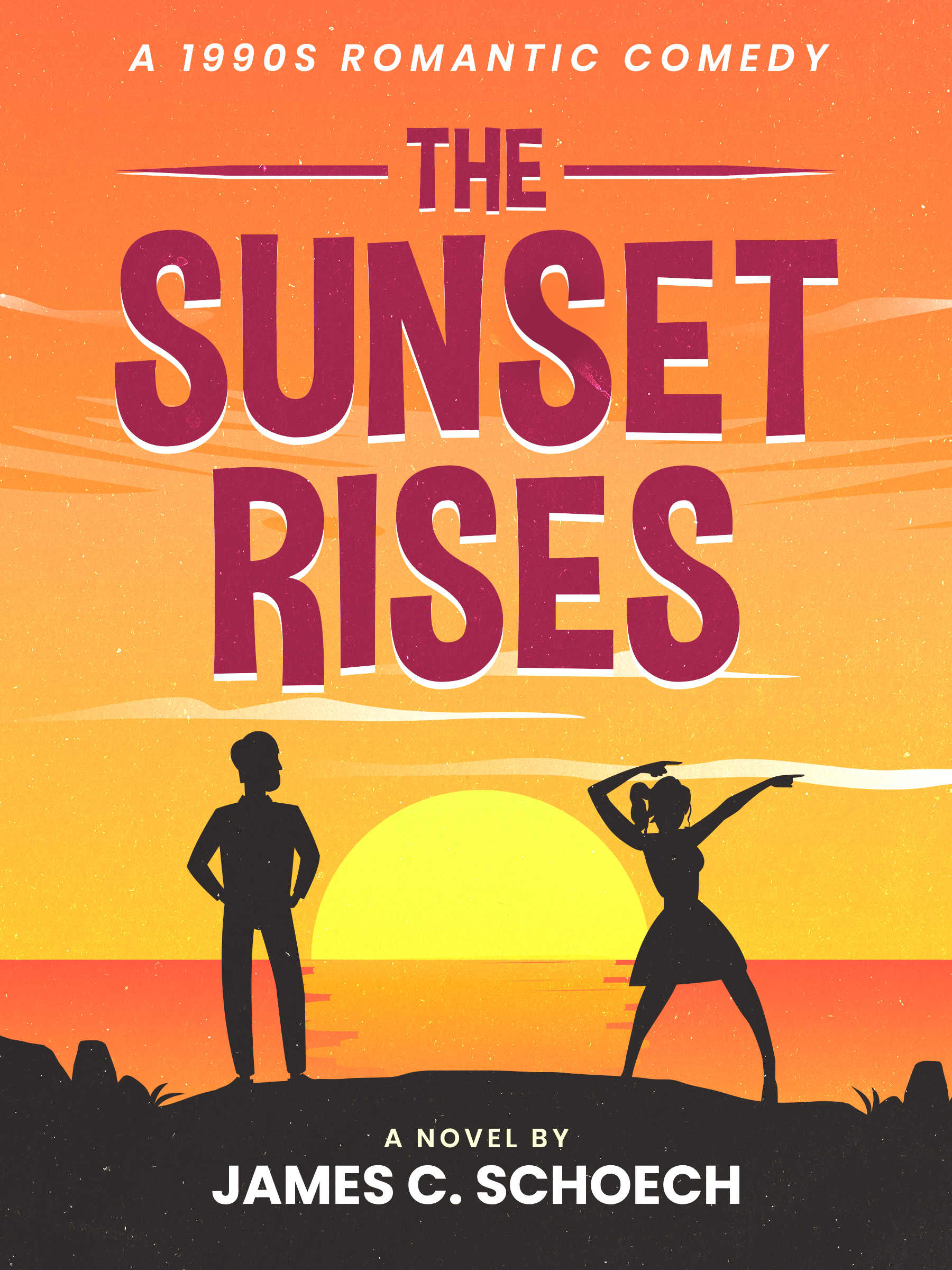
Yeah, the Kickstarter project for my novel The Sunset Rises: A 1990s Romantic Comedy didn’t reach its goal. It didn’t even come close.
This hurt my ego a little bit. I’ll admit that. But if I take my ego out of the equation (I’m still working on stuff like that), the Kickstarter failure doesn’t change my long-term plans to publish The Sunset Rises.
The book is still (almost) done. That hasn’t changed. I still have a little of my own money to publish the book myself. That too hasn’t changed. I was hoping that more people I didn’t know personally would be interested in the book, but I have plans for that as well.
The Kickstarter data was interesting. About half of my Kickstarter supporters were people I knew, and about half were people that I don’t know (as far as I know). When I began the Kickstarter, I told a few friends/family members about it just so that I wouldn’t stay at $0 for long, but I didn’t tell EVERYBODY I know.
I’m a bit reluctant to tell EVERYBODY I know. I’ve had friends who have pitched their businesses (including books that they’ve written) to their social groups, and I’ve noticed that it tends to alienate people. I have friends, friends of friends, co-workers, former co-workers, and family who would have supported my book if I had asked them directly.
But I only want to do that once. I don’t want to be the guy who’s always asking friends to support his books (or other business proposals). And if I do it once, I want to be cautious about how I go about it.
I’m saving EVERYBODY I know (not necessarily everybody, but you know what I mean) until the book gets published. Having initial book sales is more important to me than having a successful Kickstarter.
Still, Kickstarter failure is a predictor of future book sales failure if I don’t make some changes.
I know that I’m not a good salesperson. I might be a decent writer, but I’m not comfortable selling stuff. I do, however, know somebody who is great at social media and can sell stuff. So when I publish The Sunset Rises, this somebody I know has already agreed to help me promote it. As much as I like Dysfunctional Literacy, this blog isn’t effective at selling my book by itself.
So here’s my plan:
* One more month (or two) to revise and make sure the book is really really good.
* Send it to a proofreader (I don’t know how long that takes).
* Format the book (I don’t know how long that takes).
* Publish the book (I don’t know how long that takes).
* Sell the book and have my shameless promoter do most of my sales for me (or at least do what my shameless promoter says).
Even though I’d like to have all this done by July, some of the progress will be out of my hands, and I like to work at my own pace. I’m retired, but I work two part-time jobs that together get me around 40 hours a week (usually more), so I’m pretty busy.
I think every new author, especially awkward quiet guys, needs a shameless promoter, and I have mine ready. So even though the Kickstarter didn’t go as well as I had hoped, I’m still going to publish The Sunset Rises: A 1990s Romantic Comedy, and I have a plan to sell a few copies as well.
Now I just need a shameless promoter to talk for me during my book signings.

Struggling first-time authors will sometimes take unusual actions to boost sales of their unknown debut books.
For example, there was a woman who became mayor of Baltimore and subsidized her children’s book with city funds. That was genius but illegal. I prefer not to break the law when selling my book.
Then there was the male author who pretended to be a hot chick online and got a bunch of lonely guys to buy his/her book. Technically, that’s not against the law, but that’s a mean thing to do to lonely guys. I’d almost rather break the law.
Then there was the guy who lied to a bunch of women about having eye cancer and then got a job with a book publishing company and then used both to promote his mystery novel geared to women. Yeah, lying to women about eye cancer was probably fun for him and got him some decent action with a lot of women who fell for his schtick, but then he had to work for a book publishing company. Ugh, that had to be dull.
Those were pretty devious ideas, but this first-time author had the best idea of them all.
******
New Novelist Gets Support From Stephen King After Sad Tweet About Book Signing
Chelsea Banning was disappointed when only two people showed up at a signing event for her debut fantasy novel — but not for long.
The book, Of Crowns and Legends, leapt to No. 1 in its genre on Amazon after Banning’s tweet about the low turnout at Pretty Good Books in Ashtabula, Ohio, on Saturday, went viral.
“Only 2 people came to my author signing yesterday, so I was pretty bummed about it,” Banning tweeted Sunday morning. “Especially as 37 people responded ‘going’ to the event. Kind of upset, honestly, and a little embarrassed.”
She considered deleting the post later, she told NPR, but changed her mind when she saw an amazing response on Twitter, which included comforting words from some of the most successful authors in the world, as well as her favorite writers like Neil Gaiman, Robin Hobb, and Jodi Picoult…
*****
I don’t know how this first-time author got famous writers to see her tweet, but that was genius. Twitter is a constant bombardment of struggling authors trying to promote their books. I get headaches whenever I’ve tried to navigate writing hashtags or book hashtags on Twitter. Blogging is more my thing.
Whatever that unknown author did, whether it was strategy or astoundingly great luck, good for her, and good luck to her with her future books!
****
But enough about me! If you were writing a book, what famous author would YOU want to support it?

This might actually be THE BEST WRITING QUIZ, but I’m not 100% sure. After all, I haven’t taken every single writing quiz ever made. Even if this isn’t quite quite THE BEST WRITING QUIZ EVER!!!, it’s still pretty good, and I know people won’t take a quiz if it’s titled Writing Quiz That I Wrote One Afternoon When I Was Bored.
*****
Writing habits can explain a lot about your personality. Take the quiz below, keep track of the points as you go, and see what kind of writer (and human being) you really are!
A. When a commenter on your blog tells you that you suck, what do you do?
- Feel bad that the commenter didn’t like your writing.
- Feel proud that somebody cared enough to tell you that you sucked.
- You enjoy comments, but they don’t have any effect on you.
- Get mad and leave a “You suck, and so does your mom!” comment on the commenter’s blog.
*****
B. When you get writer’s block, what do you do?
- Stare at the screen until you fall asleep.
- Write “I don’t know what to write” until you think of what to write
- Shrug your shoulders and go do something unrelated to writing.
- Throw a loud, profane fit.
*****
C. When your spouse/significant other tells you that you spend too much writing, what do you do?
- Pretend you don’t hear what your spouse/significant other is saying.
- Say in a soothing voice, “You’re more important to me than my writing, but let’s discuss this when I’m done.”
- Immediately quit writing and spend time with your family.
- Push your spouse/significant other out of the den and soundproof the room the next day.
*****
D. During revisions, you notice a lazy metaphor in your writing. You-
- Add a couple words to the metaphor so that it’s not so lazy.
- Stress yourself out trying to think of a completely new and different metaphor.
- Keep the metaphor as it is and hope nobody notices.
- Drop the metaphor and go completely literal.
*****
E. A friend asks you about your latest writing project. You-
- Tell your friend that you never discuss your projects until the projects are finished.
- Tell your friend just a little bit about your project to be polite.
- Change the subject.
- Tell your friend everything about your writing project until your friend’s eyes glaze over.
*****
F. What kind of book do you think damages the publishing industry the most?
- Any book written by a “celebrity.”
- Any book series written by a new author who hasn’t proven he/she can sustain a book series.
- Any book written by James Patterson.
- Any book not written by you.
*****
G. While reading bestselling novels, what typically goes through your head?
- You nitpick over every plot hole and every poorly-written sentence.
- You look for ideas and writing techniques that you can use in your own writing.
- You’re just reading a bestseller for fun; it has nothing to do with your own writing.
- You wonder how that piece of junk ever became a bestseller.
*****
H. A friend of yours reads your novel and gives honest criticisms. What is your reaction?
- You appreciate the feedback, but you argue about the criticisms you disagree with.
- You listen intently to the criticism, and actually make a few changes because of it.
- You’re stunned that somebody actually finished your novel.
- You’re offended that your friend didn’t think your novel was perfect, and you end the friendship.
*****
I. What do you think about Ernest Hemingway’s famous quote?- “There is nothing to writing. All you do is sit at a typewriter and bleed.”
- It perfectly explains what you go through during the writing process.
- Hemingway exaggerates a little bit, but you understand what he means.
- You’re a little baffled by the quote because you actually enjoy writing.
- Hemingway, Shmemingway, that lush doesn’t know what he’s talking about.
*****
J. A friend gives you a copy of On Writing by Stephen King. What is your first thought?
- You’re grateful, but you already have five copies.
- You’re excited because you’ve always wanted to read this.
- You wonder why your friend thinks you need advice with your writing.
- You think Stephen King is a hack who doesn’t even follow his own advice anymore.
*****
SCORE
10-19 Points- You should be a writer because you’re insightful and the world needs to read your observations.
20-29 Points- You should be a writer because you care about the art and everything you write will be well-crafted.
29-35 Points- You should be a writer because you’re creative and can make up your own rules while still making sense.
36-40 Points- You should be a writer because you’re too curmudgeonly to do anything that requires interactions with real people.
*****
How did you do? What did the quiz tell you about your writing habits? Do you normally take quizzes when there is no real grade involved?
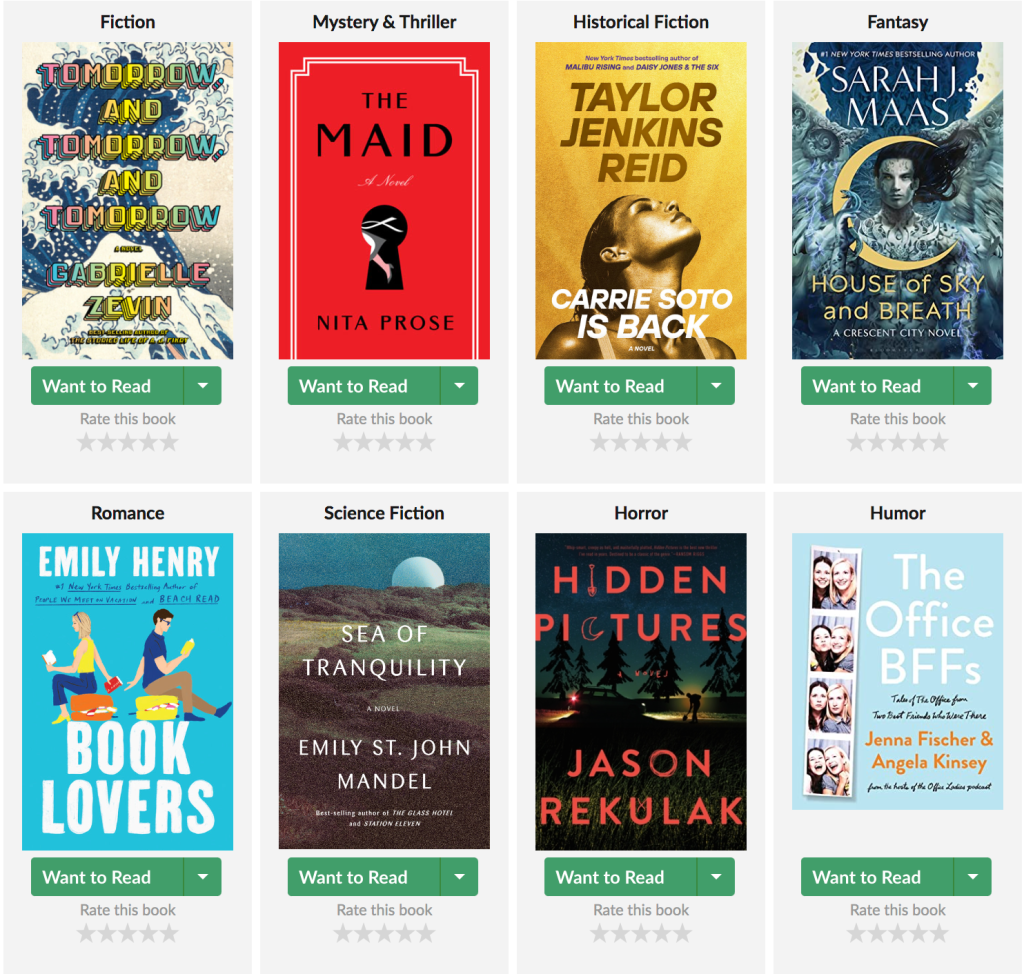
I admit up front that I haven’t read ANY books published in 2022 (except for a few that I bought off of Kickstarter). Maybe that means I shouldn’t judge the books of 2022; after all, I’m unfamiliar with them. On the other hand, I might be a great judge of these books because I don’t have any biases for or against any of these books; I’m completely objective.
Yeah, I don’t think it works that way. I’m probably not the blogger to judge what is and what isn’t the BEST BOOK of 2022.
Since I haven’t read any books published in 2022, I’ll let the ‘experts’ make the decision for me.
My first step was to read a bunch of BEST BOOKS of 2022 lists.
I’m not the type to make many lists, but if you like lists, especially book lists, here are four of what I think are the BEST of the BEST BOOKS of 2022 lists!!!
Publishers Weekly Best Books 2022
Amazon- 2022s Best Books of the Year
After perusing through these lists (and several others), I unscientifically kept track of which novels kept showing up on various lists. Coming up with a top five list wasn’t difficult because most books didn’t show up on most lists. Only a few books made a majority of lists. And out of those few, one stood out.
It’s a novel that I’d never heard of written by an author I’d never heard of. I’m sure she hasn’t heard of me or my blog either. So without further ado, the BEST BOOK (FICTION) OF 2022 is…
1. Tomorrow and Tomorrow and Tomorrow and Tomorrow and Tomorrow by Gabrielle Zevin
I think I left out a ‘tomorrow’ in the title.

Here are the honorable mentions that showed up on several lists but couldn’t overtake Tomorrow and Tomorrow and Tomorrow.
2. Carrie Soto Is Back by Taylor Jenkins Reid
3. True Biz by Sara Novic’
4. Our Missing Heart by Celeste Ngo
5. Demon Copperhead by Barbara Kingsolver
I think I’ll read Tomorrow and Tomorrow and Tomorrow and Tomorrow. I like the premise. The sample was pretty good. I just need to remember how many ‘tomorrows’ are in the title when I write about the book.
*****
What do you think? Have YOU read every book published in 2022? If not, how many? Have you read any of the novels on this list? Will these books be remembered and highly regarded by future generations?

As I walking to my car in a grocery store parking garage, I noticed a couple employees doing something kind of crazy in a small pickup. The vehicle itself was parked in probably the most well-lit spot in the garage. There was so much lighting that I could see exactly what was going on with a male and a female inside the pickup.
Some people don’t mind getting caught, but I could tell from the female’s facial expression that I was not the intended audience. In fact, she looked kind of pissed off that I saw her. I don’t know why she had the audacity to be pissed off; I didn’t even look that long. It was her fault anyway. If you’re in a well-lit location and you do something crazy, it’s your own fault if you get spotted.
I promise, I didn’t want to see what I saw. She wasn’t even that… aw, you know what I mean.
My philosophy has been that if you’re going to do something crazy in your car, do it in a really dark place. I understand that work can be stressful or boring or unpleasant, but there are still better times and places to do the crazy stuff.
This isn’t the first time that I’ve walked into a weird situation. A couple decades ago, I was returning a video to Blockbuster. When I turned the corner of the building, I stood face-to-face with two guys, one guy holding a knife, another guy holding his side bleeding. All three of us froze and made eye contact. For some stupid reason, I said, “Hey!”
To my surprise, both guys fled the scene. The guy with the knife could have stabbed me. Even the guy getting stabbed could have killed me (pure speculation on my part). I feel bad for the stabbed guy. Running from me probably cost him a lot of necessary blood. I hope he didn’t bleed out from hightailing the scene. I have to admit, I was impressed with his speed. He ran faster than the guy with knife; I’m just not sure how far he got; I would have checked, but I had a movie to return. Back then, late fees were a big deal.
This happened before cell phones were a thing, so I couldn’t call the cops right away. When I entered the Blockbuster, I almost asked to use the phone, but I wasn’t sure how I’d report this to the police. The two guys had both run off. I’m sure a detective could have followed the trail of blood, but by the time he got to the end of the trail, the situation would have already taken care of itself. Our police, as much as I respect what they do, didn’t have a great response time.
So instead of notifying the proper authorities, I returned my video and rented a new one. It wasn’t my fault that Blockbuster went bankrupt.
I’m not sure when to intervene and when to back off. There was the time when I turned the corner into the freezer aisle of a grocery store to see a guy knock down his girlfriend. We made eye contact, and I pointed out an imaginary slick spot on the floor and the guy helped her up. Or when I walked into a fast food place just in time to see an old lady about to hit her grandchild(?) with a belt. I intervened in that case too, but sometimes you have to pretend stuff isn’t happening.
Old lady with a belt?
She’s just an old lady. Intervene.
Guy knocking his girlfriend down?
She probably said something to… I mean… a man who hits his girlfriend probably won’t tangle with a guy who can fight back, but proceed with caution.
Guy stabbing another guy?
Whatever you do, don’t yell “Hey!”
Weird stuff in a car in a grocery store parking garage?
Leave them alone; they probably have to get back to work in a few minutes anyway.
*****
But enough about me! What crazy situations have you walked into? When do you respond, and when do you pretend that nothing happened?

The book Paper Lion by George Plimpton is awesome because it has the earliest printed version of the word ‘SHEE-IT’ that I’ve seen. That’s it. That’s the reason I like it.
I mean, the story of a sports writer trying out for the Detroit Lions in the NFL preseason is kind of interesting, but it doesn’t feel as groundbreaking now as it might have felt when the book was first published in 1966. Back then, there wasn’t as much exposure to the behind-the-scenes stuff that the NFL has right now. If anything, the NFL has way too much exposure today. But since that might not have been the case back in 1966, I can see why Paper Lion was popular back in the late 1960s.
Plus like I mentioned, it has possibly the first printed version of the word ‘shee-it.’ Maybe there was a book published earlier that had ‘shee-it,’ but if there is, I’ve never seen it. The word ‘shee-it’ is even spelled the way I’d imagined it.
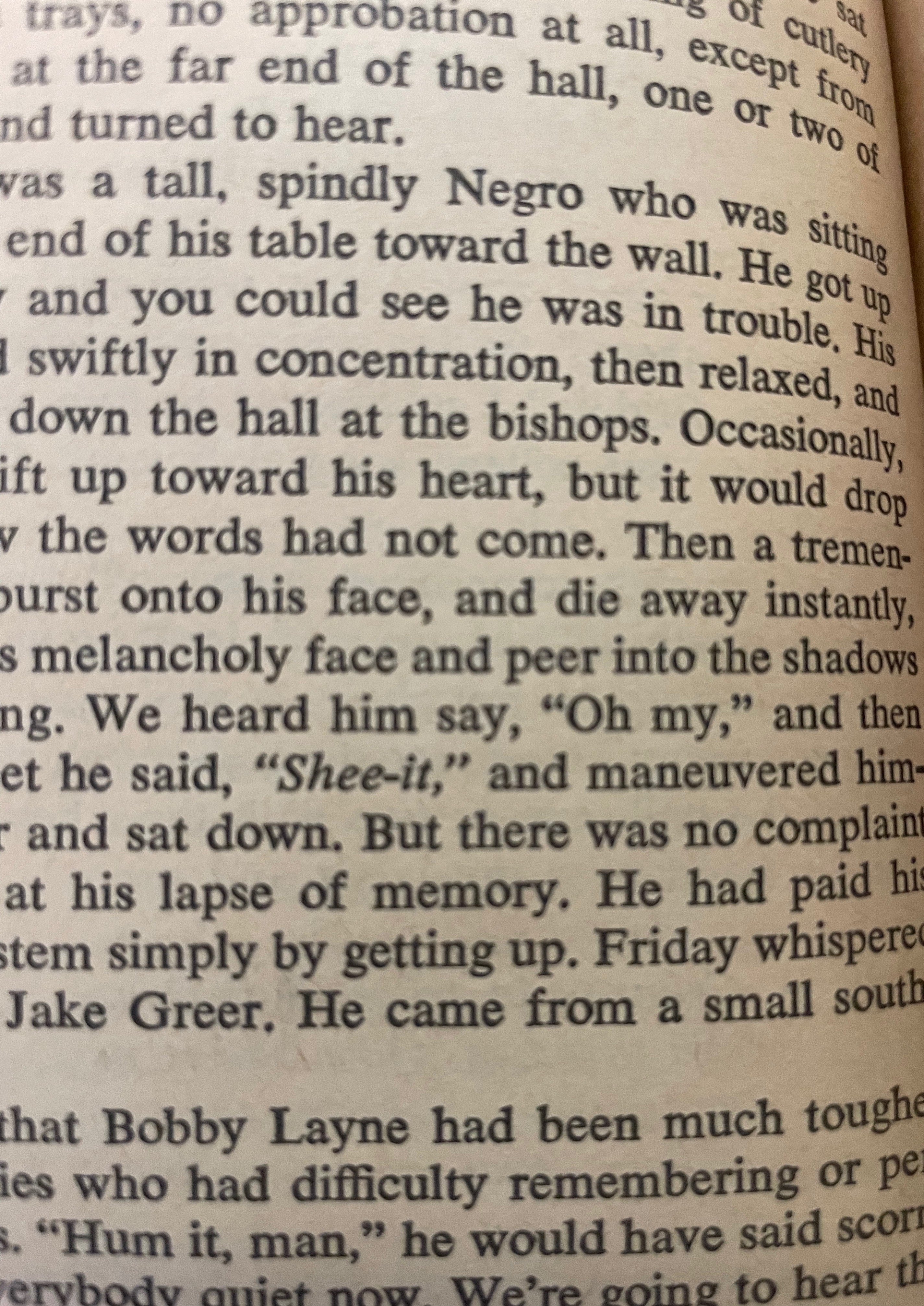
For years, my daughter did not believe that the word ‘shee-it’ was real. She thought I was the only person in the entire world to say it. Then she heard someone say it in a movie (I’ve forgotten what the movie was). I was glad to have visual/audio proof of ‘shee-it’ from a Hollywood movie (not that everything in Hollywood movies is real).
Now I have written proof that the word ‘shee-it’ is real and at least as old as I am. I didn’t make it up.
I think ‘shee-it’ should be in Scrabble. If ‘bae’ and ’embiggen’ and ‘listicle’ can be added to the Scrabble dictionary, then so can shee-it.’ But that’s for another blog post.
‘Shee-it’ has a practical purpose too. When I was an English teacher, I used the word ‘shee-it’ to explain third-person nominative case pronouns. I used to say that ‘he, she, it’ were third-person pronouns and that “He, she, it” was also was the redneck way of saying ‘that guy went to the bathroom.’
I’m half-redneck, so I can say stuff like that.
The above page from Paper Lion also has the word ‘negro’ on it, and the term ‘negro’ is kind of frowned upon today, but it was considered the appropriate term back then. I know the appropriate term has changed several times in my lifetime, so I try to go by whatever is considered appropriate at any given time. I don’t know who makes that decision, but I know it’s not I who makes that decision, so I stay out of it.
Paper Lion received some pretty good book reviews at the time, and you can see them prominently displayed on the paperback back cover. If you think the front cover is kind of bland, the back cover makes up for it with bright red surrounding several extremely positive reviews. I think some of these reviews overdo it a bit, but the author of Paper Lion was a sports writer, and journalists, including critics working for the newspapers, have to look out for each other.
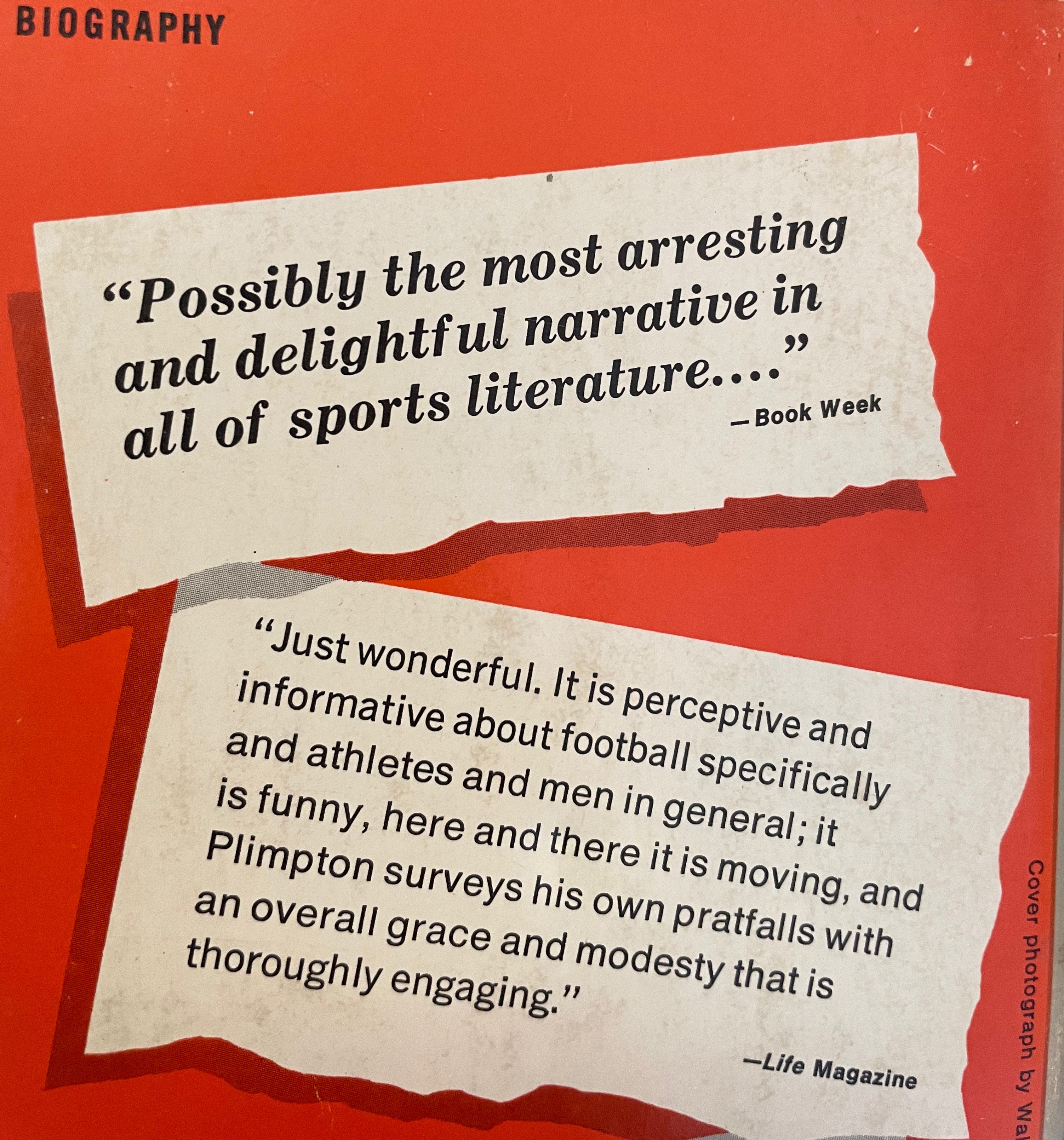

If Paper Lion was ever the best book about football ever (as claimed in one of the reviews), I’m not sure that’s true anymore. I liked Friday Night Lights (which came out in the 1980s) a lot better. Yeah, the Friday Night Lights television series is way too melodramatic to be taken seriously, but the book was pretty good, and I don’t believe in punishing a good book because of an over-dramatic television series.
Even without the word ‘shee-it,’ I like Paper Lion. I think it’s better to read this book non-chronologically, though. When I initially got bored with the author’s personal story, I just flipped to a random page and began reading football anecdotes. The book is filled with football stories and background information from the mid 1960s. I like older books because you can get perspectives of history from people who didn’t realize they were living through it at the time.
I’ll probably keep my copy of Paper Lion. I’ll go back to it occasionally and read a page or two. And if I ever play Scrabble again (which I probably won’t) and I need proof that ‘shee-it’ is a word, I have this book as evidence.
Shee-it.
*****
What do you think? Is ‘shee-it’ a word? What is the best football book ever written? Have you even read every football book ever written?
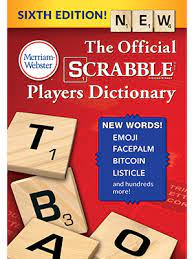
When the new Scrabble word list came out last month, I wasn’t sure what to think about it. I really wanted to have a negative knee-jerk reaction to it, but I try not to have knee-jerk reactions anymore. So I decided to mull it over for a few weeks to think about if I even need to have an opinion about this.
*****
Out this month, the add-ons in the seventh edition of “The Official Scrabble Players Dictionary” join more than 100,000 words of two to eight letters. The book was last updated in 2018 through a longstanding partnership between Hasbro and Merriam-Webster.
The new words include some trademarks gone generic — dumpster for one — some shorthand joy like guac, and a delicious display of more verb variations: torrented, torrenting, adulted, adulting, atted, atting (as in don’t at me, bro).
“We also turned verb into a verb so you can play verbed and verbing,” said Merriam-Webster’s editor at large, Peter Sokolowski, a smile on his face and a word-nerd glitter in his eye during an exclusive interview with The Associated Press.
Fauxhawk, a haircut similar to a Mohawk, is potentially the highest scoring newbie, he said. Embiggen, a verb meaning to increase in size, is among the unexpected. (Sample sentence: “I really need to embiggen that Scrabble dictionary.”)
Read more at Yeehaw, bae: An embiggened Scrabble dictionary cuts slurs and adds words new and old
*****
First of all, it’s probably good that Scrabble has finally gotten around to cutting slurs. The linked article, however, doesn’t say what the slurs are. That’s the problem with slurs; you can’t say what the slurs are without being accused of using slurs. Even using the slur in the context of the slur being a slur can get somebody accused of using a slur because that somebody used the slur, even when the context behind using the slur was to explain why the slur is a slur.
Anyway, besides getting rid of slurs, whatever they are, the new Scrabble dictionary has added a bunch of fake words to its playing list. Not that I play Scrabble anymore, but I’m pretty sure the new words give younger players an advantage over older players. I guess this makes up for all the older generation ponzi schemes that the younger generation is going to have to pay for.
If that’s the case, then this new Scrabble word list is okay by me.
Even so, some of these new words seem kind of stupid. The worst of these new so-called words is ‘listicle.’ ‘Listicle’? That just sounds stupid. I guess if an article filled with lists is called a ‘listicle,’ then a test full of lists would be called a ‘testi…’ never mind; that’s already a word.
I don’t trust Scrabble to determine what makes a word and what doesn’t. I don’t think Scrabble has that kind of authority. I don’t think Merriam-Webster has that authority either. I lost my trust in Merriam-Webster when it added the definition ‘not literal’ to the word ‘literally’ just because a bunch of people were misusing the word.
The word ‘ain’t’ is the real victim in all this. It took the word ‘ain’t’ decades to be accepted by most dictionaries. There was even a saying- “‘Ain’t ain’t a word, so you ain’t supposed to say it three times a day because it ain’t proper.” The sophisticated humor in that sentence is that the word ‘ain’t’ is actually used four times.
It’s not fair to ‘ain’t’ that words like ‘bae,’ ‘listicle,’ and ’embiggen’ are accepted so quickly. A new word should have to wait a few generations before being accepted by a dictionary, like ‘ain’t’ had to.
I’ve never liked Scrabble. All you do in Scrabble is make words with the letters. I didn’t see the point in just making words. I like using the words and making up stories with them.
I might play a Scrabble version where you make words, collect the words that are yours, and then write a story based on the words that you used in the game, and then get the story published. Whoever’s story earns the most money in publication wins the game.
But there’s no way I’m putting the word ‘listicle’ in my story.
*****
Enough about me! What do you think? Are these new ‘words’ really words, or has Scrabble resorted to letting anything be a word? Has anybody actually spoken the word ‘listicle’ before? Do the new words give younger people an advantage? If so, does this make up for the older generations ponzi schemes? Leave a comment below!


 Dysfunctional Literacy