.jpg)
I think I did a double take when I saw that a new Brick & Mortar Bookseller is opening in a plaza about a five minute drive from where I live. I don’t remember what store used to be in the vacant space. Currently, there’s a grocery store on one end of the plaza and a pet store on the other with a pharmacy, an urgent care place, and several shops that I don’t remember in between.
A few years ago, B&M Booksellers shut down several locations in my area (one of them was kind of a cool store). I’m more into used books (especially stuff published before 1970), so I’m more concerned about the disappearing used book stores, but I’m still glad that B&M Booksellers might be making a comeback.
Here’s an article from Publisher’s Weekly that suggests maybe book sales are on the upswing, but there are mixed signals. Of course, there are always mixed signals. If there weren’t mixed signals, decision making would be easy.

B&M Booksellers is usually too expensive for me (I’m a cheapskate), and it’s a chain, but I like having a bookstore nearby, so I might have to buy the occasional expensive book just to support a (chain) bookstore.
Back in the 1990s, B&M Booksellers was seen as the villain by some bibliophiles because its dominant presence was shutting down smaller bookstores. Now some book readers have more sympathy for B&M as it’s trying to survive Amazon’s onslaught.
I’m actually kind of fortunate. I have a decent used bookstore less than five minutes away from one of my current jobs, and now I’ll have a B&M Bookseller five minutes away from my home.
I’d rather have a used bookstore 5 minutes away from me, but I’m not going to complain about B&M Booksellers. At least, not until I see the prices of the books I want to buy.
*****
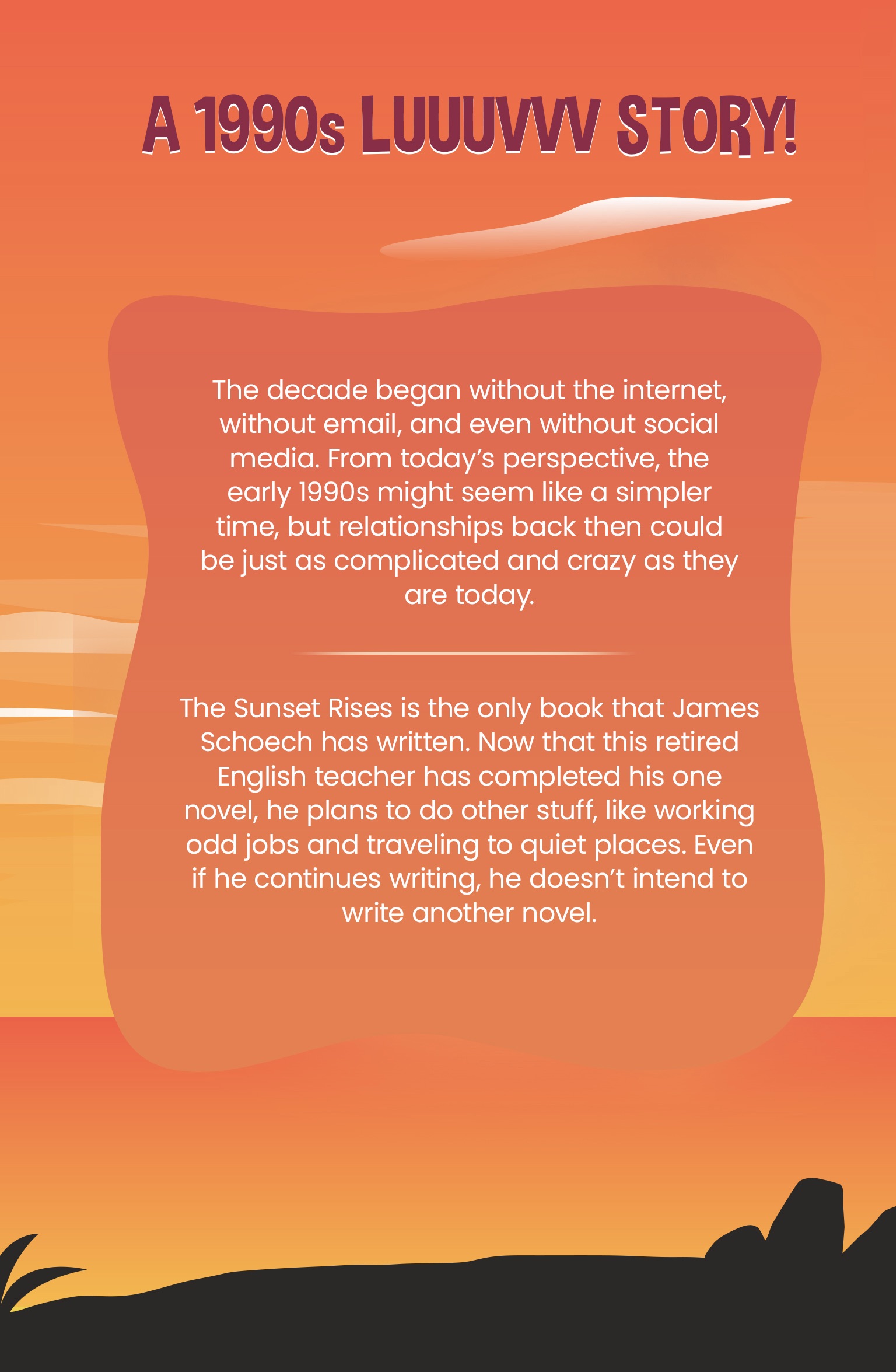
A grammar-obsessed English teacher falls in ‘luuuvvv’ but discovers how chaotic and dangerous ‘luuuvvv’ can be.
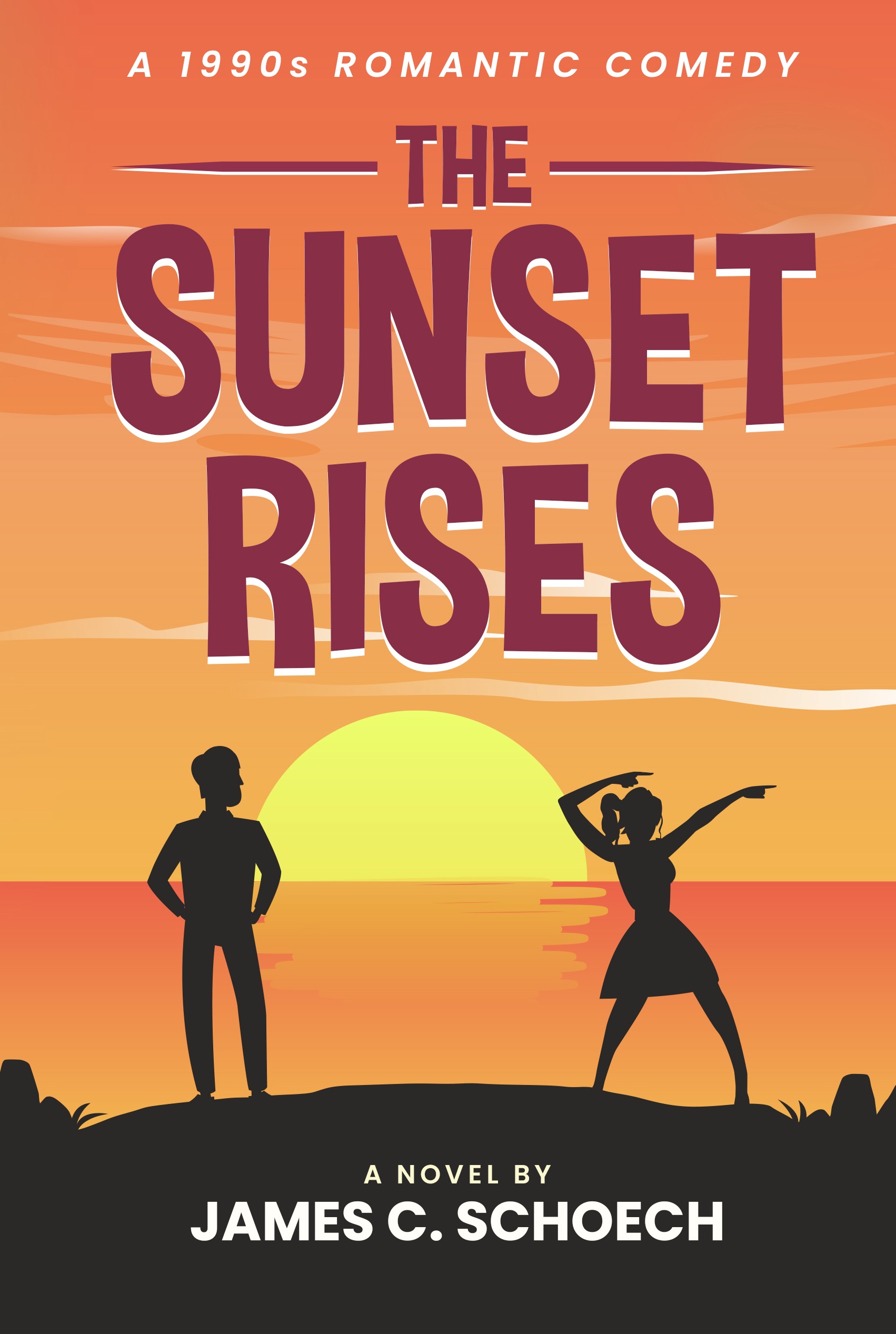
The Sunset Rises: A 1990s Romantic Comedy
Get a signed copy of my one and only novel, The Sunset Rises: A 1990s Romantic Comedy! My handwriting is actually legible too. Postage included in the United States.
$20.00
Or you can buy a copy here on Amazon!
Not sure? Read a sample chapter of The Sunset Rises: A 1990s Romantic Comedy.
I’ve gotten a little feedback about my novel The Sunset Rises: A 1990s Romantic Comedy.
THE SHORT VERSION-
Male feedback: Men seem to read it quickly (usually within a week) and have made positive comments without me initiating any conversations.
Female feedback: Almost nothing.
THE LONG VERSION-
A few months ago I self-published my one and only novel The Sunset Rises: A 1990s Romantic Comedy, and the sales were pretty much what I thought they would be. A few people have bought physical copies on Amazon. A few people have bought the Kindle version. I can’t tell how many people have read The Sunset Rises on Kindle Unlimited, but it looks like either a few people read the whole thing or a bunch of people started it and quit (or it’s something in between).
More people have bought the book from me from the trunk of my car. All ‘the trunk of my car’ means is that I keep a few books in my car so that when an extrovert friend talks about my book, I have a copy to sell/give away (I’ll explain more in another blog post). That’s where I’ve gotten most of my feedback.
Several men have finished the book, and they finished it quickly. I can tell because they talk to me (or my extrovert friend) about what happened in the book, including what happened at the end. They were surprised by a couple turns. They mentioned some stuff they liked about the ending. The feedback has been positive, and I can tell they’ve read the book.
Women, on the other hand, have told me and my extrovert friend almost nothing. I don’t know what ‘almost nothing’ as feedback means. It might mean that female readers don’t like the book but don’t want to tell me. It might mean that they haven’t read the book yet. It might mean that they just haven’t told me their reactions yet.
I know, I know: it’s not really my business what anybody thinks of my novel. I’m just noticing a pattern. It might not mean anything. And the sample size might be too small for me to make any conclusions.
Anyway, some authors say it’s counterproductive to think too much about feedback, but I think I’m allowed to be interested in the responses to my writing and that it’s okay to have questions about it (or the lack of it), especially on my own blog.
On the other hand, I’m notorious for not finishing books that I start reading, so I don’t expect anybody who’s not into my book to finish reading it. That leaves me torn. It’s none of my business, but I’m still wondering:
Why do men seem to like The Sunset Rises: A 1990s Romantic Comedy than women do?
****
A grammar-obsessed English teacher falls in ‘luuuvvv’ but discovers how chaotic and dangerous ‘luuuvvv’ can be.
The Sunset Rises: A 1990s Romantic Comedy
Get a signed copy of my one and only novel, The Sunset Rises: A 1990s Romantic Comedy! My handwriting is actually legible too. Postage included in the United States.
$20.00
Or you can buy a copy here on Amazon!
Not sure? Read a sample chapter of The Sunset Rises: A 1990s Romantic Comedy.
There are a bunch of books that I’d theoretically like to read, but I just don’t have the time. I’m 58 years old, and this might sound morbid, but I don’t know how much time I have left. I could have another 30 years of reading. Or I could have five minutes. I don’t know. I might not want to know ahead of time either (but that’s for another blog post).
It’s a little risky writing about books that I know I’ll never read when I have my own book The Sunset Rises: A 1990s Romantic Comedy that most people don’t have the time (or money or inclination) to read. Even so, I must continue.
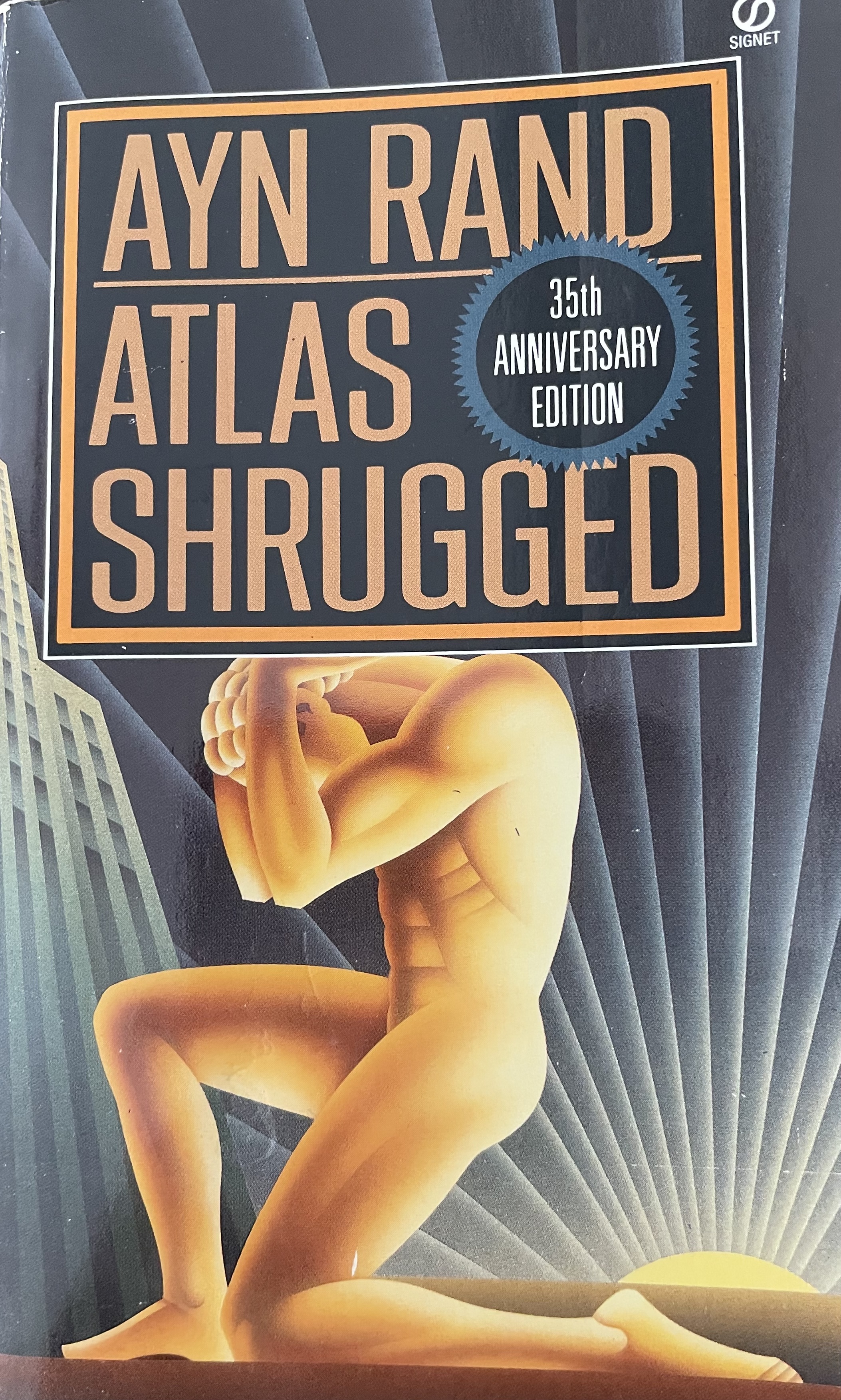
5 BOOKS THAT I MIGHT NEVER HAVE TIME TO READ
- Texas by James Michener

I’d like to read Texas by James Michener because I live in Texas. James Michener has written a lot of books, and they’re supposed to be great, but most of them are really, really long. For such long books, they have simple titles.
Texas.
Hawaii.
Chesapeake.
Alaska.
Poland.
Space.
The Novel
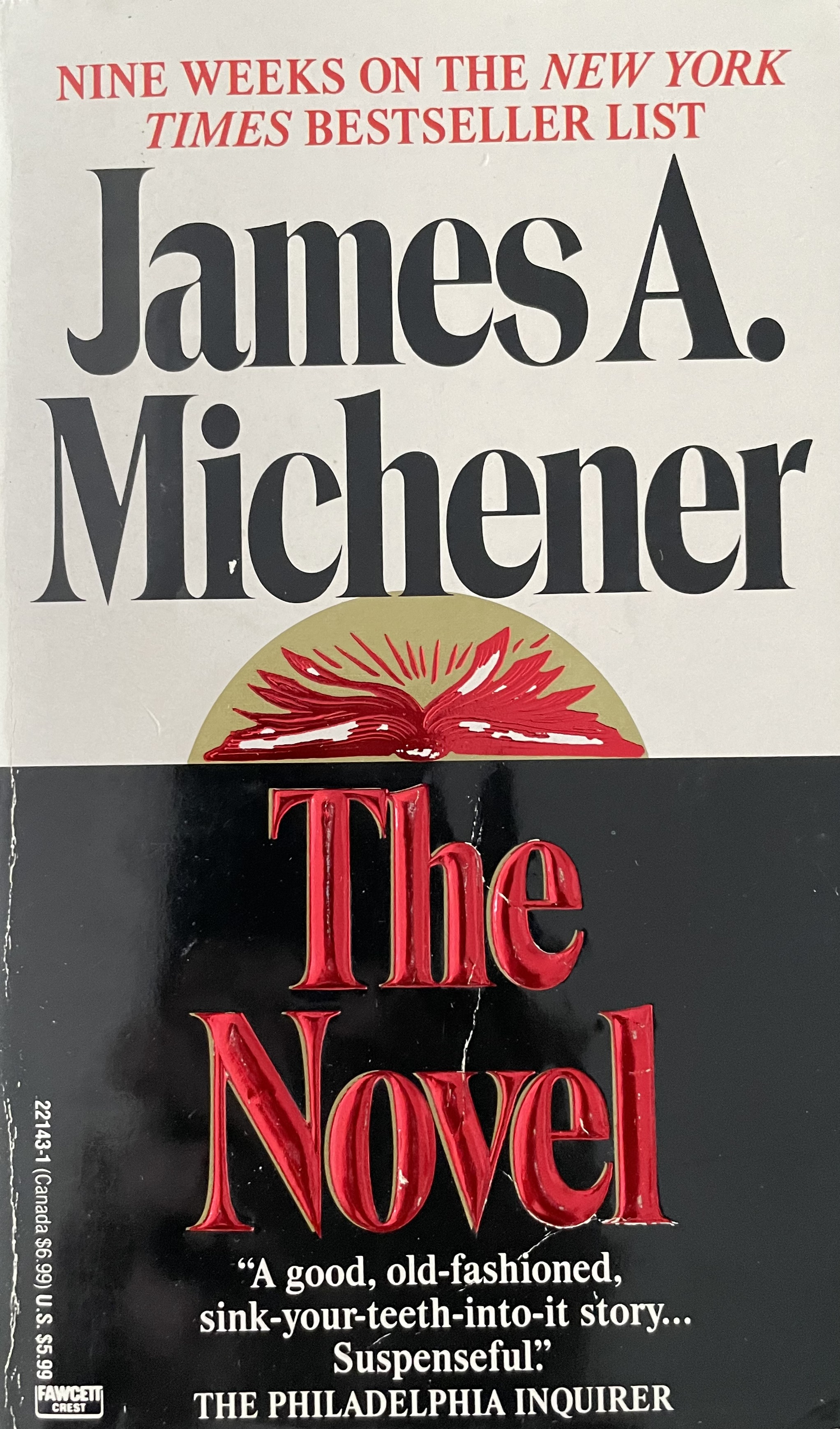
There are too many James Michener books for me to read all of them, but if I get to any of them, it will probably be Texas. But I’ll probably never get to it.
2. The Man in Rome series by Colleen McCullough

Here is another book that is around 1,000 pages long. I don’t mind 1,000 page books because if it’s good, you really get your money’s worth, but in this case The First Man in Rome is the first book in a six(?) book series of other 1,000 page books. Even if I finish The First Man in Rome, I have five more books to read. It’s almost like reading A Game of Thrones, except The First Man in Rome books are already done and I don’t think the author ever resented her fans. I’m not sure I can commit to six 1,000 page books, though.
I think I’ll just watch Rome again.
3. War and Peace by Leo Tolstoy

I’d like to read War and Peace by Leo Tolstoy. Even better, I’d like to be able to say with pride that I’ve read War and Peace. But it’s not going to happen. I’ve tried. I can’t keep up with the Russian names. The Russian names give me a headache. I could never live in Russia. It wouldn’t be the cold or the rampant alcoholism or the tyrannical government that would bother me. It would be the long Russian names. Plus, I don’t speak Russian. And I probably don’t have time to learn it.
4. Noble House by James Clavell
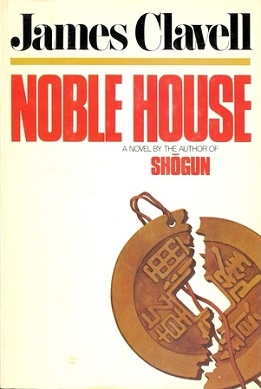
I started reading Noble House in my junior year in high school but had to stop because my English teacher assigned us a bunch of novels to read. I said that I’d come back to Noble House later, but I never did. I think I got hooked on a bunch of Stephen King books at the end of my junior year. In eighth grade I had read Shogun by James Clavell (right before the television miniseries was broadcast), so all of my ill-read classmates were impressed with the size of the novel and that I had read it before the movie.
Yeah, reading Shogun improved my nerd status. Plus, it was a good book.
5. Any Stephen King book written after 1990
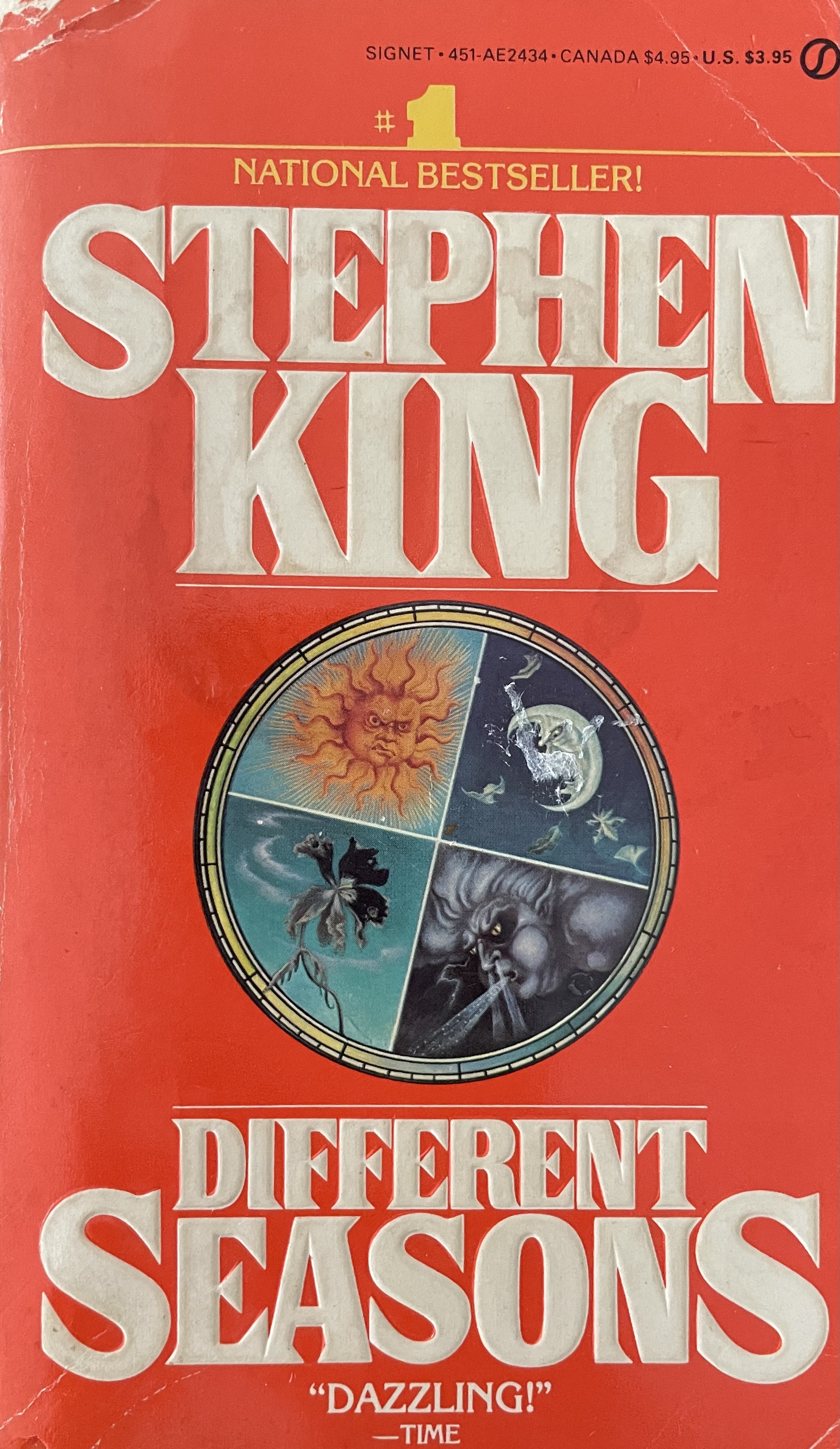
The good thing about Stephen King is that once you’ve read a few of his early books, you’ve read most of all of his books. That’s not an insult. Those three or four books he keeps writing are pretty good books. And now there are no Stephen King books that I want to read because I’ve already read a bunch of them.
Once every five years I pick up a new/recent Stephen King book and then after a few pages stop because I’ve read it before (but that’s not quite the same thing as not having time to read it).
BONUS!!!- Every James Patterson book.

I have no desire to read any individual James Patterson book. I’m sure that out of the hundreds of books his name is attached to, one or two of them have to be good. I just think it would be a great accomplishment to have read every single James Patterson book in existence. But that’s not going to be me.
I’m sure there are more books that I won’t have time to read. Basically, it’s every book in existence that I haven’t read by the time I… you know. But these are the first books that come to mind when I think of books that I’m pretty sure I’m never going to get to.
But enough about me! What books are you kind of interested in but know you won’t read?
*****
A grammar-obsessed English teacher falls in ‘luuuvvv’ but discovers how chaotic and dangerous ‘luuuvvv’ can be.
The Sunset Rises: A 1990s Romantic Comedy
Get a signed copy of my one and only novel The Sunset Rises: A 1990s Romantic Comedy. My handwriting is actually legible, but I’m left-handed, so I might smudge the signature. Free shipping in the United States!
$20.00
Or you can buy a copy here on Amazon!
Not sure? Read a sample chapter of The Sunset Rises: A 1990s Romantic Comedy.

I can’t believe I just read a book about the board game Monopoly.
The book is called The Monopolists: Obsession, Fury, and the Scandal Behind the World’s Favorite Board Game by Mary Pilon, and yes, the subtitle is a little long and maybe obnoxious, but it’s only 11 words, and I’ve seen subtitles that are way worse than this, so I was able to overlook it.
I don’t even know why I pulled The Monopolists off the library shelf. I think I thought The Monopolists was a cool title, and the print for the subtitle was so small on the side of the book that I didn’t notice it until I had already started flipping through the book. Once I noticed the subtitle, it was too late; I was already interested in the book.
Despite the subtitle, I actually finished reading The Monopolists. I didn’t get bored. When I had to stop reading for various reasons, I looked forward to reading it again. That’s my book review.

As I mentioned earlier, I can’t believe I just read a book about Monopoly. I’ve never been a fan of board games, and, to me, Monopoly was the worst. It took too long, and all that money was fake. I played Risk because it dealt with world conquest. Conquer the world, and you can crush the monopolists and take their women (of course, I would have treated them respectfully).
Anyway, reading about Monopoly and the history of board games is more interesting than actually playing board games. I never understood sitting around a table for hours playing a board game. I also never understood killing somebody over a game of cards. I could understand killing a guy if you were drunk and the other guy had cheated you out of a bunch of money by cheating at cards, but you solved that problem by not getting drunk and not playing cards in the first place.
But there was no internet back when people got drunk and killed each other over card games. And there was no cable television. Or television at all. Or radio. There were books, but most books back then were boring, so if you were lucky enough to have leisure time, then you might get bored pretty easily (unless you liked to go outside and write poetry).
Anyway, people played cards and board games because they didn’t have many other choices. And some people would rather get killed over a card game than be bored.

I understand that; I’d rather get killed over a card game than play Monopoly. Uuuuuhhh, maybe not, but I’d think about it for a moment.
Cheating at cards is bad, but the worst cheaters are those who cheat at Monopoly. I can understand cheating in a marriage (I’m kidding!) or cheating in an election. (I’m still kidding!) or cheating the IRS (I’m really, really kidding!!!) because they’re some positive rewards (supposedly… and I’m still kidding). But cheating at Monopoly has no real benefits (unless you’re the one who cheated at ‘creating’ Monopoly).
Plus, I’d feel pretty stupid if I killed a guy for cheating at Monopoly and then realized the money he had cheated me out of was fake after I sobered up. Yeah, the guy was cheating, but still… I’m not sure if even the state of Texas would let me get away with that.
Florida might let me get away with that, but I’m not sure it’s worth the risk.
*****
My ONE novel The Sunset Rises: A 1990s Romantic Comedy has a subtitle with only four words in it.
You can read a sample chapter here at The Sunset Rises: A 1990s Romantic Comedy (sample chapter).
You can get a copy or an ebook version here on Amazon!
Or you can get a signed copy from me! I might even write a personal note and pretend that I know you!
The Sunset Rises: A 1990s Romantic Comedy
Get a signed copy of my one and only novel, The Sunset Rises: A 1990s Romantic Comedy. The price includes USPS media rate shipping in a sturdy box. My signature is legible, but I’m left-handed, so I might smudge it sometimes. I usually mail out the book within two business days of payment.
$20.00

What’s the deal with having to read certain books before you die? When I found 1,000 Books To Read Before You Die: A Life-Changing List by James Mustich (whoever he is) at the library, my first reaction was “This again?”
I immediately thought of a library book I had found a few years ago called 1001 Books You Must Read Before You Die by Dr. Peter Boxall (whoever he is); I even wrote a blog post about it called 1000 You MUST Read Before You Die… Yeah, I’m not going to make it .

I admit that bringing death into the equation gives reading a sense of urgency. When I think about my mortality too much, I wonder if reading for the sake of reading would be wasting my time. I like a healthy balance of reading/writing/experiencing. I’m not sure what that balance is, but reading all 1000 of the books in each of these books would probably make me hate reading.
I’ve always thought that there are NO BOOKS that everybody must read before he or she dies. If I ever put together a book recommendation list, I’ll give it some bland title like 1000 Books That I Actually Liked Enough To Finish.
Even though I’m not going to read most of the books listed in 1,000 Books To Read Before You Die: A Life-Changing List, I’m interested in knowing about them. So maybe a better title for the less ambitious reader would be 1,000 Books That Are Worth Knowing About (even if you don’t ever read them).
My book title wouldn’t set the reader up for failure. Plus, it wouldn’t remind the reader about his or her mortality.
James Mustich’s book suggests that everybody should read Ulysses by James Joyce. To me, suggesting Ulysses disqualifies an expert from making any more recommendations. Ulysses MIGHT be a great book for some people, a very few people, but it’s not for everybody. It has too much insider knowledge that isn’t explained.
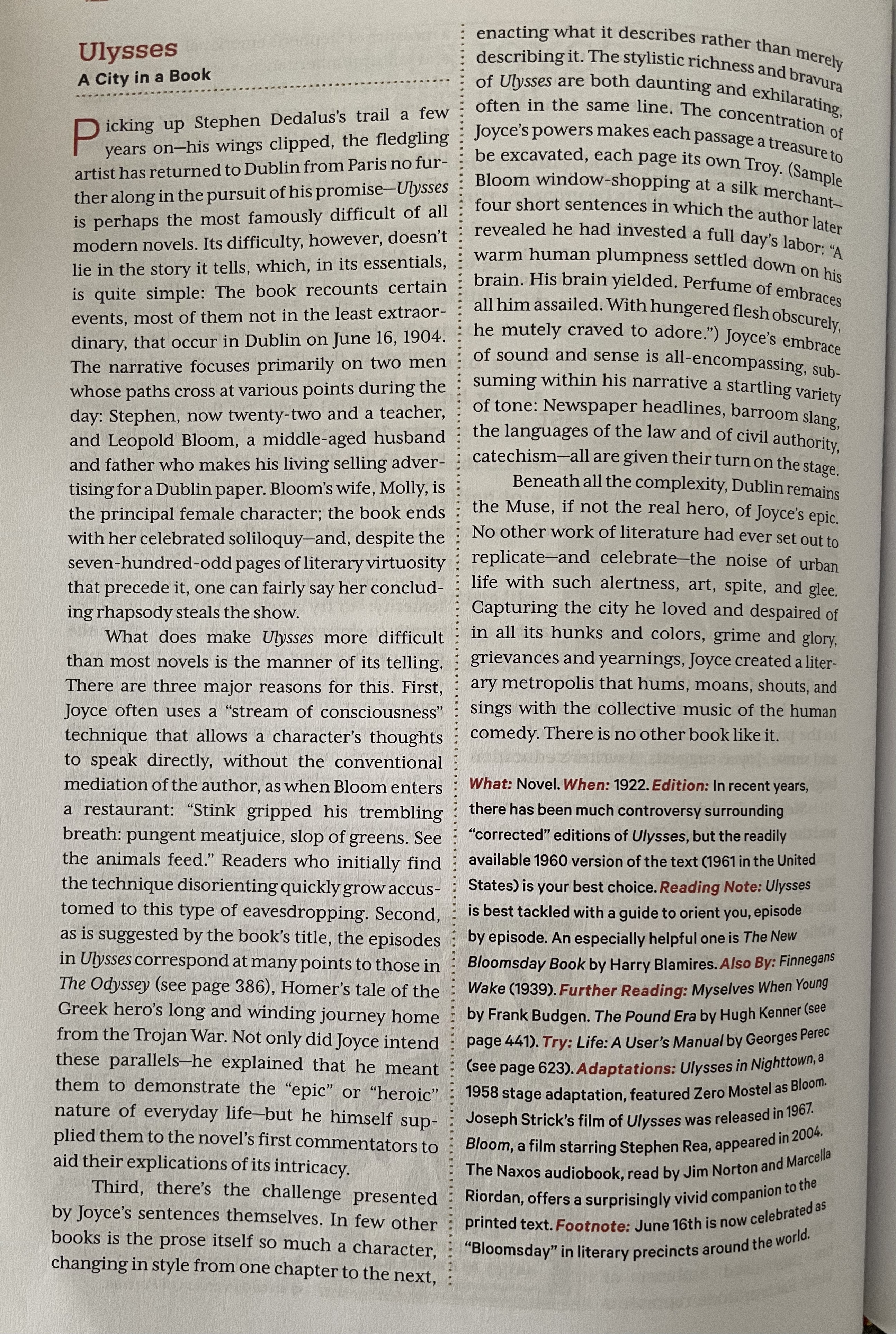
So maybe Ulysses is great if you understand the references, but most people don’t have time to keep researching terms and references. James Mustich suggests reading a guide while you read Ulysses. I suggest just reading about Ulysses instead of reading Ulysses.
James Mustich also putThe Book of Common Prayer on his must-read list. Don’t get me wrong. I have three copies of The Book of Common Prayer. It’s not because I read it a lot (though I do occasionally). My family went to an Episcopalian church when I was a kid, and when I was confirmed I was given this book by several different people and each one has a personal note inside. That’s why I keep several copies of The Book of Common Prayer. I might not suggest it for everybody though.

I do suggest reading The Sermon on the Mount by Jesus. This speech is the foundation of what Christianity is supposed to be, yet I rarely hear it talked about.
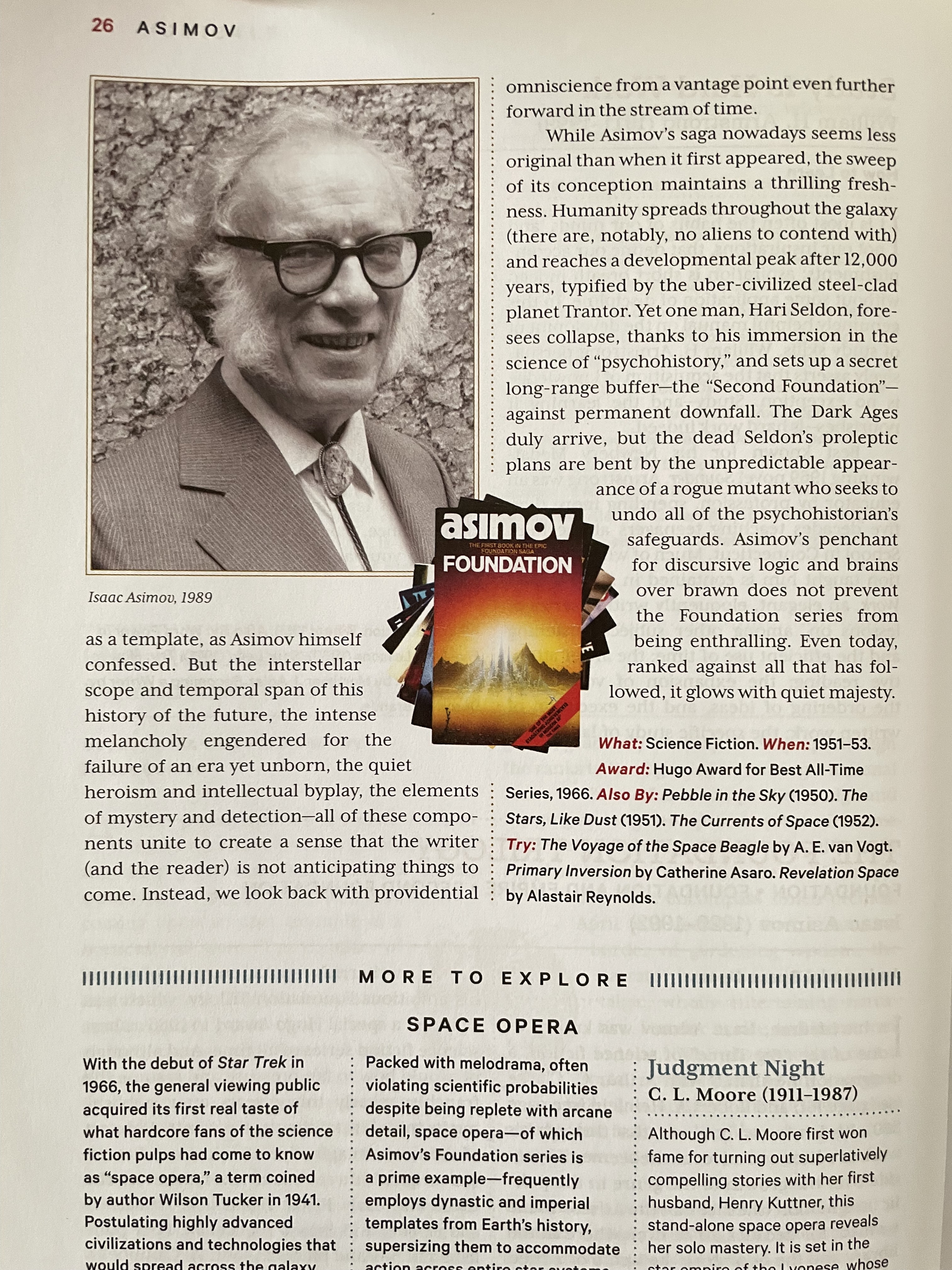
Another recommendation that I’m familiar with is The Foundation Trilogy by Isaac Asimov. I like The Foundation Trilogy, but it’s a little tedious (and it’s a trilogy), so I’d recommend I Robot instead. It’s way shorter but just as relevant. with its depiction of the progression of artificial thought.
Sometimes I’m not sure how much I can trust experts, so when I can, I judge them on the topics that I know a lot about. I don’t know about all 1,000 of Mustich’s book recommendations, but I can tell from the books that I’m familiar with that we don’t have the same taste or perspectives.
I think the next time I look for book recommendations, I might choose somebody who writes a shorter list and who doesn’t mention death.
******
What are some books that you think everybody must read before he or she… you know?
******
Here’s a book you DON’T have to read before you die, but you might like/appreciate it.
The Sunset Rises: A 1990s Romantic Comedy
Get a signed copy of my one and only novel, The Sunset Rises: A 1990s Romantic Comedy. The price includes USPS media rate shipping in a sturdy box. My signature is legible, but I’m left-handed, so I might smudge it sometimes. I usually mail out the book within two business days of payment.
$20.00
Or you can read The Sunset Rises: A 1990s Romantic Comedy (sample chapter) here!

I get this question occasionally when I’m selling copies of my book The Sunset Rises: A 1990s Romantic Comedy from the trunk of my car: Why did you write a romantic comedy when you don’t read romantic comedy novels and you don’t watch romantic comedy movies?
It’s a fair question. And I guess my answer is pretty good because the ‘trunk of my car’ sales of The Sunset Rises have been decent.
Short Version: Because nobody would have read my memoir.
Long version: For about 35 years, one of my few goals in life was to write a novel. Just one novel. During my 30 years of teaching, I wrote several rough drafts of different ideas, but I never could quite get a finished story that I was satisfied with.

After I retired from teaching, I started writing a memoir that bounced between childhood memories and war stories from my teaching years. I was really happy with the quality of my writing, but one day I realized that nobody would ever read my book.
It was kind of a jarring thought: Why would anybody read my memoir?
To most people, I would just be another retired English teacher who had an unfulfilled dream of being a writer. There was almost no point in pouring so many personal thoughts and experiences and emotions into a memoir that nobody would read. Plus, my memoir wasn’t even a novel. Finishing my memoir wouldn’t have even been fulfilling my writing goal. What a waste!
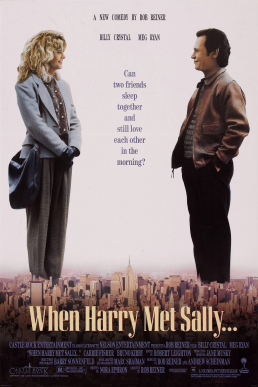
But I also liked some of the elements in my memoir.
At the time, I had just finished up a blog serial called “Awkward Moments in Dating,” where I (usually) embellished some stuff that had happened to me back in the late 1980s and early 1990s. Even though the views on these stories were hit and miss (as the views are hit and miss with most of my blog posts), I believed most of these blog episodes were engaging .
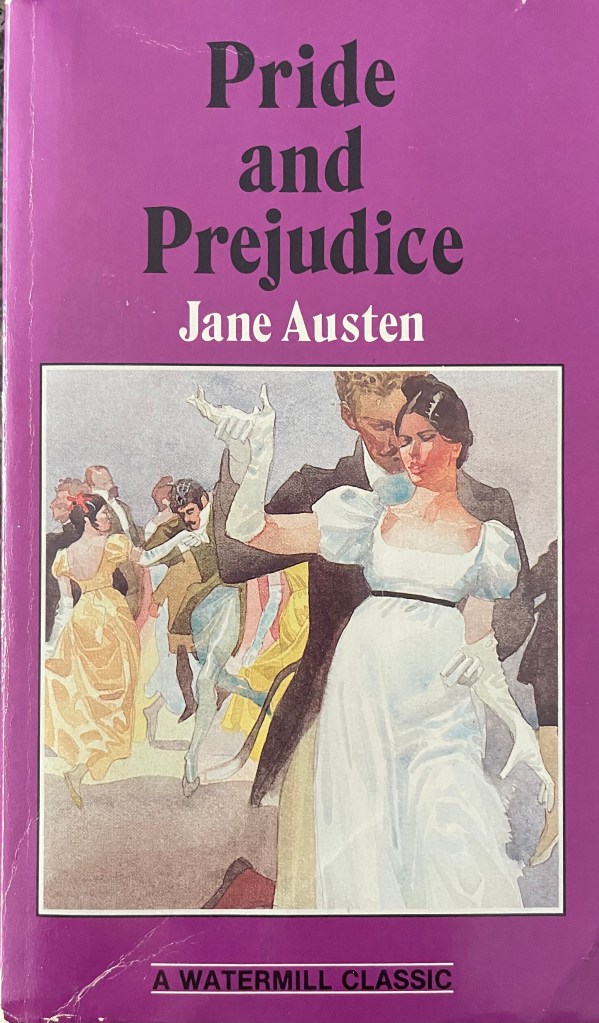
“Awkward Moments in Dating” didn’t get this blog a lot of hits, but it got a high percentage of binge stats, which tells me that the few readers who find an episode will read through several of them and finish the entire story. That in turn tells me that the readability of those blog posts is high (as opposed to when I diagram sentences written by Charles Dickens or James Joyce).
Then another thought hit me. I could disguise my memoir as a romantic comedy, kind of like how Kurt Vonnegut ‘allegedly’ disguised his ‘memoir’ of his experiences at Dresden as a science fiction novel in Slaughter-House Five.
No, I’m not comparing myself to Kurt Vonnegut.
No, I’m not comparing The Sunset Rises: A 1990s Romantic Comedy to Slaughter-House Five.
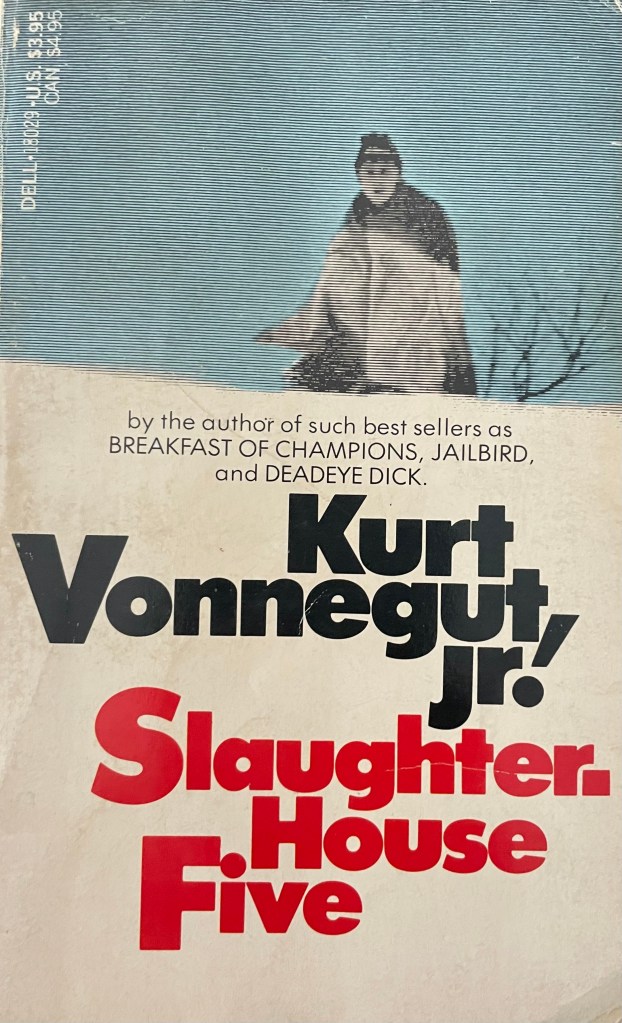
I’m just doing something that Kurt Vonnegut did in a different way. And I’m pretty sure Kurt Vonnegut had read some science fiction before he began writing science fiction novels.
Nothing is guaranteed. Just because I wrote a romantic comedy doesn’t mean anybody will read it. People who know me might read The Sunset Rises: A Romantic Comedy just because they can’t believe I wrote a romantic comedy of all things, and they have to see what I did with it. But that only gets me so far.
The next step is to get people who read romantic comedies to read The Sunset Rises: A 1990s Romantic Comedy when The Sunset Rises: A 1990s Romantic Comedy is different from most romantic comedies (from what I’ve heard about them) in a lot of ways.
Part of that next step is also to get people who DON’T normally read romantic comedies to read The Sunset Rises: A 1990s Romantic Comedy when there’s no way for the readers to know ahead of time that it’s unlike most romantic comedies.
But that’s for another blog post.
*****
I think my short version is the more effective answer.
*****
For those who can’t buy The Sunset Rises: A 1990s Romantic Comedy from the trunk of my car, you can find it here on Amazon!
Or I can send you a signed copy myself!
The Sunset Rises: A 1990s Romantic Comedy
Get a signed copy of my one and only novel, The Sunset Rises: A 1990s Romantic Comedy. The price includes USPS media rate shipping in a sturdy box. My signature is legible, but I’m left-handed, so I might smudge it sometimes. I usually mail out the book within two business days of payment.
$20.00

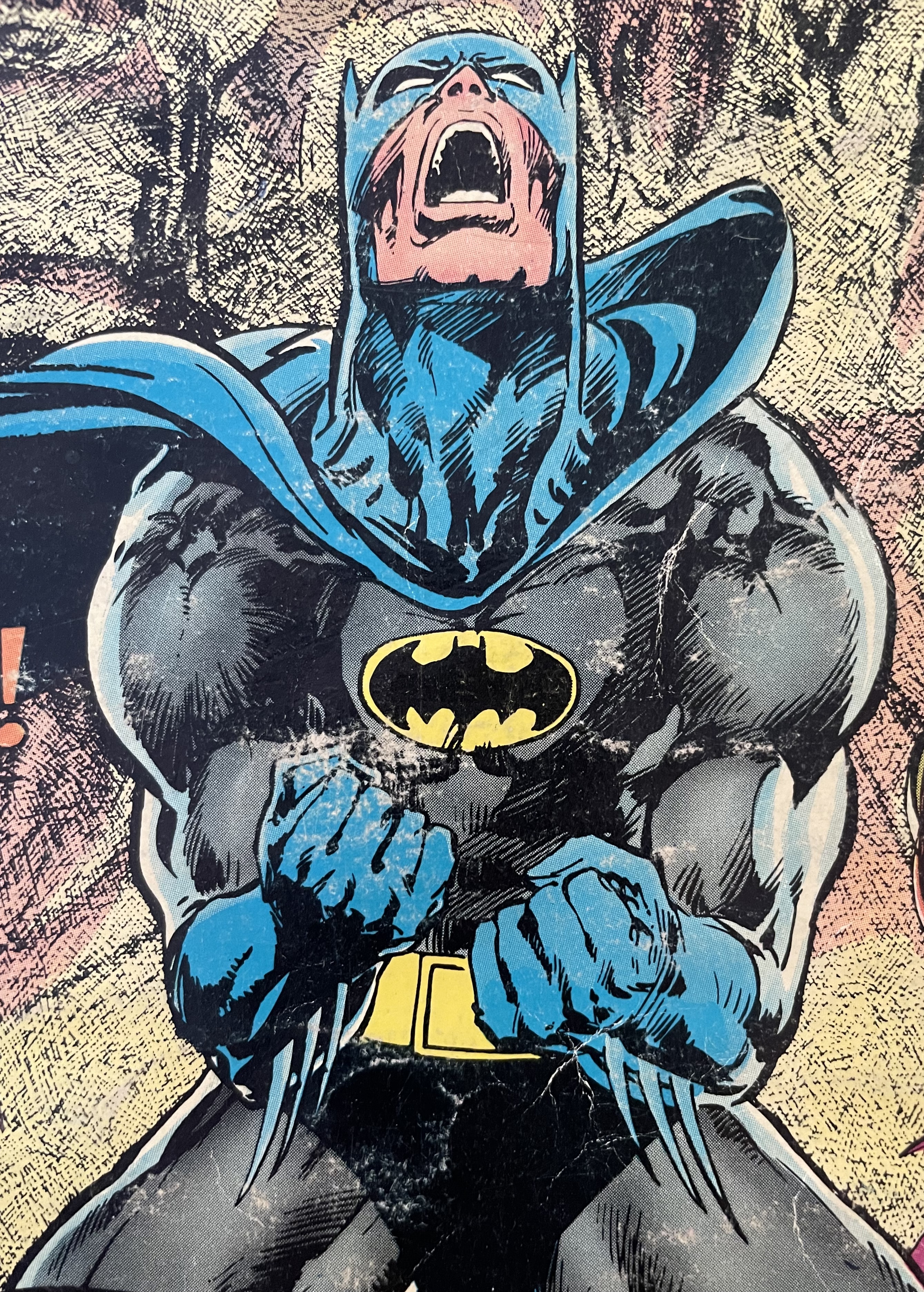
I’m probably too old to be reading superhero comic books. Yeah, I’m at the age now where I enjoy reading about the comics more than I like reading the actual comic books. And for the last couple years, I’ve been fascinated by the creative process (and subsequent conflicts) between Stan Lee and artist Jack Kirby.
Last year I even wrote a blog post called Jack Kirby: The True Creator of the Marvel Universe?. I’m not exactly an expert on the topic, but that’s never stopped me (or anybody else) from having an opinion. Now I’ve found a book about Stan Lee and Jack Kirby called Kirby and Lee: Stuf’ Said written by an actual expert (I think), and the book is AWESOME!!!
****
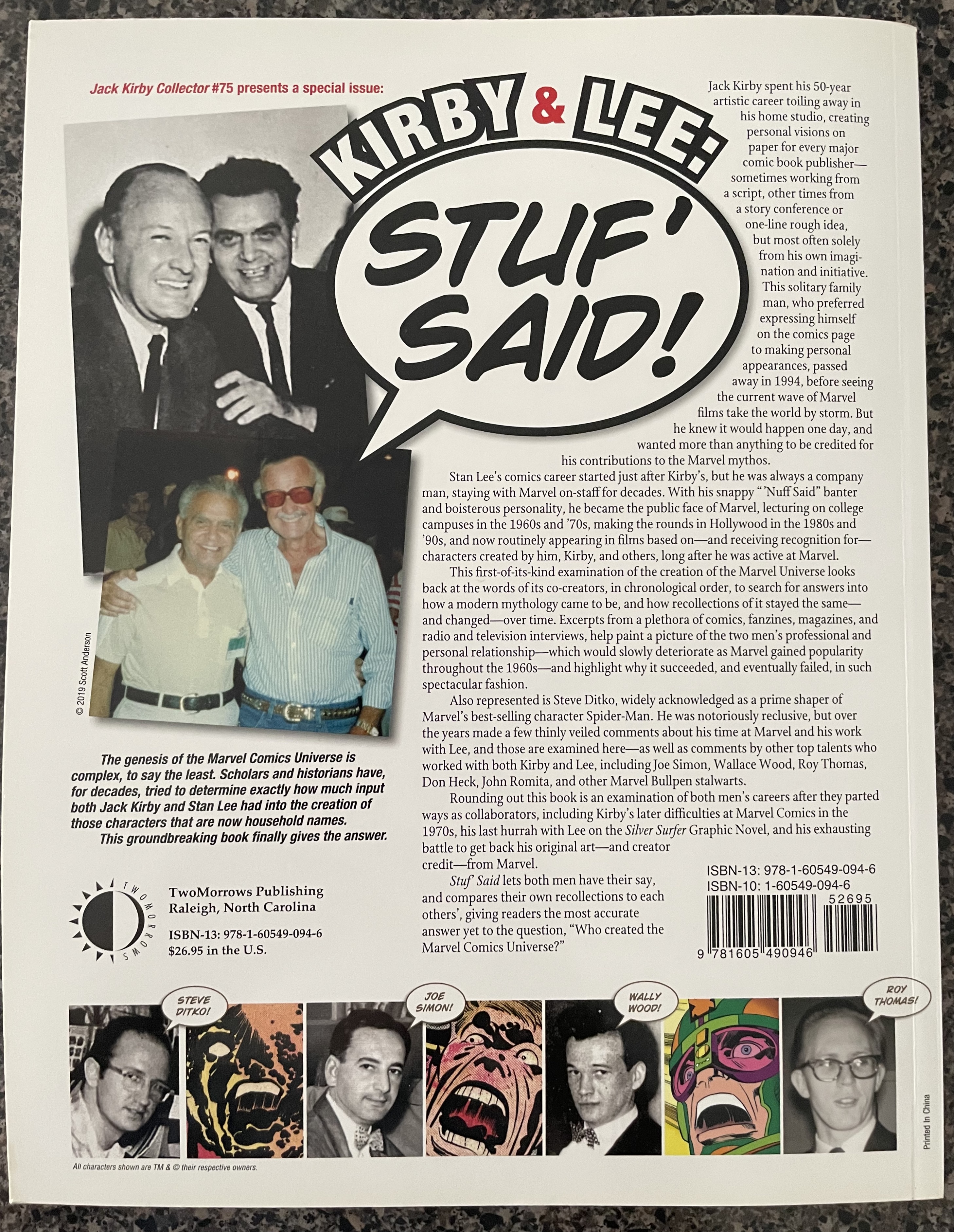
Even if you’re not a Silver Age comic book geek like I am, you might find the format of this book interesting. It’s visually appealing (for the most part) and makes a complicated situation easy to follow. Or maybe the book is easy to follow because I have some background knowledge.
Anyway, I can get long-winded in my blog posts, but this time I might show and not tell for once.
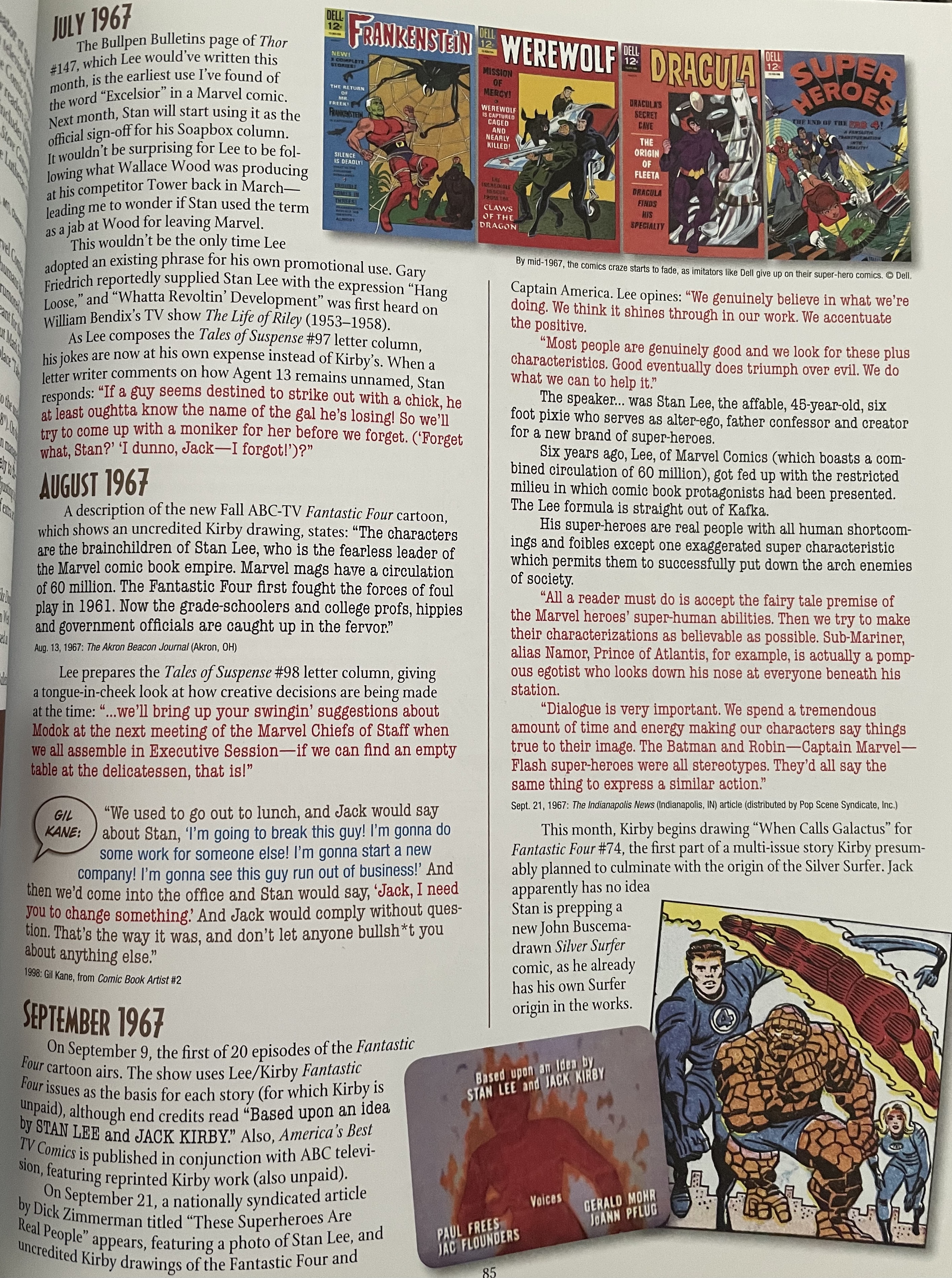
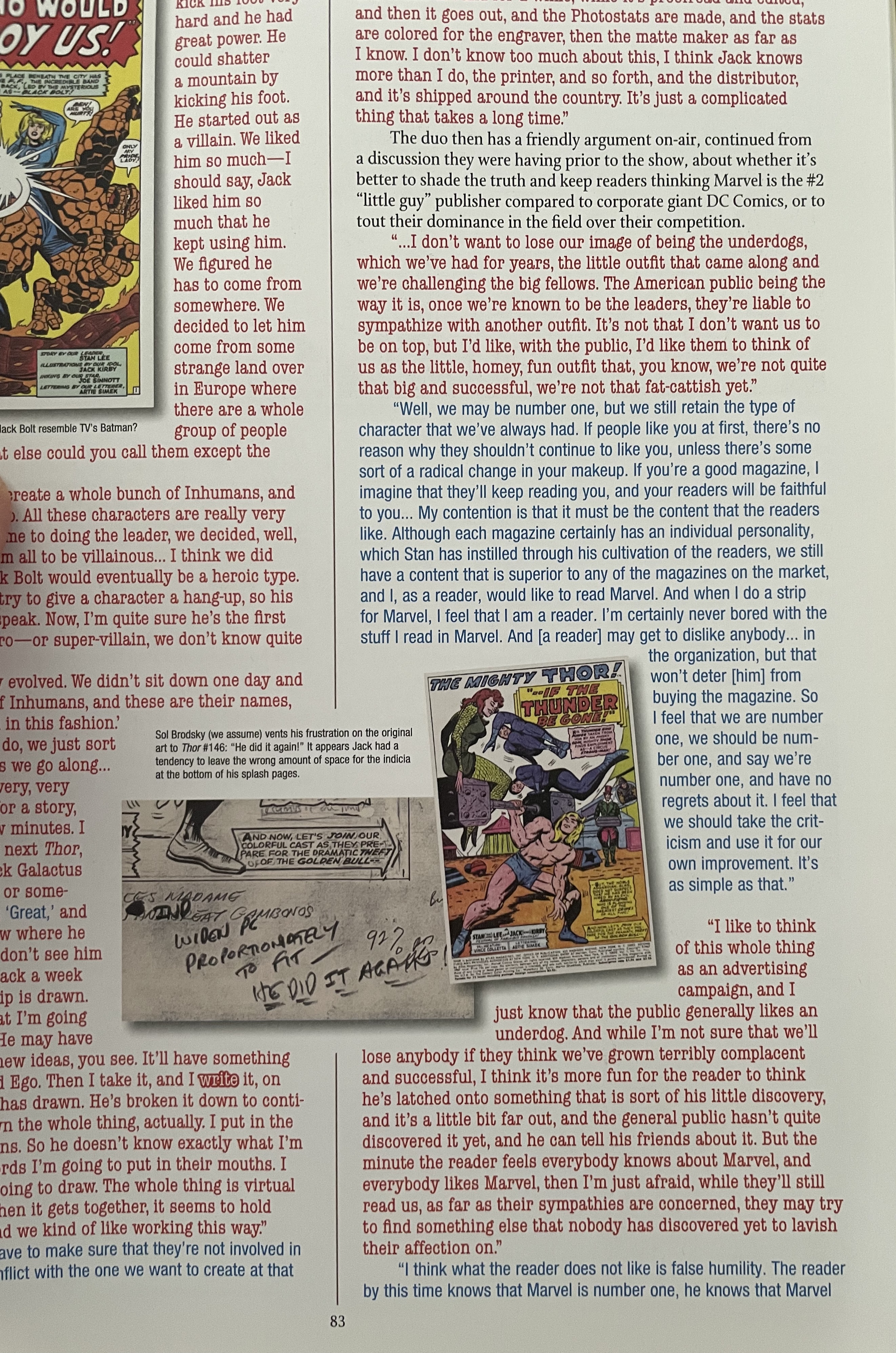
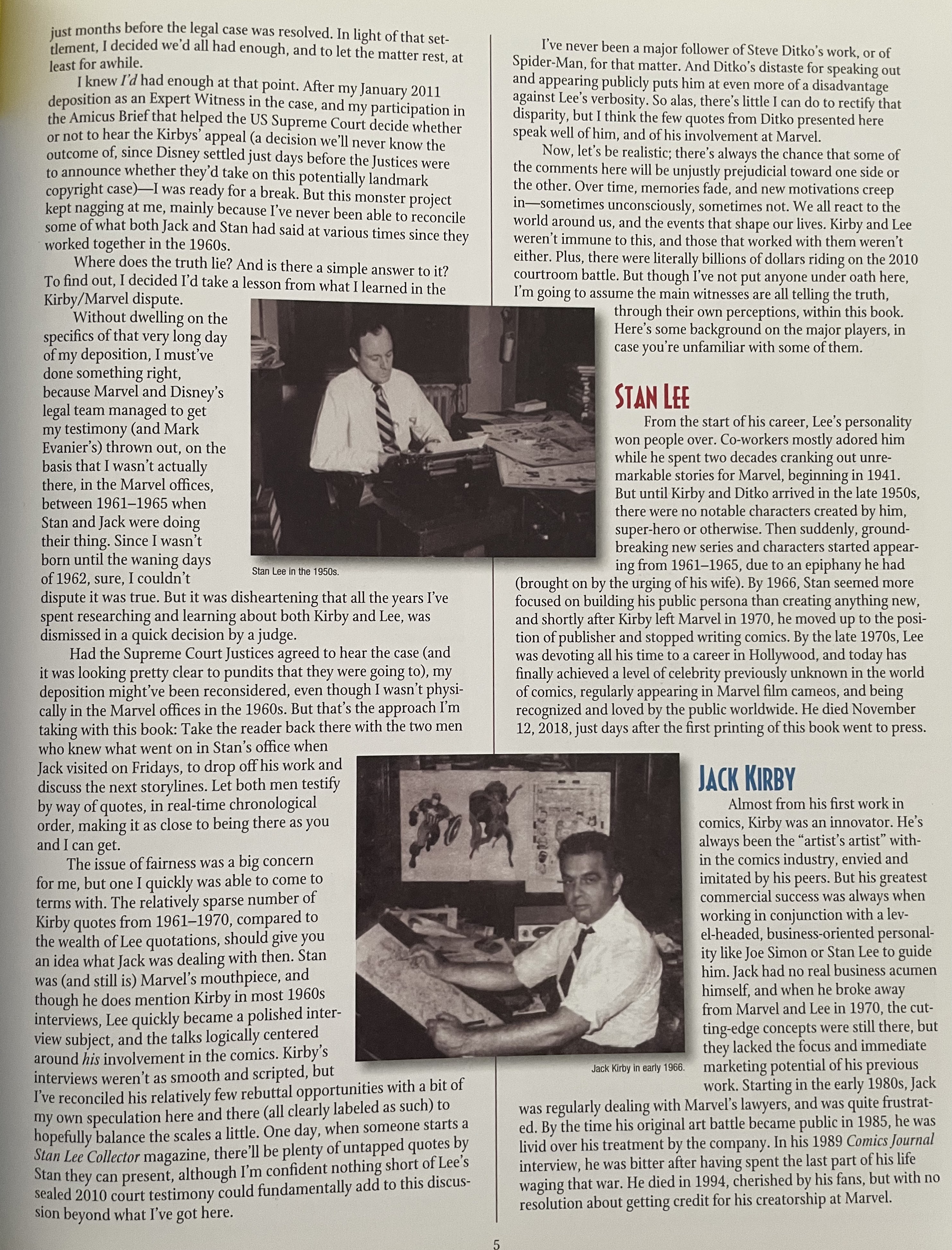
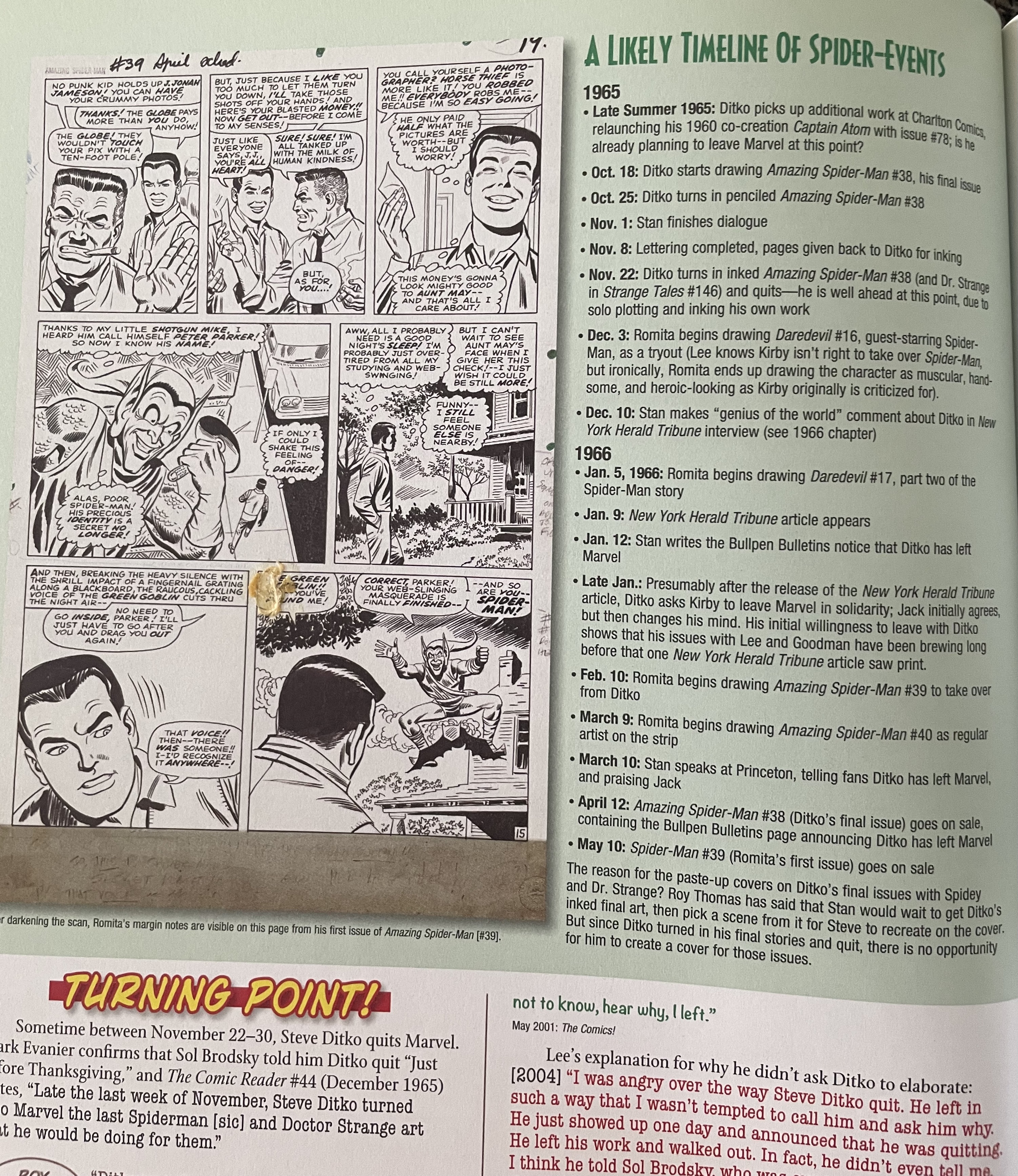

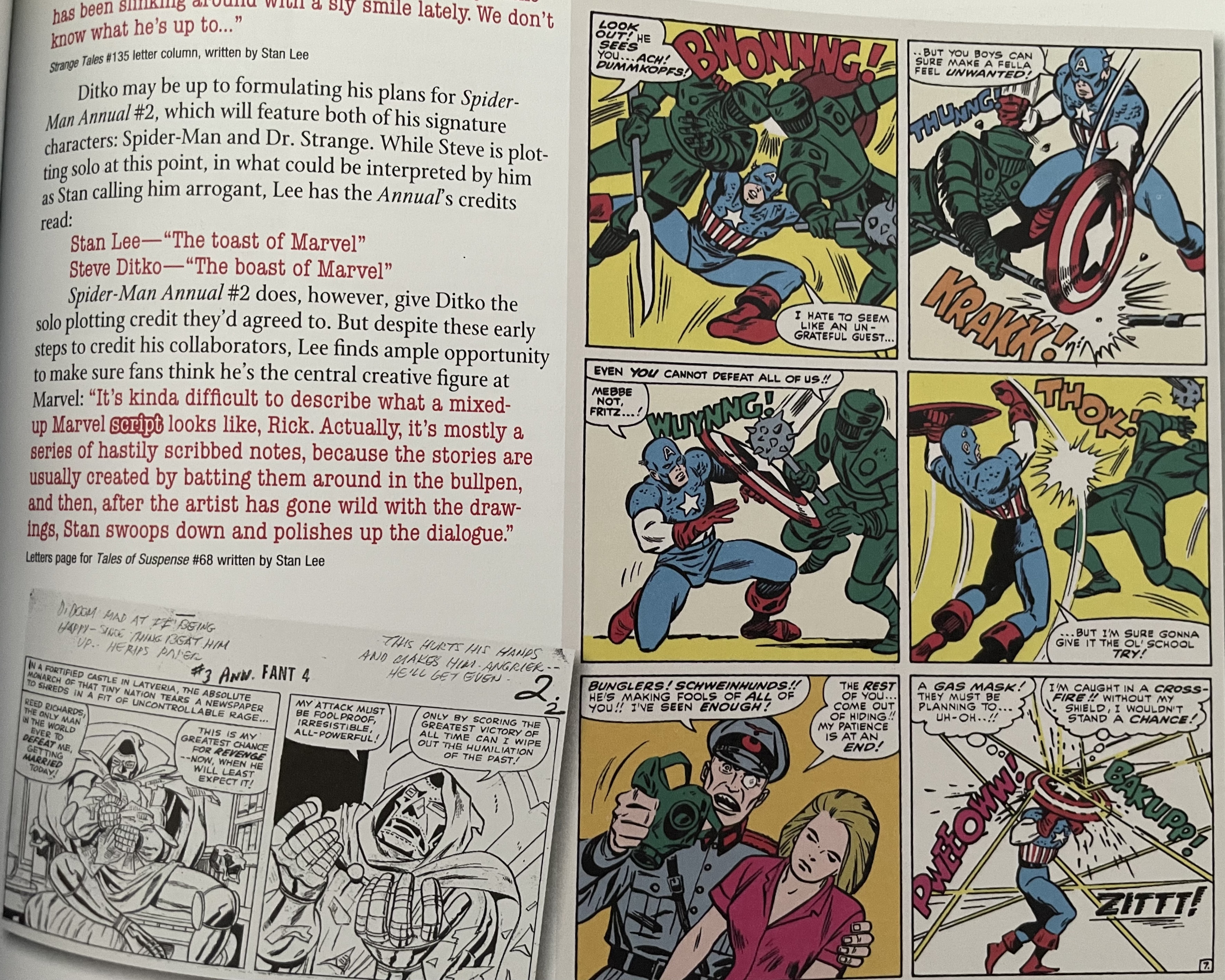
I’m pretty sure the author didn’t make much or any money on this book, especially if you consider the time and research that had to have gone into it. A book like this take passion to put together, but unfortunately, it’s about a topic that isn’t exactly mainstream, despite the high profile that Stan Lee had for a while.
I’ve read this book from beginning to end. And when my mind doesn’t really feel like reading but I want to be entertained for a few minutes, I randomly page through the book and stare at the graphics. Like I said earlier, I might be too old to read super hero comic books, but I’m still entertained when I read about super hero comic books.
*****
Over ten years ago, I wrote about Stan Lee and a Pulitzer Prize winning book that was kind of like reading about super hero comic books. You can tell that at that time I wasn’t really thinking about how much Jack Kirby and other artists like Steve Ditko had contributed. Man, I can’t believe that was over ten years ago.
The Amazing Adventures of Kavalier and Clay by Michael Chabon vs. Excelsior by Stan Lee vs. an Actual Comic Book
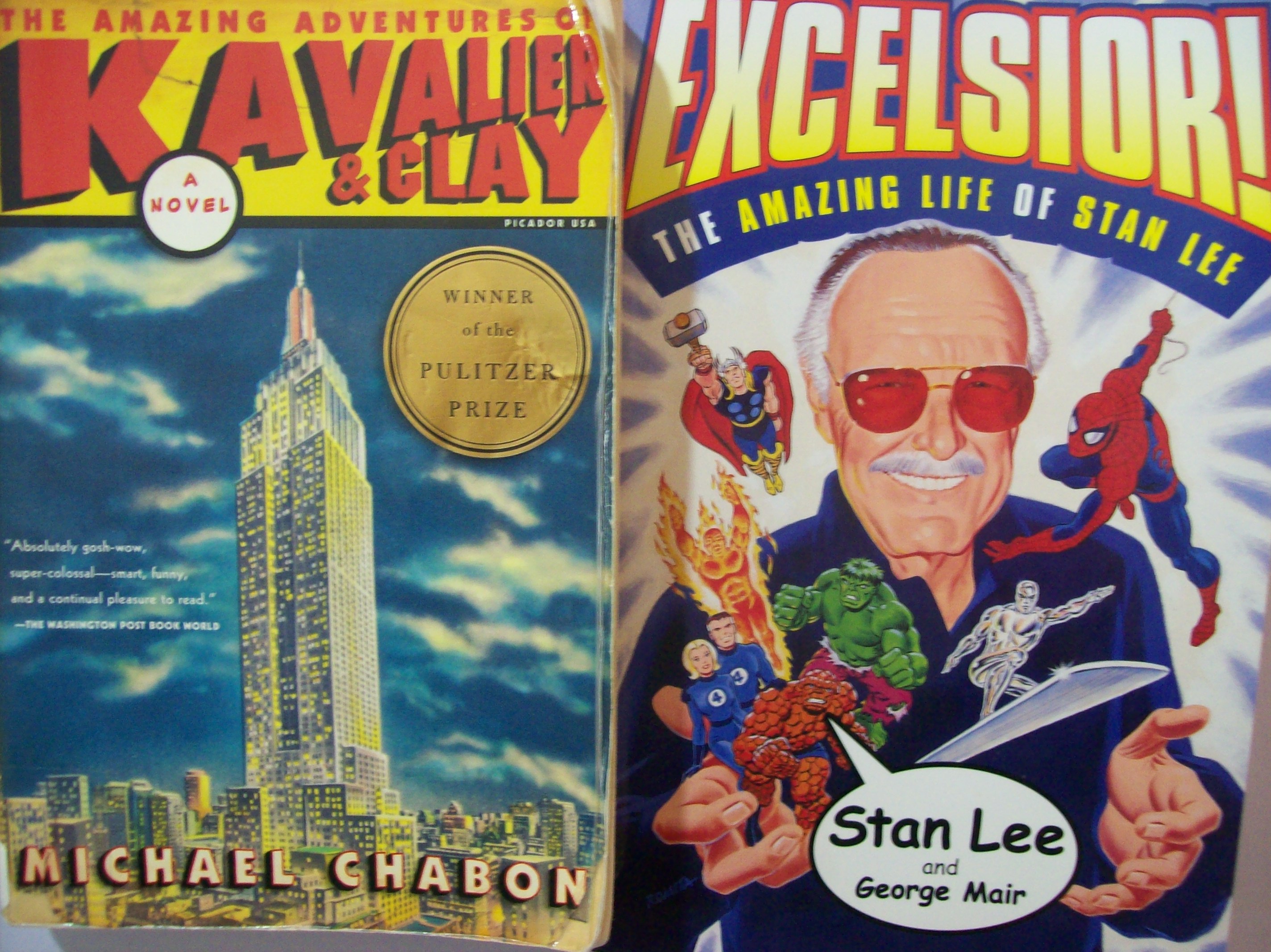
Comic books created by Stan Lee can do many things. A comic book created by Stan Lee can get a boy through a troubled childhood. A comic book created by Stan Lee can get a bunch of kids who hate reading to suddenly become interested in the written word.
But a comic book created by Stan Lee can never win a Pulitzer Prize. And that’s what a novel about comic books The Amazing Adventures of Kavalier and Clay managed to do.
Read more here.
And if you’re reaaally interested in my thoughts about Jack Kirby and Stan Lee, here’s what I wrote last year.
Jack Kirby: Creator of the Marvel Universe?

I used to think of Stan Lee as the creator of Marvel Comics. I admit it. I fell for the cheesy mustache and the “Excelsior!” schtick. Then one day I was looking at a bunch of DC comic books that artist Jack Kirby had created in the 1970s after he’d left Marvel, and I asked myself, why did Stan Lee stop writing comic books after 1970?
Once I saw it, it was pretty simple.
Jack Kirby created a bunch of stuff without Stan Lee.
Stan Lee didn’t create anything without Jack Kirby .
Okay, that’s not quite true. Stan Lee created a few Marvel characters without Jack Kirby, but he always had the help of other artists (like Steve Ditko).
Once Jack Kirby and the other 1960s artists left Marvel Comics, Stan Lee stopped writing/editing and became more of a figure head. Yeah, I know that’s an oversimplification of the situation, but this is a short blog post.
You can finish the blog post here if you’d like, but if you do, you might be a COMIC BOOK NERD!!!

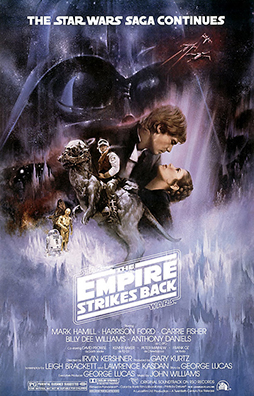
DISCLAIMER: I haven’t seen the movie Dune II. I have, however, read the novel Dune by Frank Herbert (plus the book came out the year that I was born), so I know almost everything that happens in Dune II. I also saw the movie The Empire Strikes Back the day it was released, so that gives me more credibility than the common movie/book critic.
*****
A lot of movie critics and sci-fi geeks are comparing Dune II and The Empire Strikes Back because both movies are high quality sequels in the sci-fi genre, and I’m sure there are some other reasons too. Both Dune and The Empire Strikes Back are are/were movies that are/were supposedly best ‘experienced’ in a theater, and, yeah, I’d love to ‘experience’ a movie like Dune II in a theater, but somebody else in the theater would probably ruin the ‘experience’ for me. If not, then I’d have to go to the bathroom at a bad time (and probably more than once).
The best movie ‘experience’ for me nowadays is hitting pause whenever I feel like it.
We didn’t have the option of ‘experiencing’ The Empire Strikes Back at home when it came out. We had to ‘experience’ it at a theater, a really crowded theater filled with loud, smelly people. Theaters have always kind of sucked, but we put up with the other loud, smelly people back then because we had to. Now we don’t have to.
If the loud, smelly people stayed home, I might go ‘experience’ movies at the theater more often. But I’d still have to go to the bathroom at a bad time, and I wouldn’t be able to hit pause.
As far as the movies go, Dune II was necessary and expected as a movie. Almost everybody who viewed Dune I knew there was going to be another Dune. On the other hand, The Empire Strikes Back was almost seen as a bonus movie after the original Star Wars. When Star Wars first came out in the late 1970s, it was seen as a stand alone movie. Yes, fans were excited at the prospect of a sequel, but if there hadn’t been a follow up, everyone would have understood (with great disappointment). Star Wars could have been a stand alone movie.
Just like everybody else, I really liked The Empire Strikes Back when it came out. I think I saw it three times. That wasn’t many times compared to other comic book sci-fi geeks at the time, but it’s still more times than I saw most other movies. Maybe I’ll watch Dune II more than once. If not, I’ll probably watch the really good scenes more than once on various video platforms.
You couldn’t watch clips of The Empire Strikes Back on social media or video platforms because they didn’t exist. The idea of smart phones and video platforms would have been seen as science fiction. The technology for such devices was so advanced that it didn’t even exist in the Star Wars universe. How differently would the movies have turned out if all the characters in the Star Wars films had been addicted to their phones?
Could Jedi Knights have had cool lightsaber duels if they all were afflicted with tech-neck?
In Dune II, could Paul have ridden the sand worms if he had kept checking his phone notifications?
Even though both Dune II and The Empire Strikes Back were sequel blockbusters, not everybody was sure how Dune II would perform at the box office. The Empire Strikes Back was pretty much a sure thing. Fans made plans to see the movie multiple times. They would have planned to see it multiple times on the same day, but that would have required planning because lines went out the movie theater doors out onto the sidewalk into the parking lots and sometimes on to the streets (if the theater was big enough to seat that many people).
If you want to see Dune II, you can probably just walk right up to the theater and go in (if the theater still exists when you read this).
If you like Dune II and you can’t wait for the next Dune movie to find out what happens, you can read the next Dune book. If you saw The Empire Strikes Back and wanted to find out what happened next, you were screwed; you were going to have to wait three years for Return of the Jedi. There were other Star Wars books coming out, but none of them covered Return of the Jedi.
At least, if there were books with SPOILERS (they weren’t called SPOILERS in the 1980s), I didn’t know about them. If I remember correctly, the events in The Empire Strikes Back and Return of the Jedi contradicted some stuff that had been published in the books before them, but I don’t remember what those events were (I stopped caring about those things once I got a girlfriend).
The point is that you could only watch The Empire Strikes Back once at a time non-stop. When I watch the Dunes, I’ll probably watch them at home by myself… and hit the pause button whenever I want to.
When I was a kid, reading a book was the only form of entertainment you could do twice. You could go to see a movie once in the theater, and the next weekend it would be gone forever, replaced by another movie. If you missed a television show, you waited six months for a rerun, and then that show was most likely gone forever. There was no cable, no internet, and no smart phones.
But books? If you liked a book, you could read it as many times as you wanted. Sometimes we read a book more than once simply because we could. Or because it was raining outside and the electricity went out, and there was nothing else to do.
But in these modern times, there are other reasons to read a book more than once. Even with so many other forms of entertainment, even when there are so many books out there that it’s impossible to read them all (and I’ve just added to the glut, putting my ONE book The Sunset Rises: A 1990s Romantic Comedy out there), sometimes it’s still better to read a book that you’ve already read before.
FIVE REASONS TO READ A BOOK MORE THAN ONCE
1. You need a sure thing.
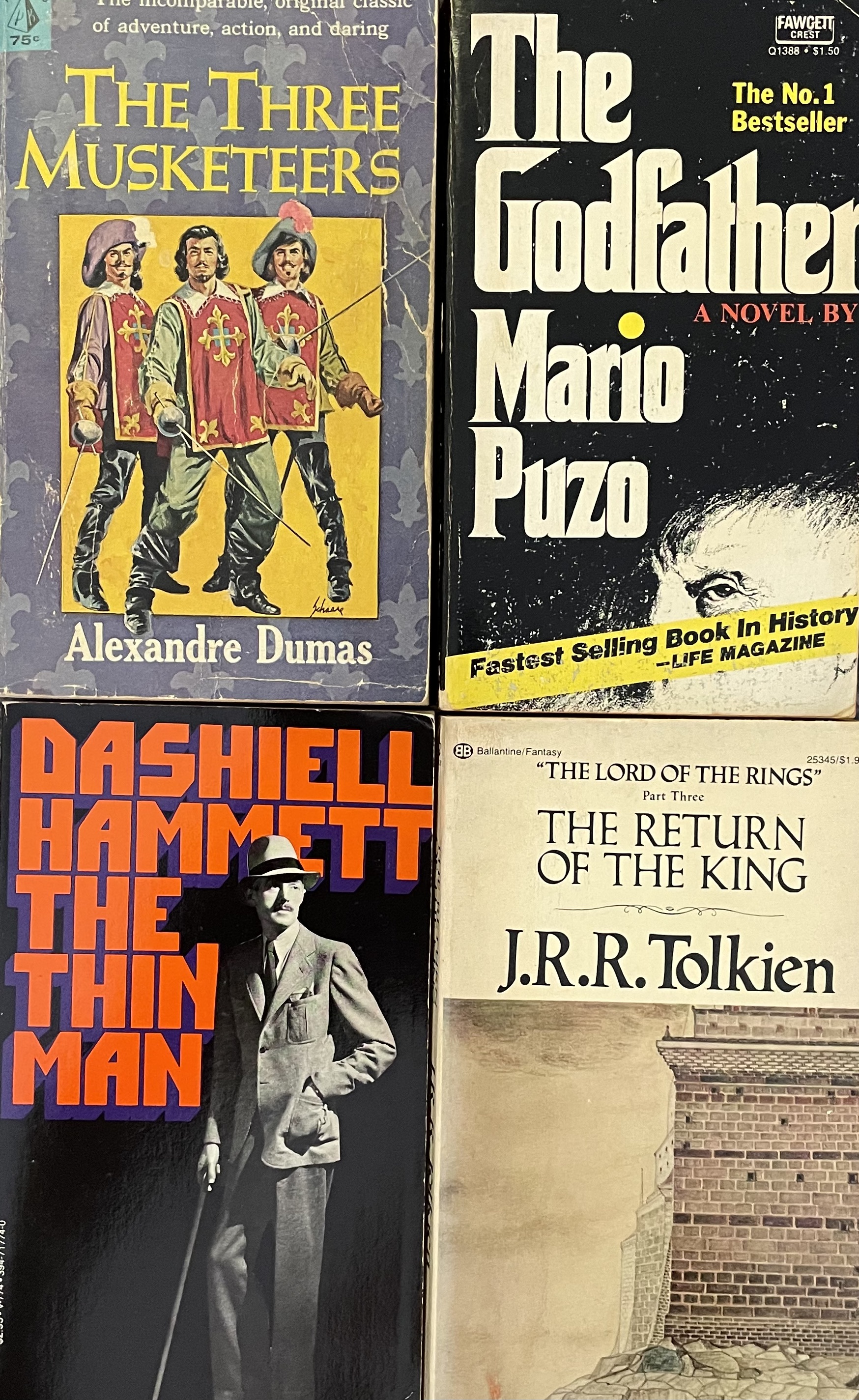
The Godfather by Mario Puzo
Sometimes you need a sure thing when you’re reading a book. Whether you’re waiting for good/bad news in a hospital or sitting at an airport, you want something that you know will get your mind off of whatever you don’t want your mind on. That is NOT the time to experiment with an unfamiliar book or author. There are times you need a sure thing, and The Godfather is my sure thing.
Yeah, the movies (the first two) are okay, but the book has so many sub-plots that you can randomly pick a page and find something interesting. It’s not a perfect book (a couple sub-plots are out of place and stupid), but it’s very readable. And I turn to it when I need to know that I’ll enjoy what I’m reading.
2. Just because you like it
The Three Musketeers by Alexandre Dumas
I read The Three Musketeers a couple times when I was in middle school. It might have been the first novel that I ever read twice, but I’m not sure. I liked it. That was the only reason I reread it. Just because… I liked it. It might be the best reason. But it’s not an interesting reason.
The Three Musketeers is the only classic literature on my list. I have fond memories of the 1970s movies with Michael York as D’Artagnan and Raquel Welch as Constance, and those movies spurred me on to read the book. Even without the movies (and the Classics Illustrated comic), I would have loved this book.
3. To relive the experience
The Thin Man by Dashiell Hammett
I accidentally found this novel during a low point in my teen years (I won’t go into what was going on). This book was lying around the house (I don’t know who bought it), and I liked the title because people often commented that I was thin, and it wasn’t meant as a compliment. I realized as I read that the thin man was the murder victim, but I liked the mystery novel anyway. The Thin Man got me through a really bad weekend. I don’t want to relive that bad weekend by reading The Thin Man, but I like remembering the joy of an unexpected great book. That doesn’t happen very often.
4. To win a contest
The Lord of the Rings by J.R.R. Tolkien
When I was in ninth grade, I got into a reading contest with another kid to see who could read The Lord of the Rings the most times. I had read it three times, and he had read it four times, and every time I read it again, he’d read it again just to stay ahead of me. The fourth time I read it, I skipped The Fellowship of the Ring (I claimed to have read it over a weekend). And the fifth time, I just lied and carried The Two Towers with me while I read something else. It may have been the first time I had ever lied about reading a book that I hadn’t really read. But it wouldn’t be the last time.
I always vowed that if I ever got into another reading contest, it would involve a short book and not a trilogy.
To be honest, I might never read this again. I read it several times in junior high/high school. Back in the 1970s, the rip-offs hadn’t been written yet, so there was nothing else quite like it (as far as we knew). TLOTR was a trilogy to be savored. It was a trilogy before trilogies were common. It was a trilogy that made sense as a trilogy. It even had a prequel. Any youngster reading The Lord of the Rings might not see anything unique in it because it’s been copied so many times in so many exciting ways (from a youngster’s point of view).
Referring to people younger than me as “youngster” probably makes me sound older than I really am. Or maybe I’m actually that old now.
5. To find details you didn’t notice the first time
Some people read books a second time to catch details that they missed the first time. That’s a great reason to read a book more than once, but I’ve never done it. I usually don’t care if I missed details the first time I read a book. I might notice details the second time I read a book, but that’s never the reason I reread a book.
I hope I’m not being disrespectful to people who reread books for this reason. If I were to reread a book for this reason, I might pick some epic like Lonesome Dove by Larry McMurttry or Shogun by James Clavell since they’re so long and I’m sure I missed some important details the first time. It’s not a bad reason. It’s probably a better reason than trying to win a contest.
BONUS REASON- To see if the book holds up.
Not every book can stand the test of time. Something that seemed great in the 1960s might feel outdated in 2024. Some literature is universal. Back in the late 1970s and early 1980s, I thought Stephen King books like Different Seasons and The Shining were great. Whenever I go back and reread them, they’re not as good. They don’t suck, but I notice flaws in the writing and awkward phrases and pop culture references that date the book. Sometimes I can even imagine bad 1970s haircuts.
I don’t know if that’s me getting older and more nitpicky or if Stephen King’s writing back then fit the time period more than it fits today. His books still sell like crazy, so it could just be me. But damn it, The Shining just sounds like it’s the 1970s.
Now I might have to reread it for a third time.
*****
But enough about me! What books do you turn to when you need a sure thing? What books have you read more than once and why?
Maybe “Aaarrrgh!” is too strong of a word. “Ugh!” might be better, especially since I knew this was going to happen. I was hoping it wouldn’t, but I figured it would. Supposedly, it happens to every self-published author.
Anyway, I’ve been flipping through my ONE novel, The Sunset Rises: A 1990s Romantic Comedy , which I self-published a couple weeks ago, and I’ve found several little errors.
I’m kind of annoyed because I spent a lot of time looking closely at my writing before I published my book. I even hired an editor, and the editor missed a few things. I can’t blame the editor, though, because I’m a retired English teacher, and I’m supposed to know what I’m doing when it comes to editing.
In my defense, the errors that I’ve spotted might not be considered a big deal. I haven’t spotted any misspellings. I haven’t noticed any missing words or weird inconsistencies with the formatting.
Here’s what I’ve noticed… so far!
- Two missing commas (not on the same page), both when there are paired adjectives that can be reversed.
- Misusage of an uncommon word (but not so uncommon that a reader would think of it as uncommon).
- A couple incorrect past-perfect tense uses. Professional writers misuse past-perfect tense all the time, though. I think some authors don’t even know what past-perfect tense is.
I’m a little embarrassed by the mistakes because the narrator is a grammar-obsessed English teacher, and here he goes making mistakes that he would mentally criticize others for making. Then again, the main character is kind of a prick sometimes, so maybe this will be a humbling experience for him.
I’ll be honest: it hurts my ego too. I promise that I’m not as grammar-obsessed as my main character, and I really hope that I’m not as much of a prick as he is, but I guess I’ll never really know. I don’t get to decide whether or not I’m a prick, and people who know me probably wouldn’t tell me if I am one.
Just so you know, online comments telling me that I’m a prick don’t count.
So, here’s my ONE novel. Overall, I’m okay with it, except for a couple missing commas, a couple past-perfect verb tense errors, and a slightly incorrect use of a word. At least, that’s all I’ve found so far.
*****
A grammar-obsessed English teacher falls in ‘luuuvvv’ but discovers how chaotic and dangerous ‘luuuvvv’ can really be.

The Sunset Rises: A 1990s Romantic Comedy is now available on Amazon !
Or you can get a signed copy directly from me!
The Sunset Rises: A 1990s Romantic Comedy
Get a signed copy of my one and only novel, The Sunset Rises: A 1990s Romantic Comedy. The price includes USPS media rate shipping in a sturdy box. My signature is legible, but I’m left-handed, so I might smudge it sometimes. I usually mail out the book within two business days of payment.
$20.00


 Dysfunctional Literacy