Yeah, I got compared (kind of) to William Shakespeare, but let’s not get carried away! (Photo credit: Wikipedia)
The worst part of presenting to a class back in my high school days was the feedback. Nobody (sometimes not even the teacher) paid attention to me. When the presentation was done, an uncomfortable silence would follow, where the class knew they should clap, but they were just too tired or bored or apathetic to do it. Somebody would cough or fake sneeze. The teacher would utter a half-hearted “Thank you.” The experience was usually miserable.
But when I finished reading “Long Story” to my tenth grade English class, I got booed. Finally, some positive feedback!
*****
After the class finished booing me, they laughed. It wasn’t a mean laugh. It was a shared joke, one that I was a part of. I could laugh too, but I wasn’t the type to laugh out loud in front of a bunch of people. I think maybe I smiled.
After the clamor had died down, my tenth grade English teacher Mr. Faggins (pronounced Fay-guns) spoke up with his raspy flu voice. “I have some bad news and some good news.”
The class paused for the bad news.
“Jimmy, that was probably the worst ending to a story I have ever heard in my 23 years of teaching.”
The class laughed, and my smile widened a bit.
Denise, the cheerleader with the really nice legs, said out loud, “You’ve been teaching for 23 years?”
And the class laughed again.
Mr. Fay-guns pretended like he hadn’t heard. “The good news, Jimmy, is that you took up the entire period reading your story. We don’t have time for anybody else to read. The rest of you are off the hook!”
The class erupted in a standing ovation. The English class who hated everything loved the opportunity to not have to read their stories. The bell rang a couple minutes later, and a relieved class rushed out.
A couple guys patted me on the back. Even Rebecca, the school’s hot vicious minx, said, “Nice job, brain.” I wasn’t really a “brain,” not by other brains’ standards, but I was probably the best student in that class, except for Denise, but she was a cheerleader and so a lot of students underestimated how smart she really was. She was clever enough to steal my best lines and ignore the bad ones, so I respected her. And she had really nice legs.
“You did a good job reading your story,” Denise said to me after I grabbed my books from my desk.
“Thanks. You would have done better.” She had volunteered to read my story for me, but I had declined the offer.
“I’m serious,” she said. “You actually sounded like your different characters. And everybody was listening. Everybody. Even Shakespeare couldn’t do that.”
That was a way to boost my self-esteem. The class had fallen asleep when we read William Shapespeare’s Julius Caesar aloud. Even O. Henry had caused a bit of drowsiness. But me? According to Denise, I had kept the whole class alert.
“But I have one complaint,” she said, pausing. “You should have treated Melinda better.”
“Melinda?” I said, probably too defensively. “But she caused all the problems. Are you mad that I let her get hit with a rock?”
“No,” Denise said. “What I mean is that after she breaks up with you or Danny or whoever the narrator is, you never mention her again. I think you should have brought her back sometime.”
I didn’t have a response. I simply hadn’t thought of adding more Melinda scenes, but then again, I had written the story quickly.
At lunch, a bunch of jocks/athletes surrounded me while I was eating. Normally, I would have gotten nervous, especially after my friends scooted away from me, but I sensed that the conversation was going to be friendly.
One of the jock/athletes, a backup quarterback who was in my English class, said, “Hey, Jimmy, did you ever do it with that girl?”
I had to think about that. “What girl?” I asked.
The jock/quarterback sat down next to me in the seat that my cowardly friend had vacated. “That girl you wrote the story about. The girl with the nice voice.”
“I don’t know,” I said. “It wasn’t important to the story.”
All the jocks around me laughed, which startled me because I was serious.
“You don’t know if you did it with her?” the jock/quarterback next to me said.
Another jock across the table said, “You should have done it with her. It’s your story. She couldn’t say no to you.”
The jock/quarterback next to me said, “If I made up a girlfriend for a story, I’d do it with her all the time.”
“Your hand is your girlfriend,” another jock behind me announced, and everybody laughed again. Since it wasn’t me they were talking about, I laughed too.
So the cheerleader and the jocks agreed that I should have done more with my fictional girlfriend. Maybe they were both right, but I wasn’t going to put much more thought into it. After the lunchroom conversation, I believed that would be it for “Long Story” and that it would soon be forgotten. But I was wrong. And this time, the feedback wouldn’t be so positive.
*****
To be continued (one more time!) in The Death of Long Story.

The Iliad might literally be epic, but a bad translation can ruin it for a reader. (Photo credit: Wikipedia)
Even though finding a good book to read can be difficult, ruining a good book for somebody else is easy. It’s so easy that excited readers usually don’t realize they’re destroying somebody else’s pleasant experience. There are probably dozens of ways to ruin a good book for somebody else, but here are (the top?) four:
1. Sneezing on it
Sneezing on a book will always ruin it for me. I don’t want to touch any book after it’s been sneezed on, no matter how much I had originally wanted to read it. It’s not just the nose debris I’m worried about either. Any type of fluid (body or not), and I won’t read the book. The moist spots might be water, but I can’t take that chance.
The only books I check out from the library are the new ones because they’re relatively undamaged. All of the older books have warped areas, or discolored sections, or green/brown spots that can’t be sanitary whatever they are. The older books can be checked out for extended periods of time, but I wouldn’t want them infecting my house, not even for a day or two.
The possibility that somebody has sneezed (or done worse) to a book will keep me from reading it. This narrows my selection at the library a little, but that also keeps me from wandering the shelves, and my kids appreciate how quickly I can choose a book from the library.
2. Spoiling the Ending
When I was reading The Iliad in junior high (by choice… 30+ years ago), some wiseacre tried spoiling it by telling me the Greeks won the war. I smugly replied that I already knew that. Then the spoiling wisacre revealed to me that The Iliad doesn’t go all the way to the end of the war. I couldn’t believe it! I cheated and read the final chapter where Achilles returns Hector’s body to Peleus, and I was shattered. I was really looking forward to reading about the Trojan Horse.
Maybe The Iliad isn’t the best example of a novel (or epic poem) that can be ruined by a spoiler. I could have used a more recent novel (like Dennis Lehane’s Shutter Island), but readers could have potentially gotten mad at me (and I try to avoid conflict whenever possible). At least The Iliad is Greek mythology. It’s (almost) impossible to spoil Greek mythology anymore.
As bad as a spoiler can be, the fake spoiler can sometimes encourage a reluctant reader to finish a book. When I was in fourth grade (way more than 30+ years ago), my vulgar older brother told me that Tom Sawyer got Becky Thatcher pregnant in the caves in The Adventures of Tom Sawyer. I eagerly read the entire book, searching in vain for an adult encounter that the Classics Illustrated comic book version didn’t have. I couldn’t find the adult scene, but I was too embarrassed to mention that to my vulgar older brother. I was afraid the scene was there and I hadn’t been wise enough to recognize it.
Maybe I fell for my vulgar older brother’s “fake dirty scene” trick, but I never painted any picket fences for him.
3. Assigning it as Required Reading
Most people aren’t going to read a classic unless it’s assigned reading for school. But a book doesn’t have to be a classic to be hated when assigned. I probably would have liked Fahrenheit 451 if it hadn’t been assigned. I probably would have liked Lord of the Flies as well.
There are only two exceptions. I liked To Kill a Mockingbird even though it was assigned, and I’m pretty sure I’d have hated Moby Dick even if it hadn’t been.
Assigning a novel is a great way to make kids hate (even what they think is) a good book. If you’re tired of The Hunger Games or Twilight or Beautiful Creatures, just get some teachers to make these books required reading. If a few teachers could overanalyze these books, the popularity of these YA novels would drop instantly.
Any teen craze can be destroyed by making it compulsory. If you’re sick of Justin Bieber or One Direction, have some music teachers require their classes to perform their songs. It’s an incredible power that teachers have to ruin teenage fads; they should use it more frequently.
4. Building up High Expectations
I probably would have liked The Catcher in the Rye if my friends in high school (about 30 years ago) hadn’t told me how awesome it was. The Catcher in the Rye was okay, but my friends had set my expectations too high. Holden Caulfield struck me as a whiner instead of a rebel. Now when I recommend a book, I just say something like “You might think this is good,” and not, “THIS BOOK CHANGED MY LIFE FOREVER!!!”
After my high school friends recommended The Catcher in the Rye, (“You HAVE to read it! It’s awesome. You won’t believe how great it is!”), I handed them a copy of Massage Parlor II by Jennifer Sills and said (probably in a monotone voice), “I think you’ll like this.”
That was it. No hyperbole. Very little emotion.
When I got my copy of Massage Parlor II back, it was in worse condition than any library book I’ve ever seen. If the kid sneezed on it, he sneezed on it a lot. Of course, I threw it away and scoured my hands. I then bought a new copy of Massage Parlor II and when I recommended it again to my other friends, I told them to buy their own copies.
That’s the final way to ruin a good book: make your literary peers buy their own copies.

I didn’t end my story with “I woke up, and it was all a dream,” but I still got a couple of these from my literary peers. (Photo credit: Wikipedia)
I really didn’t want “Long Story” to have a dumb ending. As a reader of thrillers and science fiction/fantasy and mysteries, I hated the “cavalry to the rescue” endings or the “convenient coincident” conclusions. Even when I was reading books in high school, those felt lazy. I believed that if an author was going to put his (or her) main characters into tough situations, it was up to the author to devise clever ways to get the protagonists out.
Unfortunately, I had put Danny Dornan into an impossibly unsolvable situation. There was no way he was going to get out of this without either cavalry or coincidence. He might need both. If I was going to have a stupid ending, I might as well go all out.
My tenth grade English teacher Mr. Faggins (pronounced Fay-guns) had given us one day to write our stories, and I needed an ending. At least if my ending sucked, I could blame a deadline that had been too quick. I just hoped my classmates understood that as I read my story to them.
*****
Long Story
Chapter 7
The Curse of the Curse Brothers
This was the situation. Joey Curse was holding me from behind, and I couldn’t squirm or fight my way out of his grip. Timmy Curse was directly in front of me about to punch me in the face. Tommy Curse stood behind Timmy and stomped my backpack with textbooks and homework into the mud. Johnny jumped up and down cackling.
As I closed my eyes and braced for pain, an ear piercing crack and a quick jolting flash knocked me off my feet. But my face, it was untouched. I couldn’t tell where I got hit. It was just an impact that pushed my entire body back. Joey fell back too and released his hold.
I pulled myself up and saw Timmy’s charred remains on the muddy ground. Tommy and Johnny stood in awe over the burnt body.
“He got hit by lightning!” Johnny exclaimed.
“And it didn’t touch the rest of us!” I announced, excited and relieved. “You know, the odds of this happening were astronomically low.”
I probably should have kept my mouth shut. Joey glared at me and pointed. “Get him!”
I was going to say, “Hey, this wasn’t my fault,” but I ran instead.
Timmy’s smoldering body hadn’t even cooled yet, and the remaining Curse brothers still wanted to beat me up. This was true brotherly love.
After a minute or two of straight-down-the-street running, I sprinted side-by-side next to an elementary school bus. The kids inside the bus recognized the situation and started cheering, but I don’t know if they were rooting for me to escape the Curse brothers or if they were hoping to see me get beat up.
As I paced the school bus with the Curse brothers a few yards behind me, I noticed we were getting close to railroad tracks. The bus would have to stop. This would be a good chance to change directions. I heard the squeal of bus brakes, and when I passed the hood of the bus, I gave myself a wide berth and swung myself hard to the left.
I continued my sprint to the opposite side of the street and looked back to see how the Curse brothers had handled my maneuver. As I turned, I heard a thunk and a splat. Then the bus came to a halt, but it was already halfway over the train tracks. The kids in the bus cheered again. The bus hadn’t made a complete stop like it was supposed to, and a Curse brother had gotten creamed. Whichever Curse brother it was had counted on the bus driver following the rules, which was kind of funny because the Curse brothers never followed the rules.
I expected the remaining two Curse brothers to beat up the bus driver, but then I saw the two survivors were Joey and Johnny. Johnny was ten, so he wouldn’t be much help against an adult. But me?
“We’re gonna kill you!” Joey yelled, waving his fist at me. I thought the fist wave meant that they’d wait until they went through the grieving process, but then they started running toward me. I think the fist waving was the Curse family’s grieving process.
It started to rain hard. Plus the wind was blowing against my face. It had to hurt the Curse brothers too, but they were persistent, screaming threats and profanity at me as they got closer and closer. My ribs ached. I couldn’t breathe. My legs felt like lead. I had to stop running, even if that meant getting killed.
I bent forward and gasped under a thick tree. The wind slanted in its downpour, but I stood against the trunk as protection. I saw the Curse brothers running against the wind to reach me. I braced myself to run and thought about it. I was tired of running. There were only two of them, and one of them was ten-years-old. They were as tired as I was. Still, they were probably angry about two dead brothers, and anger can make a beating even worse, so I decided make another run for it. If I ran for the tracks again, maybe I could get a train to hit them.
A whistling gust of wind blew through me past the tree trunk, and a loud lightning-like crack startled me, but it wasn’t lightning. A giant branch above me had snapped, and I watched it in slow motion fall behind me. Joey saw it too, and he also saw that he was in its path, but he couldn’t stop himself. We made eye contact as the branch plummeted onto his head. His lips blew out like he was about to cuss, and he shook his head, and then his body disappeared. All I could see were the branch and two feet sticking out.
Ten-year old Johnny, with a rock in his hand, stood behind his collapsed brother and the branch. He looked at the rock and at me, and then he threw the rock with all his might. The miniature missile whizzed past my head. It was a good throw. If it had hit me, it would have knocked me out. The way my luck was going, I expected it to bounce off a tree and ricochet back into Johnny’s face. But it landed harmlessly a few yards behind me.
Sometimes I’m slow at figuring things out. Johnny was a skinny ten-year old kid that I could beat up. He had hit my former girlfriend with a rock, and she broke up with me because of it. I had gotten beat up by his brothers because of him. I was going to fail the grading period because of him. As the anger built up inside me I came to this conclusion: Johnny Curse should not chase me; I should chase him.
I think we realized this at the same time because he turned and ran. I had to climb over the fallen branch, but I did it almost without noticing it. I was filled with adrenaline, my second wind, and each block I ran brought me a few yards closer to revenge. Johnny saw me closing in on him and turned between two houses and jumped a fence.
I’d get him now, I thought. I was stronger and faster and could leap fences more quickly than Johnny could. A couple back yards would be all I needed to catch him.
I almost caught him in that first back yard too. He was scrambling up the back fence to jump into the neighboring yard. I reached forward and was so close to knocking him off the fence, but then I heard a growling behind me. I should have thought of this. It was a stupid mistake. I should have known better.
A Doberman knocked me down from behind. The guard dog went for my face too. Teeth snapped inches away, the dog growling and wrestling me. Between my jacket and shirts, I had three layers of clothing protecting my arms and body, but those teeth still cut through. I elbowed the dog in the face, threw him back, and then jumped for the fence. The dog ripped at my left leg. His teeth cut through my calf, and I screamed. I yanked my foot up like it had hit a hot stove and pulled myself over the fence. The dog barked in its triumph. It had chased off the intruder and tasted the fresh delicacy of human blood.
Once I realized there was no new dog to attack me, I stayed on the soggy ground and rested. I couldn’t believe a Doberman had snuck up on me. And I couldn’t believe that I had been outsmarted by a Curse brother. That was the worst part of the whole thing.
A few minutes later I found my backpack a couple blocks away and what was left of my assignments. Papers were buried in the mud, and the backpack was torn by its zipper enough to be useless. All my textbooks were soaked. I’d have to pay for them. There was nothing I could do to salvage any of them. Wiping out the Curse brothers should have left me exhilarated, but instead, I was bitter. My life was ruined. Their defeat meant nothing to me. I grabbed a couple useless remnants as proof that I had at least tried to save my materials and cradled them as I sludged my way to school. There didn’t seem to be any point to going, but I did.
When I staggered into the school building, I dragged myself straight to the counselor’s office. I didn’t even bother with attendance and the mandatory late pass. I dropped myself into the counselor’s student chair without an invitation. She stared, probably surprised at my uncommon rudeness. My clothes were smelly with rain water and mud. My face was scratched and bitten. My sleeves were torn.
“Oh my… God,” she said. “What happened to you?”
“I’ll tell you everything,” I replied, taking a deep breath. “But I have to warn you… It’s a really… long story.”
THE END
*****
When I finished reading my story aloud, the class booed. A couple students flipped me off. Some kid even threw a paper ball at me. For a tenth-grade English class that hated everything, it was actually a pretty favorable response.
*****
To be continued in Long Story: Literary Analysis and Feedback.

Reading and writing may be awesome, but telling jokes about reading and writing can lead to silence and awkward coughing. (Photo credit: Wikipedia)
A literacy joke is risky to tell because most people either don’t care about reading and writing or won’t have enough background information to understand it. Even if the audience “gets” it, chances are they’ll still think the joke isn’t funny. You don’t need a master’s degree in English to “get” a Best Literacy Joke Ever! You might need to read a book every once in a while, though.
WARNING! Just because a Best Literacy Joke Ever is easy to understand, that doesn’t make it funny. It’s tough to write (and tell) a Stephen King joke.
*****
HACK WRITER vs. LITERARY AUTHOR
Stephen King, Janet Evanovich, and James Patterson were hanging out at a coffee shop bragging about how loyal their readers were.
“I could write five novels a year,” Stephen King said, “and my readers would purchase every book, no matter how poorly they were written.”
“Oh yeah?” Janet Evanovich proclaimed. “I could write ten novels a year, and my loyal readers would purchase every single one of them.”
“That’s nothing,” James Patterson scoffed. “I could write 15 novels a year, and my loyal readers would spend their money on all of them.”
Tom Wolfe overheard the conversation and became upset. “You are doing your readers a disservice with your hackery,” he said. “I took five years to write Back to Blood because I believe in giving my loyal readers my best effort.”
And with that, Tom Wolfe strolled away.
“I hate to say this,” Stephen King said, “but I didn’t think Back to Blood was very good.”
“I hate to say this,” Janet Evanovich said, “but I spend so much time writing all my books that I don’t have time to read anybody else’s writing.”
“I hate to ask this,” James Patterson said quietly, staring at Stephen King and Janet Evanovich, “but you guys actually write all your own books?”
*****
HOW CAN YOU BEAT WRITER’S BLOCK?
An overworked author was having writer’s block at the worst possible time. A deadline was approaching from his freelance job, he was working on his 100 blog posts in 100 days challenge, and he was writing a 50,000 word novel in a month all at the same time. The writer stared at his laptop screen, but he just couldn’t start writing.
Frustrated, the writer stood up and kicked his desk. Unfortunately, he wasn’t wearing shoes, and he jammed his big toe.
“Aaaaarrrrgh!” the writer screamed, hopping on his good foot from his den to the kitchen to get an ice pack. He accidentally tripped over his dog, lost his balance, and stumbled against the stove, flipping over a pot of boiling water that scorched his arm.
“Aiyeeeee!” the writer screamed, writhing in agony. His entire arm seared with pain, so he rushed to his car to drive himself to an emergency room. As he put the car into reverse, he saw smoke and flames from his kitchen. He had left the stove on, and somehow the kitchen had caught on fire.
“Nooooooo!” the writer screamed, leaping from his car, diving back into his house, holding his breath through the suffocating smoke, grabbing a fire extinguisher, and putting out the fire. As he almost breathed a sigh of relief (he couldn’t really breathe because of the smoke), he heard a loud crash. He had forgotten to set the emergency brake, and his car had rolled off the driveway and smashed into an old tree that hadn’t been removed yet from his lawn.
“AAAaaaaahhhhhh!” the writer screamed as he fled from his house just as the dying tree fell onto his home and crushed the roof. The fire had weakened the home’s structure, and entire house collapsed under the weight of the fallen tree.
The writer and his wife (who had been outside in the yard the whole time because she couldn’t stand to be around him when he was writing) stared at the rubble of what had been their home.
“At least now you have something to write about,” the wife said.
“I would,” the writer replied, exasperated. “But my laptop’s still in the house.”
*****
ANOTHER WRITER’S BLOCK JOKE
“Write about whatever you want to write about,” the English teacher said to his class as he paced across the room. “You have 10 minutes to express yourself through your writing, and fill up the entire page.”
“I don’t know what to write about,” a kid said, with a pen in his hand and paper on his desk.
“Write about what you are feeling,” the teacher suggested. “You have ten minutes.”
“I still don’t know what to write about,” the kid blurted out.
“Think about it quietly for a few minutes, so other students can concentrate while you decide what to write about,” the teacher said.
“I still can’t think of anything to write about,” the kid complained.
“Then just write ‘I don’t know what to write’!” the teacher finally snapped.
The kid scribbled furiously for about ten minutes but at least was quiet. When the teacher collected the assignment, he praised several students who had written in great detail about their feelings. When he got to the struggling kid’s assignment, he noticed that the entire page was composed of sentences saying: “I don’t know what to write about.”
The teacher crumpled up the kid’s (kind of) composition and threw it away. Outraged, the kid shouted, “Why did you throw away my essay?”
“Because you didn’t put any thought into it,” the teacher stated.
“Are you kidding?” the kid retorted. ‘That’s the first time I’ve ever written a whole page!”
*****
Read Dysfunctional Literacy on Amazon!


It might be the literary question of this generation… or maybe not.(Photo credit: Wikipedia)
Retired author Philip Roth says writing is “torture.” Eat, Pray, Love author Elizabeth Gilbert says writing is “f*cking great.” I thought I had this figured out a couple days ago, when I concluded that I agreed with Gilbert’s comment but thought that Roth’s was way cooler.
But since then, I’ve put more consideration into how these varying philosophies apply to my own writing. I don’t mean that I’ve spent long hours of reflection where I suddenly wonder where the time has gone. I only do that at church. I mean that I gave it a couple moments of thought between books and chores and meals and errands.
WHY WRITING IS “F*CKING GREAT”
I write Dysfunctional Literacy with the personality I wish I had in my non-writing life. I’m a quiet guy. When I talk, I get ignored a lot. People yawn around me. I take a long time to speak because I’m careful with my words, so I get talked over while I’m completing my thoughts, and I’m not the type of person to say, “Shut up and let me finish, ***hole.”
It’s probably good that I don’t say things like that because it’s usually my bosses that interrupt me. The last guy that called one of my bosses an ***hole got escorted out of the building. My voice also has a slow tone to it, even when I try to speak quickly. I guess it’s like an invitation to be interrupted.
I don’t get interrupted when I write. I can take my time, choose my words carefully, and most of the time, I get it right. Even though I’m very careful with what I write at work, email is awesome because I never get interrupted, and co-workers can’t take credit for my ideas. Email is a (potentially backstabbing) friend that I use sparingly.
Dysfunctional Literacy is my way of blowing off steam. I can write about stuff that has nothing to do with my job, and I get feedback from a lot of other writers who are doing incredible things with their own blogs. And when I write, I can dream of the day when maybe, just maybe, I can make a living (or partial living) off of writing, and that would be “f*cking great.” But it’s still “f*cking great” doing it for free.
I don’t think it would be “f*cking great” writing for free for somebody else’s blog (like The Huffington Post), but if other writers are happy doing that, that’s “f*cking great” for them.
WHY WRITING IS TORTURE
Yeah, writing isn’t really torture, but it can be frustrating, and Philip Roth is an old man who was in an awkward situation when he said writing was “torture,” so I’m not going to take him literally.
I think about quitting Dysfunctional Literacy sometimes, just like Philip Roth retired from writing, except maybe our reasons are different and his career is a bit more accomplished than mine. Every night when I’ve written or edited something for Dysfunctional Literacy or other projects, I wonder if I’ve just wasted my time.
I have to be realistic. All this time, energy, and effort might turn out to be pointless. I get mad and frustrated when I write. I’m kind of unpleasant to be around when I write, so much so that I’m usually left alone. Plus, I don’t make any money off of it.
The good news is that I’m always in a great mood when I’m done.
It’s not necessarily the writing process that’s torture; it’s the idea that I might be wasting my time with it. But I’m pretty sure if I don’t write, then I’d be angry with myself later on in life for not trying. But that’s the mental “torture” (too strong a word, but you know what I mean) that anybody who has a non-profitable passion has to deal with.
FINAL VERDICT
I asked the question, so I have to make the tough decision. Writing is “f*cking great” because it’s the only time I have a personality. Writing is “torture” because I probably put far too much time into it and I’m kind of an ***hole while I’m concentrating. Well, I need to have a personality, so I guess that makes writing “f*cking great,” and my family can do without me for a while every night .
For all I know, that time I spend writing might be my family’s favorite part of the day. So much for “torture.”

If Philip Roth thinks writing is torture, what would he call this? (Photo credit: Wikipedia)
Philip Roth (retired author of novels like… okay, I have to admit that I’ve never read any of his books, but I know who he is) said something either really awesome or really silly about writing to a young(?) author whose first novel is called Balls:
“I would quit while you’re ahead. Really. It’s an awful field. Just torture. Awful. You write and you write, and you have to throw almost all of it away because it’s not any good. I would say just stop now. You don’t want to do this to yourself. That’s my advice to you.”
If you don’t know the context behind the quote, here is a pretty good summary and analysis.
Maybe Roth’s statement was kind of silly. “Torture” is probably too strong a word (yeah, I know he’s not being literal!), but writing can be frustrating, especially when some young punk writer interrupts your meal.
I hate being interrupted while I’m eating. I really hate it when it’s by somebody that I don’t know. If a writer can’t enjoy eating at a restaurant without being accosted by a creepy (speculation on my part) waiter with a book, then what’s the point of being a writer?
Nobody wants to think about a book titled Balls while eating dinner. The last thing I want to think of while I’m eating is somebody else’s Balls. Even if I wrote a book called Balls, I wouldn’t want to think about it while eating. That was incredibly insensitive of the writer/waiter who interrupted Roth’s meal.
Philip Roth is an old man who had his meal interrupted, so I give him a pass on anything that he said during that conversation. Besides, I like old men who say what they want (as long as it’s not racist or homophobic… and even then it’s funny sometimes).
Elizabeth Gilbert (author of Eat, Pray, Love, a book I’ve never read even though those are three things that I do) responded to Roth’s quote by saying writing is “f*cking great.” For some reason, that reminds me of Julia Roberts saying “I love my life” while handing out an Oscar a few years ago.
It’s nice to love your life or think writing is “f*cking great,” but those are easy stands to take when you’re rich and famous. It’s more difficult to love your life or think writing is f*cking great when you’re unknown and struggling. Don’t get me wrong. I love my life too. I just don’t announce it at inappropriate times. I also think writing is f*cking great. That’s why I write my blog for free. I wouldn’t write Dysfunctional Literacy for free if I thought writing sucked (or thought it was torture).
I agree with Elizabeth Gilbert’s comment more than I agree with Philip Roth’s, but I think that Philip Roth is way cooler than Elizabeth Gilbert, so I resent Gilbert for her comment that I agree with, and I appreciate Roth for his comment that I probably don’t really understand.
It’s kind of weird how the human brain works.

A storm is such an obvious symbol of trouble that even a high school sophomore could recognize or use it.(Photo credit: Wikipedia)
The first time my tenth grade English teacher Mr. Faggins (pronounced Fay-guns) talked about the climax of a narrative, I laughed out loud. It was a short laugh because I noticed Denise (the cheerleader with the really nice legs) glaring at me. I stopped and looked at my desk.
Mr. Fay-guns sometimes referred to the climax as the “uh oh” moment, meaning that this was the time when the protagonist would resolve the problem or something very bad would happen (sometimes both).
Once when Mr. Fay-guns used “climax” and “uh oh moment” in the same sentence, a kid named Tony put his head down on his desk, and his shoulders started shaking. I could feel Denise spying on me sideways, so I somehow kept my face stone serious and pretended to take notes. Plus, I saw how stupid Tony looked laughing at stuff like that, and that inspired me to appear more mature than I really was.
The “uh oh” moment actually made sense to me because my story about Danny Dornan needed a climax. The climax was probably the easiest moment of the story to write, especially in a straight-forward high school story written by a high school student. Some high school students have lots of “uh oh” moments.
*****
Long Story
Chapter 6
Revenge of the Curse Brothers
I should have known it was going to be a bad day when I saw the dark and stormy sky from my bedroom window. Rain hadn’t begun to fall yet, but it was going to, and I wanted to run to school before it poured. I could hear thunder rumbling and knew this was going to be a bad one.
I thought about taking the umbrella, but it would slow me down and it wouldn’t fit in my locker. Plus, it might attract lightning. With my backpack stuffed with books and my all-important homework, I wanted to travel as light as possible. The walk to school wasn’t long when I ran.
Since it was just drizzling, I decided not to run. I’d look uncool panting hard running through the school’s entrance. I’d save the running for the real rain if it happened. If I could get to school early enough without running, I’d stop by the front office and deliver my make-up homework to the 10th grade counselor. Then I’d watch out for the Curse brothers in the hallway. I’d take a different long way home, even it was raining after school. I didn’t care if I got drenched in the afternoon because I could change my clothes once I got home. I cared if I got beat up after school.
Instead, I got beat up before school.
I had walked just a little over one block when the Curse brothers surrounded me. I didn’t even see them coming. They usually announced themselves with something like, “What are you looking at?” before they clobbered somebody. With me, they popped out of nowhere. Maybe it was my fault. My mind had been on other things like homework and rain when I should have been looking out for the Curse brothers.
The three older Curse brothers, thick with dark hair, black t-shirts, torn jeans, and lots of pimples, spread out to surround me, and I looked around for the best opening to run through before they got too close. Johnny, the 10-year-old runt of the family, stood back in his sleeveless white t-shirt and smirked at me.
“Is that him?” Tommy, the oldest of the clan, asked Johnny. Timmy barreled toward me saying, “What are you looking at?” Timmy didn’t care if I was “him” or not, and I was “him,” and I wasn’t going to stand still and get punched out like my friend Rodney had a few months ago. I dropped my backpack and ran.
I hated doing that. My backpack had three weeks’ worth of homework that I had to turn in to the counselor. If I didn’t, then I would fail math and English and science for the grading period. I thought about returning for the backpack and got mad at myself. What was I thinking? I wasn’t going to outrun the Curse brothers lugging 20 lbs. of books. I abandoned the backback and fled.
Four Curse brothers yelled profanity behind me, but they were running too, so I kept moving. I sprinted, but without direction. I realized that I didn’t know where to go. I could run down the street, but then what? I couldn’t go home because they were between me and my house. I couldn’t go to school because they’d beat me up there too. I decided to get away from them first and then try to think things through.
And to get away, I ran between two houses, jumped a fence and took my chances in an unfamiliar backyard.
I wish I could say that I led the Curse brothers on a long chase through the backyards and side streets of my home town, but I didn’t. As soon as I jumped the fence, I slipped and landed on my shoulder. Timmy was on me before I could even crawl back up to my feet. I tried to shake him off, but he was a heavy guy and I was skinny with almost no muscle.
“Is this him?” Timmy said, not that it mattered.
“Yeah, that’s the loser,” the runt Curse brother said in a squeaky voice.
Joey had my backpack and dumped the contents into the mud. All my homework, my textbooks, hours and hours of work, my one chance for passing grades on my report card, were getting dumped. Mud seeped through papers and pages. I couldn’t believe it. I was going to get beat up and fail the grading period too. It was unfair. More determined than ever, I struggled to break free from Timmy’s hold, but it was no use. I strained every muscle I had and pulled and pushed and gritted my teeth.
Then I got punched in the gut.
I crumpled to the soggy ground, the air knocked out of me. I hate getting the wind knocked out of me. I always know that I’ll be able to breathe again in a few seconds, but it always takes longer than I think it will. Especially with the Curse brothers standing over me. I struggled on the ground, mouth open, wheezing until I could regain my breath. I waited for my head to get kicked. I couldn’t even get the strength to put my arms over my head for protection. I kind of rolled into a ball and gasped when I could. Luckily, they didn’t beat on me while I was down.
As soon as I could suck in air again , Joey lifted me up by my armpits from behind. Timmy and Tommy stood in front of me. Johnny was a few feet behind them, cackling and jumping. I gasped and tried to brace myself for what was about to happen. This was going to be bad. My feet kicked, but I couldn’t do anything with them; I couldn’t keep them firm on the ground, and I couldn’t defend myself by kicking up.
Johnny waved his skinny arms wildly, screaming, “Hit him! Hit him!” Tommy stepped on my books, drowning them in the mud. Timmy got up really close like he was going to punch my gut again, but he looked me in the eyes and grinned.
“Now it’s time for your face,” he said.
Uh oh, I thought.
*****
To be continued in Long Story: The Controversial Ending.
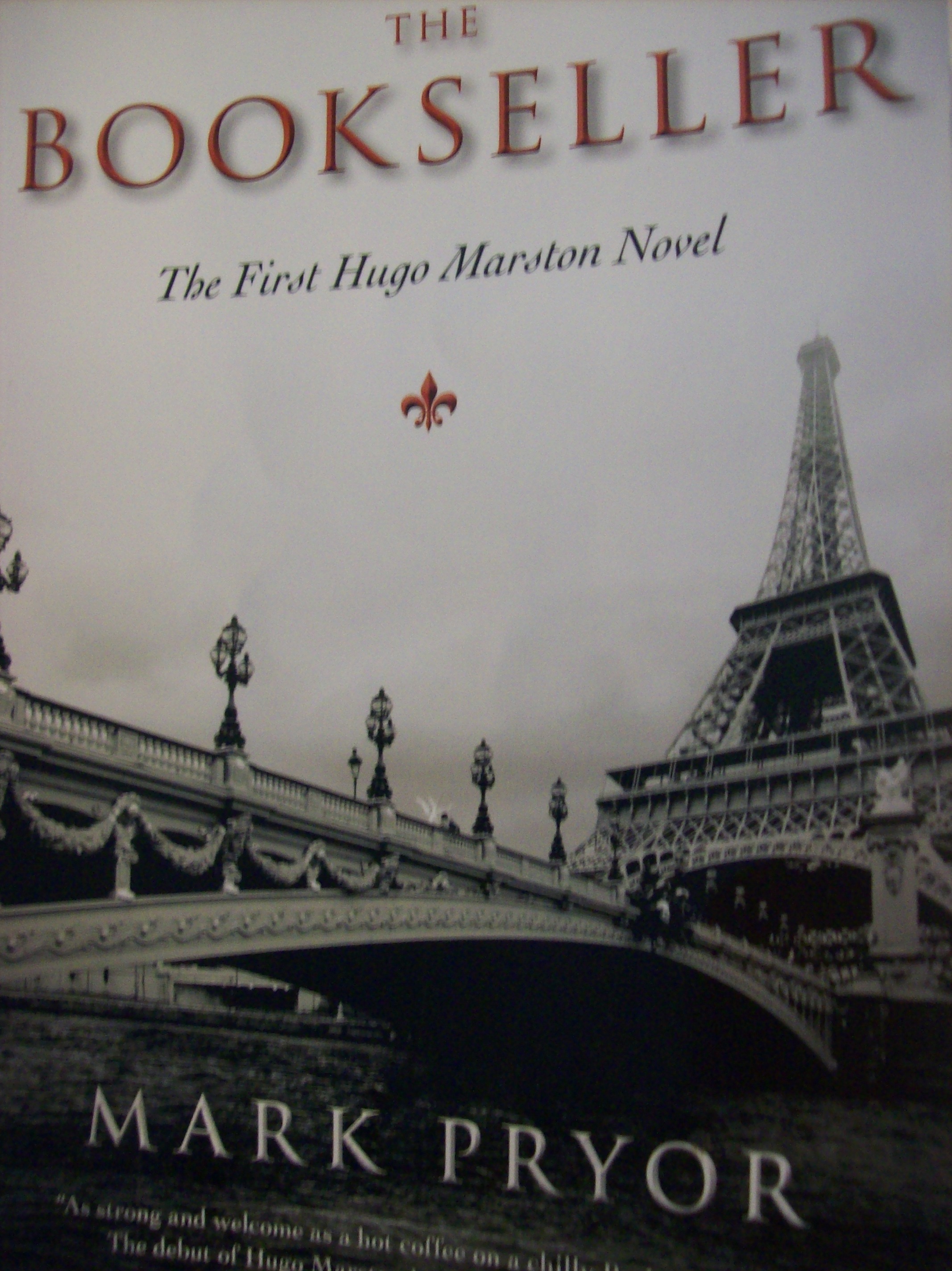
I’m reading a novel called The Bookseller by Mark Pryor. I like it so far, but something (really trivial) about it kind of bugs me.
The subtitle (shown in the above picture) says “The First Hugo Marston Novel.” Okay, I thought, that’s nice; I’m reading the first book in the Hugo Marston (whoever he is) series. Then, after reading the back cover of the book, I learned that The Bookseller is the ONLY Hugo Marston novel (so far…). Not only is The Bookseller Mark Pryor’s ONLY Hugo Marston novel (so far), it is Mark Pryor’s only novel (so far).
I’m not an expert about the publishing business. I figured a guy like Mark Pryor would write a mystery/thriller like The Bookseller with a protagonist named Hugo Marston, and if the critics liked the book enough and if it sold enough copies, then Mark Pryor could write another book with Hugo Marston, and if that was successful, then a series could be made. I didn’t know previously unpublished authors could determine that their first books would be the beginning of a series.
I knew guys like Stephen King or James Patterson could start a series whenever they felt like it, but I didn’t know debut authors could begin a series with their first book. I guess I have astonishing gaps in my knowledge.
When I wrote my first (and so far only) e-book Having a Few and Getting Some, I did it under the assumption that only a few people would read it (and so far I’ve been correct). I never assumed it would be a series. I have no plans for a sequel (tentatively called Having a Few More and Getting Some Too). I may change my mind later, but I would never have assumed that my first book would be the first of a series.
Anyway, it’s Mark Pryor’s first novel, and his main character is already getting a series. The Bookseller is a decent book, but I don’t know if Hugo Marston is series-worthy yet. That seems a bit presumptuous. First of all, it tells me that Hugo Marston will survive whatever happens to him in his first novel. A protagonist should have to be scared for at least one book. No wonder Hugo Marston acts cocky throughout the novel; he knows he gets a series.
I guess Hugo Marston doesn’t have to worry until the book cover says “The Final Hugo Marston novel.” Let’s see how cocky Hugo Marston acts then.
*****
In a few months, The Crypt Thief: A Hugo Marston Novel is being released. It doesn’t say “The Final Hugo Marston Novel” or “The Last Hugo Marston Novel,” so Hugo Marston has no reason to be nervous yet.

If somebody told me that this entire aisle was filled with James Patterson novels, I might (maybe) believe it. (Photo credit: Wikipedia)
I want to read a James Patterson novel. He’s a popular author, and I’ve never read any of his books, so I went to the library last weekend and realized I was out of my league. An entire shelf was filled with James Patterson novels, not because he was the library’s featured novelist, but because he’s written so many books that it took an entire shelf to showcase them.
Staring blankly at the selection, I noticed that James Patterson co-writes a lot of his books with various authors (whose names I didn’t recognize). This is great for James Patterson because he can put his name on a lot more books. This is great for the co-authors because their names are on books that are guaranteed to sell. This is good for the public because book readers have more (but not necessarily a better) selection of mystery/thrillers.
If I were a mystery/thriller author who was not James Patterson or one of his co-authors, I’d be kind of ticked off.
I’m guessing that James Patterson is a hack, and I don’t mean that as an insult.
I’d like to be a hack, but since I’m probably not good enough, I have to settle for making fun of them (not that they care because they have tons of money, and I don’t). For the last year, I’ve been making jokes about Sue Grafton and her alphabet series, without realizing that she’s an amateur compared to James Patterson (I have some weird gaps in my knowledge).
Now that I have finally recognized the awesome hackery that is James Patterson, I finally present…
THE “JAMES PATTERSON IS A HACK” CHALLENGE!
Below is a list of some James Patterson book titles. I also added three more fake titles. Without cheating (like checking up on Wikipedia or Patterson’s home page), pick out the three fake book titles.
Along Came a Spider
The Big Bad Wolf
Cross Fire
Don’t Blink
Dream On
Four Blind Mice
Get Ready, Get Set, Die!
Guilty Wives
I Funny
Jack and Jill
Kill Me If You Can
Kiss the Girls
Little Miss Murder
Never More
No Way Out
Now You See Her
NYPD Red
Pop Goes the Weasel
Roses Are Dead
School’s Out- Forever
Step on a Crack
Tick Tock
Violets Are Blue
Worst Case
Answers are at the end of the… no, they’re not! It wouldn’t be a challenge if I answered it for you.
BONUS CHALLENGE (only for people who have read a lot of James Patterson novels)- Choose one James Patterson book for me to read.
I want to read one (and probably only one) James Patterson novel, but I don’t know where to start. I don’t want to read his YA stuff. I’m not interested in Alex Cross. I’d like one good book that represents what James Patterson writes. I’m not reading it to “hate” it or be overly-critical; I just want to see what his books are like.
If “None” is the only answer I get, then my decision will become easier, but I really hope the answer isn’t “None.”
*****
For more about authors who are (or might be) hacks, read My Favorite Author is a Hack .

WARNING! Nothing like this really happens in Long Story. (Photo credit: Wikipedia)
My tenth grade English teacher Mr. Faggins (pronounced Fay-guns) hated stories where nothing happened. Too many of us wrote stories where we got up in the morning, brushed our teeth, ate breakfast, took a dump, showered (except for the smelly kids), and went to school. Just doing that took up half the page if the student had big enough handwriting.
Mr. Fay-guns wanted our stories to keep moving. That meant that we needed to cut everything that everybody else does. Since everybody eats breakfast, we weren’t supposed to put that into the story, unless something important happened at breakfast. Everything in the story was supposed to be unique to the characters in some way.
At the same time, I wanted to build suspense. Building suspense meant slowing the action down. Danny Dornan, my main character, had to go through his every day routine with the anticipation that something really horrible was going to happen later. This was new for me. I don’t think I had ever attempted to write suspense before.
*****
Long Story
Chapter 5
The Dead Man
I was a dead man, I was sure of it. I had just beaten up the ten-year old Johnny Curse, and he was going to tell his older brothers, and they were going to beat the tar out of me. They would knock my teeth out. They would kick my head in. They would intentionally break my bones and laugh while they did it. No parents could stop them. No police could help me. The Curse brothers would find a way to get to me.
It was Melinda’s fault. My former sweet-voiced dimwit of a girlfriend had betrayed me. I knew that as a boyfriend I should have protected her before she got hit with the rock. But as my girlfriend she should never have put me in that situation. She had started the entire confrontation, and I had felt the responsibility to step in, but I had waited too long. Now I had no girlfriend, and the Curse brothers were going to kill me.
I still had to go to school. Even though the Curse brothers never attacked in the morning, I still ran. I had to will myself to slow down my pace once I stepped into the school building.
My friends said hi and tried to make small talk, and I did my best to answer, but I always looked over their shoulders for signs of the Curse brothers. Everybody else seemed to be acting normal. There didn’t seem to be any whispering or side-view glances at me. There were no smirks or double-takes or wide-eyed stares as I walked down the hallway. Nobody muttered death warnings to me as they passed by. I was ignored like I was every normal day at school.
In fact, nobody seemed to know that I had beaten up Johnny Curse. It seemed like Melinda hadn’t said anything. The Curse brothers hadn’t said anything. I wasn’t going to say anything. I couldn’t brag about beating up a ten-year old. I wasn’t ashamed because I hadn’t had much choice, but I would have been grateful if nobody ever heard about it.
I was still scared, and the adrenaline made my brain work faster. In math, the teacher called on Melinda, and the class snickered when she maintained her silent vacant stare. When the teacher called me, however, I had my answer ready. In fact, I started raising my hand, volunteering correct response after correct response. I raised my hand so much the teacher got annoyed. If I was a dead man, at least I would die as a good student.
At lunch a few friends had realized that I wasn’t talking to Melinda, and somebody finally asked if we had broken up.
“I don’t want to talk about it,” I answered.
“Did you break up with her, or did she break up with you?” somebody asked.
“I broke up with her,” I lied. I knew to never admit that I had been the one that got dumped.
“Why?” one of my friends asked. They were stunned that I would break up with a girl. Then again, they had been stunned when they found out that I had a girlfriend.
“I’ll tell you everything later. I’m hungry.”
Everybody understood that, so they talked about other stuff while I ate lunch.
“Hey, did you hear what the Curse brothers did to Randall?” one of my friends asked the group.
I kept eating as I listened to the conversation.
“They gave him a swirlie and a wedgie in the B hall bathroom.”
“They gave him a swirdgie?”
“I thought the swirdgie was a myth.”
“I saw Randall myself. He was walking funny and had wet hair flopping over his face.”
“Was his underwear pulled up to his shoulders?”
“No, he fixed it before he came out of the bathroom. But I swear he was walking funny.”
“Did you ask him if he really got swirdgied?”
“You don’t talk to a guy who just got swirdgied. It’s rude.”
“Did they beat him up?”
“No, they just swirdgied him.”
It was weird hearing my friends laughing about Randall getting a swirdgie because something like that could have easily happened to them too. The laughter was out of relief more than humor, though. The Curse brothers went easy on Randall. Humiliation was pretty bad, but they left his face alone. I was sure they wouldn’t let me off the hook that easily.
I took the swirdgie as a good sign. If the Curse brothers weren’t in a violent mood, maybe they weren’t mad that their little brother had gotten beaten up. Maybe they knew that their little brother shouldn’t throw rocks at girls. Or maybe Johnny hadn’t said anything to them about it. Maybe the Curse brothers wouldn’t come after me at all.
I wasn’t taking chances. After school, I took the longest indirect route to my house, going steering clear of any landmarks that the Curse brothers were known to hang out at. I even snuck through a couple back yards to make sure I wasn’t seen on streets with good ambush sites. The walk home took over an hour, but I got there safely.
Homework that night was a breeze. I couldn’t believe how fast my mind worked when I was scared. I thought I wouldn’t be able to concentrate. I thought I’d be so sick with worry that I wouldn’t be able to think about anything except the Curse brothers. Instead, it was like my brain craved something else to think about. I was always a pretty good student, except when Melinda was my girlfriend, but my mind suddenly became super-smart. My homework was done within a couple hours. I loaded everything into my backpack.
I was suddenly optimistic. There was no way the Curse brothers would attack me before school. That kind of thing just didn’t happen. All I had to do was find a new indirect path home every day for the next couple years, and I’d have it made. Maybe I wouldn’t have to this for long. Maybe the Curse brothers would find some other better target soon. For the first time in 24 hours, I started to feel good about life.
*****
To be continued in Long Story: The Climax … because you know a story can’t end like this.
Or to start “Long Story” from the beginning, read Long Story: Teachers with Funny Last Names .