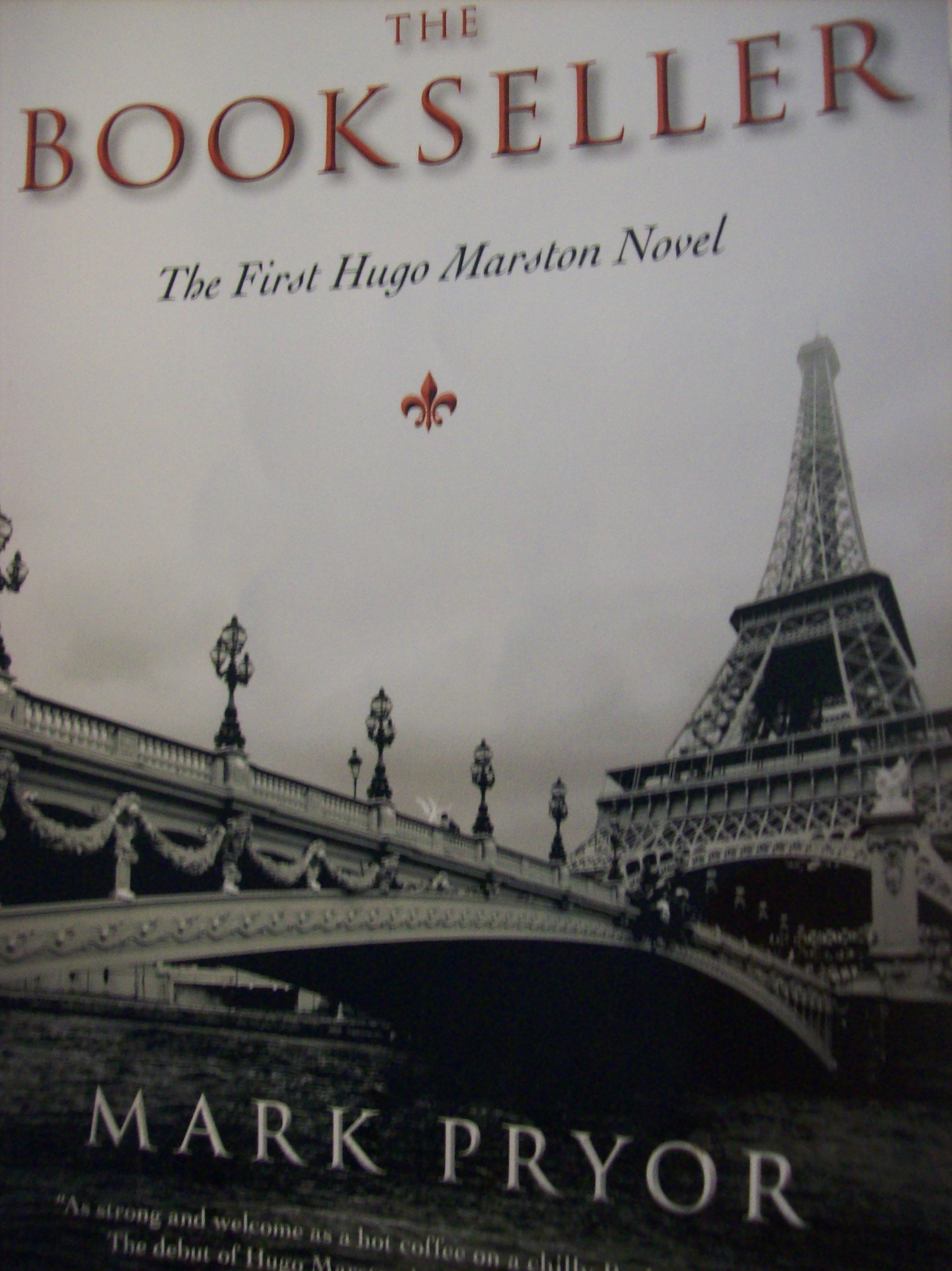
I’m reading a novel called The Bookseller by Mark Pryor. I like it so far, but something (really trivial) about it kind of bugs me.
The subtitle (shown in the above picture) says “The First Hugo Marston Novel.” Okay, I thought, that’s nice; I’m reading the first book in the Hugo Marston (whoever he is) series. Then, after reading the back cover of the book, I learned that The Bookseller is the ONLY Hugo Marston novel (so far…). Not only is The Bookseller Mark Pryor’s ONLY Hugo Marston novel (so far), it is Mark Pryor’s only novel (so far).
I’m not an expert about the publishing business. I figured a guy like Mark Pryor would write a mystery/thriller like The Bookseller with a protagonist named Hugo Marston, and if the critics liked the book enough and if it sold enough copies, then Mark Pryor could write another book with Hugo Marston, and if that was successful, then a series could be made. I didn’t know previously unpublished authors could determine that their first books would be the beginning of a series.
I knew guys like Stephen King or James Patterson could start a series whenever they felt like it, but I didn’t know debut authors could begin a series with their first book. I guess I have astonishing gaps in my knowledge.
When I wrote my first (and so far only) e-book Having a Few and Getting Some, I did it under the assumption that only a few people would read it (and so far I’ve been correct). I never assumed it would be a series. I have no plans for a sequel (tentatively called Having a Few More and Getting Some Too). I may change my mind later, but I would never have assumed that my first book would be the first of a series.
Anyway, it’s Mark Pryor’s first novel, and his main character is already getting a series. The Bookseller is a decent book, but I don’t know if Hugo Marston is series-worthy yet. That seems a bit presumptuous. First of all, it tells me that Hugo Marston will survive whatever happens to him in his first novel. A protagonist should have to be scared for at least one book. No wonder Hugo Marston acts cocky throughout the novel; he knows he gets a series.
I guess Hugo Marston doesn’t have to worry until the book cover says “The Final Hugo Marston novel.” Let’s see how cocky Hugo Marston acts then.
*****
In a few months, The Crypt Thief: A Hugo Marston Novel is being released. It doesn’t say “The Final Hugo Marston Novel” or “The Last Hugo Marston Novel,” so Hugo Marston has no reason to be nervous yet.

If somebody told me that this entire aisle was filled with James Patterson novels, I might (maybe) believe it. (Photo credit: Wikipedia)
I want to read a James Patterson novel. He’s a popular author, and I’ve never read any of his books, so I went to the library last weekend and realized I was out of my league. An entire shelf was filled with James Patterson novels, not because he was the library’s featured novelist, but because he’s written so many books that it took an entire shelf to showcase them.
Staring blankly at the selection, I noticed that James Patterson co-writes a lot of his books with various authors (whose names I didn’t recognize). This is great for James Patterson because he can put his name on a lot more books. This is great for the co-authors because their names are on books that are guaranteed to sell. This is good for the public because book readers have more (but not necessarily a better) selection of mystery/thrillers.
If I were a mystery/thriller author who was not James Patterson or one of his co-authors, I’d be kind of ticked off.
I’m guessing that James Patterson is a hack, and I don’t mean that as an insult.
I’d like to be a hack, but since I’m probably not good enough, I have to settle for making fun of them (not that they care because they have tons of money, and I don’t). For the last year, I’ve been making jokes about Sue Grafton and her alphabet series, without realizing that she’s an amateur compared to James Patterson (I have some weird gaps in my knowledge).
Now that I have finally recognized the awesome hackery that is James Patterson, I finally present…
THE “JAMES PATTERSON IS A HACK” CHALLENGE!
Below is a list of some James Patterson book titles. I also added three more fake titles. Without cheating (like checking up on Wikipedia or Patterson’s home page), pick out the three fake book titles.
Along Came a Spider
The Big Bad Wolf
Cross Fire
Don’t Blink
Dream On
Four Blind Mice
Get Ready, Get Set, Die!
Guilty Wives
I Funny
Jack and Jill
Kill Me If You Can
Kiss the Girls
Little Miss Murder
Never More
No Way Out
Now You See Her
NYPD Red
Pop Goes the Weasel
Roses Are Dead
School’s Out- Forever
Step on a Crack
Tick Tock
Violets Are Blue
Worst Case
Answers are at the end of the… no, they’re not! It wouldn’t be a challenge if I answered it for you.
BONUS CHALLENGE (only for people who have read a lot of James Patterson novels)- Choose one James Patterson book for me to read.
I want to read one (and probably only one) James Patterson novel, but I don’t know where to start. I don’t want to read his YA stuff. I’m not interested in Alex Cross. I’d like one good book that represents what James Patterson writes. I’m not reading it to “hate” it or be overly-critical; I just want to see what his books are like.
If “None” is the only answer I get, then my decision will become easier, but I really hope the answer isn’t “None.”
*****
For more about authors who are (or might be) hacks, read My Favorite Author is a Hack .

WARNING! Nothing like this really happens in Long Story. (Photo credit: Wikipedia)
My tenth grade English teacher Mr. Faggins (pronounced Fay-guns) hated stories where nothing happened. Too many of us wrote stories where we got up in the morning, brushed our teeth, ate breakfast, took a dump, showered (except for the smelly kids), and went to school. Just doing that took up half the page if the student had big enough handwriting.
Mr. Fay-guns wanted our stories to keep moving. That meant that we needed to cut everything that everybody else does. Since everybody eats breakfast, we weren’t supposed to put that into the story, unless something important happened at breakfast. Everything in the story was supposed to be unique to the characters in some way.
At the same time, I wanted to build suspense. Building suspense meant slowing the action down. Danny Dornan, my main character, had to go through his every day routine with the anticipation that something really horrible was going to happen later. This was new for me. I don’t think I had ever attempted to write suspense before.
*****
Long Story
Chapter 5
The Dead Man
I was a dead man, I was sure of it. I had just beaten up the ten-year old Johnny Curse, and he was going to tell his older brothers, and they were going to beat the tar out of me. They would knock my teeth out. They would kick my head in. They would intentionally break my bones and laugh while they did it. No parents could stop them. No police could help me. The Curse brothers would find a way to get to me.
It was Melinda’s fault. My former sweet-voiced dimwit of a girlfriend had betrayed me. I knew that as a boyfriend I should have protected her before she got hit with the rock. But as my girlfriend she should never have put me in that situation. She had started the entire confrontation, and I had felt the responsibility to step in, but I had waited too long. Now I had no girlfriend, and the Curse brothers were going to kill me.
I still had to go to school. Even though the Curse brothers never attacked in the morning, I still ran. I had to will myself to slow down my pace once I stepped into the school building.
My friends said hi and tried to make small talk, and I did my best to answer, but I always looked over their shoulders for signs of the Curse brothers. Everybody else seemed to be acting normal. There didn’t seem to be any whispering or side-view glances at me. There were no smirks or double-takes or wide-eyed stares as I walked down the hallway. Nobody muttered death warnings to me as they passed by. I was ignored like I was every normal day at school.
In fact, nobody seemed to know that I had beaten up Johnny Curse. It seemed like Melinda hadn’t said anything. The Curse brothers hadn’t said anything. I wasn’t going to say anything. I couldn’t brag about beating up a ten-year old. I wasn’t ashamed because I hadn’t had much choice, but I would have been grateful if nobody ever heard about it.
I was still scared, and the adrenaline made my brain work faster. In math, the teacher called on Melinda, and the class snickered when she maintained her silent vacant stare. When the teacher called me, however, I had my answer ready. In fact, I started raising my hand, volunteering correct response after correct response. I raised my hand so much the teacher got annoyed. If I was a dead man, at least I would die as a good student.
At lunch a few friends had realized that I wasn’t talking to Melinda, and somebody finally asked if we had broken up.
“I don’t want to talk about it,” I answered.
“Did you break up with her, or did she break up with you?” somebody asked.
“I broke up with her,” I lied. I knew to never admit that I had been the one that got dumped.
“Why?” one of my friends asked. They were stunned that I would break up with a girl. Then again, they had been stunned when they found out that I had a girlfriend.
“I’ll tell you everything later. I’m hungry.”
Everybody understood that, so they talked about other stuff while I ate lunch.
“Hey, did you hear what the Curse brothers did to Randall?” one of my friends asked the group.
I kept eating as I listened to the conversation.
“They gave him a swirlie and a wedgie in the B hall bathroom.”
“They gave him a swirdgie?”
“I thought the swirdgie was a myth.”
“I saw Randall myself. He was walking funny and had wet hair flopping over his face.”
“Was his underwear pulled up to his shoulders?”
“No, he fixed it before he came out of the bathroom. But I swear he was walking funny.”
“Did you ask him if he really got swirdgied?”
“You don’t talk to a guy who just got swirdgied. It’s rude.”
“Did they beat him up?”
“No, they just swirdgied him.”
It was weird hearing my friends laughing about Randall getting a swirdgie because something like that could have easily happened to them too. The laughter was out of relief more than humor, though. The Curse brothers went easy on Randall. Humiliation was pretty bad, but they left his face alone. I was sure they wouldn’t let me off the hook that easily.
I took the swirdgie as a good sign. If the Curse brothers weren’t in a violent mood, maybe they weren’t mad that their little brother had gotten beaten up. Maybe they knew that their little brother shouldn’t throw rocks at girls. Or maybe Johnny hadn’t said anything to them about it. Maybe the Curse brothers wouldn’t come after me at all.
I wasn’t taking chances. After school, I took the longest indirect route to my house, going steering clear of any landmarks that the Curse brothers were known to hang out at. I even snuck through a couple back yards to make sure I wasn’t seen on streets with good ambush sites. The walk home took over an hour, but I got there safely.
Homework that night was a breeze. I couldn’t believe how fast my mind worked when I was scared. I thought I wouldn’t be able to concentrate. I thought I’d be so sick with worry that I wouldn’t be able to think about anything except the Curse brothers. Instead, it was like my brain craved something else to think about. I was always a pretty good student, except when Melinda was my girlfriend, but my mind suddenly became super-smart. My homework was done within a couple hours. I loaded everything into my backpack.
I was suddenly optimistic. There was no way the Curse brothers would attack me before school. That kind of thing just didn’t happen. All I had to do was find a new indirect path home every day for the next couple years, and I’d have it made. Maybe I wouldn’t have to this for long. Maybe the Curse brothers would find some other better target soon. For the first time in 24 hours, I started to feel good about life.
*****
To be continued in Long Story: The Climax … because you know a story can’t end like this.
Or to start “Long Story” from the beginning, read Long Story: Teachers with Funny Last Names .

Grammar Police Rule #1: Don’t say the word “ain’t” three times a day, or else! (Photo credit: Wikipedia)
When I was a kid, nobody in my house said the word ain’t. In a way, the word ain’t was worse than profanity. I heard my parents say other inappropriate words like the F-word, and the Shhhhhhh-word and the word that rhymes with Mod-Gammit, but I never heard my parents say ain’t.
I think I said ain’t a couple times and was corrected, but I didn’t get my mouth washed out with soap for saying ain’t. I got my mouth washed out for saying other words, so in that regard, ain’t wasn’t worse than profanity. I just knew not to say it.
In elementary school, I had a friend who used to say, “Ain’t ain’t a word, so you ain’t s’posed to say it three times a day cuz it ain’t proper.”
The humor in that statement was that the word ain’t was used four times in one sentence when you weren’t supposed to say it three times in one day. I had some rebellious friends. That same rebellious friend became a police officer (but NOT part of the grammar police), but I don’t know how long he was a cop. When I last spoke to him (over twenty years ago), he said, “I can’t believe I’m a f###ing pig.”
But I don’t remember him saying the word ain’t during that entire conversation.
WHY IS AIN’T IMPROPER?
Most (if not all) forms of the verb be have contractions. Is not has isn’t. Was not has wasn’t. Were not has weren’t.
And a few hundred years ago, am not had amn’t.
Somewhere along the way, amn’t became ain’t. And somewhere along the way, ain’t became improper.
PURE SPECULATION ALERT!!!
Amn’t does not (or doesn’t) roll off the tongue. It sounds like a mild form of profanity. Say amn’t and dammit in the same sentence, and people could get confused. Dropping the m makes it much easier to say. Unfortunately, that makes the contraction an’t which can be confused with ant or even aunt. The pronunciation then may have changed to ain’t because people would rather sound low class than be confused.
If a bunch of linguists and etymologists are shaking their heads in disgust right now, then I’ve done my job well.
HOW TO USE AIN’T CORRECTLY
Even if ain’t were proper (and it isn’t), people who say ain’t usually use it incorrectly. Ain’t was originally the contraction for am not. In order to say am not properly, you need the subject I.
For example, you might say, “I am not ever going to read another John Grisham book again.” Therefore, saying “I ain’t ever going to read another John Grisham book again” might have been grammatically correct a long time ago. And from my point of view, the statement is also factually correct.
However, it is grammatically incorrect to say, “We am not ever going to read another James Patterson novel.” The sentiment might be right, but the grammar is not. Therefore, saying “We ain’t ever going read another James Patterson novel” would never have been grammatically correct.
It is incorrect to say, “He am not (ain’t) going to ever read another Tom Clancy novel again.”
It is also incorrect to say, “She am not (ain’t) going to read another Janet Evanovich novel ever again.”
Technically, the only time ain’t should be used is when I is the subject. That might be what originally infuriated the English language purists. It wasn’t the word ain’t itself; it was probably the overuse.
So if you want to frustrate a grammarian (it’s fun to do on a slow day), use the word ain’t properly.
IS AIN’T A DYING WORD?
I don’t hear the word ain’t used frequently anymore. As a kid, I heard it all the time, and it was corrected a lot. Today, I live in a section of the United States that is reputed to use ain’t, but I don’t hear it. I even hang out with the type of person who is supposed to say ain’t, but I still haven’t heard it used much. Maybe ain’t is on its way to becoming a dying word.
No matter how much its use may decline, ain’t will never be a completely dead word. It’s too easy to say to ever go away. Plus, it will always be fun to watch the grammarians get mad.
*****
I just read this whole thing out loud. If I’m not supposed to say ain’t three times a day, then I’m in huge trouble with the grammar police. But my rebellious police officer friend would be proud of me.
*****
If you’re the type of person who is interested in the word “ain’t” and other grammatical issues, you might also like…

Now available on the Amazon Kindle!

(Photo credit: Wikipedia)
My tenth grade English teacher Mr. Faggins (pronounced Fay-guns) warned us not to put bad language or inappropriate adult situations in our short stories whenever he assigned us narratives. “If you can’t say it or do it in school without getting into trouble,” he’d say, “then don’t put it into your story.”
“But people swear in real life,” Denise, the cheerleader with really nice legs, said one day during a rare class discussion. “How should we handle that? Do our characters say ‘Darn’ and ‘Shucks’?”
“Or ‘dagnabbit,’ ” I whispered to her.
“Or dagnabbit,” she said with a hokey accent.
The class laughed.
Mr. Fay-guns smiled at Denise. “I’ve always liked ‘dagnabbit.”
His suggestion was that instead of writing out the curse words with symbols like in the cartoon strips, we should just say that the characters cursed or used inappropriate language. He said if we wanted to rewrite the stories with the actual words, then we could do that at home on our own time, but not to bring those versions to class.
I avoided the adult situations in “Long Story.” There wouldn’t be any nudity, but there would be a little violence and a lot of cursing, so I had to be careful when writing these scenes, especially if I was going to read this story to my English class.
Technically, I don’t think this part of “Long Story” worked well, but my English class found it entertaining when I read it to them.
*****
Long Story
Chapter 4
The Rocky Relationship
Since I had so much homework to do in the next two nights, I had to walk Melinda home the short way . There would be no malts at the ice cream shop. It would be a straight walk to her house, which meant passing through Curse brother territory. I had fallen in love with Melinda’s voice, but as we walked and she chatted, I was mentally going over my homework and keeping an eye out for the Curse brothers. I tried to pick up the pace, but then she would intentionally slow down.
“You should enjoy the time you’re spending with me,” Melinda said. “Once I get home, all you have left today is homework. Lots and lots and lots and lots of homework.”
“You’re making fun of my situation,” I complained. If I didn’t turn in all my homework by Friday, I’d fail math and lose my teen phone line.
“My parents don’t complain if my grades are bad,” Melinda said. “As long as I do my chores and stay quiet, they leave me alone.”
“Stay quiet? You talk to me every night until three in the morning.”
“I talk quietly.”
We were just a few houses away from her home when it happened. We really should have walked faster.
“That’s Johnny Curse,” Melinda said, pointing at a kid a few houses down. Johnny was a skinny ten-year old runt kicking a soda can down the middle of the street.
“Everybody knows Johnny Curse,” I said. Even though he was five years younger than me, I felt like hiding. His three older brothers terrorized the neighborhood, and I didn’t want him seeing me. Johnny Curse liked to start fights with older boys because he knew we couldn’t fight back without his older brothers kicking our teeth out. So we older boys stayed away from him.
“I hate that kid,” Melinda said, all sweetness gone.
I hated him too, but I was also scared of him, so I tried to veer Melinda off the sidewalk behind some trees so the little Curse brother wouldn’t notice us. I should have kissed her just to get her attention off him, but I was more worried about not getting seen. As I tugged Melinda off the sidewalk, she pulled back and howled out a bunch of four letter words at Johnny Curse.
I was shocked. I had never heard her voice like that. I had never heard anybody talk like that to a Curse brother. And it had happened so quickly.
Johnny Curse stopped in the middle of the street. Once he saw it was Melinda shouting profanities at him, he grabbed the soda can he had been kicking and flung it at her. The can was empty so it only made it a few feet before it dropped harmlessly. Melinda cackled at him and howled out even more profanity. Johnny shouted a bunch of inappropriate words at Melinda and started flinging gravel rocks at her.
I had backed away from Melinda so the rocks whizzed past her head but weren’t anywhere close to me. As Melinda’s boyfriend, I knew I should have protected her. I should have gotten between her and the rocks. I should have charged at the boy threatening her, but I stood and watched. I was a fascinated outsider.
I had never heard so many curse word combinations at one time, especially from a girl. Melinda’s shrill voice hurt my ears, and I suddenly knew that’s what she would be like in a few years. I had seen angry mothers with frightening voices, and that’s what I saw her becoming. A demon had possessed my sweet-voiced dimwit of a girlfriend, and now that I’d seen that side of her, I could never believe in her sweet voice again.
Melinda continued her string of four letter, five letter, six letter, and seven letter words in combinations I had never heard before. She even used a twelve letter word several times, but that could have been a compound word of six letters each. When she was finished and the demon in her was done, Johnny was silent. Melinda had out-cursed a Curse brother.
Then a rock bounced off Melinda’s forehead, and she collapsed.
She wasn’t dead or anything. Her hands covered up her head, and she rolled on the ground, and I knew that running to her wouldn’t do any good. We’d just get pelted with more rocks. Johnny danced and laughed, and seeing that ten-year old bouncing with such glee …
I rushed him, but when I got to him I didn’t know what to do. I couldn’t punch out a kid that small. I didn’t know if I should pick him up and shake him, or throw him against something, or drag him to his parents. I got within arm’s reach and froze, and he punched me in the groin, and it hurt more than I expected it to, not enough to make me fall, but enough for me to act decisively.
I pushed Johnny hard, and he stumbled backward and fell against a parked car. Johnny jumped toward me again, but I was used to the ache in my groin now, so I braced myself and when he punched me again, I took it, drove my body into his wiry frame, and took him down. I mashed his face into the dirt and grabbed both his hands behind his back. Once again, I didn’t know what to do. I knew this position would look bad to anybody passing by, so I couldn’t stay like that for long.
So I picked him up, kicked him in his butt, and threatened him as he ran off. Then I turned to Melinda. She was bleeding a little on her forehead and was crying. Between the blood and the tears and the snot and the demonic voice, I was afraid to approach her. And I was right to be scared of her.
She pointed her finger at me and started cursing at me. She said I was a terrible boyfriend because I hadn’t protected her. I couldn’t argue with that. Then she said horribly inappropriate things about me, made false accusations about my parents and dogs, and broke up with me without actually saying that she was breaking up with me. I couldn’t respond to her. It didn’t seem right to curse back at her since she was the one who had been hit with the rock. So I figured I’d better get home before Johnny rounded up the rest of the Curse brothers to pound my face in.
The whole thing was really intense. But I can’t tell you what she said because it would be inappropriate for school.
*****
To be continued in Long Story: Foreshadowing and Building Suspense .

Even though Stephen King’s essay “Guns” is about gun control, my essay about Stephen King’s essay is not (about gun control). (Photo credit: Wikipedia)
Stephen King wrote a 25 page essay about gun control, put it on the Amazon Kindle, and now it’s a top ten Amazon Kindle bestseller. I’m not going to read a 25 page essay about gun control (that may be more a reflection on me than Stephen King). I can barely read the 2nd Amendment without seeing the yellow dots of sleep.
25 pages isn’t long for an essay about gun control. I bet any gun control legislation that is passed (or proposed) will be way over 25 pages long (and probably filled with a bunch of stuff that has nothing to do with guns). If it’s any consolation, I won’t read that either.
I usually get annoyed at celebrities who spout off about politics, but I don’t get annoyed at authors who write about political issues. That’s what writers should do. If there’s one group of celebrity that should talk (or write) about politics, it’s authors. I may not always agree with the ideas of other writers, but their views are probably better thought out than those of most celebrities (like actors, singers, musicians, or athletes).
In fact, I hope other famous authors start writing about gun control too. Maybe Tom Clancy can write a response, except he’d probably make it a 1,000 pages long with way too much filler.
Maybe Sue Grafton could write about her views on guns, but she’d probably write an alphabet series of 26 essays and title the first one “A is for Automatic.”
Maybe James Frey could write about his thoughts on guns, but he’d probably make up a bunch of really wild stories about hanging out in a destructive gun control, and then we’d find out years later that his stories weren’t true.
Even if I wanted to read Stephen King’s essay on guns, I don’t want to pay to read it. Why should I pay a famous guy to tell me his opinion? If anything, he should pay us for reading his opinion. Better yet, he should offer free e-copies of his older books (like The Shining or The Stand) for downloading his essay. I’d gladly read his essay about guns if I could get a free e-copy of Different Seasons. I’d even take a quiz to prove that I’d read it.
As a writer, there’s one thing that bothers me about this Stephen King essay: Stephen King reportedly wrote his essay while he was angry. Then his editors approved it. What editor is going to say no to an angry Stephen King?
I have never written a book about writing like Stephen King has, but even I know that writing (and publishing) while angry is not a good idea. Then again, saying no to an angry Stephen King is probably an even worse idea. If I were an angry Stephen King’s editor and he turned in a manuscript that said “Whffl nk;rt vkld qtbl,” I’d say it was great!
But I’m sure his essay is not written like that.
Stephen King’s short novel Rage (about a school shooting) was linked to several school shootings a couple decades ago, so that gives King a perspective that most authors don’t have. From what I understand, he discusses Rage in his essay, and that part is probably worth reading (but I’m still not going to pay for it).
*****
Maybe I shouldn’t get annoyed at celebrities who spout off about politics. That’s their right. I think the 1st Amendment gives them that right (but I see yellow dots when I read that too). The problem is that celebrities usually don’t know what they’re talking about, and the coverage of the celebrity’s opinion takes air time away from experts who might inform the public (if the public is willing to listen to experts).
Maybe I should get annoyed at the news folk for reporting on the celebrities who spout off about politics. If the news didn’t report it, then I wouldn’t hear about it, and I wouldn’t get annoyed. Or maybe I get annoyed too easily.
I don’t know if Stephen King’s essay is any good, and I don’t really care. My mind is already made up on the issues of gun control, and I can tell from the reviews where he stands. But I don’t have a problem with famous authors writing about political issues. I’d rather have authors spouting off about politics than actors, singers, or athletes. At least with an author, the sentence structure will be pretty good.
If Stephen King writes an essay that can explain the fiscal cliff, I might pay $.99 to read that.
Related articles
- Stephen King writes post-Newtown essay on guns (boston.com)

When I was in tenth grade, I knew nothing about women (I probably still don’t), but since I was writing a short story about a girlfriend, I had to pretend to be an expert. (Photo credit: Wikipedia)
My tenth grade English teacher Mr. Faggins (pronounced Fay-guns) often suggested that we students write about what we knew. The problem was that my main character in “Long Story” (the story I was writing for Mr. Fay-guns’s class) had a girlfriend, and I didn’t, and everybody in my class knew that I didn’t. I had to be careful, especially with the possibility that I would read my story aloud.
If the girlfriend in my story sounded fake, then everybody would be reminded that I didn’t have a girlfriend, so I had to make the girlfriend sound realistic.
I had friends who had girlfriends, and all those friends did was complain about them. It was an easy solution once I thought of it. I simply took a bunch of the complaints about girlfriends (except for the complaint about venereal disease because that would have gotten me in trouble at school) and put them into “Long Story.”
*****
Long Story
Chapter 3
Girl Talk
It had been three weeks since Melinda became my girlfriend, and in that time I learned that Melinda was great at talking. I had a teen phone line in my bedroom, and she kept me up until 2:00 or 3:00 every morning. I loved her voice. I still did. I could listen to it forever. Each emotion brought out a different sensation in my ear, and her emotions changed in an instant.
She talked about her puppies. She talked about her sisters, and her parents, and other kids at school, and her teachers. She talked about becoming a veterinarian. A veterinarian? How could she become a veterinarian when she couldn’t even complete simple math problems? I never asked her that. I just kept the phone to my ears and listened.
She talked nonstop when we walked home from school every day. We always took the long way to avoid the Curse brothers, and so far my strategy had worked. Last week the Curse brothers had beaten up a kid outside a video game arcade, but that place was way off our route home. I hadn’t seen even a glimpse of the Curse brothers in the last few weeks. Life should have been great.
But my grades were going down. These late nights on the phone were killing me at school. I couldn’t concentrate in class. My math teacher had called on me one day, and I couldn’t answer the question. I just stared vacantly. Then the teacher called on Melinda, and she just stared vacantly too. The whole class laughed at us. I would have laughed, but it wasn’t funny. Report cards were coming out soon. If I failed math, my parents were going to take away my teen line, and then I wouldn’t be able to listen to Melinda’s voice anymore.
One day the counselor called me to her office during study hall. She had long graying hair, and was kind of skinny, and she had a runny nose. It didn’t run down to her lip like it does with some of my friends, but she sniffled a lot really loud.
“Danny,” she said. “Your grades have… dropped drastically over the last few weeks.”
She put her paperwork down and looked me in the eyes. “Is there… anything… you… need to tell me?”
“No, ma’am,” I answered. “I’ve just been tired lately.”
“Is… everything… okay at home?”
“Yes, ma’am,” I said. “The problem is that I’ve got a girlfriend.”
“Oh,” she said. Like everybody else I knew, she was surprised I had a girlfriend. “Does she… take… a lot of your time?”
“Yes, ma’am.”
The counselor nodded and gave me a huge stack of papers. “These… are the missing assignments from… the last three weeks. You need to get all of this work done before… the end of the grading period in order to… pass.”
“When is that?”
“Friday,” she answered.
“What?” That was in two days. I knew that I could do it, but it would be a lot of work. For two straight nights I’d have to go straight home and do nothing but homework. I could do it.
“You can’t do that,” Melinda protested at her locker after school. “You have to spend time with me.”
“We can talk this weekend,” I said, almost frantic. “But I have to do my homework tonight.”
“You’d rather do your homework than spend time with me?” She folded her arms and looked down at me, even though I was taller than her.
“If I don’t do my homework, then I’ll never be able to spend time with you again.” That was a dramatic statement, but I thought it had a chance of working.
“At least get me a malt at the ice cream shop,” she demanded.
“I have to go straight home.”
“Then at least walk me home first.”
“I have to go straight home!”
“Then call me when you get home.”
“I need to get all my homework done before I call you. I promise, I’ll call when I’m done.”
Melinda must not have believed me because my teen line was ringing when I got home.
“I just wanted to make sure you were okay,” she said.
Her voice still caused tingles to go down my neck and back, but I was getting annoyed. “I told you I have to do my homework before I talk to you.”
A few minutes later she called again. “Are you mad at me? You sounded mad at me when you hung up.”
This time I disconnected the phone.
The door bell rang about 30 minutes later.
“No,” I said, slamming my pencil down on the dining room table where I was doing my homework. “Please don’t be her,” I repeated as I trudged to the front door. “Please don’t be her.”
It was her.
“We need to talk,” Melinda said. “You can’t just hang up on me like that. That was very rude.”
I didn’t realize that I had hung up on her. “I really have to get my homework done.” I was whining. I could feel it. I couldn’t stand the tone of my own voice, it was so whiney.
“Invite me in,” she said. “I’m not a vampire. We can do our homework together.”
“You don’t do homework. You don’t care about homework.”
She smiled. “Then walk me home. It will take you longer to argue with me than it will to walk me home.”
She was probably right about that. I was starting to wonder if she was as dimwitted as she acted. So I took a deep breath, and I walked her home that afternoon.
And this is where it became a really long story.
*****
To be continued in Long Story: Content Not Suitable For Children .
Or to start “Long Story” from the beginning, read Long Story: Teachers with Funny Last Names .

If you think Scrabble is difficult to play without using the letter “E,” try writing a 50,000 word book without it. (Photo credit: Leo Reynolds)
As much as readers and writers love literature, we have to admit that the literary world abounds with bad ideas. For example:
* Snooki got a book deal.
*Somebody other than Mario Puzo wrote a sequel to The Godfather.
*Sue Grafton’s alphabet mystery series is a bad idea (A is for Alibi, B is for Burglar, ugh!… but it seems to be working for her. Bad ideas work sometimes).
* Stephen King is writing a sequel to The Shining (the sequel and the idea behind the sequel both seem like bad ideas to me, but he’s Stephen King, and I’m not).
*Madonna writes children’s books.
*Ernest Hemingway supposedly wrote a six-word short story on a napkin. A six-word short story is a great idea, but writing a story on a napkin is not.
But the worst idea ever in literature was Gadsby: A Lipogram Novel by Ernest Vincent Wright in 1939. The bad idea behind the book? 50,000 words without the letter “E.” That’s it.
Writing anything without the letter E is difficult. Even Hemingway’s mythical(?) six-word story (“For sale. Baby shoes. Never worn.”) had a bunch of Es. Ernest Vincent Wright’s name had a few Es in it (that didn’t count, he claimed, and I agree with him on that). “E” is the most commonly used letter in the alphabet, (according to the Oxford Dictionary ) used 57 times more than the least used letters “J” or “Q.” I was expecting “Z” to be the least used letter, but I’m not going to argue with Oxford.
Gadsby: A Lipogram Novel or (Gadsby: Champion of Youth ) is not the WORST BOOK EVER! It’s just the worst idea. Since Wright wrote 50,000 words without using E, I’ll give him some credit. If he had slipped up and accidentally used an E, then it would have been worst book. If he had gone insane and had pages filled with “EEEEE I can’t take it anymore!! EEEEEEE!” then his book might have been WORST BOOK EVER! But he was successful. And I’ll give an author credit for successfully completing the WORST IDEA ever.
Writing without any Es is the ultimate literary gimmick. Literary gimmicks, however, should add something to the piece of literature. If a book is consumed by the gimmick, then the piece of literature is… gimmicky? And Gadsby was definitely consumed by the gimmick (and consumed by a fire too. Most copies of Gadsby burned in a warehouse fire in 1939, so original copies of the book are very rare.).
Even without the gimmick, Gadsby probably wouldn’t have been for me. Gadsby is about youth. I don’t care for kids all that much. I love my own kids, but I’m not really interested in the “Champion of Youth.” To read a 50,000 words book (with or without Es), I have to be interested in the topic, and even then there’s no guarantee that I’ll finish the book.
When reading the prose of Gadsby: Champion of Youth, I was always aware of the lack of an “e.” I couldn’t get into the story (if I ever got to it, I’m not sure) because I was too aware of the e-lessness of the text.
I’ll give Ernest Wright credit for a couple things. He’s achieved something nobody else has done. I’m pretty sure nobody is going to write a 50,000+ word book without an E. Then again, some people will do anything for attention. Wright also created a book that people should know about. Even if this book was a really bad idea, people should at least be aware of its existence. And flip through a few pages (probably e-pages). And then laugh (or nod) and move on to something else.
ONE SENTENCE WITHOUT AN E
Writing without that most common word symbol is fun as a brain building opportunity, but analyzing words is not amusing and it hurts my mind.
TRANSLATION
Writing without an E is fun as a challenge, but reading the results can be a chore.
*****
DISCLAIMER!
I don’t know if a 50,000 word book without Es is really the worst book idea ever because I haven’t heard every single book idea ever. So if you’ve heard of a worse idea, feel free to let me know.
*****
Maybe I shouldn’t speak badly about a book with no letter “e.” My own ebook is about a story that I wrote in high school (a YA romance) and some weird stuff that happened to me after people read it.
Like I said, it might have been a bad idea, but I used every single letter in the alphabet.
Now available on the Amazon Kindle!

After a run-in with the Curse brothers, Danny Dornan would need lots and lots of adhesive bandages. And maybe a doctor too. (Photo credit: Wikipedia)
I took a risk by starting my tenth grade narrative “Long Story” with a romance when there was a chance I’d have to read it in front of the class. Tenth graders don’t have a lot of patience for romance, unless there are naked bodies and some humor. I could put some funny moments in my story, but all my characters had to keep their clothes on. As I read my story to the class, my peers laughed every time I said “sweet-voiced dimwit.” But a high school story also requires some action.
Therefore, “Long Story” needed a villain. In high school, the perfect villain is the bully. Everybody hates bullies. Even real life bullies hate bullies in fiction. And the only thing worse than a bully is a group of bullies, so I created my own team of evil bullies.
And thus, the Curse brothers were born! Danny Dornan, the protagonist of “Long Story,” was in trouble now.
Long Story
Chapter Two
The Curse Brothers
That sweet-voiced dimwit was going to get me killed.
I had just convinced Melinda to let me walk her home after school when I found out that she lived on South Wade Street. There wasn’t a lot wrong with South Wade Street. It wasn’t rundown or anything like that. The houses were kind of nice. There weren’t a bunch of murders or crime or anything like that. South Wade Street would have been a nice neighborhood, except for the Curse Brothers.
There were four of them: Tommy, Joey, Timmy, and Johnny Krzinski. They were called the Curse brothers for several reasons. It was easier to say “Curse” than “Krzinski.” All four liked to curse a lot. And everybody that crossed their path was cursed. Even the mother was cursed because she was dead. The three oldest Curse brothers were built the same, with bodies like tanks and faces like pizzas. The youngest was Johnny, and he had the body of a turd, small, dirty, and smelly.
Johnny might have been the youngest and smallest of the Curse brothers, but he was the most dangerous. Since he had three older brothers that terrorized the neighborhood and protected him, he knew he could get away with anything. He picked fights with older kids and then laughed when his brothers beat them up for him. That meant that a bunch of high school kids had to run away from a ten-year-old. It had never happened to me, but I could imagine the humiliation, getting taunted by the skinny Curse runt while the older brothers lurked in the background, waiting to pounce in a Pearl Harbor style attack.
One of my friends got chased by Johnny Curse once. Johnny threw a bunch of rocks as my friend walked home. The other Curse brothers stood a few feet behind Johnny and laughed. My friend tried running, but he tripped, and he got clobbered with a rock. The Curse brothers laughed so hard that they couldn’t even follow my friend the rest of the way. I guess he was lucky the Curse brothers had a sense of humor.
Timmy Curse was in tenth grade with me, and I had managed to stay off a first name basis with him. Every once in a while, he’d say something like “Hey, stupid,” or “Hey, fairy,” but then he’d walk away. That’s how the Curse brothers were. If one of them said “Hey, stupid,” you were usually okay. If one of them said, “What are you looking at?” then you’d better start running.
That’s what had happened to my friend Rodney last summer. He was walking home from a chess tournament when the Curse brothers surrounded him. As they came up to him, Timmy had yelled at him, “What are you looking at?” Rodney stood there and said, “Nothing.” Then he got beat up.
I guess the Curse brothers didn’t like people looking at them, so the trick was to look for the Curse brothers without appearing to look at them.
I really didn’t want to get beat up by the Curse brothers while walking Melinda home. But I couldn’t admit that to her. No guy wants to look like a coward in front of his girlfriend. Even if I am a coward, I didn’t want to look like one. So I had to convince Melinda to walk home the long way without he knowing I was a coward.
“We can talk longer if we take the long way to your house,” I said, almost cringing. I loved hearing Melinda’s voice, and the point of walking her home was to hear her talk, but I thought she could sense my fear of the Curse brothers.
“And you can buy me a malt at the ice cream shop,” Melinda said with no hint of sarcasm in her voice.
“Yeah, that’s what I meant,” I said, relieved that she wasn’t a mind reader.
So I slung Melinda’s pink Josie and the Pussycats backpack over my shoulder, and we walked down the school hallway to the crowded exits.
A pink backpack would normally make a guy like me a target, but nobody said anything. One guy in the hallway was about to. I could see him notice me and the backpack, the smirk growing on his face as he thought of his insult, and then he saw Melinda next to me, and the smirk vanished. Melinda wasn’t pretty, but she was a girl, and most guys will leave other guys alone if they’re carrying a girlie backpack for a girl. It’s part of an unwritten code.
So I made it out of school with my new girlfriend without getting humiliated. Now if I could get to the ice cream shop and to Melinda’s house and back out of South Wade Street without being spotted by the Curse brothers, I’d have it made.
No problem… with a hint of sarcasm.
*****
To be continued in Long Story: Write about What You Know .
Or to start “Long Story” from the beginning, read Long Story: Teachers with Funny Last Names .

Writers don’t have to take drug tests. (Photo credit: Wikipedia)
Even though I love reading and writing, there’s a part of me that wishes I could have been an athlete instead. I’d love to throw a perfect 50 yard game-winning touchdown pass in the Super Bowl, but I have a weak arm and no depth perception, so that was never going to happen. I’d love to pitch a perfect game in the World Series, but again, my lack of arm strength and depth perception would get in the way.
Sometimes I daydream about what it would have been like to be a great athlete and enjoy the benefits of my athleticism (except that I was taught that “athleticism” isn’t really a word). I daydream of the money, fame, and hot chicks with cleavage that follow professional athletes. Then something bad happens to these professional athletes, and I again appreciate how my life has turned out so far.
Here are a couple more reasons why I am really glad I have stuck to reading and writing instead of playing competitive sports.
1. Drug tests suck.
Taking performance enhancing drugs can get athletes into trouble. Baseball players get rejected in Hall of Fame voting because of suspicion about performance enhancing drugs. Athletes get indicted by the federal government for perjury. Football players get suspended from games.
Lance Armstrong had to humiliate himself by going on Oprah and confessing that he had taken more drugs than he had earlier claimed. When author James Frey humiliated himself by going on Oprah, he confessed to NOT taking as many drugs as he had earlier claimed. At least writers can take a lot of drugs and then write about it and be rewarded for it, even if they were lying about the taking drugs part.
This just demonstrates that nobody cares if authors take performing enhancing drugs. People might make fun of Aaron Sorkin’s alleged drug usage, but it’s not going to stop anybody from seeing movies or television shows that he’s written. Readers might wonder if Lewis Carroll was doped up on opium when he wrote Through the Looking Glass, but he never had to testify in front of Congress for it. The judges for the Pulitzer Prize for Fiction won’t yank the award if they find out Harper Lee drank a bunch of coffee while writing To Kill A Mockingbird (I’m not suggesting she did; I’m just using her as an example).
Writers can take drugs without worrying about drug tests. Athletes have to worry about drug tests. Drug tests suck. Writers win.
2. Concussions suck.
The more we learn about concussions and other head injuries, the more we learn they suck. Football players can get paid a lot of money, but with that fortune comes risk, especially with all the hits they take and the brain damage it can cause. Brain damage is a serious matter, and I’m glad I didn’t participate in a sport where that can be an issue. As a writer, I don’t have to worry about concussions.
If I had been an athlete (especially a football player), I’m at the age where I might not be able to think clearly anymore. I like thinking clearly. I have enough trouble thinking clearly without having taken so many shots to the head. I’m glad that my passion (though maybe not too much talent) is in something that doesn’t physically hurt me.
Concussions in football are not the only dangers athletes face. Basketball players can get an elbow in the face. Baseball players can get a fastball to the chin or a line drive upside the head. Gymnasts take really bad falls. Writers only get piles of rejection slips from publishers and literary agents.
DISCLAIMER: I have been conked on the head once, but it wasn’t because I was a writer (or an athlete). It has something to do with strippers, and I learned my lesson (one of those lessons was to call them “entertainers”).
Writers don’t have to worry about concussions or any other injuries while writing. Athletes have to worry about concussions and other injuries that might affect their quality of life. Concussions suck. Writers win again.
*****
For more about why it’s better to be a writer than an athlete, read More Proof That It’s Better to be a Writer Than an Athlete .


 Dysfunctional Literacy