
(image via wikimedia)
When I went to the used book store a few days ago, I was excited because I hadn’t been surrounded by so many books for so long. Before the lockdowns and the masks, I would go to the city’s main branch public library once every couple weeks, but that has been closed since mid-March, so I’ve been stuck with the remnants of my once great book collection. And that collection is in a closet.
Believe me, I still have plenty of books at home that I haven’t read. After I finished reading my library books, I read East of Eden by John Steinbeck, The Spy Who Came in from the Cold by John LeCarre, and Texas by James Michener. I was even challenged by some guy to read Ulysses by James Joyce, but I told that guy that being in a lockdown was enough punishment for a while. I’m still reading The Bible too. All those books are worth talking about, except Ulysses. I’m not talking about Ulysses.
Before I left for the used book store, I made sure to clean my mask. I usually only wear a mask in grocery stores (I don’t go out much), and I never spend much time there, so I don’t worry about how clean my mask is then. But I knew I’d be in the book store for a while. I even got a new filter. Yeah, I know people get upset about when and where and how you should wear masks, but I’m not that kind of blogger, and I’m just telling you what I did.
As soon as my daughter and I walked into the used book store, she almost ruined the trip by asking an employee for help. She has one book for her summer reading list and… wait a minute… only ONE BOOK!?!? A couple summers ago, she had five books. Now she’s older and has only one book. That doesn’t make sense. And that book is 1984 by George Orwell. Schools must have given up right after the pandemic started. They even gave up on their massive summer reading lists.
Anyway, my daughter asked the employee where 1984 by George Orwell would be. I was disappointed In her. You never ask a book store employee where a book is. You find the book yourself. Only people who can’t read ask for help finding books.
“We could have found the book ourselves,” I said to my daughter as the employee led us around the store.
“This is faster,” she said.
“No, it isn’t,” I said. “I know exactly where 1984 is. Fiction/Literature. Right there.” I pointed to the correct shelf before the employee got there.
“Hmmmfff,” my daughter said and shrugged her shoulders.
There were two copies of the book, one that spelled out Nineteen Eighty-Four and 1984.
“Go with the numerical title,” I said. “Nobody spells out years.”
My daughter agreed. That was the cheaper book and it was in better condition. No bloodstains or boogers.
“Check for missing pages,” I said. That had happened a few years ago when I’d bought a really nice old copy of Dr. Zhivago for a really cheap price. Then I got home and discovered it was missing 30 pages. The used book store didn’t do returns. I didn’t even try. Jerks.
My daughter started walking to the check-out counter.
“I want to browse a few minutes,” I said.
“I already have what I want,” my daughter said.
“I’ve waited four months to be surrounded by books I don’t already own,” I said. “I want to browse.”
“I’m the one who drove,” she said.
“I’m the one paying for your car,” I said. “And your insurance.”
She shrugged again. I set my timer for 15 minutes. I wanted an hour, but my daughter had things to do.
As I waited for a woman to leave the Antique Books alcove (only one customer at a time for each alcove, according to the signs), I strolled through a couple nearby sections. I was still disappointed that my daughter had asked an employee for help. I had never taught her not to do that, though, so maybe it’s my fault. I just thought it was an understood unwritten rule: You don’t ask for help at a bookstore. Maybe it’s a generational thing.
When it was finally my turn to enter the Antique Books alcove, I grabbed an old edition of some classic (I didn’t care what it was). I couldn’t smell the pages through my mask, so I pulled it down over my nose and breathed in.
“Ahem!”
I turned around and saw some woman behind me pointing at her mask and staring at me. Ugh, I thought, a mask enforcer… and she wasn’t even an employee. Just so you know, I respect employee mask-enforcers. But busybody mask enforcers?
“Please step back,” I said in my loud fake police voice. “Only one customer per alcove.” I pointed to the overhead sign. Haha! The woman hadn’t seen it, so all her moral authority was gone. That has to be a bad feeling, to believe you’re superior with moral authority only to find out that your own behavior is just as bad.
I sniffed the book one more time. Then I pulled the mask up over my nose again. I was tempted to hang out longer in the Antique Books section just to antagonize the mask enforcer, but that would have been wrong, so I left and gave her the nod, and she returned the nod. Everything was cool.
I bought a couple cheap paperbacks but nothing noteworthy. I paid for my daughter’s book too. Maybe I’ll read 1984 before my daughter gets to it. Some people call it a warning for the future. I think of it as a history lesson. I wondered if the characters had to wear masks in 1984.
*****
What do you think? Should you ask for help at a book store? Is it okay to pull down your mask to smell the pages of an old book? Would you buy Nineteen Eighty-Four or 1984?

(image via wikimedia)
This is a true story. Yeah, I know; when a writer starts off by saying it’s a true story, you automatically think it’s a lie, but you’ll be able to tell this is true while you’re reading it.
I’m not crazy either. Again, I know a narrator isn’t supposed to say that, but you might think I’m crazy while I’m telling this story, but I’m telling you I’m not. Sometimes you just have to give a narrator the benefit of the doubt.
People will think I’m a liar or a crazy guy because I’m about to claim that I saw a ghost in my house when I was a kid. At the time, I thought it might have been my imagination, but now I’m pretty sure I saw a ghost. I couldn’t tell anybody at the time because I probably would have been punished or laughed at, but now I’m coming out and telling the truth.
There was a ghost in my house. I’m saying it with certainty. I’m 95% sure I’m right. To me, that’s certainty.
I have to set up the situation a little bit, so please stay with me here. When I was in 5th grade, my family lived in the rural south. I’ve written about this time of my life before in a couple other stories on this blog, and I’ll probably write a few more. It was an interesting time.
I was the youngest of four children. My oldest brother had already graduated high school and had moved out (or had gotten kicked out, depending on which version you believe). The next oldest was a senior in high school. My sister was a tenth grader, so I was the youngest by five years.
Our small house wasn’t designed for a family of five, so my parents took a back living room and used that for their bedroom. My older sister got the first bedroom down the hallway, while my older brother and I took the opposing bedrooms at the end. The family room was at the front of the house so you could see down the hallway from there, but we had to go through our parents’ bedroom to get to the kitchen, and there was only one bathroom, which was opposite of my sister’s room in the hallway. These details will matter later on.
Now that I think about it, having only one bathroom created more horror stories than the ghost did, but everybody believes the bathroom stories. Trust me, you don’t want to hear the bathroom stories.
The major dynamic for me was that I was scared of my dad. He was a drinker and could get violent (but not as bad as some drunks that I’ve heard about), and I’d seen him do some some bad stuff and heard him do some bad stuff. I’ve always said that I learned from the mistakes of my older brothers and sister. When I saw them do something that got them severely punished, I told myself not to do those things.
For example, I’d seen my sister and my oldest brother smart off and then get severely punished, so I knew not to smart off. I’d seen my sister lie a few times, and I’d seen her get severely punished. Even with my good behavior, I still got punished a couple times, but not as bad as my older brothers and sister. The worst punishment I took was for something that didn’t even happen (I’m not going to explain it because it- the punishment- happened over 45 years ago, but I still remember it).
Day-to-day life was okay for me because my dad was trying quit drinking and his personality was mellowing out, but his temper could still flare up, and it was unpredictable. My dad was charming when he was out in public, but I was always a little anxious around him in the house. Even as an adult, I never really got over it. Except he’s dead now, so I guess I’m over it after all.
We also had a really nervous hound dog. She was a really cool hound dog. She’d been a stray, and she’d obviously been abused because she was scared of almost everybody, but she trusted me. She would come into the house only if I was with her. If I wasn’t home, she’d refuse, even if you tried to lure her with food.
At night, she would sleep in my room, most of the time on my bed. If I got up to go to the bathroom, she would follow me. She would even follow me to school. She wouldn’t wait for me all day, though. She’d wander off and do dog stuff, but then she’d catch up with us on the way home.
One day she got hit by a car while we were walking home. It all happened so quickly that I couldn’t react. She got hit, and then she rolled around and got up and yowled and ran away from the scene. With all the noise she was making, I thought she was like a headless chicken, running dead without even knowing it. But when I got home, she was wagging her tail in the front yard. She wasn’t even limping.
We couldn’t take her to the vet because she’d get car sick almost immediately. We had learned that the first time when we’d had her checked for everything. If she were going to the vet, she’d need pills and a 24-hour fast. We only had one car, and dad wasn’t going to risk dog vomit in the car, even though he liked the dog. My dad had to spend a lot of time driving that car.
At any rate, this dog was loyal to me. I think the dog trusted me because both of us were nervous all the time. Then the ghost showed up.
And I’ll get to that in the next episode.
To be continued in Childhood Ghost Story: The First Sighting !!
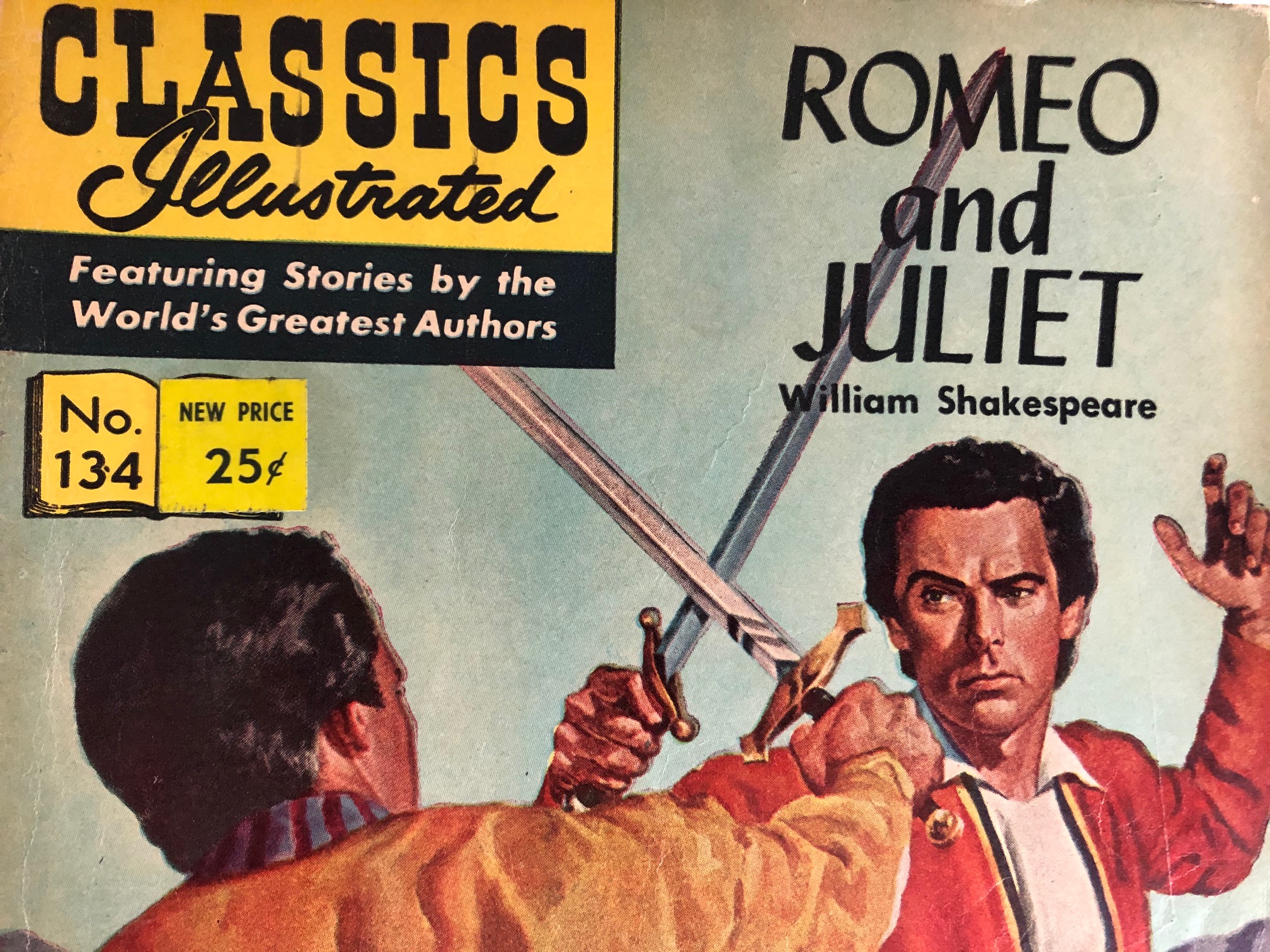
Literary snobs might look down upon comic books, but Classics Illustrated is what got me into reading classic literature. My dad had his childhood collection of classic comic books stored in a cabinet, so my brothers and I would read them on summer days when the electricity was out and weather was too bad to do anything outside.
Classic comic books can’t replace reading the original novel. I’ve always known that. But it’s probably better than just watching a movie, unless the movie is really true to the book and entertaining.
When my 8th grade English class read Romeo and Juliet, I had an advantage over most other students in the class because I knew the story, thanks to this comic book. Like any other 8th grader (except for the weirdos and the super-brains), I still struggled with the Shakespearean language, but I at least understood what was going on.
Just so you know, I used my advantage wisely. I didn’t spoil the ending for anybody. Back in the 1970s and 1980s, we didn’t call them SPOILERS. If some snooty guy ruined the ending of a book that we were reading in class, we called it “helping.” If they ruined a popular movie that had just come out, we beat them up. Remember, I grew up before anti-bullying campaigns existed. So did William Shakespeare.
It would have been tough to ruin a Shakespearean play during the Elizabethan Age because so many of his scripts were based on commonly-known stories. Still, I’m sure someone tried to spoil it a different way, maybe by yelling out popular lines ahead of time or screaming “You suck!” at actors, even if they didn’t suck.
Haha! Yelling at actors. At any rate, here is a comic book review of Romeo and Juliet with no shaky cam.
.jpg)
(image via wikimedia)
It’s tough to say no to people if you’re polite or an introvert. Maybe this doesn’t only apply to polite people or quiet people or introverts. Maybe saying no is tough for everybody.
I started thinking about this topic recently when I refused to make a small donation to a children’s fund and my daughter looked horrified. I don’t even remember which children’s fund it was. It’s probably a scam. I was just paying for groceries, and after I’d swiped my card, the screen requested two extra dollars . I stared blankly, and the clerk asked if I wanted to donate to the charity. I said no without any thought until I saw my daughter’s facial expressions.
“You were rude,” my daughter said, as we left the store.
It’s tough to explain how to say no without making it sound mean. My wife and I work hard, and it seems like more and more people are asking for money or other stuff (and it’s going to get worse). We live in a city with a lot of panhandlers. If I said yes to everybody who asked, there wouldn’t be much left. And it’s important for my daughter to know it’s okay to say no.
“Just say no,” gets made fun of a lot. Back in the 1980s, it was seen as an oversimplified solution to a complicated drug use problem. To be fair, it was a lot better than “This is your brain on drugs. Any questions?” And it was better than “I learned it from you!” Anybody can say no. Not everybody can scramble eggs and blame their parents. But “Just say no” gets a lot of grief. It doesn’t get as much flak as “I’ve fallen, and I can’t get up.” But it’s right up there.
“Just say no” is great when it’s not politicized. If somebody asks you for something and you don’t want to give it him/her, just say no. There’s nothing wrong with saying no. Here are a few steps:
1. Have a strong neutral face.
I was taught to smile a lot and be pleasant when I was a kid, and unfortunately people take that as a sign to use against you. If you’re too approachable, some people will think you’re weak. Work on having a strong stoic blank face. It doesn’t have to be mean. Look in the mirror if you have to and practice being expressionless. This is great prevention. Never being asked in the first place is better than saying no.
2. Recognize and resist shame tactics
Manipulators use shame tactics to get what they want because they know you have compassion. It’s called “weaponized empathy,” where people use your own compassion against you. Shame tactics don’t work if you have no empathy, and a bunch of manipulators know about empathy but don’t have it themselves. Shame doesn’t work once you recognize the tactic, even if you have empathy or compassion.
Anytime guilt is involved, it’s a scam. If it’s “for the children,” it’s a scam. If they say “If we can save just one life…” it’s a scam.
And if a person tries to guilt trip you into saying yes, then they probably don’t deserve your help anyway. I should know. That stuff used to work on me, but now it doesn’t. I don’t like guilt trips because the person asking for help shouldn’t make demands.
3. Set the rules
The person doing the favor sets the rules. You don’t have to be a dick about It, but it’s important to remember. I decide how much money I give (because I know I’m never getting it back). I I decide what time I pick you up.
If I’m helping out, I want to see results. If you say it’s “for the children,” I don’t want to find out you’re flying private jets to Epstein Island. You want to save “just one life”? I want to save a bunch of lives for generations upon generation to come. I set the “terms and conditions.” I’ll be nice about it, but don’t treat me like a sucker either.
4. Have a Go-To phrase
My favorite rejection phrase is “No, I can’t right now.” That’s all anybody needs. The requester doesn’t deserve an explanation, especially if he/she asks for one. If a demander is pesky/rude and asks “Why not?” (which has happened), a good response is “I have a good reason, but I’m not explaining it.” That’s it. That’s more than most people deserve.
Like I’ve mentioned before, I live in a city filled with panhandlers, and I know some introverts or quiet people ignore them or pretend they’re not there, but I’d rather acknowledge a person and say ‘I can’t right now.” That’s usually it. Every once in a while I have to repeat myself, but I say it and keep walking.
5. (Optional): Say yes every once in a while.
You don’t have to say yes if you don’t want to. I occasionally do just to show my daughter that I will. I also encourage her to look up charities that are actually reliable. But I want her to have the ability to say no. Otherwise, people will take advantage of her.
I’m glad my daughter is compassionate, and I’m glad she’s polite (except to my wife and me), but I told her that it’s okay to say no. She doesn’t even have to be polite about it. Polite people have no responsibility to be polite when saying no. I try to be polite, but that’s just how I was taught. You can pretty much say no any way you want to. And if they guilt-trip you, then you can say “Get lost, you leech!”
I don’t insult people very often, but it’s in my arsenal when I need it.
*****
As my daughter and I exited the plaza, we saw a collection stand for children with very serious afflictions. It had the coin slots and the funnel so you could watch the coins roll like a cyclone to the bottom of the canister. It was mesmerizing. And it was (supposedly) to help children with very serious afflictions. If there’s any group that I’ll donate money to, it’s an organization that helps children who have very serious afflictions.
Plus, the collection stand had a coin funnel contraption. I can’t emphasize that enough. I don’t care who I’m donating to if there’s a coin spiral contraption. My money could be going to hate groups or international terrorists or a politician, and I wouldn’t care. I could stare at the coins spiraling all day long. When we had given up all our change, my daughter and I ran back to the car, cleaned coins out of all the compartments, and ran back to the store to feed the coin spiral. And it was all for the children (I hope).
Maybe I’ll buy my own coin spiral and start asking other people for money. Who can say no to the coin funnel?
*****
What do you think? What is your policy for saying yes or no to people who ask for money (or help)? Is there a better way to ask for money than a coin funnel? If so, what is it?

It looks so innocent but caused so much chaos. (image via wikimedia)
I promise I’m not going to describe anything gross in this part of the story. Some authors would describe what happened because they get a kick out of shocking readers, but I’m not like that. What the gross thing looked like and sounded like doesn’t matter in this story. It’s what happened afterward that matters.
So let’s get the gross part out of the way. The short version ( you can read about it here) is that in sixth grade I got into a milk-drinking contest at the end of lunch with a kid named Kevin. He won, but after lunch he started feeling nauseous. And of course, right before class started, Kevin had made a slow dramatic walk to the classroom door, but right before he got there, he… you know.
Since some readers have queasy stomachs, I’ll fast-forward a couple minutes (and finally get to the story joined-in-progress). The teacher showed up right after it happened (lucky her!), and we filed out of class and sat in a line in the open lobby by the principal’s office. Kevin went to the nurse. I’m pretty sure it was a simple diagnosis.
Once we were out of the classroom, I felt like I could breathe again. We watched as the cleaning crew (I don’t remember what they looked like or what they carried) entered the classroom. All I can remember is that we only talked about how Kevin had done something gross and disgusting.
“Ewww,” one kid (I think his name was Chris) yelled. “That was gross! It looked like a flood of….”
“Aaaaaak!” another kid (I think his name was Ben) shrieked. “That was disgusting. It sounded like a bucket of….”
A bunch of boys and a couple girls were clamoring about how what had happened was gross and disgusting, and they were so loud that I couldn’t get a word in. Even the girl who had screamed (in the previous episode) was excitedly describing how gross and disgusting everything had been. It was a shared traumatizing experience that would be blamed on Kevin for the rest of the year.
We probably would have compared gross and disgusting observations all afternoon if our teacher hadn’t told us to shut up.
Back then, teachers told students to shut up all the time. Nowadays, parents would complain that the teacher was being verbally abusive. Now that I think about it, parents would also complain about the teacher leaving kids in the classroom unsupervised for so long (in the previous episode). And parents would complain about lunch ladies passing out unlimited cartons of almost-expired milk (in the first episode). I guess everybody used to get away with stuff back then.
As we sat in enforced, temporary silence, it occurred to me; Hey, I was the milk-drinking champion of the 6th grade! I had to think about that for a second. Yes, since Kevin had failed to digest all of the consumed milk, I was the 6th grade champion. All I had to do was to NOT do what Kevin had done. And I felt fine!
Yes! I was the champion!! This was something to be excited about. I couldn’t wait to rub that in Kevin’s face, especially after the way he had immediately taunted me after lunch. I was going to say something to the class. In an exhilarating moment of victory, I took a deep breath, and then…. and then…
Some kid gave me a note to go to the principal’s office. That was a letdown.
I don’t remember our principal’s name, but I remember that she used a switch. This was in the rural south in the mid-late 1970s. Corporal punishment at school was expected. School administrators were fired if they didn’t beat kids often enough (I’m not sure that rumor really was true). Once or twice a week a student in the lobby would hear the CRACK coming from the office and then see a kid walking out holding his butt. You never heard that CRACK on girls, though.
Our principal lady was old, but most of the ladies at school were old. I was a little scared of her because I’d heard the CRACK and I’d never talked to her before. All I remember is that I didn’t have to wait long. As soon as I stepped into the main office, the clerk pointed me to the principal’s open door. As soon as I stepped into the principal’s office, the principal told me to sit down. As soon as I sat down, she started asking questions.
“Did you have a milk-drinking contest at lunch?”
“Yes ma’am.”
“Did you drink multiple milks during lunch?”
“Yes ma’am.”
“Did you throw away any unused milk?”
“Yes ma’am.”
“Did you induce your friend to throw up in class?”
“Excuse me, ma’am?”
“Did you cause your friend to throw up in class?”
“No ma’am.”
The principal didn’t give me a speech. She grunted, I think in disapproval, and handed me a slip. I knew what it was, a detention pass for after school that day. I’d seen enough of these. They’d never been issued to me before, but I knew what they looked like. I wanted to ask why I was being punished, but I was afraid to. I just took the pass and read it. The bottom said:
REASON-Being stupid.
I looked at the principal, and she said, “I expect that kind of behavior from Kevin. I don’t expect it from you.”
I hadn’t known she was even aware of me. I just left the office, and I never talked to her again. At least she hadn’t used the switch on me, I thought.
The story is kind of anti-climactic, but so is most of life. Yeah, Kevin and I drank a lot of almost-expired milk, but the milk won in the end. Kevin had thrown up in class and was embarrassed about that for a long time. I had to sit in detention for an hour after school and missed the King Kong vs. Godzilla after-school movie on television.
I mean, I got home that afternoon just as the battle between the two monsters was getting started, but I couldn’t watch it because my parents yelled at me for getting home late, and then they yelled at me for having gotten detention. To be fair, they laughed when I told them what had happened. Unfortunately, by the time I was back on their good side, the movie was over. Remember, there was no way to record TV back then. Now with the internet, I can watch those old monster-fight movies any time I want.
I found out later that Kevin hadn’t been sent to the principal’s office at all. He had kept faking like he was sick with the nurse so he got to go home early. I wouldn’t even be able to brag to him that I’d won the milk-drinking contest because there was a girl fight before school the next morning, so by the time class started, nobody cared about the previous day’s contest. Back then, girl fights were unusual, so that’s all anybody talked about. From what I understand, girl fights happen all the time today.
So whether this was a tale or a legend or just a simple story of revenge, the almost-expired milk Incident is one of my few sixth grade memories that stand out. I learned from this to not get goaded into acting out somebody else’s stupid idea. I learned that you can get into more trouble than people who have committed worse deeds than you. But most importantly, I learned that if you’re going to drink almost-expired milk, don’t drink too much because it will get its revenge, one way or another.
THE END

When I was a kid, few books were as traumatic as Go Ask Alice. It was probably fun to write! (image via wikimedia)
Before you start reading this, I want you to know that I’ve never had eye cancer.
If I start saying that I have eye cancer, I’m just trying to get your sympathy. Having said that, I hope I never get eye cancer because now nobody will believe me.
*****
I’m starting to get annoyed with trauma. I don’t like it in my personal life, and now I don’t want to see so much of it in my entertainment either. I’m changing the channel or turning off the the television/phone when I see too much horrible stuff on the news or in movies/shows.
People screaming and crying. Blood everywhere. Pundits arguing about horrible stuff that’s been going on for decades. Loud dramatic music that ramps up our emotions. It’s gotten old. I’ve started to just shut it down.
I’m also annoyed now when authors put too much trauma in books. I don’t like hearing about it in author interviews or memoirs. Sometimes I think authors are lying about the terrible events in their own personal lives.
I recently heard an author being interviewed about his/her latest book, and it’s based on horrible experiences that the author had as a kid. And I thought, “That author is lying.”
I have no proof the author is lying. I don’t want to say who that author is because then the issue becomes the author and not the over-saturation of trauma. Plus, I could be wrong about the author. But I still think there’s an 85% chance the author is lying.
Trauma is so important in entertainment that writers are willing to make up stuff just to sell books. James Frey made up trauma to sell his fake memoir over a decade ago, but he probably had no intention of crying on Oprah. Being seen crying on Oprah had to be more traumatizing than any fake story he had come up with for his memoir. For the rest of his life, men will point out James Frey and laugh at him for crying on Oprah.
Author AJ Finn lied about having cancer. Nobody likes men who lie about having cancer, but he sold a bestseller and will probably write more. The publishing companies haven’t fired him yet. Lying about cancer should be a fireable offense in any job, even fiction writer. You can write about a character who lies about having cancer, but you can’t actually be the guy who lies about having cancer.
I have to admit, lying about eye cancer, that was a good one. All that guy had to do was wear an eye patch. He could look like a pirate and get cancer sympathy from a bunch of women. I bet cancer sympathy is awesome. If I ever absolutely have to scam people with a fake traumatic experience, I might go with eye cancer. Even if it doesn’t work, the eye patch would be cool. And it wouldn’t cost much money.
Fake trauma is a good scam for a writer. When an author writes about personal trauma, the audience is automatically sympathetic. It’s tough to criticize the author because if you do, you’re seen as criticizing the victim. If you criticize victim authors, fans go ballistic and say nasty things about you on social media and try to get you fired (but that can be fun for an author if the author has already been fired).
Even if the author isn’t lying about horrible personal experiences, I don’t think it’s ethical to make money off of personal trauma. I was taught not to get too personal with people you don’t know; you don’t want to put your demons on other people. And once you tell everybody about your horrible life-experiences, that’s all they think about you for a while. You’re the guy who had cancer in your eye, not the guy who’s great to be around.
Remember, I’ve never had eye cancer; that was somebody else!
Anyway, trauma can be used as manipulation. It’s like “I endured all of this, now you should buy my book.” That’s not fair to the reader. I know a lot of authors will do anything to sell a book, but if you’re going to use eye cancer, sell something like a vacuum cleaner or a car.
A lot of trauma is poorly-written trauma too. I’m tempted to review some poorly-written trauma on this blog, but there could be a trauma backlash. Poorly-written trauma is the opposite of poorly-written sex because everybody laughs at poorly-written sex. You can’t laugh at poorly-written trauma. If you do, you can be interpreted as laughing at the trauma.
I’ve laughed at poorly-acted trauma at the movie theater, and I almost got punched out (I had to stand up quickly so the guy could see I was wearing an eye patch, and I told him my laughter was caused by my eye cancer treatments). He couldn’t punch me out because of my previous trauma.
I don’t like public confrontations anyway. They can be traumatic.

(image via wikimedia)
When I was in sixth grade, I knew not to drink expired milk. Everybody knew. Even the dumb kids knew not to do that. When dumb kids drank expired milk, it was because they hadn’t known it was expired. Sometimes dumb kids didn’t check the expiration date on the cartons or didn’t sniff the milk before they drank it. But everybody knew not to drink expired milk if they knew it was expired.
Almost-expired milk was a little different. A bunch of us sixth-grade boys (and maybe a couple fifth graders too, now that I think about it) had collected stacks of almost-expired milk from the cafeteria ladies (you can read more about it here). My classmate Kevin had just challenged me to a milk-drinking contest, and there were only a few minutes left in lunch.
We had to establish the rules quickly. We each would drink a carton at the same time. After were were done, we would drink the next one simultaneously. Whoever gave up first, lost. I don’t remember if we shook on it. The winner didn’t get anything out of it except pride.
Bets weren’t always like that. Sometime that year (I don’t know if it was earlier or later), some kid bet me $20 that the droids in Star Wars, R2D2 and C3PO, were real robots. I knew there were actors inside the droids, so I took the bet. Weeks later, I found a magazine that had an interview with one of the actors (the internet didn’t exist back then, so stupid bets could take a long time to settle), and that was that. I didn’t even take the money, it was such a stupid bet. My mom actually got mad at me for not taking the money because she knew that kid would have taken mine (and probably would have tried to charge me interest).
When it came to drinking milk, pride was enough. We drank the first pint-sized cartons together just fine. The second was uneventful too. I don’t even think the third was a problem. To be honest, I don’t remember how many I drank. I just know that at some point my stomach told me to stop, so I bailed out.
“I can’t do anymore,” I said slowly. I hated saying it. I really hated losing to Kevin. A couple classmates behind me called me names.
Kevin took one gulp from the next carton and slammed it down on the table. The boys cheered. Most of them had wanted me to win, but they cheered anyway. If we had kept drinking milk, I told myself, we would have gotten in trouble for being late to class.
As we were walking out the cafeteria and into the school lobby, Kevin kept badgering me.
“Hey, stick. Who’s the Milk-Drinking King? I am. And don’t you forget it”
And he kept going on.
“You think you can drink more milk than me, stick? I’ll beat you again tomorrow if you challenge me. I’m the Milk-Drinking King.”
Kevin sat behind me in class too. The classroom was set up in rows of five, and I was in the fourth desk of a row. The teacher was late (it was okay for her to be late, but not us), and most of us were just sitting around talking, and a couple of boys were wandering around like they always did and would keep wandering until the teacher told them to sit down. I think I had a comic book out while I waited. I was reading when I noticed that Kevin wasn’t talking anymore.
I turned to see what he was up to. The smirk was gone. His eyes looked a little glazed. He stared straight, but he wasn’t looking at me. His mouth hung open a bit.
I recognized that look. Oh no, I thought. I didn’t want to say anything. Saying something could make it worse. I was in Kevin’s direct line of fire, but if I moved abruptly, I could cause him to… I didn’t want to think about it.
Nobody else seemed to notice Kevin. They had forgotten that he’d consumed a bunch of almost-expired milk. Milk drinking wasn’t the kind of contest that people remembered for long, unless afterwards the contest caused the participants to…
“Kevin,” I said slowly and quietly, “do you need to walk to the bathroom?”
His eyes focused for a moment, and he nodded.
“I don’t think the teacher will mind,” I said. She wasn’t even in the room.
Kevin stood up. I really wanted to jump out of my desk and get out of his range, but I kept still. It’s weird what causes me to panic and what doesn’t. I’ve been in life-threatening situations where I handled things cooly and without thinking. In other times, I’ve panicked and freaked out over nothing. I’m not sure this situation was life-threatening, but my instincts told me to be very still.
Kevin took a step and looked down at me, his glazed eyes watering. I pointed the opposite direction to the door. Please at least look toward the door, I thought. He looked at the door and took another step. Then another step. And another. And he was past me.
I slumped in my desk. I was safe.
Meanwhile, Kevin kept walking, step by step. He made it to the front of the classroom by the teacher’s desk and turned toward the door. The class was silent. Even the wanderers had stopped moving. The wanderers were frozen in the back corner of the room. They weren’t going anywhere.
Kevin kept his steady walk toward the door. Just make it to the hallway, everyone thought collectively. Not in the classroom, we thought, not in the classroom. Kevin was almost to the door. He had one more row of students to pass.
He was going to make it, I thought. It was just milk. He could make it to the bathroom if it was just milk. He could at least get out of the classroom. He had only a few more steps…
And then Kevin stopped. And a a girl screamed.
You know what happened next.
To be continued in Revenge of the Almost-Expired Milk !

This is getting a sequel.
I just saw a headline that James Patterson and Bill Clinton are teaming up again to write a sequel to their novel The President is Missing. I didn’t read much beyond that. I didn’t click the article. I just said, “Of course,” and moved on.
Of course Bill Clinton and James Patterson are writing a sequel. Why wouldn’t they? The President Is Missing made a ton of money, and it didn’t require much effort. When you make a ton of money from not trying very hard, you’ll do it again.
I read the first few chapters of The President Is Missing a few weeks after it came out. It wasn’t as sloppy as most of James Patterson’s book, but it was still pretty bad, and the first scene didn’t make any sense once you realized what had really happened.
I understand why James Patterson and Bill Clinton would feel comfortable working together. Both have been rewarded for their bad behavior. At the very least, their bad behavior has been ignored.
James Patterson is a competent writer who intentionally puts out books that aren’t really publishable. If any non-famous writer tried to get a James Patterson book published, the book companies would think the writer was incompetent. I’ve listed the flaws in Patterson’s writing in the past. Nobody argues about the flaws. It’s just that nobody cares.
James Patterson has talent and the resources to write higher quality books and still make a ton of money. Instead, he intentionally publishes garbage to make even more money, and he rarely gets called on it. I think there’s a chance he purposefully writes crappy books just to see how much readers will put up with.
Nobody has ever really disagreed with me about James Patterson. Like I said, people just don’t care. I don’t even care THAT much. I don’t lose sleep over it. It’s just something interesting about book publishing that the big book sites won’t talk about, so somebody has to (even if I have no influence).
Bill Clinton’s bad behavior is a little different (and I hesitate to write about it because people turn demonic when it comes to politics, so I’ll tread lightly to make my point). Some policy wonks believe that Bill Clinton has been rewarded for legislation in the 1990s that is now looked on with disfavor. That’s not exclusive to Bill Clinton. Most politicians enact legislation that looks good short-term but you find out 10/20/30 years later that a bunch of people got screwed over.
Some also believe that Clinton got away with really bad personal behavior too. I’m not getting into that argument, but I understand. If you believe that Bill Clinton did what he was accused of doing, then you would think he got away with (and maybe was even rewarded for) bad behavior. I mean, he’s been a politician for most of his adult life; of course he’s gotten away with something.
At any rate, both James Patterson and Bill Clinton are being rewarded because they wrote(?) a mediocre book that sold a lot of copies. In my mind, the publishing companies used hype and celebrity to trick readers into buying a mediocre book, and they’re going to do it again.
The book publishers don’t think there’s anything wrong with what they’re doing. From a trickster’s point-of-view, it’s up to the other person not to get tricked.
Now that I think about it, though, I’m not sure where the headline about the sequel to The President Is Missing came from. I didn’t read the article, and I didn’t cross-reference the information. I hope the article wasn’t from a hoax site. I really hope I didn’t just write a blog post based on a headline from a hoax parody site. Aaarrgh!
I hate getting tricked.
(image via wikimedia)
I just realized today that the bookstores in my area are open! So many stores have been closed for so long that I forgot that the places I used to like could reopen when everything else reopens. So today I am finally going to a used book store
I haven’t been in a used book store for a long time. Even before the abbreviated horror closed everything down, I hadn’t visited for a while. A few years ago, I sold most of my book collection to help pay off debt (and clear up clutter), and I began using our public library for fresh reading material.
Even though I made the right decision in selling the books, I could have used some of those books right over the last few months. A bunch of them were old paperbacks that I knew I wouldn’t read again, so they were just wasted sitting on my shelves. I’m pretty sure I sold them to people who’d read them. If not, that’s the new owners’ fault, not mine. I did my part by parting with the books.
But I could really use a used book store right now. I miss being surrounded by old paperback books, even if I know I won’t read them all. I can find almost all those old books online now. Access isn’t a problem. It’s just that I want a real book. Most of my work is done on a computer now. A lot of my entertainment is on my phone now. I want real books so that I’m not staring at a screen all the time.
Right now I’m reading The Spy Who Came In From The Cold by John LeCarre. I’ve had this book since I was in high school, but I’ve never read it. When I sold my books, I kept it because I hadn’t read it yet. Now I’m reading it because the libraries and used book stores are closed.
I have other old pulpy books that I didn’t get rid of. I kept my Horatio Hornblower books because my dad had them as a kid and some of them are good. I kept a bunch of old Isaac Asimov books. I also kept a bunch of sword & sorcery from the 1960s and 1970s because it had been so difficult to find before the internet. If I had struggled to find certain books before the internet, I usually get attached to them. I worked to get those books, dagnabbit!
Even with all these old books still in my closet, I’m looking forward to going to a used book store. I’m going to walk up and down the paperback aisles and browse through the fantasy section, the mystery/thriller section, the fiction/literature section. I’m going to find a few old paperbacks that are almost falling apart, even if they haven’t been sanitized recently. I’m going to take my time, even if there’s a line outside because of 25-50% capacity (I don’t know which).
I promise that I’ll wear a mask. I’ll even wear more than one mask if necessary. I’ll hold my breath the entire I’m in the store. I’ll social distance and keep a thermometer in my ear the whole time, I promise.
I might even buy something.

This story takes place before faces were on milk cartons. And who thought it was a good idea to do this? Why would you traumatize kids while they’re drinking milk? (image via wikimedia)
My memory isn’t always the most accurate, but I’m pretty sure this happened when I was in sixth grade. I had a lot of friends in sixth grade, and this story took place in elementary school, and sixth grade back in 1977 was the final grade in elementary school. This story couldn’t have happened without a bunch of friends around me egging me on. I had friends in seventh grade too, but that was junior high, and there’s no way this happened in junior high.
The whole thing started when a kid named Kevin sat down with a tray stacked with pint-sized milk cartons from the food line. It was nearing the end of lunch time in the school cafeteria, and everyone except me was done eating. I have a fast metabolism, so I ate a lot. If a school gave me 30 minutes to eat, I ate for 30 minutes. I’ve always been like that.
“They’re giving these away,” Kevin said. “They expire tomorrow.” He showed us the expiration date on one of the cartons.
I’d taken only one milk earlier, and I was still eating, so I asked, “Do they have any left?”
“Yeah!” he said excitedly, maybe too excitedly.
A bunch of us got up from the table and rushed to the food line. I don’t know why everybody was excited about free milk. I guess it was because it was free. “Free” makes everything better to a kid. Most of my friends threw away the milk they got in line every day. Now they wanted more free milk just because it was there.
The cafeteria ladies gave it to us too. We asked them to stock our trays with free almost-expired milk, and they did. They piled the free milk on our trays. They didn’t even ask us why we wanted so much free milk. That’s okay. We wouldn’t have had a reason.
And just so you know, they were all cafeteria ladies. At least they were female and old. Back In 1977, no man would work in our school cafeteria. The men might clean the school, and they definitely did the maintenance and outside stuff, but no men worked in the cafeteria in 1977. At least not where I lived. So we called them cafeteria ladies. And everybody liked it just fine.
Actually, I’m pretty sure not everybody liked it just fine, but I’m getting older, and I’d better start talking like I’m getting older. It gives the story more of a nostalgic feel.
Looking back (another nostalgic detail), you can learn a lot about bureaucracy from this. The cafeteria ladies ordered too much stuff, gave most of it away on the final day, and then they ordered too much stuff again because on paper they had run out of it on the last day; that or they adjusted the next order. Either way, nobody would get in trouble for ordering too much stuff. It would all look good on paper. And if the bureaucracy plays funny numbers with milk, they’ll play funny numbers with anything.
But I don’t do math. I tell stories. And some of them are even true, like this one.
So a bunch of us boys (no girls were involved with this part of the story) sat at our lunch table with a bunch of full pint-sized milk cartons and maybe ten minutes to do something with them. We all looked at each other like, what now? I thought we were going to stack them. And then knock them down. That’s what we should have done, built a giant leaning tower of milk cartons and then knocked it down right before the dismissal bell.
When it comes to hundreds of almost-expired milk cartons, there are a lot of bad ideas that kids can get. And my brain was just starting to get fired up.
Then Kevin started it. This wasn’t my idea, I promise. I had a bunch of bad ideas, but this wasn’t one of them.
“”Hey, Jimmy,” Kevin said to me. “You gonna drink your milks?”
“Some of them,” I said. I hadn’t even counted all my milks yet, but I was going to drink at least one of them. I didn’t want to be too wasteful. Even back in 1977, there was talk about how humans were too wasteful. If I remember correctly, back in 1977 everything was supposed to have been dead by 1999 because of human wastefulness, so sometimes I get skeptical when I hear people talk about the end of the world. I remember acid rain, ozone layer depletion, overpopulation, and destruction of the Amazon Rain forest. We humans were supposed to have destroyed the world by 1999.
The thing is, whenever I mention to doomsayers that we’ve lived an extra 20 years and act like it’s great news, doomsayers get sour (even more-so than normal) and push the date back. I think now they say we have 12 years, but I’ve lost track. If we’re still alive in 12 years, they’ll probably get mad.
“I bet I can drink more milks than you,” Kevin said.
Kevin was shorter than I was and kind of pudgy, but he couldn’t put down food like I could. Or milk.
“No, you can’t,” I said. I didn’t mean it in an argumentative way. It was factual. From anecdotal data that I had witnessed myself, I knew that I could drink more milks than Kevin. Yeah, there was ego involved too, but I knew he was factually wrong.
“You skinny stick,” he said. “”There’s no way you can drink as much milk as me.”
You can imagine the circular argument that followed. And there was only one way to resolve this kind of dispute. And I’ll get to it in the next episode.
To be continued in The Legend of the Almost-Expired Milk!


 Dysfunctional Literacy