I was ten years old when this book came out, and I looked like that kid on Superman’s back. I had the floppy red hair and high water jeans. Now I’m bald, but that hair was nice while it lasted.
Maybe I’m a little too harsh with this Superman story that I am reviewing. Even though this cover picture is from 1975, the story that I’m reviewing was originally published in 1947. I always say that we can’t judge old culture by today’s standards, but then I reviewed this Golden Age Superman story by using the somewhat high standards that I had for comic books in the 1970s.
At any rate, I thought that this Superman story was kind of dumb, even when I was ten years old. But it was still fun to read.

Teacher meltdowns have always been fun to watch, no matter when you were growing up. (image via wikimedia)
A lot of public schools have announced that they’re conducting most of their classes online at the beginning of this new academic year, and that makes me wonder how my former teachers from the 1980s would have handled this new educational format.
When I look back, I think I would have regretted not seeing some of my teachers in action in a classroom.
I remember one English teacher, Mr. Faggins (pronounced Fay-Guns). It’s weird that I was inspired to write in Mr. Fay-gun’s class because he wasn’t an inspirational teacher. He read novels to us in a monotone voice (my voice is monotone too, so I can relate) and seemed to go out of his way to make class boring.
Mr. Fay-guns wasn’t a bad teacher; he just wasn’t inspirational. None of my high school teachers were. One teacher was perspirational. My senior math teacher reeked of body odor, and his white shirts had constant wet spots under the armpits. Looking back, I feel bad for him. The poor guy was probably nervous all the time, being surrounded by high school kids who weren’t interested in calculus (I wasn’t either, but I needed the grade). I would have been nervous too.
Mr. Dillon, my tenth grade social studies teacher, sat at his desk and read the newspaper to us for about 15 minutes each period. Since he liked sports, we usually talked about football in the fall and baseball in the spring. I liked Mr. Dillon’s class, but he wasn’t inspirational at all.
Mr. McAllister, my 11th grade government teacher, called me “Jimmy, the Geek” every day. I was a geek, but nobody else ever called me a geek to my face. There was a football prognosticator on television back then called Jimmy the Greek, but I don’t think Mr. McAllister was making a play on words because he called a bunch of other smart kids “geek,” and I was the only Jimmy. He called other kids worse names: “moron,” “dipstick,” “dummy,” “el stupido,” and “moose breath” were his favorites. With Mr. McAllister, “geek” was about as good as any student was going to get. That wasn’t very inspirational.
Mrs. Mitchell, my junior math teacher (pre-calculus?) had monstrous flaps under her arms that waved like a rolling tide whenever she wrote on the chalkboard, and she usually spent the whole period talking and writing on the chalkboard. I didn’t even notice the flaps until a friend pointed them out (thanks a lot!), and then I couldn’t pay attention to anything else. I obsessed over the arm flaps, almost like Ahab did with the whale. To make matters even worse, Mrs. Mitchell always went sleeveless. Even on the coldest of wintry days, she went sleeveless, and her intense writing almost made me motion sick.
I’m not trying to make fun of her. If we had pointed out Mrs. Mitchell’s arm flaps to her, she could have easily pointed out all of our flaws to us. Half of us had so many zits that we could have played connect-the-dots with each other. Several of us had bad teeth, one kid walked funny, and several others were just plain goofy looking and were never going to change, no matter what. We probably didn’t inspire her either.
The closest a teacher ever came to inspirational was my over-sensitive ninth-grade English teacher. She tried to be inspirational by reading some high-brow poetry that “spoke” to her. She read it dramatically to the class, and we sat there awkwardly as she almost acted out the narrative within the poem. It was deep (and probably moving), so we didn’t get it, but she was trying really hard, and we sat quietly out of respect (and curiosity). When she was done, there was a silence where she probably expected at least half-hearted applause.
Instead, some kid farted really loud(ly). And then we laughed.
I hope my over-sensitive ninth-grade English teacher realized at some point (in her life or career) that we weren’t laughing at her performance. If there’s a silence in the classroom and a kid fills that void with flatulence, somebody’s going to laugh. Personally, I blame the farter.
This is probably what happens to a lot of teachers; they go into the profession thinking they are going to inspire a bunch of kids, and then they get farted on (literally and metaphorically).
This reaction might be a surprise to novice teachers. We’ve all probably seen the movies with the teacher (usually young and not of the same race/ethnicity/socioeconomic status as the students) giving a speech and the students sitting quietly, hypnotized, mouths almost slack-jawed open, with quiet dramatic music in the background as the idealistic teacher “reaches” the kids.
In reality, there’s no background music, and some kid always farts.
I remember all of these teachers because I interacted with them every day. I might not have enjoyed all my interactions (I’m pretty sure the teachers didn’t either), but I also wouldn’t have these memories without them. I’m pretty sure it’s difficult to have memorable high school classes online. I don’t know; maybe I’m wrong.
Getting back to “Long Story,” if Mr. Fay-Guns had taught me online, I might not ever have been inspired to write in his class. But despite being a mediocre teacher with a monotone voice and a boring class, Mr. Fay-Guns did something that actually made me want to write.
And I’ll start to explain that in the next episode.
To be continued in Long Story: The Cheerleader with Really Nice Legs.
*****
To start “Long Story” from the beginning, read
Long Story (Part 1): Teachers with Funny Names .
*****
This original version of this episode was published in Dysfunctional Literacy on November 15, 2012 .

Here’s a random famous author. (image via wikimedia)
First off, I want to say to this famous author: “I got your message. This will be the last blog post where I write about you. I will never mention you again.”
There’s a reason for this. I have written several blog posts where I’ve made good-natured fun of a famous author’s writing. I’ve reviewed several of the famous author’s novels (none of them positively). I didn’t think the author would care. But now I’m not so sure.
A friend of mine sent me an excerpt from a page of a recent novel written by this famous author. I’m not sure what the plot is (plots don’t matter in novels written by… Aaarrrgh!, I’m not doing that anymore), but one of the murders happens in the city where I live… in the neighborhood where I live… and on the street where I live.
I don’t live on a major street. My street doesn’t run for many blocks. I haven’t figured the exact calculations, but it’s almost statistically impossible for the famous author to have selected this street randomly from a city he rarely writes about or mentions. There are a lot of streets to choose from, and most of them are much longer, more visible, and far more likely for a murder to take place on.
We don’t have murders on my street. We have the occasional property crime. A few years ago, somebody stole my daughter’s bike. I’m not blaming the famous author for that.
If you think I’m being too conspiratorial, I’m just a beginner when it comes to conspiracy theories. For example, I don’t pay attention to numerology. I don’t know anything about the Free Masons or the Illuminati.
I DO believe that a bunch of people who work for the BBC knew that Jimmy Saville was molesting kids, and they let it happen. I know that the PizzaGate emails weren’t talking about pizza (I’m not saying they’re talking about trafficking kids, but they WEREN’T talking about pizzas). I was aware of Epstein’s Island (I’ve never been there) years and years before the news decided it was real. I know that the current stuff that is going on isn’t what is being presented on TV (but… I’m not that kind of blogger).
I also know that the famous author has ties to Bill Clinton, and there’s a pretty decent chance that Arkancide is real. I’m not 100% sure Arkancide is real, but I’m not taking chances. If the famous author is sending me a message, I’m reading it loud and clear.
Just so you know, I was never trying to harm the famous author’s career goals. I was just making fun of his writing. I shouldn’t matter to him.
If I actually matter to him, if the famous author really wants to respond to me, he should just make fun of my non-existent book sales. He could rightfully claim that, statistically speaking, nobody reads my blog and nobody is willing to pay for my writing. He could mock the low quality of my videos or the way that I talk. If he did that, I’d laugh and move on. I’d respect him. He doesn’t have to send me a death threat.
Having said that, if I “commit suicide,” it was murder.
If I get killed in a car accident, it was murder.
If I slip in the shower and die, it was murder.
If I get COVID-19 and die, it was definitely MOYDER!!
A normal person wouldn’t want to kill me just because somebody mocks his books. Heck, some weirdo has been sabotaging my blog and ebooks for the last year and I don’t even wish that weirdo dead. I think it’s kind of funny, and I wonder what’s wrong with the weirdo. I don’t think that the weirdo is the famous author either.
At any rate, I’m not messing with the famous author or anybody who’s friends with the Clintons. I’m going to focus on my own writing, my own stories, and I’ll stick to making videos about comic books. That’s probably what I should be doing anyway, and I’m perfectly fine with it.
And I don’t believe that the famous author really wants me dead. If the famous author wanted me dead, I’d be dead already. I think the famous author is just sending me a message. And I’m accepting the message.
I’m not, however, going to start pretending to like the famous author’s books. I’m not going to delete my previous blog posts. I’m just going to say that I was going through a phase and now my writing has evolved. I hope everybody who reads my blog understands.
And I really, really hope that the famous author understands.
I remember owning this comic book when I was seven years-old. I don’t remember buying it, but I remember having it and reading it. It’s actually a really good comic book, and it still is good. It holds up, even after (almost) 50 years.
But was this appropriate for a seven year-old boy?
I just made a video (posted below) reviewing Conan the Barbarian #24. This comic book was published maybe ten years before the first Arnold Schwarzenegger Conan movie, and Conan in the comics wasn’t a muscle-bound Hulk-like brute yet. Conan was uncivilized, but he was cunning and quick with a sense of honor.
Looking at it again, this comic book had everything anti-comic child psychologists were concerned about: magic/occult, extreme violence, sexy women, and phallic symbols. In other words, it was great!
But should this have been marketed/sold to kids in 1972?
What do you think? Was this comic book appropriate for kids?

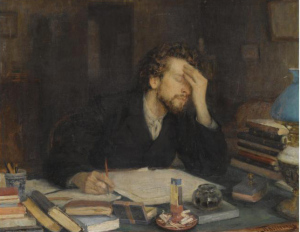
The poetry professor who dated my ex-girlfriend looked just like this. (image via wikimedia)
I’m not sure if the poetry professor who ended up with my ex-girlfriend really was a professor. He wrote poetry and taught poetry in a class I had taken my sophomore year at the State University over 30 years ago, and even though I was a lousy poet, he had encouraged my effort and had even highlighted to the class a humorous piece that I had written. As a teacher of poetry, he was pretty good. I give him credit for that.
But a couple years after I took his class, he dated my ex-girlfriend.
It was my senior year at the State University, and things were going my way. I was well-liked, had some social status on campus, and that status made other students, including some attractive women, overlook my social awkwardness. Despite this, my collegiate literary girlfriend had just broken up with me, but I was sure we’d get back together.
My ex-girlfriend was a junior, and we had been dating since the summer. She was extroverted but liked to read, so we could talk about a bunch of stuff. When I told her that I didn’t like Interview with the Vampire by Anne Rice and I couldn’t articulate a good reason (I might have said “It just sucks.”), she broke up with me. There were some other issues too. I had to work a lot, I had already set up a job interview several states away, and it was autumn so I wanted to watch a lot of football and she thought that was beneath her/us. Interview with the Vampire was the final straw.
Just a couple days later, I heard that she had been seen several times on campus holding hands in public with the poetry professor. I was floored. I had expected us to get back together after she’d had a few days to be mad at me. That type of reconciliation had already happened once during our time together. I was pretty sure it was going to happen again. Then the poetry professor had to go and ruin it.
It wouldn’t have been so bad if the poetry professor had been a nice-looking smooth guy. Instead, he was old, bald with a scraggly beard, and wore ratty jeans, and all my friends gave me grief about how I’d been replaced by a guy who looked like Shel Silverstein.
A couple weeks after I had heard about the poet and my ex-girlfriend, I noticed him standing next to me while we were both taking care of business in a public men’s bathroom on campus. Since men aren’t supposed to make eye contact in that situation, I wasn’t sure it was him until I stepped back. When you’re in the men’s room, you’re always supposed to look upward without making eye contact until after after you’re done, and that’s when I knew.
We both washed our hands at different sinks at the same time too. Yeah, the guy had been my poetry instructor a couple years earlier, but I wasn’t sure he recognized me or if he knew I was his girlfriend’s ex-boyfriend. He avoided eye contact when he didn’t have to anymore, so he probably knew I was somebody and wasn’t sure what to say.
I wanted to ask him how he had managed to get involved with my ex-girlfriend so quickly after we had broken up. Two days was fast. They had to have had something going on before she broke up with me. There was no way I could ask that, though, and I probably was better off not knowing.
On the other hand, I couldn’t walk out of there without saying something. If he knew who I was (and I sensed that he did), then he’d tell my ex-girlfriend that we’d met face-to-face in a bathroom and I hadn’t said anything to him. I couldn’t let that happen.
“Hey, I read your book,” I said.
I could tell that startled him. At the end of his course, he had given all of his students a copy of his poetry collection. He didn’t do it to brag. He said he didn’t want any of his students to feel compelled to read it. Since it wasn’t forced on me, I had read it when there wasn’t any football on. It was a thin paperback, and I hadn’t understood all his poetry (I don’t think in metaphors), but a lot of it was comparing/contrasting where he was from to our campus, which was almost a completely different side of American culture.
“What did you think?” he asked after a little hesitation.
I don’t remember the exact words. I thought about telling him that his poetry sucked, but I didn’t. Instead, I said that his poetry wasn’t what I expected. I told him that most people on campus who had moved there from other parts of the country bragged about where they had come from. He could describe the shortcomings of his home and our campus without being mean or condescending. He had never made fun of people in class, but he was good at gently mockery in his poetry.
He didn’t say anything, so I inwardly panicked. Had I misinterpreted his book? Was it even the right book? He was going to tell my ex-girlfriend that I was too stupid to read his poetry.
“Did I get it wrong?” I asked. “It was two years ago. Maybe I was thinking of a different book.” Somehow I had made an awkward situation even more uncomfortable. I have that talent.
“No, you’re right,” he said. “I’m always surprised when students read my book.”
“I know I’m not the only one who’s read it,” I said, which was true, and I wasn’t even thinking about my ex-girlfriend. I had discussed the book with another student a long time ago, and that might have been the only reason I remembered the poetry enough to mention it.
As we left the bathroom, I told the poetry professor that I was getting a job in another state after the semester and we might not run into each other again. He wished me good luck, and we shook hands, and that was it. Nothing dramatic.
Shortly after that, I went through a spiteful phase where I kicked myself for not telling the poetry professor that his book sucked when I’d had the chance. That would have been perfect retribution; at least that’s what I thought at the time.
Now I’m glad that I didn’t do that. You should never tell a poet that his or her poetry sucks. It’s too emotionally damaging to the poet. As retribution, it’s too harsh, even for a poet who ends up with your ex-girlfriend.
*****
NOTE! The original version of this story appeared on Dysfunctional Literacy on May 12, 2017.

(image via wikimedia)
The ghost in the doorway freaked me out a little bit, but I didn’t scream or cry or yell out for help. I was 10 years-old, it was in the middle of the night, and I had just woken up, and I was going to get up to use the bathroom when I saw it.
An old guy in a robe was staring at me in my bedroom doorway. That’s what it looked like. A sad old guy. Looking back, I’m probably lucky he didn’t open his robe and flash me, but no, it wasn’t like that. He looked like an old man, and he had a night cap on his head, and he just stood there looking at me.
I could still see my brother’s closed bedroom door across the hallway, but it looked kind of murky. I could kind of see through the guy, but I definitely couldn’t see past him clearly.
I’m not sure I even believed in ghosts before this happened. Growing up in the 1970s, we didn’t have the internet to look up stuff, so we believed in whatever we believed in. I remember kids believing in Bigfoot, and UFOs, and the Lochness Monster, and the Sasquatch. Nobody believed in vampires or King Kong or giant bugs. Ghosts were somewhere in the middle.
Our small town theater (that got movies a year after they’d come out) had once shown a documentary about the paranormal and other weird stuff. There was a scene that reenacted some girl dying and a photographer catching a light that looked like her soul. That scene wasn’t very believable, even by 1970’s standards. The scene where Bigfoot smashed his giant arm through a window was way more compelling to me. I was scared of a giant hairy arm crashing through my window. A light that might be (but probably wasn’t) a soul? No way.
Movies like that had just intensified my imagination. Even in 5th grade, I knew I had an imagination. I read comic books. I drew my own books and came up with my own stories. I daydreamed a lot, but not enough to get in trouble in school. I could get my work done, daydream, and then get more work done. I daydreamed in increments. Daydreaming was like my way of getting mental energy back. It was like coffee before I started drinking coffee.
Since I was already aware of my imagination, I thought at first the old guy in my doorway was just a trick of the light, and I tried to be logical about it. There was no way an old guy could get into our house and walk down our hallway without my parents hearing him from their makeshift bedroom right by the front door. Plus, my hound dog would have gone nuts. My hound dog hated strangers. There was no way my hound dog would let a ghost near me. My hound dog could probably detect a ghost before I could, and I hadn’t heard a peep from my hound dog.
I squinted and rubbed my eyes. My muddled brain filled with questions. What if it really was a ghost? What if I got up and tried to walk through it? I hadn’t seen enough ghost movies or read enough ghost books to know what happens if you walked through a ghost. Would it retaliate it or, even worse, possess me? I didn’t want to get possessed by a dead old man. But I needed to use the bathroom too. This wasn’t something I could ask for help with.
That was the problem. As cautious as I was of the ghost, I was more scared of being thought of as a wimpy kid. I didn’t want to be shamed by screaming about a ghost. My dad already thought I was a bit odd. I didn’t want to add to it by screaming about an imaginary ghost.
Under normal circumstances, maybe I could have waited out the ghost. Yeah, it was the middle of the night, but it would be light out in a few hours. No ghost like this would stick around during the day. Plus, if he did, my parents would see him and then I’d be off the hook. I wouldn’t be the crazy one if somebody else spotted the ghost before I mentioned it.
But I had to use the bathroom. Having a ghost stare me down probably made the bathroom urge even worse. I didn’t think of that then, but it’s probably true. I had a choice to make. Be scared of the ghost? Or use the bathroom?
Then I felt for the warm lump on my bed that was my hound dog… and the warm lump was gone. I patted around the bed. I slowly pressed my palms to the floor, hoping that maybe she had switched to a nearby location, but I felt nothing. No! No! No!
My hound dog was gone! That didn’t make any sense. She never left in the middle of the night. Where would she go? That was simple, I thought; she went somewhere the ghost wasn’t. My hound dog had abandoned me. And I had to use the bathroom! And the ghost was still blocking my doorway.
Aaarrrgh!
To be continued in Childhood Ghost Story: 4 Rules for Living with a Ghost !
And you can read from the beginning at Childhood Ghost Story- The Prologue.
I was six years-old when this comic book came out, alright? I’m not still traumatized by it! Now I think it’s kind of funny.
Every super hero goes through a time when he/she wants to quit, and it lasts only a couple issues. If the hero quits, sales of the comic book go down, and the publishers can’t have that.
Still, this cover was kind of unsettling for a six year-old with no cable or internet in 1972.
What was on the cover that could disturb a six year-old? What would make Spider-Man want to quit in 1972? What are you waiting for, true believer? Watch the video!!

He can’t concentrate because some kid in the front row is picking his nose. (image via wikimedia)
When I was growing up, I had some teachers with funny last names. In junior high I had a math teacher named Mrs. Butte. She insisted her name was pronounced “Bee-Yute” like the word “beauty,” but she wasn’t attractive at all. If she had been a hot chick with cleavage, we might have pronounced her name correctly. But she wasn’t, so we didn’t.
There was also a social studies teacher named Mr. Dick (and his name was pronounced exactly like it was spelled). Nobody made fun of Mr. Dick. You would think a guy named Mr. Dick would stay out of teaching because of his last name, but nobody ever made fun of him.
Mr. Dick was an old man who had cool tattoos on his arm (none of them looked like his last name). He had been teaching for decades, and everybody in town had grown up knowing Mr. Dick (or knowing about him), so nobody thought anything about his name anymore. He was just an old man named Mr. Dick.
There’s no way to prove this, but my junior high was probably the only school that had both a Mrs. Butte and a Mr. Dick.
Then in high school I had an English teacher named Mr. Faggins. Mr. Faggins announced on the first day of school that his name was to be pronounced as “Fay-guns.” I knew my rules of pronunciation and how the double consonant causes the vowel in front of it to have the soft sound, but I was also polite enough not to argue with an adult about how to pronounce his last name. I’ve always believed that a person should be able to choose how to pronounce his or her name.
Of course, somebody would have to test Mr. Fay-guns.
It was the second day of school, and there was this kid named Tucker who sat in the front middle desk of Mr. Fay-guns’ classroom. I was in the third desk two rows closer to the door. Tucker was an annoying kid who got beat up every once in a while (but he brought it on himself, so nobody felt sorry for him). Mr. Fay-guns was going over classroom rules when Tucker asked a question.
“Can I go to the bathroom, Mr. Faggins?”
Mr. Fay-guns paused and said, “Not now. And in the future please pronounce my name correctly.”
Mr. Fay-guns continued lecturing about his rules, but a few minutes later Tucker interrupted him.
“When can I go to the bathroom, Mr. Faggins?”
“You will not go to the bathroom as long as you are mispronouncing my name,” Mr. Fay-guns said slowly.
“I need to go to the bathroom, Faggins,” Tucker said.
Here is what everybody who was there agrees about. Mr. Fay-guns thwacked Tucker upside the head, grabbed him, and physically threw him out of the classroom.
Here’s where there is some disagreement. I think Tucker left out the word “mister.” Other students said that Tucker said “mister”,” but stressed the “Faggins” so much that it sounded like an insult. Also, I think Mr. Fay-guns hit Tucker with a dictionary (not an unabridged dictionary, though that would have been really impressive and maybe deadly). Others insisted it was just a paperback book that had been lying around. A couple students said Fay-guns open-palmed Tucker, but I heard a clear THWACK, and a slap doesn’t make a THWACK sound.
I saw Mr. Fay-guns grab Tucker by his shirt collar and drag him out of the classroom. Others said Mr. Fay-guns pulled Tucker by his arm, then armpit, and then threw him out. A couple guys said Tucker ran out of the room crying like a baby.
Tucker maintained all-year long that he had done nothing wrong and that Mr. Fay-guns had attacked him for no reason.
There is no cell phone footage of the event (which took place in 1980, I think), so it shall forever remain a mystery what exactly happened.
If something like this occurred today, things would be handled a bit differently. Nowadays if a teacher hit a kid with a dictionary (I stand by my version of the story), the teacher would get fired and probably get sued. Nothing like that happened to Mr. Fay-guns. Even better, Tucker got switched to another English teacher. That was great because we didn’t like Tucker anyway. But I was a little scared of Mr. Fay-guns after that.
I remember Mr. Fay-guns, not because of his last name (though that helps) and not because he beat up a kid in class (that helps too). I remember Mr. Fay-guns because something happened in his class one day (nobody got beat up) that made me realize that I could be a pretty good writer.
But it’s a long story.
To be continued in Long Story: The Power of Mediocre Teachers .
This story originally appeared in Dysfunctional Literacy on November 11, 2012.

(image via wikimedia)
Even though I don’t remember most holidays from childhood, I vividly remember the 4th of July of 1976. I was ten years old, and the United States was turning 200.
The United States had just gone through the Vietnam War and Watergate and there was a presidential election coming up, but there was no internet or cable news or social media, so people didn’t get consumed by all that stuff as much (and if they did, we didn’t see it). We just got consumed by other stuff.
The 4th of July isn’t my favorite holiday. It’s probably not even in my top five. But I remember this particular July 4th of 1976 more clearly then I do any other holiday. I have such a fond memory of it that I wrote a story about it a few years ago, and now I post the story every 4th of July (if I remember to do it… sometimes I forget). My title might be a little lazy, but at least it tells you what the story is going to be about.
4th of July Story
I was 10 when the United States turned 200 years old. It was a big deal back then, but at the time, the meaning of the 4th of July was lost on me. As an adult, I understand July 4th is the annual celebration of the signing and approval of the Declaration of Independence by the Continental Congress.
I understand how important the following sentence from The Declaration of Independence is:
“We hold these truths to be self-evident, that all men are created equal, that they are endowed by their Creator with certain unalienable Rights, that among these are Life, Liberty and the pursuit of Happiness.”
That one sentence had a bunch of concepts that were unique way back in 1776.
The Declaration of Independence is also known for John Hancock’s really big signature. As an adult, I appreciate how momentous the signing of that document was and how it began the process of liberating the colonies and forming one of the greatest nations in the world. I appreciate John Hancock’s really big signature. I even remember a couple jokes about how a guy named John Hancock had a really big signature.
When I was a kid, I didn’t understand all this, including the John Hancock jokes. Back when I was 10, the 4th of July was about shooting off fireworks. And 1976 was a great year to shoot off fireworks.
Read more at 4th of July Story: The Box of M-80s


Uncle Tom’s Cabin by Harriet Beecher Stowe is kind of hard to read. It was written in 1851, and that automatically makes the novel difficult for a lot of readers. Some sentences are long, and the dialogue is filled with dialects and accents that over-sensitive readers today might (and probably would) find offensive.
Still, Uncle Tom’s Cabin was kind of an influential novel, and it sold a lot of copies. It shocked readers with its portrayal of slavery in the United States south and helped inspire the abolitionist movement. Several pejorative terms (which I’m not going to get into because I’m not that kind of blogger) came from this book, but many people today don’t understand the foundation of these pejoratives.
Even though I’ve never read Uncle Tom’s Cabin from beginning-to-end, I HAVE read this classic comic book. It was in a stack of Classics Illustrated comic books that my dad kept and let us read. I’ve outgrown comic books to some extent, but I’m interested to see how this 1946 (reprint) comic book version of Uncle Tom’s Cabin holds up today.
In today’s environment, reviewing a 1946 (reprint) comic book version of an 1851 story that deals with slavery can be a bit risky, but hey, that’s just the kind of guy I am! If you’re interested in what a classic comic version of Uncle Tom’s Cabin looks like, watch the video below.


 Dysfunctional Literacy