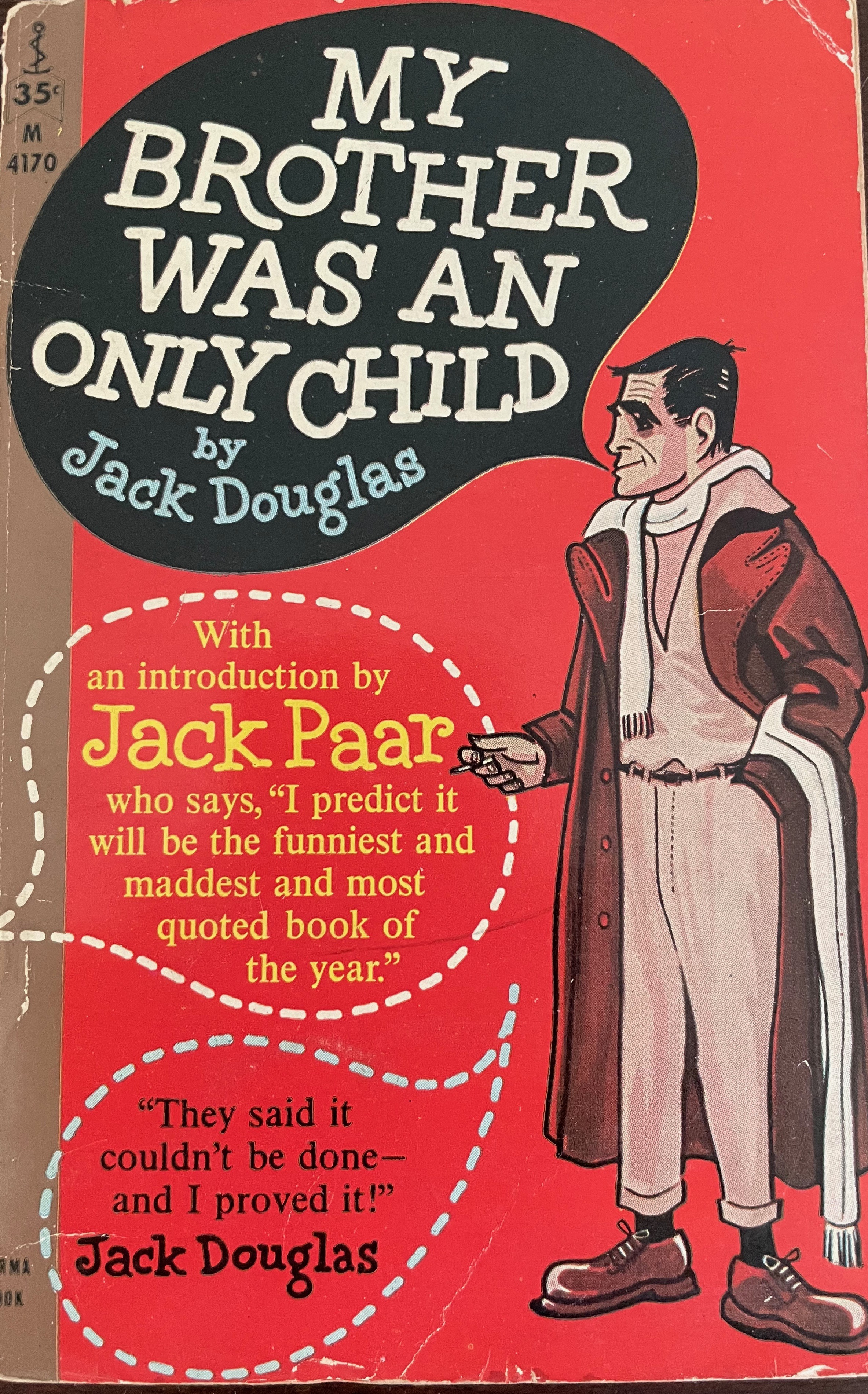
My Brother Was An Only Child by Jack Douglas is a cool book to own, but I don’t want to read the whole thing. From the title and the cover, this book looks like it’s filled with dad humor.
I should like dad humor, but I don’t, which might seem strange because I fit the dad humor demographic. I’m a dad. I like humor. Why wouldn’t I like dad humor?
First of all, dad humor exists because dads feel like they have to edit themselves. They can’t tell the jokes that they want to tell, that they used to tell, because there are kids around. Plus, women today will get (or act like they are) offended. Dads feel like they can’t talk the way they want to talk because they’re worried about offending somebody. Dad humor is harmless, and ‘harmless’ seems to be a good description My Brother Was An Only Child.
Since Jack Douglas, the author of My Brother Was An Only Child , was a comedy writer for Jack Paar, who was the host of The Tonight Show in the late 1950s and early 1960s, it makes sense that a book written by a television writer would feel restrained, hence the dad humor. Television humor was regulated heavily back then. I’m pretty sure Jack Douglas had to hold back and censor his jokes when he wrote this book.
Today, humorists are so desperate to shock that they put profanity in their book titles. At least there’s no profanity in the title of My Brother Was An Only Child. Back then profanity in the title would have been groundbreaking. Today, it comes across as desperate. I’d rather read a book filled with dad humor than a book filled with unnecessary profanity.
Don’t get me wrong. I don’t mind profanity. I wrote “The Ten Worst Bad Words Ranked in Order, the U.S. Version,” and I spelled out all the words (except one). I’m a fan of strategic profanity, but unnecessary profanity is unnecessary.
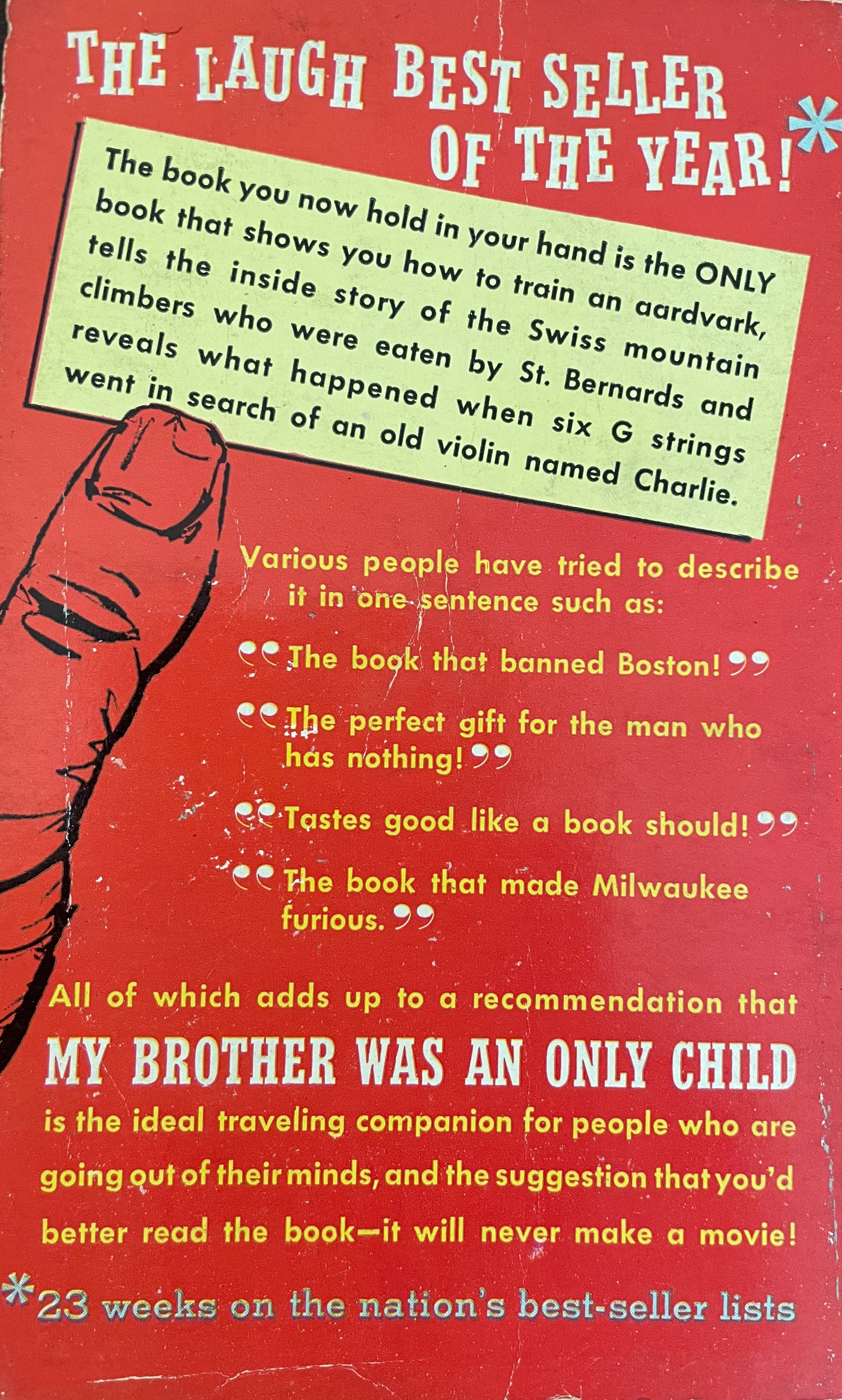
I’m pretty sure the term ‘dad humor’ didn’t exist in 1960 when this copy of My Brother Was An Only Child was printed. There were still categories for humor, but the word ‘dad’ wasn’t in any of them. I wasn’t around in 1960, but ‘dad humor’ seems to be a recent term for lame humor. Lame humor has always existed. Just read the back book cover:
If you think of a guy with fake painted eyebrows and a fake painted mustache as you read this book, it might become funnier.
There are a bunch of references in this book that I’m not familiar with. Even though I could have used use a search engine to research a bunch of the stuff I didn’t know about, I instead focused on the stuff I actually understood to determine if the pop cultural references were funny or not (to me). Chapter 15 is called “The Private Mitty of Walter Thurber” which is a reference “The Secret Life of Walter Mitty” by James Thurber.
Mixing up words for a pop culture joke is easy to do. I think it’s lazy. If the book had been longer, I would have understood using a lazy pop culture reference as humor, but this book is only 128 pages, and a lot of those pages aren’t even filled up.
On the other hand, I liked Chapter 19. Chapter 19 is famous for a reason. I didn’t want to take a picture of Chapter 19 because I’d have to spread the pages in this old paperback and that would damage the binding. Even though I have some complaints about this book, I don’t want to hurt it. That’s kind of my personality. I might complain, but I don’t want to harm anything.
Anyway, Chapter 19 says:
*****
Chapter 19
To hell with Chapter 19. Every damn book you pick up has a Chapter 19.
*****
That was it for Chapter 19.
Putting the words ‘damn’ and ‘hell’ in the same sentence was pretty hardcore for 1960. This might have caused most readers back then to gasp. Even Holden Caulfield thought Jack Douglas was pushing the boundaries a little bit.
I’m not sure that My Brother Was An Only Child holds up. If you were born before 1960, you might think it’s funny. If you were born after 1965, it might seem dated. Still, I think it’s a cool book to have. I like the cover. People my age might complain about the way things are now, but I’m glad there’s way more variety in humor than back then, even if there’s an over-reliance on profanity.
Just so you know, I’m almost done with my own book, the first book that I’m willing to commit to paper. It doesn’t have a Chapter 19.
Jack Douglas can rest easily, knowing that at least one (aspiring) author has taken his advice. To hell with Chapter 19. Jack Douglas got that part right.

I bought a copy of Created, The Destroyer by Richard Sapir and Warren Murphy in memory of a good friend who died last October from a heart attack. He’d had some weight issues and was a high stress guy. He’d had the option to retire from teaching a few years ago, but he kept going back to the classroom because he wanted to end his teaching career at a certain age. His family and I had been trying to get him to just retire and find a low stress job and relax with his hobbies.
One of my friend’s hobbies was reading crappy books. I read crappy books too, but I’ve always admitted that they’re crappy. My friend actually thought some of the crappy books were good and would recommend them to me. If I enjoy a book but know that it’s crappy, I usually don’t recommend it.
I found this copy of Created, The Destroyer a couple weeks ago at a used book store for $3.49 and I thought of my deceased best friend who often recommended this series to me. This was back in the early1990s, before either of us got married; we had a lot of spare time and talked about books, movies, sports, comics, and women. Never video games, though. Video games were for losers.
Anyway, my now deceased best friend thought that I’d like The Destroyer series since I liked The Punisher comic book. The thing is, I didn’t really like The Punisher comic book all that much; I would just read my friend’s copies and say they were okay.
You can tell that Created, The Destroyer was written in the 1970s. The protagonist is a Vietnam vet. The protagonists complain about rising crime and how society is falling apart. And it’s okay to kill the criminals. I can visualize the overly wavy hair and tacky clothes without any of that being described in the. book. I grew up in the 1970s. I’m not a big fan of that decade.
The chapters in Created, The Destroyer are short. The protagonist is amazingly awesome as a state of being. Even though there’s action, there’s not really any suspense because you know the main characters are going to survive, and you don’t care enough about the minor characters for there to be any suspense. The characterization is one-dimensional. The dialogue is occasionally funny but usually crappy. I wonder why it took two authors to write this book.
Wait a minute.
Short chapters?
Action but no suspense?
One-dimensional characters?
Crappy dialogue?
Co-authors?
I’m reading a James Patterson book that was written before James Patterson books even existed!
Now everything makes sense! Right now there are over 150 books in The Destroyer series, starting in 1971 with Created, The Destroyer. The two authors managed to write about five books a year in the 1970s. It’s not quite at James Patterson’s pace, but keep in mind that the two authors were focusing on The Destroyer series and James Patterson’s co-authors write for just about every genre.
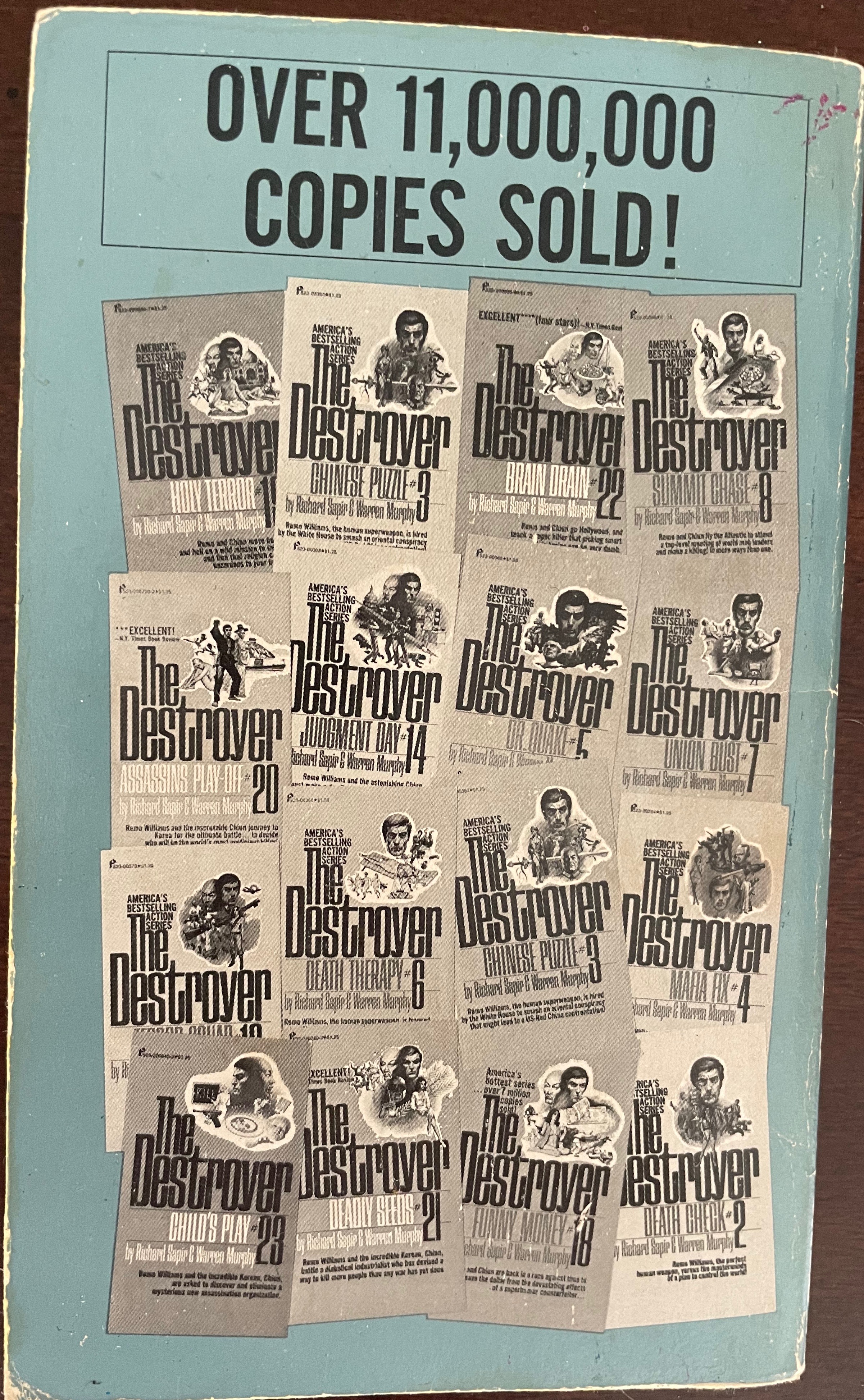
As of 1977 when this copy came out, The Destroyer series had sold 11,000,000 copies. Maybe that’s impressive for a paperback series back then. From the back of the book, it looks like there were at least 23 books in the series at the time this copy came out. That’s just under 500,000 copies per book. I don’t know if that’s really very impressive for the 1970s.
I think a higher percentage of people read books back in the 1970s. The mall in my hometown had two book stores. I remember the convenience store in my neighborhood had a book rack filled with trashy bestsellers, trashy romance novels, and trashy adventure pulps like The Destroyer. Maybe the 1970s sucked, but at least book stores were everywhere.
Yeah, this first book in The Destroyer series was crap. I think it’s funny that James Patterson is so intent on making crappy novels popular again. As much as I might mock The Destroyer books, this first one is better than a lot of what James Patterson writes. I might be too harsh with these Destroyer books. They’re cheap and fast-paced and reflective of the 1970s. There might be some value in reading an occasional crappy book from the 1970s. I don’t think I’m ready to try a Mack Bolan book yet, though. Not yet.
Anyway, I miss my best friend, but he had crappy taste in books.
Or he had a low opinion of my reading ability.
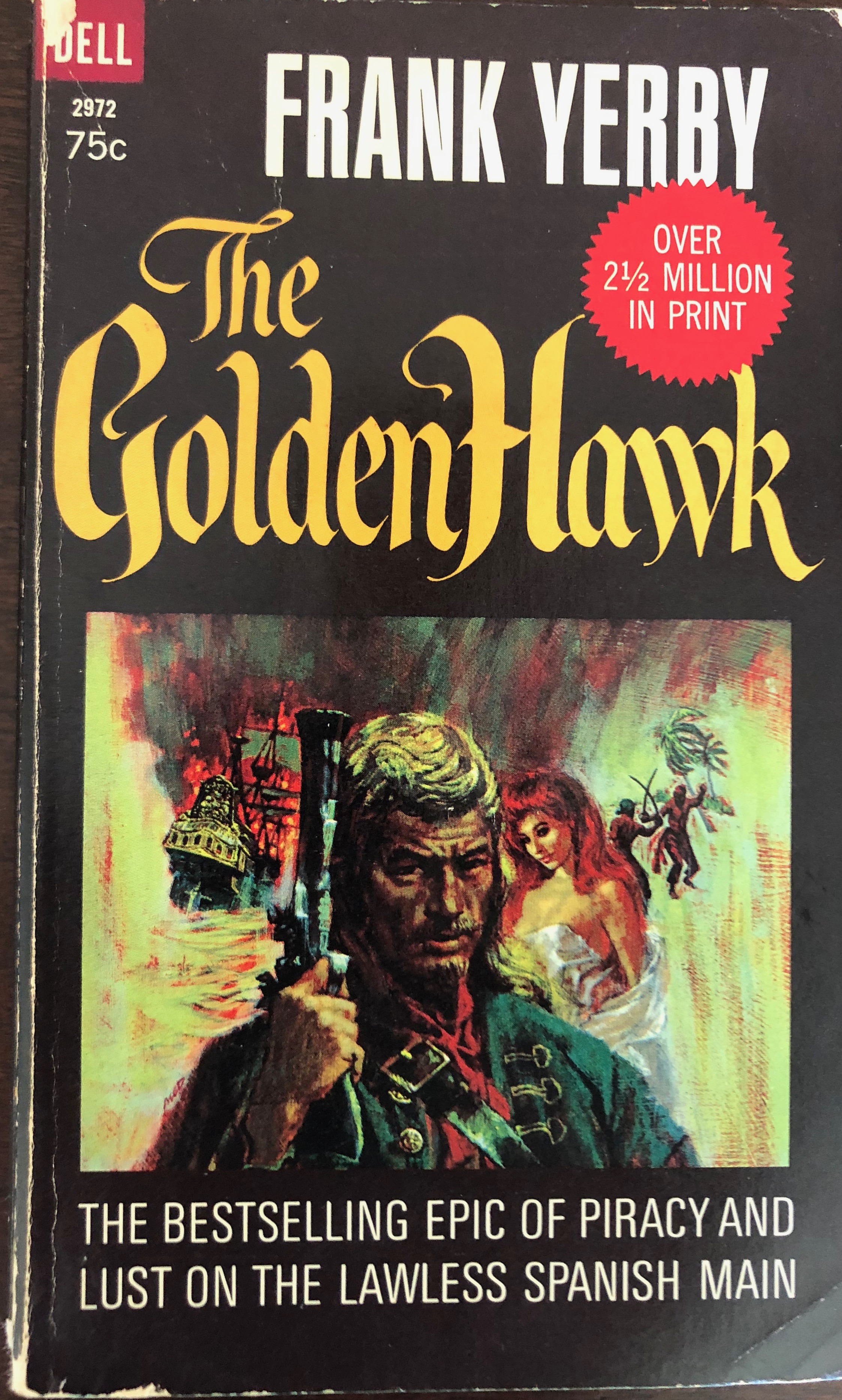
The novel The Golden Hawk by Frank Yerby was okay, but I think the main character was a rapist. I mean, he didn’t think of himself as a rapist. He was never actually described as a rapist. But what he does in the novel would be considered rape by today’s standards.
Several scenes go like this: Male protagonist approaches woman. Woman says no. Male protagonist forcefully kisses woman. Woman struggles and says no. Male protagonist gets really forceful (holding her tight, tearing off her clothes). Woman finally relents and likes it a lot.
This approach might work for really attractive men with lots of money and power and alcohol (and more powerful substances/drugs). But for normal guys (or ugly guys with no money, power, or status), this approach is a disaster and would probably be called rape or attempted rape. It makes me wonder how much rape happened before I was born. I mean, if things are bad now, they had to have been really messed up before I was born.
I don’t even want to contemplate how much rape there used to be. At least, according to popular fiction of the 1940s, 1950s, and early 1960s, there had to be lots of rape going on. But it wasn’t called rape.
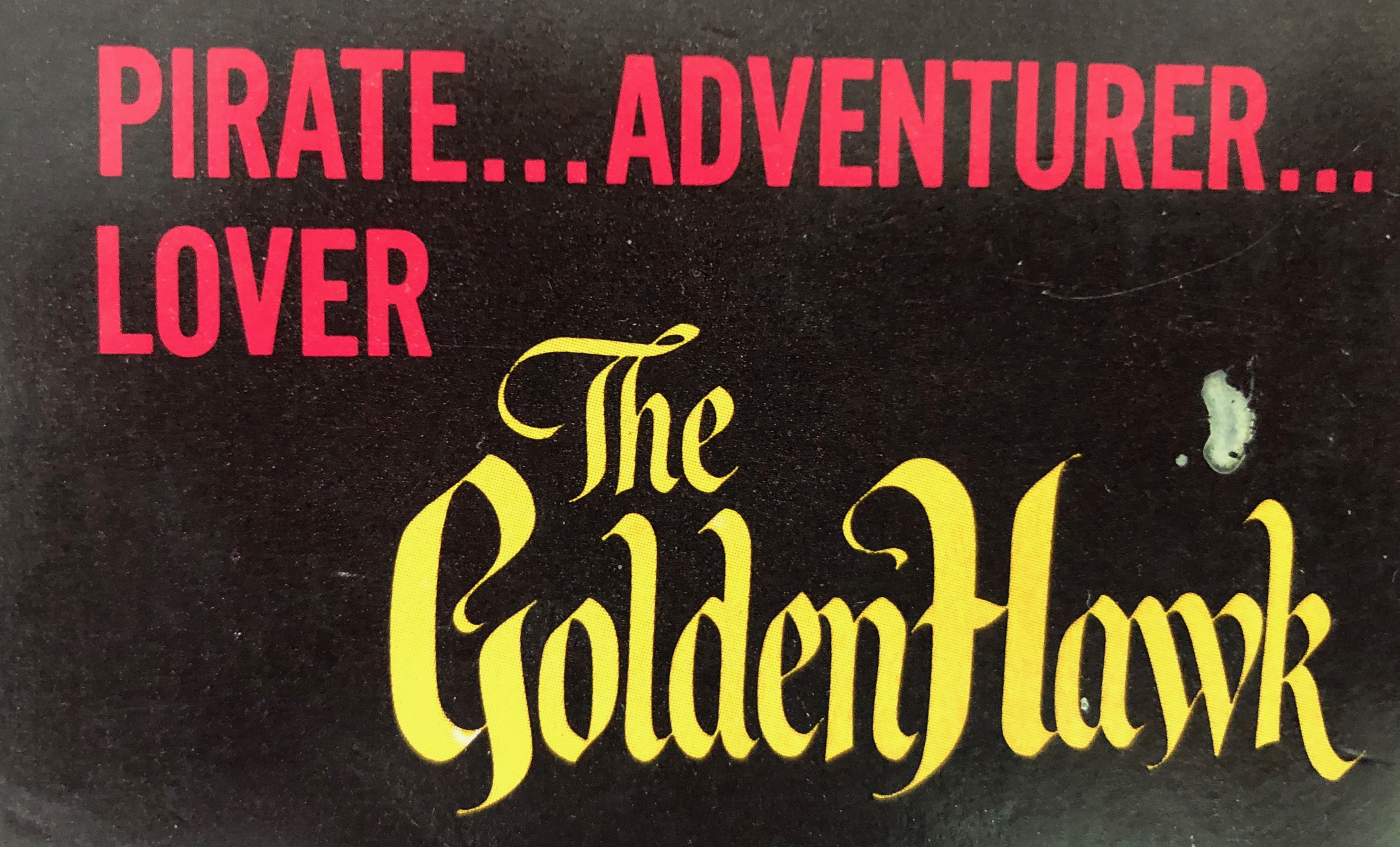
The cover blurb calls this type of behavior ‘lust’:
THE BESTSELLING EPIC OF PIRACY AND LUST ON THE LAWLESS SPANISH MAIN
In this case, ‘lust’ could be replaced with ‘rape’ and attempted ‘rape.’ I think a more accurate blurb would have been:
THE BESTSELLING EPIC OF PIRACY AND RAPE ON THE LAWLESS SPANISH MAIN
I’m no saint, but if a woman ever told me no, I’d back off. When I was dating, I tried to avoid being in a position where a woman told me no in the first place. I’d look for non-verbal signals. Did she voluntarily stand close to me? That was often a good sign. Did she flinch if I casually moved closer? That wouldn’t be so good. Did she have older brothers threatening to beat the crap out of me if I ever looked at her again? That was an automatic turn off.
The women in The Golden Hawk aren’t necessarily weak. Early in the novel, one major female character even shoots the male protagonist while he’s making a ‘lustful’ advance. Instead of contemplating the error of his ways, he spends the entire novel trying to hunt this woman down and seduce/rape her. I don’t want to belabor a point, but if a woman ever shot me while I made a lustful advance, I’d deduce that she wasn’t into me.
This 1966 paperback copy of The Golden Hawk proclaims that it was a bestseller. I think my dad read this book decades ago because I remember seeing Frank Yerby books, along with books by James Michener and Harold Robbins, around the house when I was a kid. My dad also liked Horatio Hornblower books (I don’t remember the author’s name) and Isaac Asimov, but I don’t think there was any lust/rape in those books. If you liked lust/rape, you’d read Frank Yerby and Harold Robbins.
Other than the rape (if you can ignore it), this was a very uneven novel. Some scenes were written well, with great dialogue, fast moving action, and reasonable descriptions/exposition. Then a great scene would be followed by a poorly written scene accompanied by unrealistic plot armor, crappy dialogue, and actions that didn’t make sense.
And then there’d be an attempted rape, usually followed by actual rape, except the woman ended up liking it, but it was still rape.
Maybe I’m wrong. Maybe women like to have men force themselves. Maybe I’ve allowed myself to fall for today’s wimpy social constructs. Maybe the pre-1960s had it right. Maybe. But I’ll let somebody else test it out for me today. I don’t want to go to prison.

Assassins Have Starry Eyes is kind of a stupid title for a book. That’s okay. Assassins Have Starry Eyes by Donald Hamilton is kind of a stupid book.
I like reading stupid books from the 1950s. The paper smells old. I don’t sniff the paper like some people do, but I usually hold the books close enough to my face so that I can catch the faint aroma of the pages. If a book like Assassins Have Starry Eyes were republished today, I probably wouldn’t buy it just because the paper wouldn’t smell old enough.
I think I just like holding and reading old paperback books. A few months ago, I realized that I had lost all interest in current fiction, but once I started reading old books with yellow, crumbling paper, my interest in fiction was rekindled.
Anyway, the title Assassins Have Starry Eyes caught my attention. I’m not sure if this is a good title or if the title is so stupid that it’s good.
The book’s former title Assignment-Murder is also kind of stupid and very misleading. Assignment-Murder sounds like the protagonist received the orders to kill somebody. It sounds like a James Bond knockoff title. In Assassins Have Starry Eyes, a couple of losers get the assignment to murder the protagonist, and they fail. You can’t have a book titled Assignment-Murder unless the murder is successful.
The book cover kind of gives the mystery away. From looking at it, the reader can infer that the blond chick on the cover is the assassin. She turns out to be the ringleader (kind of), but she doesn’t really threaten the protagonist like this in the novel. Plus, you can’t tell from the picture whether or not she has starry eyes.
The protagonist in Assassins Have Starry Eyes is an engineer developing atomic/nuclear weapons in the late 1950s, and people are trying to kill him. He’s not your typical scientist/engineer, though. He’s nice looking, and he knows how to talk to women. He’s more socially aware than most mad scientists or engineers because he knows not to talk about science/engineering to women. He talks normal stuff to women and makes fun of the other scientists/engineers behind their backs.
The scientist/engineer protagonist also likes to do masculine stuff life hunting and camping and getting laid in his spare time. He’s actually successful at all three while being an engineer; that’s how you know this book is fiction.
The title is also kind of a lie. There were several assassins in Assassins Have Starry Eyes, and only one of the assassins would have maybe fit the description. The first two would-be assassins were dudes and weren’t described as having starry eyes. I don’t even think their eyes were described. One assassin had closed eyes because he got killed before the narrator even saw him. The other assassin got beat up, so he might have had a black eye or his eyes might have seen stars after he got beaten up. Either way, the fortunate male assassin who survived didn’t have starry eyes.
More accurate titles might have been:
The Hot Blonde Assassin Had Starry Eyes.
Hot Blonde Assassins Have Starry Eyes.
That Hot Blonde Holding a Gun Isn’t Really An Assassin, But She Has Starry Eyes Even Though They Were Never Described That Way In The Novel.
Assassins Have Starry Eyes wasn’t a bad book. I enjoyed it, but it was kind of stupid. The banter between the protagonist and his wife was funny. I can forgive a lot of flaws in a book if it’s funny. Having an egghead scientist beat the crap out of would-be assassins was a little far fetched, but it didn’t ruin the book for me. Yeah, the cover spoils the ending a little, even if the scene doesn’t exactly happen as it’s shown.
Donald Hamilton also wrote a bunch of Matt Helm books, which I guess were popular in the 1960s. I’m not going to go out and look for a bunch of Matt Helm books at the used book stores now, but if I see them, I might buy one or two, especially if they have stupid titles.

*****
After more than ten years of blogging, I’ve finally written a novel.
A grammar-obsessed English teacher falls in ‘luuuvvv’ but discovers how chaotic and dangerous ‘luuuvvv’ can really be.

The Sunset Rises: A 1990s Romantic Comedy is now available on Amazon and from the trunk of my car at various local bookstores… until parking lot security kicks me out. Buy it now while supplies last!
I’ve been blogging on Dysfunctional Literacy for over ten years, but that doesn’t mean I’m necessarily good at blogging. I probably don’t have the traffic I should. I don’t get a lot of comments from new posts. I don’t make any money off of my blog. From those perspectives, Dysfunctional Literacy might be considered a failure.
On the other hand, I’ve written a lot of stuff that I’m proud of. WordPress recommended my blog for about 18 months a few years ago, so somebody other than my mom thinks I’m a decent writer.
As far as social media relevance goes, though, I’ve done a lot of things wrong. This might not be everything I’ve messed up, but it’s a pretty good list.
1. Putting profanity in a bunch of my post titles
A few years ago I wrote a bunch of posts about the etymology of certain profane words. They were meant to be tongue-in-cheek, and I didn’t think much of them, but they kind of messed up my blog a little bit. I didn’t censor the words either. I wrote ‘shit’ instead of ‘sh*t.’ I don’t see the point of writing ‘sh*t’ instead of ‘shit’. Everybody knows what ‘sh*t’ means.
Unfortunately, these are the only blog posts that have caught Google’s attention. Now most of my blog traffic comes to read about why words like shit and fuck are bad words. And I can’t monetize my blog because Dysfunctional Literacy is not considered a family friendly website. I bring in enough traffic to get monetized, but the posts that bring in the traffic make my blog unable to be monetized.
That’s okay. I didn’t want their stupid money anyway.
2. Not having a product to sell
I should have had a product to sell. I didn’t even have a book to sell when I started Dysfunctional Literacy. I still don’t have a real book yet. I’ve put out a few ebooks as practice and learned a few lessons (I’ll get to those lessons another time).
My one actual real book should be ready in about six months, and I’ll use Dysfunctionally Literacy a lot differently once I start promoting it. Don’t worry. I’m not bombarding everybody with a bunch of crap five times a day when I start selling my book , but if I do decide to bombard everybody five times a day, it will only be for that one book and for a little while. I won’t make a habit of bombarding everybody with crap all the time.
3. Writing about books and writing
This blog has way too narrow of a niche. Out of all the things to review on a blog, books are the worst. Books take way too long to read. I should have picked movies, television shows, or even comic books to review. Those guys who review movies or television shows or comic books can crank out content every day or even more frequently if they want to. Me? I have to take a week to read a whole damn book, and then I have to process it before I even start writing.
For a while I wrote what was called a Literary Glance, where I’d read the first few pages of a current popular book and review that. I was reading so many crappy books that I wasn’t enjoying them at all. I was reading books just to have something to review; I had no desire to read most of the books I was reviewing for a Literary Glance. I should have a desire to read a book before I decide to review it.
4. Not responding to comments
I don’t respond to comments as frequently as I should. Years ago when Dysfunctional Literacy was a WordPress recommended blog, I’d get dozens of comments almost every day and I had a full-time job and a family, so I couldn’t respond to everybody. Besides, most of the time I had no response other than “Thank you.” Maybe I should have littered my comments section with “Thank you” after “Thank you,” but I’m slow on the keyboard; even that would have taken time.
If you write a comment and I don’t respond, I don’t mean to be rude. It just means that I have no response other than “Thank you.”
5. Not having a clear purpose
I write book reviews. I write stories. I write humorous pieces. But my blog doesn’t have one specific purpose.
Plus, my blog’s name is Dysfunctional Literacy. The good thing about Dysfunctional Literacy was that the domain name wasn’t taken when I chose it, but nobody knows what it means. At the time, I was thinking of the term ‘functionally illiterate,’ and I thought about people who were capable of reading and chose to read what is considered crap rather than what is considered literature. They were literate but dysfunctional in their choices. Hence the term ‘dysfunctional literacy.’
Next time I start a blog, I’ll choose a name that I don’t have to explain.

The Carpetbaggers by Harold Robbins isn’t very good. It’s supposed to be one of those ‘steamy’ epics and focuses on several characters through several time periods. It starts off with a ‘steamy’ scene that is actually rape, except the female character gets into it.
In this scene, the female character says “no” to the guy a bunch of times He gets physical, so she slaps him. He hits her in the face. And then things get steamy. She even says “Do it to me” to him. Yeah, she’s playing a psychological game with the guy, but it’s still seems a bit much.
I don’t know. I wasn’t around in 1961 when this book was written, and this scene takes place in the 1920s. Maybe women got ‘steamy’ when they got hit in the face back in the 1920s, but I doubt it. I think it’s human nature not to like getting hit in the face.
I’ve been punched in the face a few times, and I’m not sure I would have been up for getting steamy right after that. I might have needed a couple minutes for my face to recover first. There are some things that I can’t do when my teeth are rattling.
A friend of mine in high school read The Carpetbaggers and took this face-punching scene to heart. There was a girl that he liked, and he wasn’t reading her nonverbal signals. Plus, she kept saying no. You don’t need nonverbal signals when the girl keeps saying no to you.
Anyway, he got a little too grabby, so she slapped him. He hit her in the face and tried to get steamy, but she scratched his eyes and got away. Then she called the police, and he got arrested. After he got out of jail, her older brothers beat the hell out of him really good, and the police didn’t do anything about it. He ended up with scratched eyes, a sideways nose, busted teeth, a permanent limp, and a criminal record.
Oh yeah, that guy wasn’t really my friend. I just knew who he was.
I bought this copy of The Carpetbaggers for $3.00 at a used book store. I almost didn’t buy it because it has a movie version cover with a guy who looks like Steve McQueen who’s in the movie version of this book. I have nothing against Steve McQueen. It’s not like he’s Kevin Spacey on the cover of The Shipping News. Steve McQueen was way cooler than Kevin Spacey could ever hope to be. I just like to visualize characters for myself when I read.
I haven’t seen the movie version, but I don’t think Steve McQueen played the character who hit the woman in that ‘steamy’ scene. I’d be disappointed if he did. Hitting a woman in a steamy scene seems more like a Kevin Spacey move.
Besides rape that’s portrayed as steamy, The Carpetbaggers has a lot of what is called ‘plot armor’ now. For example, a main character escapes a Louisiana prison by wading through a swamp for a week. That’s it. No problem. No explanation. He just waded through it. This character was so awesome that he could wade through a Louisiana swamp with no explanation.
He does a bunch of other improbable stuff too. A bunch of hot, rich women get steamy with him. He becomes a 1920s film star. He finds the men who killed his parents. He kills the men who murdered his parents with no tension whatsoever.
And the revenge isn’t written very well. I could have accepted the plot armor and other flaws in the writing if the revenge had been written well.
I think it’s funny that a book like this was such a bestseller in the 1960s and was still being read in the 1970s and 1980s. It shows that old stuff can suck just as much as new stuff. The Carpetbaggers is like a really long James Patterson novel, except he would have split this up into at least five books and had someone else write it for him.
That’s the lesson that I took from The Carpetbaggers; old stuff can suck just as much as new stuff. Yeah, that’s probably obvious to everybody else, but I knew one guy who read The Carpetbaggers and learned a different lesson.
And that guy wasn’t my friend. I just knew who he was.
*****
Here’s a book that has a much more appropriate lesson for readers:
It’s the oldest story in the world, 1990s style!
Man meets woman; man falls in “luuuvvv” with woman; man gets suckerpunched by reality!
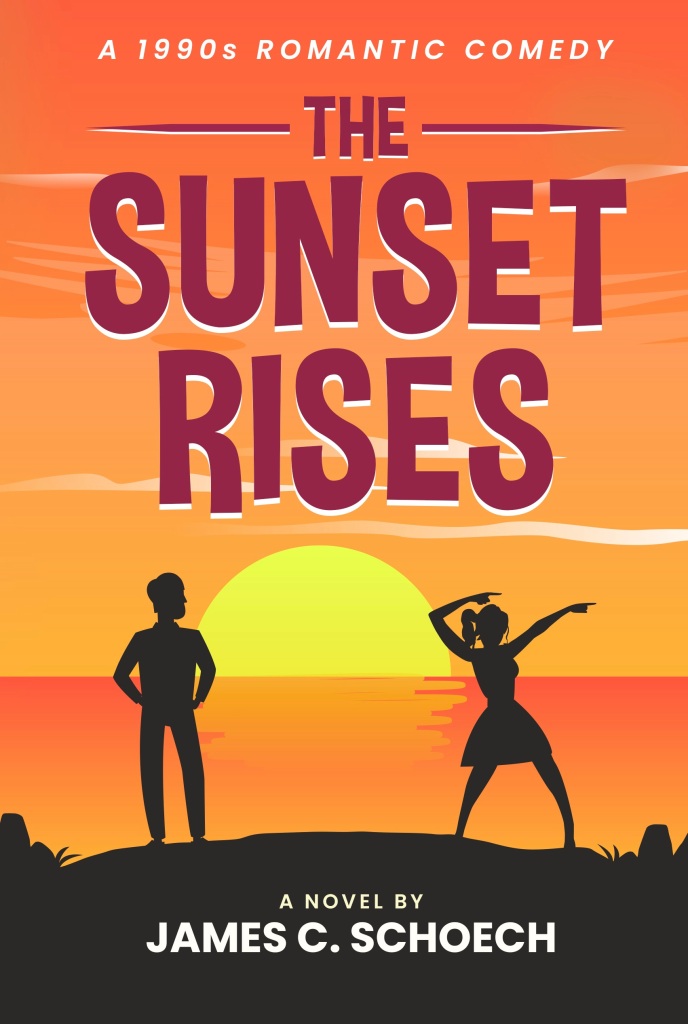
The Sunset Rises: A 1990s Romantic Comedy is now available on Amazon !

I’ll get to the adverb abuse in a moment.
I intended to finish Where Eagles Dare by Alistair MacLean. I bought it for $3.00. If I spend my own money on a book, I intend on reading the whole thing. I remember several friends in the 1970s reading old Alistair MacLean paperbacks like The Guns of Navarone and Where Eagles Dare and proclaiming how great they were.
For some reason, I was a bit skeptical. These same friends also really liked Hogan’s Heroes.
Anyway, I have a thing for old paperback novels right now. I went through a phase where I was having a tough time concentrating on fiction, but ever since I’ve started buying cheap old paperbacks again, I’ve been reading (almost) voraciously. I even liked From Russia with Love by Ian Fleming far more than I thought I would a few weeks ago.
Despite my rediscovered love for old paperback books, I stopped reading Where Eagles Dare after about 100 pages. It was way too outlandish, even by my standards. Too many close calls, harrowing escapes, and false alarms on every page. Characters handling trauma way too calmly. Double agents, triple agents, quadruple agents.
At some point governments have to wonder if they can trust their double/triple agents. Who do you hire to keep track of the double/triple agents? Another double triple agent?
And then there were the adverbs. As a former English teacher, I usually defend adverbs. A lot of writers claim that they dislike adverbs and consider overuse of adverbs as a sign of weak writing. My philosophy is that the adverb is a major part of speech; what’s the point of having a major part of speech if we’re not going to use it?
But then Alistair MacLean showed me exactly how not to use an adverb. All of the examples below are from one page early in the book. Don’t worry about the context, though. Everybody turns out to be a double or triple agent agent anyway, so it doesn’t matter what they’re saying.
*****
“I can’t help what you think,” Smith said kindly, patting her on the back.
–
“Language, language,” Smith said severely.
–
She said curiously: “What on earth excuse did you give for coming back up here?”
–
“It’s still inside Sergeant Herrod’s tunic,” Smith said sombrely. “He’s up here, dead.”
–
“Don’t tell me,” Mary said resignedly. “I’m only a little girl. I suppose you know what you’re doing.”
“I wish to God I did,” Smith said feelingly.
*****
That’s all on one page. Where Adverbs Dare is an entire novel filled with this. Maybe it wasn’t the entire novel. Maybe the author stopped writing like this after page 100, and I didn’t see it because I stopped reading, but I’m pretty sure it’s like this the entire book.
Where Eagles Dare was published in 1967. Maybe this type of adverb usage was normal in the middle-to-late 1960s, but I doubt it. I’ve read a bunch of books from that period, and I don’t recall seeing this many -ly adverbs used so frequently so many times so consistently in one novel.
As much as I defend adverbs, even I have to admit this is poor. It’s not the reason that I stopped reading Where Adverbs Dare, but the overuse of -ly adverbs didn’t help.
*****
I could never be a double/triple agent. I’m horrible at lying. My ears get red.
Or maybe I can make my ears turn red, even when I’m telling the truth, and I just pretend that I’m bad at lying so that people can trust me.
Or maybe I just say that I can turn my ears red at will so that when I lie I can hide the fact that I’m bad at lying. But then my ears would turn red.
I just confused myself now. That just proves that I’d be a double/triple agent. Or maybe I’m just pretending that I confused myself.
*****
What do you think? Were any of these -ly adverbs necessary? Did they add anything to the sentence (as far as you can tell)? Was it fair of me to judge my friends’ tastes negatively because they liked Hogan’s Heroes?

If you’re reading this, you’re probably against the idea of banning books in public libraries. At least, you won’t admit out loud that you want to ban books. I rarely meet anybody who’ll admit that he/she wants to ban books.
I’m pretty sure you’re against banning books because according to a recent poll, hardly anybody in the United States wants to ban books from libraries anymore. Last week the American Library Association put out a poll about voter opinions on banning books from the public libraries. It’s tough for the ALA to get coverage even on a slow news day, so with wars breaking out and economies collapsing, nobody paid attention.
The last time I saw the ALA make news was a few years ago when they renamed the Laura Ingalls Wilder Award for children’s books because her Little House on the Prairie books had a few racist references back in the 1930s. That made news, and everybody had an opinion about it. If you throw race into a topic, it will always make news. The next time the ALA wants to make news again, they should just throw race into their poll, and it will make the news and everybody will have an opinion.
Anyway, everybody knows not to trust polling anymore. If there’s any group that’s less popular than lawyers or politicians or journalists or Hollywood celebrities, it’s pollsters. Still, pollsters have to make a living, and the American Library Association wants to try to make news or raise awareness, so here we go!
*****
https://www.ala.org/advocacy/voters-oppose-book-bans-libraries
- By a substantial 42-point margin, voters oppose efforts to have books removed from their local public libraries because some people find them offensive or inappropriate and do not think young people should be exposed to them: 71% oppose, 29% support. Majorities of Democrats (75%), independents (58%), and Republicans (70%) are opposed.
- Parents also oppose efforts to remove books from their local public libraries by a significant 20-point margin: 60% oppose, 40% support.
*****
I’m a bit skeptical. All this poll shows is that democrats and republicans are less likely to admit that there are books they’d ban if they had the chance. At least Independents are more likely to be honest about it.
Hey, I’m opposed to banning books too, but I have my limits. I’d probably ban Massage Parlor II by Jennifer Sills if I had the chance. In the interests of full disclosure, I obtained a copy of Massage Parlor II from one of my older brothers when I was a teenager in the late 1970s, so I can’t blame the public library (or the Ivy League, like I usually do) for that.
If I saw a copy of Massage Parlor II at the library, I might suggest that it was inappropriate for a public library. I’ve heard that Massage Parlor I was kind of inappropriate as well. You know, I’m pretty sure the whole series is inappropriate!
Once I started banning books, I’d probably go on a banning spree. I’d ban 1984 by George Orwell and 2001: a Space Odyssey by Arthur C. Clarke. I remember both 1984 and 2001, and both books got those years completely wrong. I’d probably ban those two books from school libraries if I could too. I don’t want students reading 1984 and 2001:A Space Odyssey and believe that 1984 and 2001 were really like that.
I’d also ban children’s books written by celebrities. In fact, any book that a celebrity writes should be banned from public libraries, just because. The exception would be a celebrity who became famous for writing books. That doesn’t happen very often, but I’d make allowances for that.
And anything by James Patterson? Banned. And anything written by James Patterson and a co-author? Double banned! Banning books by James Patterson would save a lot of space in the public libraries for books that are actually good.
I could probably think of a bunch of other books to ban, but I’ll stop there. I don’t want to get carried away. I think I’ve been reasonable so far. Besides, I’m against banning books anyway. And so are you.
*****
What do you think? I know you’re against banning books, but if you absolutely had to ban books against your will, what books would you ban?
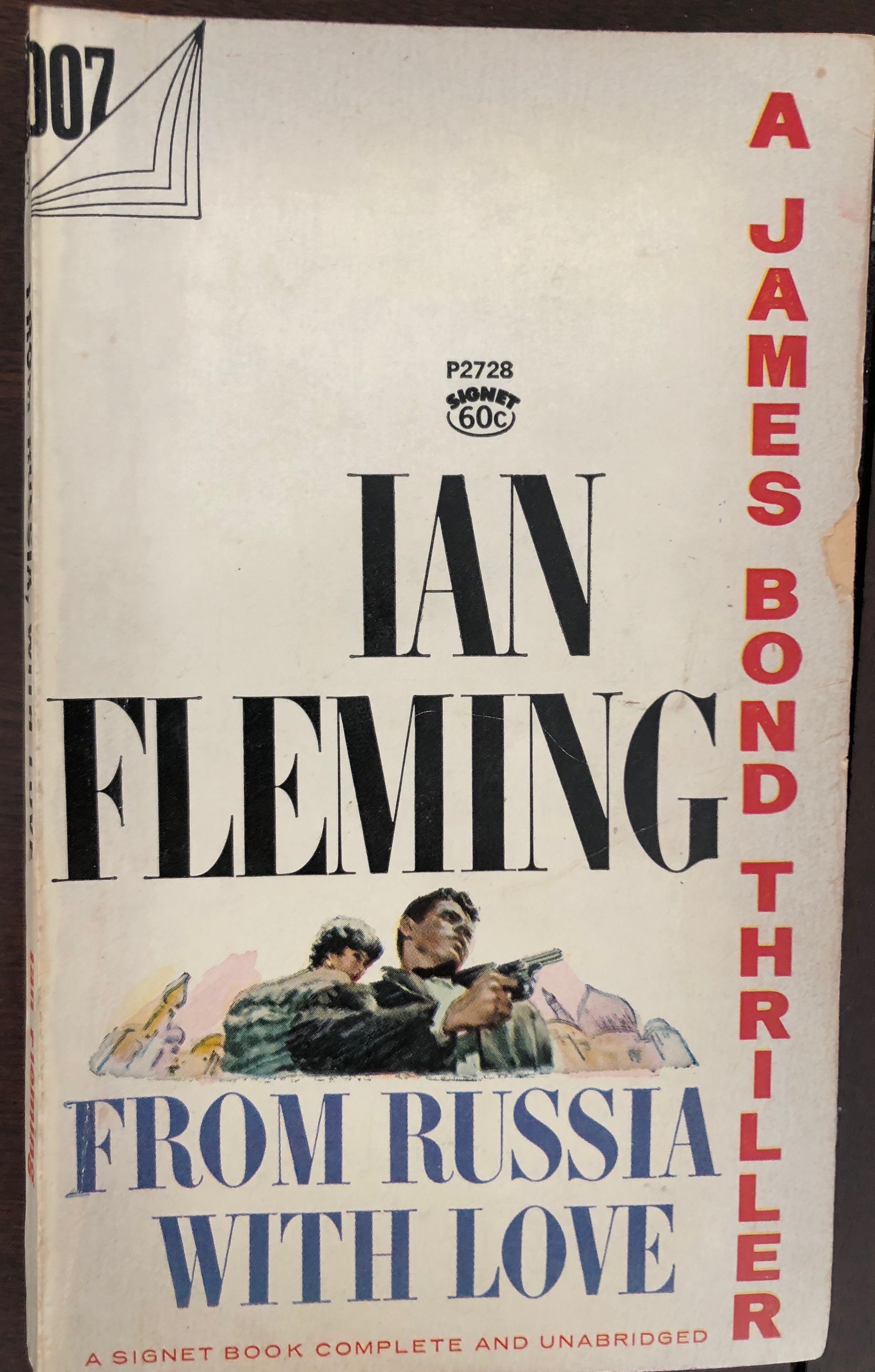
The novel From Russia With Love by Ian Fleming caught me by surprise with its cliffhanger ending.
*****
Bond pivoted slowly on his heel and crashed headlong to the wine-red floor.
*****
That was it! That was the final sentence of the book.
Yeah, I’m sorry I spoiled the ending. The novel came out in 1957, and I haven’t had any coffee yet, so my empathy hasn’t kicked in. I might apologize for the spoiler later.
Anyway, I was kind of pissed off when I read that final sentence. I checked to see if my copy had missing pages. But the back of the final page had an advertisement, so I knew that was it. Either James Bond had died, or From Russia With Love had a cliffhanger.
I didn’t know that James Bond books had cliffhanger endings. The book ending is similar to the movie ending in that this old lady SMERSH director Rosa Klebb is kicking James Bond with her poison-laced steel-spiked boot. The scene in the movie version looks ridiculous, but she actually gets him in the book, and the last sentence shows James Bond collapsing.
I’ve always hated cliffhangers in books and movies. The worst was the cliffhanger in the Star Wars movie The Empire Strikes Back because I was in middle school when it was released and knew I had to wait three years for the next movie. Three years seemed like an eternity when I was in middle school. Now three years seems like tomorrow.
I don’t mind a cliffhanger in an old James Bond book because From Russia With Love came out in 1957 and I can easily get the next book if I want it. I might read another James Bond book if I see it, but only if it’s a copy that came out before the movies.
I bought this copy of From Russia With Love for $3.00 at a used book store because it doesn’t have Sean Connery on the cover. Even though Connery is considered to be THE James Bond, I like to visualize my own characters, and Sean Connery isn’t what my brain came up with while reading this book. I like too many low-brow books to be a book snob, but I still want to have copies of books that came out before the movie adaptations, even if the movies are good.
This cover (pictured above) is kind of nondescript, with a bland white cover and a tiny illustration with the female barely visible. The 007 on the top left corner is cool. I’m surprised the publishing company didn’t try to have a book cover that stood out more. Maybe James Bond books back then didn’t have to have appealing covers; maybe being a James Bond book was enough to guarantee sales.
The structure of the novel is backwards in some ways. James Bond doesn’t even make an appearance until after page 70. The beginning focuses on SMERSH’s plan to kill James Bond. It introduces the SMERSH agents involved and a also a bunch of minor characters that the reader never sees again in this book. The reader knows the SMERSH plans before James Bond does.
The SMERSH plot to kill James Bond is kind of ridiculous. The SMERSH organizers admit that the plan seems ridiculous. James Bond and his boss M don’t know what the plan is, but they think the situation that the Soviets have presented them with is ridiculous. They’re sure it’s a trap, but it’s so ridiculous that they can’t pass it up.
I’m not complaining that the plot of From Russia with Love is ridiculous. I’ve seen almost every James Bond movie, and the plots are always ridiculous. This book is just more low-key ridiculous than any of the movies (except for maybe the movie version of From Russia With Love).
Ian Fleming, the author of the original James Bond books, was supposedly a knowledgable world traveler and used his experiences to describe locations in his books. After reading From Russia With Love, I’m guessing that Ian Fleming did not like Istanbul. If I were to base my world traveling on portrayals in James Bond books, I’d say stay away from Istanbul. Do not go to Istanbul! Bad things happen in Istanbul! At least in the 1950s they did. Maybe Istanbul has improved since then.
I enjoyed reading From Russia With Love, but I’m glad I didn’t read it in 1957. That cliffhanger ending would have put me in a bad mood.

First of all, a part of me can’t believe that famous author George R.R. Martin is still alive. That might sound harsh, but he doesn’t look like a healthy guy. I know several health conscious people, and none of them want to follow the George R.R. Martin regimen.
I suggested on this blog way back in 2012 that George R.R. Martin might not finish the Game of Thrones book series, also known as A Song of Ice and Fire. Back then, nobody noticed because nobody read my blog. Statistically, nobody reads my blog now, but at least now I occasionally get a comment when I say something controversial.
Even though I thought George R.R. Martin might not finish the series, I believed in 2012 that he would at least finish the next book The Winds of Winter. I thought Martin’s problem with completing A Song of Ice and Fire was going to be wrapping everything up in two or three more books. I thought he was writing himself into an infinite series that would require too many books for his life span.
Back in 2012, I would have been surprised to find out that George R.R. Martin was still alive in 2022. Even back in 2012, George R.R. Martin looked rather unhealthy. I’ve lost friends and family that looked healthier than George R.R. Martin in 2012. Last year, a good friend of mine died. He was a fan of A Song of Fire and Ice and was pissed that the series never got finished.
His final words were, “I can’t believe that George R.R. Martin outlived me, that bastard.”
I admit, those probably weren’t his final words. I wasn’t there in my friend’s final moments. But I’m pretty sure he had that thought at some point. He was pissed that he never had the chance to read The Winds of Winter.
The reason I’m writing about this topic on my blog is because last week Martin made some remark that he was “weary” of his fans asking him about The Winds of Winter. According to Martin, he has a bunch of other projects that he’s working on first and that fleshing out his fantasy world of Westeros is more important than than the one story of A Song of Ice and Fire.
To be fair, George R.R. Martin didn’t say the exact words “I’ll never finish writing A Song of Ice and Fire,” but I know that’s what he meant. Why else would he be tired of answering questions about it? If he were going to finish the series, he’d probably be encouraged by the questions.
At this point, I don’t care if he finishes A Song of Ice and Fire. Yeah, I must care a little if I’m writing a blog post, but you don’t have to care about something to write about it. I think the topic is interesting, but I don’t care anymore if he doesn’t finish the series. I might still read the remaining books if they ever come out (which they won’t), but I won’t miss them if they’re never completed (which they won’t be).
I admit, I cared about five years ago. I had stated several times that I wouldn’t start reading A Song of Ice and Fire until he’d finished the series, but then I broke down and, one by one, I read the books. My opinion of the books was pretty much the same as everybody else’s opinion, and my opinion of the HBO television series is pretty much the same as everybody else’s, so I won’t get into what I think about them.
Some fans are so desperate for a literary conclusion to A Song of Ice and Fire that they want Martin to have some other author finish the series, like Brandon Sanderson did with Robert Jordan’s The Wheel of Time series. I think James Patterson would be a good choice. He could have the remaining books out by next month. Yeah, they’d have one-page chapters with cheesy dialogue, but at this point nobody cares about writing quality anymore. Nothing could be worse than Season 8.
I take that back. A lot of things could be a lot worse than Season 8, but you know what I mean.
And to be clear, I don’t want George R.R. Martin to die. I’m just surprised he hasn’t. I mean, c’mon! Look at the picture!
*****
It’s the oldest story in the world, 1990s style!
Man meets woman; man falls in “luuuvvv” with woman; man gets blindsided by reality!
The Sunset Rises: A 1990s Romantic Comedy is now available on Amazon and from the trunk of my car!


 Dysfunctional Literacy