
How was I supposed to concentrate enough to write in English class when a girl like that (with legs like that) was sitting next to me? But I did! (Photo credit: Wikipedia)
It was tough to concentrate in Mr. Fay-guns’ English class because the girl who sat next to me had really nice legs. Her name was Denise, and she was a cheerleader, and almost every day she either wore her cheer outfit (it seemed like every day) or some shorts. Either way, her legs were right there. They were long, tan, and muscular in the right way. When she crossed her legs, there was a muscle that… I know that sounds creepy, but I was in tenth grade, so give me a break.
I really wasn’t thinking anything that weird (for a tenth grader). I admired her legs. They were nice.
My own legs weren’t so nice. My legs were pale, hairy, and very thin. I wore jeans to school every day and never considered wearing shorts, not even on the hottest days.
The cheerleader stereotype is that they’re evil and manipulating (if you watch Nick and Disney shows, which I only do because I have kids. In a few years, they’ll outgrow the shows… hopefully). The cheerleaders at our school were pleasant to everybody and maybe too sensitive. It really bugged them if we didn’t cheer loudly enough, but since most of us actually liked our cheerleaders, we’d fake enthusiasm at the pep rallies just so that they wouldn’t get upset. Maybe they were manipulating us after all.
Denise didn’t fit the cheerleader stereotype either. She was smart. Her boyfriend wasn’t an athlete (but he was a senior). She was nice most of the time. And she didn’t say ditzy stupid stuff. I was more likely to say stupid stuff than she was.
Every guy in school had a crush on Denise at some point in high school. I was lucky because I got mine over with. My delusional stage (where I thought I had a shot at her so I’d freeze whenever I had the chance to talk to her) lasted only a few days. When I realized she was unattainable, I calmed down around her and could speak freely. But I never got tired at looking at her legs.
Denise was the only person at school who called me James instead of Jimmy. She didn’t ask if I wanted be called James, and I never told her to stop or asked her why she did it. It was either really arrogant or incredibly cool of her.
She also stole material from me. Not pencils or papers or homework (or my heart). She stole my lines. Every once in a while, I would whisper something funny to her during class, and then she would repeat it more loudly to her friends who sat on the other side of her. Her friends would laugh which made me feel pretty good, but I don’t think I ever got credit for my work. Copy write infringement wasn’t an issue for me in tenth grade because at least I knew my material was pretty good. And maybe Denise’s delivery was better than mine.
The reason I mention Denise (other than she had great legs) is because one day I wrote something in English class that was so awesome that even she couldn’t steal it from me.
And I promise that I’m getting to it.
*****
To be continued in Long Story: The Sick Teacher .

“Did you say ‘over’? Nothing is over until we decide it is? Was it over when the Germans bombed Pearl Harbor? Hell no!”- Bluto from National Lampoon’s Animal House (Photo credit: Ms_Spinwax)
Everybody has bad moments, and a couple weeks ago I temporarily became the person I avoid. I get annoyed at people who recite famous movie quotes. To me, it’s a way for the movie quoters to seem witty when they can’t make up their own original thoughts.
Maybe I’m being harsh, but I work really hard to come up with (my few) original thoughts, and when I finally get one, I don’t want to get upstaged by a guy who quotes a line from a movie.
A couple weeks ago, I got called into a meeting by my boss. She’s a nice person and we get along fine (you know a “but” is coming), but she’s young and she tries too hard to change things that don’t need to be changed.
I’ll try to explain the situation without getting into the details because my job is boring to most people (including me).
A few years ago, my boss changed a bunch of stuff that had worked fine, and the change added more work for everybody (except her bosses), and she gave us several long lectures about how things always change and we can’t resist change and those of us that resist change have to be willing to adapt (or get fired).
Now the boss who lectured us about these changes needs new changes to save her job, and she expects us to give her the new idea for which she can take credit. All she really needs to do is to go back to the old way but call it something different (preferably with an acronym that spells out a short motivational word). And I don’t get paid the big bucks (because I can’t think of good acronyms).
After a couple hours of pointless idea exchanging, one co-worker said, “That’s it. We’re done.”
There was a silence because our boss usually decides when we’re done, not the co-worker.
“Did you say ‘done’?” I said in a mock animated voice.
My co-workers were surprised. I hardly ever talk, and when I do, I have a monotone voice. I’m actually pretty good at impersonations, though, so my impression of an emotional guy must have been convincing.
“Nothing is done until we decide it is!” I continued in a fake outraged manner. “Was it done when the Germans bombed Pearl Harbor? Hell no!”
The mood in the office was about to change; I could feel it. One co-worker (who was old enough to understand the reference) laughed.
Then my boss said, “The Japanese bombed Pearl Harbor, Jimmy. You should know that.”
And we brainstormed in drudgery for another hour.
I have to admit, that was a bad time for a brain glitch. I can’t remember another time where I’ve quoted a movie line in conversation (except for “Is it safe?” from Marathon Man a couple times), and the timing couldn’t have been worse. The meeting was probably about to be over due to exhaustion, and I inadvertently gave my boss a new momentum. Plus, she believes I’m stupid because she thinks I think the Germans bombed Pearl Harbor.
Maybe my boss’s generation is to blame because everybody should recognize the “Germans bombed Pearl Harbor” line. When Animal House came out, I was too young to see it because it was rated R (pre-cable and pre-internet days), but the line was legendary. Every boy wanted to see Animal House just for Bluto’s Pearl Harbor line (and the rumors of full frontal female nudity).
I know it’s not a good idea to explain the context of the Germans bombing Pearl Harbor to my boss because the explanation would take a long time and she still might not think it is funny.
Besides, I’d rather have my boss believe that I think the Germans bombed Pearl Harbor than have her think I’m the kind of guy who injects movie quotes into conversations.
I may get confused whether “To be or not to be” is from Macbeth or Hamlet, but I put the Animal House quote right up there, and it’s a shame that it’s fallen out of the pop culture lexicon.
I’m going to kick myself about this for a while. I’d better think of a really good motivational acronym for my boss.

What did you expect? If you’re disappointed, just scroll down a bit further. (Photo credit: Wikipedia)
When I was a kid, I thought I could get away with saying the word “ass” in front of my mom because everybody knew it meant “donkey.” But I got my mouth washed out with soap anyway. I didn’t think that was fair. Was my mom a mind reader? How could she tell if I meant “buttocks” or “donkey” when I said the word “ass”?
I couldn’t say the word “b*tch” either, even if I saw a female dog. I couldn’t even say the word “shih-tzu” without getting my mouth cleaned.
I was the only kid in the neighborhood who wasn’t allowed to say “shih-tzu.” I still think it was unfair.
I knew that “ass” could mean “donkey” and that it could also mean “buttocks” (that was the word the dictionaries used in their definitions), but I could never see the connection between “buttocks” and “donkey” (I didn’t lose any sleep worrying about it).
It’s not unusual in English for a word to have multiple meanings (it’s unusual if a word in English doesn’t). But very few vulgar words in English have non-vulgar multiple meanings. So how did this happen? After a little research (good old Merriam -Webster), I discovered that the multiple meanings came from multiple original languages.
For example, the donkey version of “ass” comes from Latin “asinus” which means “an African mammal, the ancestor of the donkey.” The Old English version is “assa, and the old Irish version is “asan.” The first known use of “ass” is before the 12th century.

Whether you think this is awesome or offensive, it’s done for the sake of etymology. (Photo credit: Wikipedia)
The “buttocks” version of “ass” comes from the German and Old Norse word “ars” which meant “buttocks.” “Arse” is a cool word, so cool that Middle English adapted it (ars), and somewhere along the way, “arse” became “ass.” “Arse” is way cooler than “ass,” but I probably would have gotten my mouth washed out for saying it.
A potential problem with “ass” is that it has so many compound word combinations that a listener might not know if the speaker means “donkey” or “buttocks.”
Context can help. If the speaker says “a**hole,” then the speaker’s meaning is clear.
But what about “dumbass”? That could mean either “dumb donkey” or “dumb buttocks,” and context might not be helpful.
“A**hole” is pretty clear. “Horse’s *ss” is pretty clear. “Piece of *ss” is pretty clear. “Kicking *ss” is pretty clear. “Kissing *ss” is pretty clear. “Shove it up your..!”
I think everybody gets the idea.
“*ssface?” “*ssbite?” “*sslick?” Those could go either way.
Even movies are pushing the envelope by using the word “ass” in some titles. The Jack-Ass movies refer to the donkey, but they act like a**holes. My kids are forbidden from saying the word “jack-ass” and from seeing the movies (until they’re 30). The movie Kick-*ss is a decent super-hero movie if you can get past the extreme violence and an 11 year-old girl that slaughters people. Again, my kids are not allowed to watch it.
I’m sure my own kids will say some of the same things I said (I’m surprised it hasn’t happened yet). I don’t think I’ll wash their mouths out with soap (it’s probably illegal now), but there are still words they cannot say. They are not allowed to say “b*tch.” And they are not allowed to say “ass.”
They will be allowed to say “shih-tzu” as long as it’s in the correct context.
I haven’t decided yet if my children will be allowed to say “arse.”
It’s weird that the moment I was inspired to write happened in Mr. Fay-gun’s class because he wasn’t an inspirational teacher. He read novels to us in a monotone voice (my voice is monotone too, so I can relate) and seemed to go out of his way to make class boring.
Mr. Fay-guns wasn’t a bad teacher; he just wasn’t inspirational. None of my high school teachers were. One teacher was perspirational. My senior math teacher reeked of body odor, and his white shirts had constant wet spots under the armpits. Looking back, I feel bad for him. The poor guy was probably nervous all the time, being surrounded by high school kids who weren’t interested in calculus (I wasn’t either, but I needed the grade). I would have been nervous too.
Mr. Dillon, my tenth grade social studies teacher, sat at his desk and read the newspaper to us for about 15 minutes each period. Since he liked sports, we usually talked about football in the fall and baseball in the spring. I liked Mr. Dillon’s class, but he wasn’t inspirational at all.
Mr. McAllister, my 11th grade government teacher, called me “Jimmy, the Geek” every day. I was a geek, but nobody else ever called me a geek to my face. There was a football prognosticator on television back then called Jimmy the Greek, but I don’t think Mr. McAllister was making a play on words because he called a bunch of other smart kids “geek,” and I was the only Jimmy. He called other kids worse names: “moron,” “dipstick,” “dummy,” “el stupido,” and “moose breath” were his favorites. With Mr. McAllister, “geek” was about as good as any student was going to get. That wasn’t very inspirational.
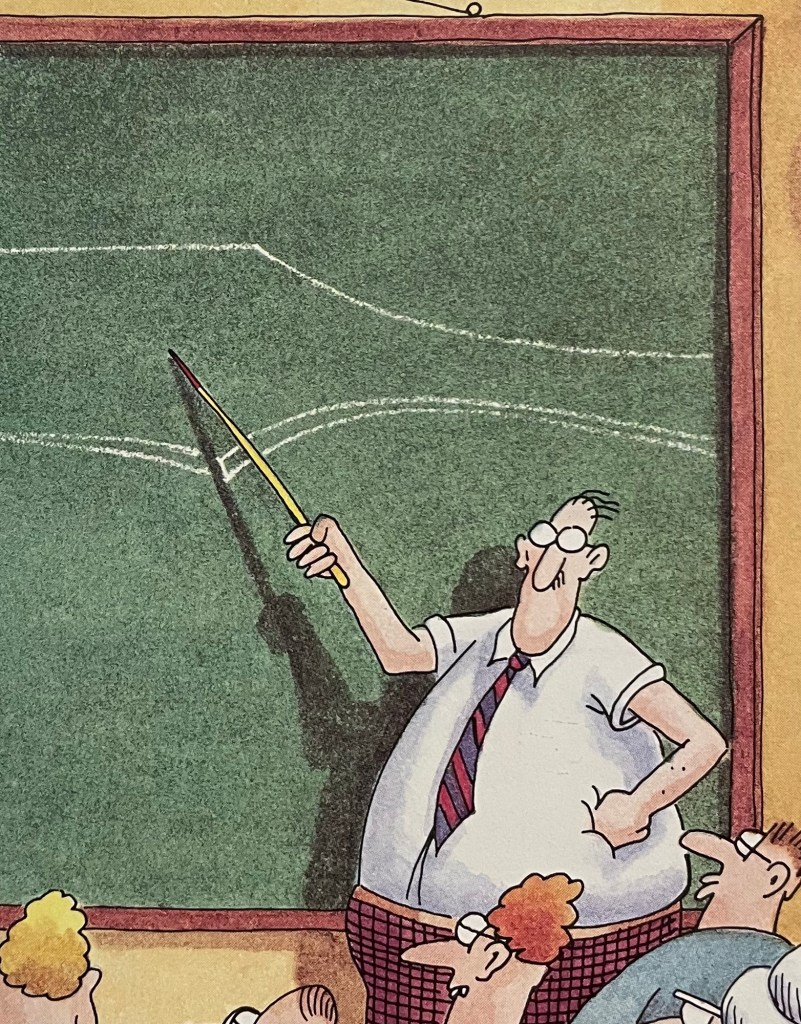
Mrs. Mitchell, my junior math teacher (pre-calculus?) had monstrous flaps under her arms that waved like a rolling tide whenever she wrote on the chalkboard, and she usually spent the whole period talking and writing on the chalkboard. I didn’t even notice the flaps until a friend pointed them out (thanks a lot!), and then I couldn’t pay attention to anything else. I obsessed over the arm flaps, like Ishmael and the whale or Nora Ephron and her neck. To make matters even worse, Mrs. Mitchell always went sleeveless. Even on the coldest of wintry days, she went sleeveless, and her intense writing almost made me motion sick.
I’m not trying to make fun of her. If we had pointed out Mrs. Mitchell’s arm flaps to her, she could have easily pointed out all of our flaws to us. Half of us had so many zits that we could have played connect-the-dots with each other. Several of us had bad teeth, one kid walked funny, and several others were just plain goofy looking and were never going to change no matter what. We probably didn’t inspire her either.
The closest a teacher ever came to inspirational was my over-sensitive ninth grade English teacher. She tried to be inspirational by reading some high-brow poetry that “spoke” to her. She read it dramatically to the class, and we sat there awkwardly as she almost acted out the narrative within the poem. It was deep (and probably moving), so we didn’t get it, but she was trying really hard, and we sat quietly out of respect (and curiosity). When she was done, there was a silence where she probably expected at least half-hearted applause.
Instead, some kid farted really loud(ly). And then we laughed.
I hope she realized at some point (in her life or career) that we weren’t laughing at her performance. If there’s a silence in the classroom and a kid fills that void with flatulence, somebody’s going to laugh. Personally, I blame the farter.
This is probably what happens to a lot of teachers; they go into the profession thinking they are going to inspire a bunch of kids, and then they get farted on (literally and probably metaphorically too).
This reaction might be a surprise to novice teachers. We’ve all probably seen the movies with the teacher (usually young and not of the same race/ethnicity/socioeconomic status as the students) giving a speech and the students sitting quietly, hypnotized, mouths almost slack-jawed open, with quiet dramatic music in the background as the idealistic teacher “reaches” the kids.
In reality, there’s no background music, and some kid farts.
Maybe at one time Mr. Fay-guns wanted to inspire kids and settled instead for just keeping kids in line (which isn’t always a bad thing). But despite having a monotone voice and a pretty boring class, he actually inspired me enough to want to write.
And I’m getting to that part pretty soon.
To be continued in Long Story: The Cheerleader with Really Nice Legs.
*****
To start “Long Story” from the beginning, read

Quoting Shakespeare can be awesome, but it can backfire too if you’re not careful. (Photo credit: Wikipedia)
The reason I like the Best Literature Quotes Ever is because they can make a guy seem smarter than he really is. I’ve gotten by in life by surrounding myself with people who are way more intelligent than I am. One way to attract smart people is to appear intelligent, and I’ve been successful at that when I’ve needed to be. One way is to be able to quote a line from literature when the correct situation arises.
The great thing about Best Literature Quotes Ever is that you don’t have to read the literature that the quotes are from. I used to own a book of famous quotes, and I memorized a few (not many) that I figured could come in handy. The only problem is that I had to make sure to hide the book of quotes (and my football magazines) whenever my intelligent friends came over. I might have been a fraud, but I didn’t want my intelligent friends to think I was a fraud. They probably knew anyway.
A Best Literature Quote Ever has to meet several criteria in order to be effective. The quote has to be short. If the quote is too long, it’s hard to memorize it. If you misquote a line from literature, then some overeducated guy will correct you in front of everybody and make you look stupid. That defeats the whole purpose of learning a Best Literature Quote Ever!
The literary quote also has to have a universal context. You should be able to interject it easily into conversations. It does you no good to memorize a great literary quote and never be able to use it. But be careful. If you use it in the wrong circumstance, you can look like you’re trying too hard.
WARNING!! Stuff like “Bah, humbug!” or “Elementary, my dear Watson” doesn’t count because everybody knows these.
*****
BEST LITERATURE QUOTES EVER!
“… a rose by any other name would smell as sweet,” Romeo and Juliet by William Shakespeare
I almost used this once when a woman accidentally passed gas in public. Instead, I took the blame and apologized to everybody.
*****
“These words are razors to my wounded heart.” Titus Andronicus by William Shakespeare
I said this when my literary girlfriend in college broke up with me. When I found out she broke up with me to date a professor, I think I quoted a song by Fishbone instead.
*****
“Good night, good night! parting is such sweet sorrow, That I shall say good night till it be morrow.” Romeo and Juliet by William Shakespeare
I would say this to my literary girlfriend (before she broke up with me). It’s probably why she broke up with me.
*****
“O, beware, my lord, of jealousy! It is the green-eyed monster, which doth mock the meat it feeds on.” Othello by William Shakespeare
My ex-literary girlfriend said this to me (or paraphrased it) when she found out I was mad about her dating a professor. I hate it when my own techniques are used against me.
*****
“Surprises, like misfortunes, seldom come alone.” Oliver Twist by Charles Dickens
It took me a long time to get another girlfriend after that literary girlfriend broke up with me. It was a misfortune but not really a surprise. It was years and years later before I met my wife (that was NOT a misfortune).
*****
“A baby has brains, but it doesn’t know much. Experience is the only thing that brings knowledge, and the longer you are on earth the more experience you are sure to get.” The Wonderful Wizard of Oz by L. Frank Baum
This could come in handy when some inexperienced snot just out of college starts bossing me around on my job, but I’ve never used it because inexperienced snots out of college don’t handle criticism from older subordinates very well. Fortunately, we haven’t hired many snots out of college recently as bosses. I guess that’s a benefit of a bad economy.
*****
“I am now quite cured of seeking pleasure in society, be it country or town. A sensible man ought to find sufficient company in himself.” Wuthering Heights by Emily Bronte
A perfect justification for porn (not that I’ve ever… never mind).
*****
“Men get tired of everything, of heaven no less than of hell; and that all history is nothing but a record of the oscillations of the world between these two extremes. An epoch is but a swing of the pendulum; and each generation thinks the world is progressing because it is always moving.” Man and Superman by George Bernard Shaw
I like this quote, but I never managed to memorize it, so I’ve never used it.
*****
“Life appears to me too short to be spent in nursing animosity or registering wrongs.” Jane Eyre by Charlotte Bronte
Somebody needs to tell that to the Real Housewives (of any city).
*****
“Cowards die many times before their deaths; the valiant never taste of death but once.” Julius Caesar by William Shakespeare
This quote sounds cooler than it really is. I have run from danger in a cowardly fashion several times, and I don’t regret it at all. I have not died a single time yet.
*****
“There are people, who the more you do for them, the less they will do for themselves.” Emma by Jane Austen
Never use this quote during a discussion about politics. Better yet, never get into discussions about politics.
*****
“Poor nations are hungry, and rich nations are proud; and pride and hunger will ever be at variance.” Gulliver’s Travels by Jonathon Swift
And that explains the behavior of the United Nations. Oops… I forgot my rule about never talking politics.
*****
“Nobody is healthy in London, nobody can be.” Emma by Jane Austen
Jane Austen has never been to Detroit.
*****
“From hell’s heart I stab at thee; for hate’s sake I spit my last breath at thee.” Moby Dick by Hermann Melville
A far better quote than “Call me Ishmael.” I shouted this at the end of a football game when we lost to our rivals. My football obsessed friends were impressed that I knew some Shakespeare.
*****
“If you observe, people always live for ever when there is an annuity to be paid them.” Sense and Sensibility by Jane Austen
I guess if I make it to retirement, I have it made.
*****
“A man of genius makes no mistakes. His errors are volitional and are the portals of discovery.” Ulysses by James Joyce
In my book of quotes, this was punctuated correctly. I’m not sure what it looked like in Ulysses.
*****
“Grief makes one hour ten.” King Richard II by William Shakespeare
So did reading Shakespeare while I was in high school.
*****
“One man’s ways may be as good as another’s, but we all like our own best.” Persuasion by Jane Austen
The key word is “may.”
*****
“Take nothing on its looks; take everything on evidence. There’s no better rule.” Great Expectations by Charles Dickens
BEST… QUOTE… EVER!!!
*****
Since I haven’t read every single book ever (or read every single book of quotes in literature or gone to every website that lists literary quotes), I don’t know for sure that these are the best literature quotes ever. I probably (definitely) missed some.
Since I know this list cannot be complete, feel free to help me out. What do you think should be added to the BEST LITERATURE QUOTES EVER?

I didn’t know that I had the potential to be a good writer until this happened, but it’s a long story. (Photo credit: Wikipedia)
When I was growing up, I had some teachers with unfortunate last names. In junior high I had a math teacher named Mrs. Butte. She insisted her name was pronounced “Bee-Yute” like the word “beauty,” but she wasn’t attractive at all. If she had been a hot chick with cleavage, we might have pronounced her name correctly. But she wasn’t, so we didn’t.
There was also a social studies teacher named Mr. Dick (and his name was pronounced exactly like it was spelled). Nobody made fun of Mr. Dick. You would think a guy named Mr. Dick would stay out of teaching because of his last name, but nobody ever made fun of him.
Mr. Dick was an old man who had cool tattoos on his arm (none of which were phallic in nature). He had been teaching for decades, and everybody in town had grown up knowing Mr. Dick (or knowing about him), so nobody thought anything about his name anymore. He was just an old man named Mr. Dick.
There’s no way to prove this, but my junior high school was probably the only one that had a Mrs. Butte and a Mr. Dick.
Then in high school I had an English teacher named Mr. Faggins. Mr. Faggins announced on the first day of school that his name was to be pronounced as “Fay-guns.” I knew my rules of pronunciation and how the double consonant causes the vowel in front of it to have the soft sound, but I was also polite enough not to argue with an adult about how to pronounce the adult’s last name. I’ve always believed that a person should be able to choose how to pronounce his or her name.
Of course, somebody would have to test Mr. Fay-guns.
It was the second day of school, and there was this kid named Tucker who sat in the front middle desk of Mr. Fay-guns’ classroom. I was in the third desk two rows closer to the door. Tucker was an annoying kid who got beat up every once in a while (but he brought it on himself, so nobody felt sorry for him). Mr. Fay-guns was going over classroom rules when Tucker asked a question.
“Can I go to the bathroom, Mr. Faggins?”
Mr. Fay-guns paused and said, “Not now. And in the future please pronounce my name correctly.”
Mr. Fay-guns continued lecturing about his rules, but a few minutes later Tucker interrupted him.
“When can I go to the bathroom, Mr. Faggins?”
“You will not go to the bathroom as long as you are mispronouncing my name,” Mr. Fay-guns said slowly.
“I need to go to the bathroom, Faggins,” Tucker said.
Here is what everybody who was there agrees about. Mr. Fay-guns thwacked Tucker upside the head, grabbed him, and physically threw him out of the classroom.
Here’s where there is some disagreement. I think Tucker left out the word “mister.” Other students said that Tucker said “mister”,” but stressed the “Faggins” so much that it sounded like an insult. Also, I think Mr. Fay-guns hit Tucker with a dictionary (not an Oxford, though that would have been really impressive, and maybe deadly). Others insisted it was just a paperback book that had been lying around. A couple students said Fay-guns open-palmed Tucker, but I heard a clear THWACK, and a slap doesn’t make a THWACK sound.
I saw Mr. Fay-guns grab Tucker by his shirt collar and drag him out of the classroom. Others said Mr. Fay-guns pulled Tucker by his arm, then armpit, and then threw him out. A couple guys said Tucker ran out of the room crying like a baby.
Tucker forever maintained that he had done nothing wrong and that Mr. Fay-guns had attacked him for no reason.
There is no cell phone footage of the event, so it shall forever remain a mystery what exactly happened.
If something like this occurred today, things would be handled a bit differently. Nowadays if a teacher hit a kid with a dictionary (I stand by my version of the story), the teacher would get fired and probably get sued. Nothing like that happened to Mr. Fay-guns. Even better, Tucker got switched to another English teacher. That was great because we didn’t like Tucker anyway. But I was a little scared of Mr. Fay-guns after that.
I remember Mr. Fay-guns, not because of his last name (though that helps) and not because he beat up a kid in class (that helps too). I remember Mr. Fay-guns because something happened in his class one day (nobody got beat up) that made me realize that I could be a pretty good writer.
But it’s a long story.
To be continued (I’ve always wanted to do that).
For more Long Story, read
Long Story (Part 2): Inspirational vs. Mediocre Teachers .

She’s smiling because her unseen display of ankle is going to drive the guys crazy. (Photo credit: Wikipedia)
Men don’t usually think about the history of pornography when they think about porn. When a normal guy thinks of porn, he usually thinks of women who… aw, never mind. We know what guys think about when they think of porn. But once the porn gets old (and it does), a guy like me starts to wonder things like “Where did the word ‘pornography’ come from?”
The word “pornography” has ancient Greek roots. The root “porne” means “prostitute” and “graphy” means “to write about.” Together, the roots form the word “pornographos” which meant “writing about prostitutes.” I thought all the ancient Greeks wrote about were history and philosophy (and mythology and weird plays).
Knowing that “pornography” means “writing about prostitutes” puts things in context. In all those old porn movies when the porn boss made a porn joke to his porn secretary about taking “dictation,” I thought it was a reference to the boss’s body part; he was actually making an inside joke about porn’s roots (based on the literacy of prostitutes), and I was too ignorant to understand it.
The word “pornography” didn’t even exist in the English language until around 1858. The French (of course) had their version “pornagraphie” (best said with an Inspector Clouseau accent) in the 1800s. Leave it to the French to export their perversions to us (not that men are complaining).
Nowadays “pornography” is often referred to as “porn” because guys who watch porn are too lazy (or too excited) to add the “ography.” When guys say they are about to watch “porn,” they are unknowingly saying (but probably don’t care) that they are about to watch some prostitutes.
PROSTITUTION vs. ETYMOLOGY vs. FREEDOM OF EXPRESSION
Maybe “pornography” really means “writing of prostitutes,” which would change the way many people view porn actresses. If actresses wrote their own scripts, they would be thought of as literary figures rather than glorified prostitutes. And maybe the scripts would be better.
Pornographers have mainstreamed porn by using the argument that it is covered under “freedom of expression.” Prostitution, however, is not considered freedom of expression (since it’s illegal almost everywhere in the U.S.). If “porn” means “prostitute,” and prostitution does not fall under “freedom of expression,” then pornography cannot be considered “artistic” or “freedom of expression.”
I’m really not that literal of a person.
IS EROTIC ART THE SAME THING AS PORNOGRAPHY
When studying the history of pornography (no videos were used during research, so it was actually kind of boring), a lot of historians include ancient erotic art. In my opinion, ancient erotic art is not the same thing as pornography. Ancient erotic art may show a dangling body part or two members of the opposite gender really close together, but this ancient art doesn’t include any of the specific acts that make pornography what it is.
If you can look at ancient art and not feel a twinge of guilt, then it’s not pornography.
The first known erotic literature is from the 1700s. I haven’t read any of it (or read about any of it), but I’m pretty sure what was erotic in the 18th century isn’t the same thing as what is erotic today. I think in one “erotic” scene from the 18th century, a young lady smiles seductively as she displays her ankles, and a bunch of guys excuse themselves for a few minutes.
The first pornographic film was in the very late 1800s when some guy talked a woman into posing nude in his film. Even back then some guys could talk some women into anything. This guy discovered that other guys would pay lots of money to see naked women on film (and an industry was born).

Yeah, some guys would watch him. (Photo credit: Wikipedia)
Maybe back in the 1800s, “pornography” was about the writing, but the writing today is almost irrelevant (for men). Most guys would rather watch the moving images, and most women would rather read the words, unless Matthew McConaughey is shirtless in the video.
If somebody could convince Matthew McConaughey to do an actual porn flick, then a new industry would be born, porn that men and women could enjoy together.
Then we’d have to come up with a new word for it. And I’d have to write about the history of a new kind of porn.
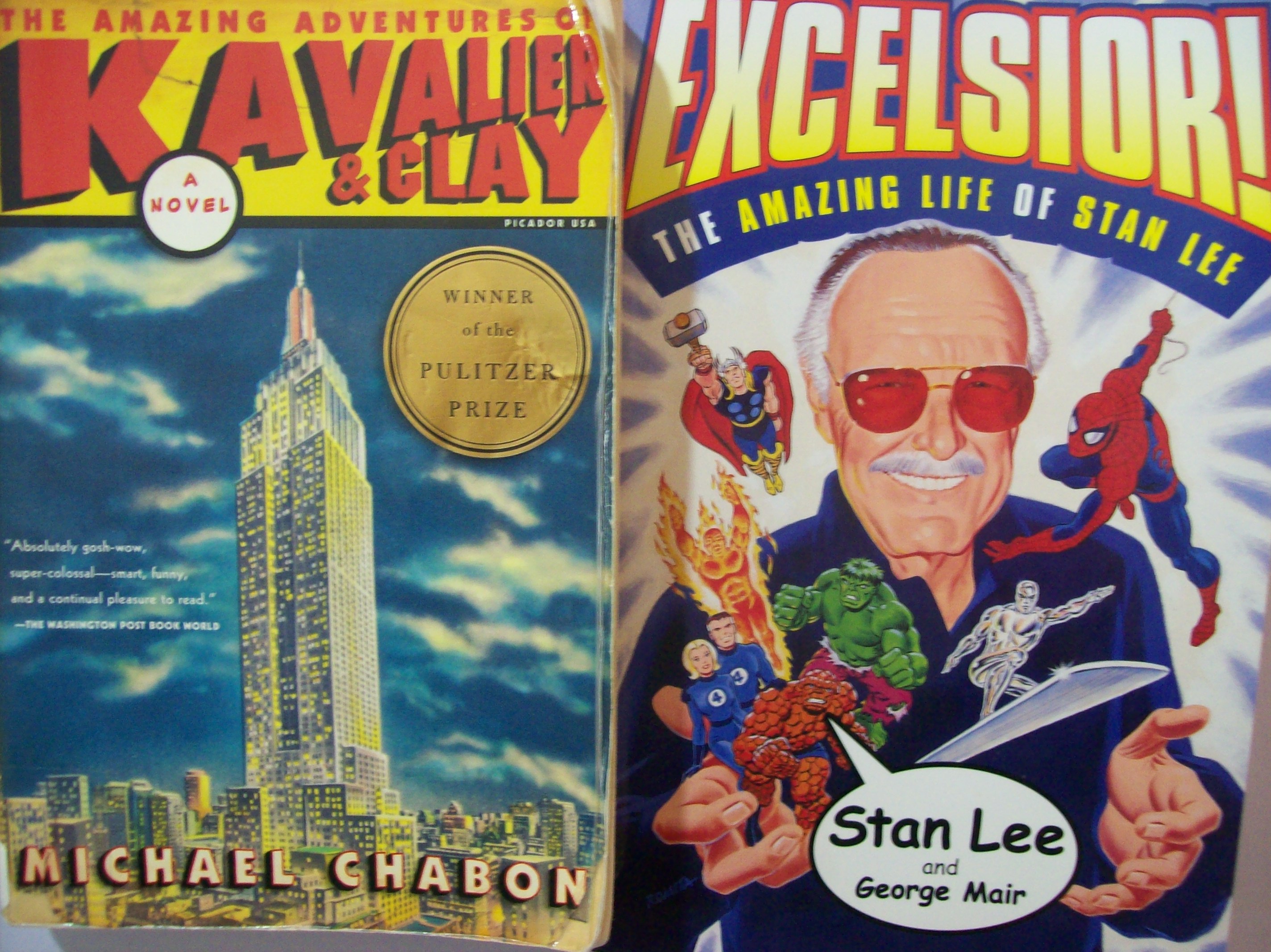
The book on the left won a Pulitzer Prize. The guy on the right should have won a Pulitzer Prize just for being awesome!
Comic books created by Stan Lee can do many things. A comic book created by Stan Lee can get a boy through a troubled childhood. A comic book created by Stan Lee can get a bunch of kids who hate reading to suddenly become interested in the written word.
But a comic book created by Stan Lee can never win a Pulitzer Prize. And that’s what a novel about comic books The Amazing Adventures of Kavalier and Clay managed to do.
*****
The Amazing Adventures of Kavalier and Clay by Michael Chabon
Even though The Adventures of Kavalier and Clay is kind of about two guys who create a comic book hero, the book itself is the opposite of a comic book. It’s literary fiction, which means a guy like me has to concentrate in order to read it. I don’t mind concentrating if the book is really good, but we’re in the middle of football season, so Kavalier and Clay will have to wait until mid-February.
Fans of Kavalier and Clay say that you don’t have to like comic books to enjoy this book. I’ll take it a step further. It probably helps if you know nothing about comic books. I love comic books (or the idea of comic books), but Kavalier and Clay seems to be more like a period piece about the 1930s and 1940s than it is about comic books. Literary fiction that is really about comic books would never win a Pulitzer Prize.
*****
Excelsior: The Amazing Life of Stan Lee by Stan Lee and some other guy of whom I have never heard
Stan Lee is my hero. This guy churned out comic heroes in the 1960s faster than Janet Evanovich can pump out “humorous” mysteries. Yeah, he’s a shameless self-promoter, but I don’t care. Yeah, he hasn’t written any good comic books since maybe 1968, but I don’t care. Yeah, he has a really cheesy mustache, but so would I if I could get away with it.
Stan Lee created Spider-Man, the Fantastic Four, the Hulk, the Avengers, Captain America, Thor (well, the Norse created Thor, but Stan Lee made him relevant), and the X-Men (plus a whole lot more), and he created most of them within a few years of each other. Most writers would give anything to have a 5-10 year creative run that Stan Lee had in the 1960s. I’m in awe of the guy.
Excelsior is Stan Lee’s (auto)biography. Unlike Kavalier and Clay, a reader probably has to love comic books to love Excelsior. I could read Excelsior during a football game. I could even read Excelsior on an airplane (before or after I take my completely legal pills). Even though (especially because) I can’t afford to buy many comic books anymore, I reread Excelsior once every few years. When I got rid of most of my books (and comic books), I kept Excelsior.
*****
AN ACTUAL COMIC BOOK
I went through a phase where I loved comic books. I used to collect them, but that was before I had a wife and kids. Comic books now cost between $3.00 and $5.00 an issue, and they take about 5 minutes to read, so that’s not a good value for my money. I guess I now love the memories that older comic books provide for me. If I can read the new comic books (some of them are pretty awesome) for free, I’ll gladly do it. But I will not pay $1.00 per minute for reading entertainment.
The Amazing Adventures of Kavalier and Clay cost me a little over $10.00, and I’m guessing it will take me about a month to read. That means I will spend hours and hours reading it (during the summer). It will probably end up costing me pennies per minute, and that’s a pretty good value, especially if I enjoy the book.
WHICH ONE?
If you like reading literary fiction, read The Amazing Adventures of Kavalier and Clay. All the literary folk say that you don’t have to like comic books to love it. And it won a Pulitzer Prize.
If you need light reading (and also like comic books) but want something that lasts more than five minutes, read Excelsior. It didn’t win a Pulitzer Prize, but Stan Lee should have, just for his contributions to society.
If you have lots of disposable money and not much time to read, then read an actual comic book. The five minutes spent reading a comic book will probably be enjoyable, but the comic book (and the artists who created it) probably will never win a Pulitzer Prize.
*****
After you’ve read your comic books, read the true story of a writer’s one moment of high school glory!!

Only 99 cents on the Amazon Kindle!
Related articles
- The Amazing Adventures of Kavalier and Clay by Michael Chabon (lookingatbooks.wordpress.com)

Yes, you can/may use the restroom, but first you have to explain the difference between “can” and “may.” (Photo credit: Wikipedia)
Grammar might not really suck, but everybody thinks it sucks. By “everybody,” I mean “almost everybody.” A few people might like grammar, but it has to be a statistically insignificant number (or percentage), so I’ll stick with the term “everybody.”
Even English teachers hate grammar. At least they hated teaching it when I was a kid. The same teachers who were animated and dynamic discussing metaphors in literature would become subdued or grouchy while teaching grammar. My over-sensitive 9th grade English teacher would apologize before every grammar lesson (we should have apologized for the way we treated her). Every other English teacher told us to shut up and do it because we had to. I don’t think I need to apologize to them.
If asked why they hate grammar, most people might say because it’s hard. That’s not a good reason to hate something. Grammar might be difficult for some people to master, but that shouldn’t be why people think it sucks.
Below are three perfectly good, rational reasons that explain why grammar sucks. Any errors in grammar are unintentional and not meant to be ironic.
#1- The rules are nitpicky.
English grammar has some really strict rules. Don’t split infinitives. Don’t end a sentence with a preposition. Be careful to use “who” as a subject pronoun and “whom” as an object pronoun (I had to look that one up).
Grammar might have been more pleasant in junior high and high school if the focus had been on the basics, like when to say “she and I” instead of “her and me.” That’s important. Split infinitives and prepositions at the end of sentences? Not important.
#2- People who correct grammar are really unlikeable.
I don’t know if there is a good way to correct grammar, but there are a lot of annoying ways to do it. I think teachers are taught in college to answer the question “Can I go to the bathroom?” with “I don’t know, can you?”
When I was a student, this led to many unnecessary classroom confrontations between kids who wanted to leave class and teachers who wanted their students to speak properly. All a kid had to do was rephrase the question (usually with an eye roll) as “May I please go to the bathroom?” The “please” was sometimes optional.
But some kids were too stubborn to do that and simply returned to their desks. Those were the kids who just wanted to hang out in the hallway for a few minutes and didn’t really need to use the facilities. To me, hanging out in the hallway was worth rephrasing the question, and I threw in the “please” without being prompted.
The good news is that I know the difference between “can” and “may.” The bad news is that the teachers that did this were so unlikeable (from our point of view), we probably ignored everything else they tried to teach us for the rest of the class period.
#3- Most people don’t use correct grammar most of the time.
The problem with grammar is that most people don’t use it in their everyday conversations. We say “ain’t” and “got” and a bunch of phrases that send English teachers to early retirements (but hopefully not early graves). As a public school student years ago, I worked hard for 45 minutes a day on grammar that I wouldn’t use for the other 16 hours I was awake that day.
The cool people (or the people that I thought were cool) didn’t speak properly, so there was little incentive to practice outside of school what I was learning in English class.
It seemed almost irrelevant. And I was wrong.
PAYBACK TIME!!
I didn’t become a writer because of grammar. When I was in college, I was thinking about going into a field involving writing, but then I got careless with a composition and messed up a bunch of “its” and “it’s.” My writing instructor admonished me, saying I couldn’t be successful in a writing profession by making basic mistakes.
At the time, I knew the rules, but I also knew I had a tendency to get careless, so I ended up going into a profession that has nothing to do with writing. I’m good at my job, but I kind of regret not going into a writing field (especially when I see professional writers today making more mistakes than I do on my nonprofessional blog).
It’s my fault I didn’t choose a writing profession. But everybody hates grammar so much that if I blame grammar, (almost) everybody will agree with me.
Stupid grammar!
*****
BONUS REASON
“Grammar” is not spelled the way it sounds.
People pronounce the word “grammar” as “gram-mer.” It’s spelled as if it’s pronounced “gram-mar.” Maybe I’ve been mispronouncing “grammar” all my life (and unintentionally exposing my ignorance by admitting it), but so have a bunch of other people too. If grammar is going to have strict rules, it should at least follow basic spelling and pronunciation guidelines. It’s almost like a politician who writes a law and then exempts politicians (or government officials) from their own rules. The word “grammar” should not be exempt from its own rules.
Grammar is a hypocrite.

Tucker Max is a nice looking guy. You have to be a nice looking guy to put yourself on the covers of your books when your books are about getting drunk and getting chicks. (Photo credit: Wikipedia)
Writing a book about getting drunk and chasing women is kind of risky. If (you’re a guy and) you’re successful seducing women in every story, then you come across as a cad or (at the very least) an unsympathetic protagonist. If you fail at picking up chicks, then you’re a loser, and nobody wants to read an entire book about a loser who’s no good at picking up women.
The Tucker Max trilogy (I Hope They Serve Beer in Hell, @ssholes Finish First, Hilarity Ensues) and Having a Few and Getting Some by Dysfunctional Literacy’s Jimmy Norman (that’s me)are all books about getting drunk and chasing women, but there are two different approaches to this high level concept. Tucker Max is almost always successful at what he does (getting drunk and getting women). His three books are a collection of tales where he gets what he wants while others play the parts of the buffoon or the manipulated. Tucker Max’s fans think he’s funny. His critics complain that his stories are stale (and perhaps misogynistic).
Having a Few and Getting Some is an e-book about the stories I used to tell about getting drunk and chasing women when I was single. I’ve always been a quiet guy, and most people don’t pay attention to me when I talk, but I learned to tell stories about having a few and getting some to get people’s attention. Some of the stories are true, and some aren’t, but it’s easy to figure out which ones are which if you really want to.
Now that I’m married with kids, I don’t tell stories about having a few and getting some anymore. My wife listens to me most of the time (and she really doesn’t want to hear these stories), and my kids are either too young or would be grossed out if they ever heard me talking about this kind of thing. They don’t know about the book and hopefully won’t until they’re about 35.
ARE THE STORIES TRUE?
One of the complaints about the Tucker Max trilogy is that his stories are either made up or recycled. I don’t know if those accusations are true, and I really don’t care. The point of telling a story about having a few and/or getting some is not to be truthful; the purpose in telling such a story is to entertain. If readers are entertained by Tucker Max’s stories (or even mine), then it doesn’t matter if the stories are true.
CONSEQUENCES OF DRINKING AND CAROUSING
Another problem some readers have with the Tucker Max books is that nothing really bad seems to happen to him. However, when I (or others around me) got drunk, something bad almost always happened, often to me (even when I wasn’t the one drinking).
Maybe something horrible did happen to Tucker in one of his books (I read one of his books and skimmed through the two others), but I didn’t see anything really bad happen to Tucker Max. I’d love to read about Tucker Max maybe getting punched out . I got conked on the head once by an evil stripper (my fault, I put myself in a bad situation, and it’s explained in Having a Few and Getting Some), and I’m a much nicer person than Tucker Max seems to be.
If anybody deserved to get conked on the head, it should have been Tucker Max. Maybe it will be in his next book.
CAN A GUY GET TOO MUCH?
Tucker Max’s getting drunk trilogy has way too many stories for them to be interesting if you read all three books within a short period of time. When there are that many books with that many stories, some of the anecdotes in the books can seem like filler.
Having a Few and Getting Some is just under 30,000 words. If it were an actual book (maybe one day it will be), it would be pretty thin. At one point, it was almost 90,000 words, and I decided to chop everything that could be interpreted as filler. I figured that if I were going to write an e-book, I’d make it short and to the point rather than too long and too fillerized.
CADS AND THE WOMEN WHO LAUGH AT THEM
I’m surprised at the women I know who have read at least one Tucker Max book and think it’s funny. These are strong, independent women who like being around men and understand the b.s. that a man can say when he’s bragging, and they find humor in that kind of attitude. There’s very little bragging in Having a Few and Getting Some because for long periods of my life (the time period that this book is about), I usually wasn’t the one having a few and getting some .
WHICH BOOK(S) SHOULD YOU READ?
If you don’t mind a guy bragging (when he should probably be ashamed of himself) about having a few and getting some, then read the Tucker Max trilogy.
If you want to read about a quiet guy who tells stories about having a few and getting some (or getting assaulted and knocked out by a stripper), then you might like Having a Few and Getting Some.


 Dysfunctional Literacy